
Scalable Sunglasses SKU Architecture
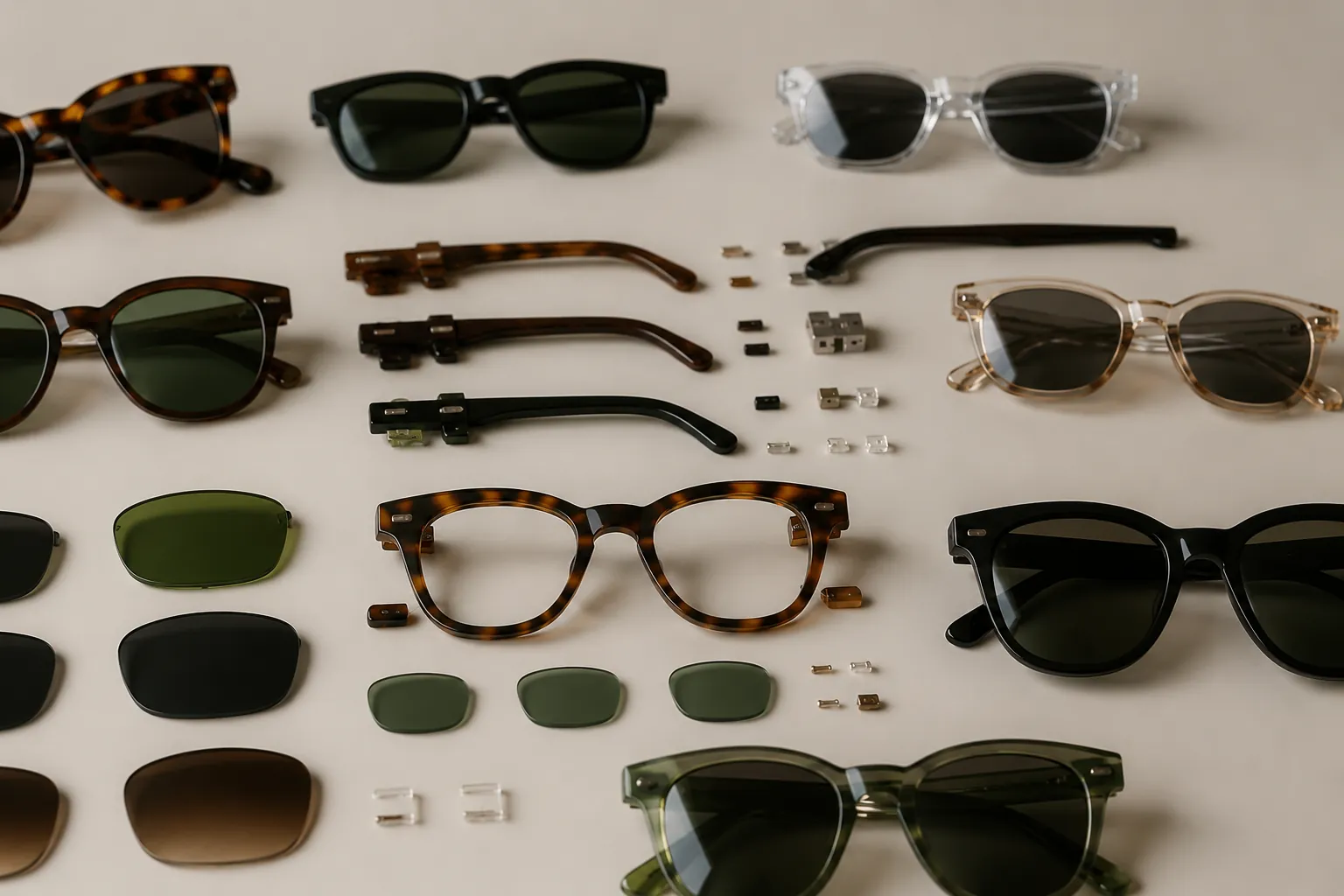
This guide is for brands, importers, distributors, and retailers that need to grow sunglasses assortments without turning the line into a mess. A scalable SKU architecture concentrates volume, protects margin, and makes replenishment more predictable. A weak one does the opposite. It creates too many low-run styles, slow-moving inventory, and factory friction you do not need. The fix is not more designs. It is a clean structure for core, seasonal, and channel-specific programs, with frozen specs, realistic MOQ logic, and compliance built in from the start.
Start With the Job Each SKU Must Do
Before you choose shapes, colors, or logo finishes, define the commercial job of every SKU. A core style should carry repeat volume, reorder cleanly, and work across channels with minimal change. A seasonal style should create freshness, test color or finish ideas, and support sell-through spikes. A channel-specific style should fit a retailer, marketplace, or promo brief without distorting the main line.
That distinction matters. Buyers often treat every style as if it deserves the same investment. Then inventory fragments and factory pricing never improves. A frame that sells in one account but has no broader reorder path is not a core SKU. It is a test style. Call it what it is.
A practical starting structure is:
- Core: 5 to 10 shapes, built for reorder stability, with color and lens variations only.
- Seasonal: 20% to 30% of the line, used for fashion color, lens tint, or limited detailing.
- Channel-specific: styles adapted for drug, club, convenience, ecommerce, gift, or private-label programs, with packaging and price point matched to the channel.
Most overseas buyers make the same mistake: they launch too many hero styles too early. Better to keep one or two frame families active, then vary lens tint, temple color, logo method, and packaging. That keeps tooling, decoration, and QC simpler. It also gives you real sell-through data before you commit deeper.
One useful rule: if a style cannot plausibly earn a second order, it should not be treated like a core SKU. It should be treated like a controlled market test.
Build Around Frame Families, Not Random Designs
SKU architecture works best when styles share a platform. A frame family is one front shape, one or two temple designs, and a controlled set of lenses and finishes. On the factory side, that means shared tooling, fewer setup changes, more stable QC, and faster approvals. On the buying side, it means less confusion when you reorder, extend a range, or swap a color.
The most scalable families usually share a single front mold or acetate pattern, then vary in safe ways: lens tint, surface finish, temple profile, logo method, or packaging. That keeps fit consistent and reduces the chance that a new SKU creates a hidden engineering problem. If the bridge, lens groove, or temple geometry changes, the style may look related, but it behaves like a new product in production.
Frame families also make it easier to manage material strategy. TR90 and other injection constructions are generally better suited to faster production and repeatable mass-market programs, while acetate can support richer color and a more premium finish. Neither is automatically better. The right choice depends on target price, finish expectations, and manufacturing complexity.
Good family design usually means:
- One front shape with minor size variants, such as 52-18-145 and 54-18-145, with temple length held within a 1 to 2 mm tolerance across the family.
- Two to four temple options: standard, thicker profile, textured, or logo-ready, without changing the hinge location.
- Three to five lens directions: smoke, brown, green, mirror, or fashion tint, while keeping base curve and thickness consistent.
- Limited hardware changes unless the channel truly needs them, because small hardware changes can create reassembly and yield issues.
A family with six colorways is usually better than six unrelated frames with one color each. The first gives you leverage in tooling, decoration, and carton planning. The second burns time, adds duplicate MOQ exposure, and raises dead stock risk. It also simplifies photography, line sheets, and account-level presentation because buyers can see the range logic immediately.
Material choice should follow the family strategy, not the other way around. Acetate generally supports deeper polish and stronger visual depth, but it requires careful cutting, polishing, and finishing control. Injection materials such as PC or TR90 are typically faster to produce and more consistent for repeat production, but they limit some premium detailing options. If the price tier is under pressure, choose the construction that fits the business model rather than trying to force one material to do everything.
For tight-fit programs, ask the factory to confirm lens seating, hinge alignment, and temple symmetry before bulk. A small drift in lens groove or temple opening can create visible imbalance in a sunglass frame.
Use a Price Ladder That Matches Volume Reality
Many buyers build assortments backward from target retail. That is risky because retail target alone does not tell you how the factory cost behaves. A better method is to build from production economics up: MOQ, setup time, decoration complexity, material waste, and QC load. The exact price of a pair depends on spec, order size, and market, but the order structure matters as much as the design itself.
A practical ladder looks like this:
| Order tier | Typical role | What changes | Buyer risk |
|---|---|---|---|
| 50 pairs/design | Market test | Small run, limited color count, simple logo application, minimal packaging variation | Highest unit cost, weakest negotiation room, more exposed to defects per unit |
| 300 pairs/design | Early repeat | Broader color choice, more stable packaging, better decoration efficiency, more realistic price step | Still sensitive to sell-through and exchange rate swings |
| 1000 pairs/design | Core program | Better material buy, fuller decoration options, stronger QC planning, more efficient carton packing | Inventory risk if the style is not yet proven in the channel |
| 5000+ pairs/design | Volume SKU | Lowest unit cost, best factory efficiency, tighter packaging economics, more leverage on components | Requires confidence in demand forecasting and replenishment speed |
The point is not that one tier is always best. It is that different tiers support different business purposes. A test style should not be priced or managed like a core style. Likewise, a volume program should not be handled with test-run uncertainty. When the spec is still moving, the order cannot behave like a stable volume program.
Think in cost layers. Every SKU has a base cost for material and assembly, then a variable cost for decoration, packaging, and inspection, then a hidden cost for changeovers and small-batch inefficiency. The smaller the run, the more those hidden costs matter. That is why the same frame can look inexpensive at quote stage and expensive in landed-cost reality.
If the business depends on a lower unit cost that only appears at higher order volumes, then the launch plan needs to be honest about sell-through timing and replenishment ability. Otherwise, the company is carrying inventory just to chase a price point.
The most accurate way to use a price ladder is to compare the launch plan against the actual order tier you can sustain, not the one you hope to reach later.
Decide Which Variables Are Allowed to Change
SKU discipline is mostly about what you freeze. For volume programs, freeze the frame geometry early and let only low-risk variables move. The goal is to separate cosmetic choice from structural change. Cosmetic changes can help sell the style. Structural changes usually create new tooling risk, fit variation, and QC complexity.
Best candidates for variation are the ones that do not force retooling or revalidation:
- Lens tint and mirror finish
- Temple color or temple print
- Logo method
- Surface finish, such as matte, gloss, or soft-touch coating
- Packaging insert and carton print
Variables to lock sooner are the ones that affect fit, stability, and repeatability:
- Frame front dimensions
- Hinge type and screw spec
- Lens base curve
- Material family
- Temple length and temple angle
A small change in front width can create fit issues across channels, especially if the product is sold into different face sizes or multiple geographies. A slight shift in lens curvature can affect appearance, glare performance, and assembly consistency. Those changes may look minor in a CAD file, but they can become expensive if they force new jigs, new sample approvals, or extra hand finishing.
For decorated styles, define the decoration window up front. Laser engraving is best when you want a clean, permanent mark on suitable materials and surfaces, but it depends on consistent placement and substrate finish. Pad printing is usually more flexible for color logos, but it has limits on opacity, abrasion resistance, and alignment. Metal logo plates can raise perceived value, though they add cost and may require more control at application. Hot stamping can work on some materials, but it is sensitive to heat, surface condition, and run consistency. The right method depends on channel economics and product intent.
The more decoration methods you allow on the same SKU family, the more control points you create. For that reason, lock the decoration method before bulk and do not switch methods late unless the change solves a real commercial problem. Rework on decorated eyewear is usually slower and more visible than rework on plain frames.
For premium programs, ask for a decoration tolerance plan in writing: logo placement tolerance, ink registration tolerance, and acceptable surface variation. That makes QC easier when production scales.
Match Channel to Assortment Depth
Different channels do not want the same assortment depth. Treating them the same usually leads to either an overbuilt main line or a weak channel-specific offer. The right depth depends on how the channel shops, how often it replenishes, and how much variety it can actually support at shelf or online.
| Channel | Recommended SKU depth | Best construction | Notes |
|---|---|---|---|
| DTC / brand site | Fewer hero SKUs, more color variants | Stable core family | Use color and lens variation to create choice without new tooling |
| Distributor | Broader shape mix, controlled depth per style | Mixed core and seasonal | Distributors need breadth, but not random one-off styles |
| Retail chain | Repeatable pods by price point | Family-based range | Plan around shelf resets, planograms, and replenishment cadence |
| Promo / private label | Simple, high-clarity styles | Injection or straightforward acetate | Lead with cost, decoration, and delivery reliability |
If a chain buyer wants 12 SKUs, do not give them 12 unrelated concepts. Give them three families with four variants each, or four families with three variants each. That structure helps store teams, replenishment, and future extensions. It also makes the next purchase easier because the commercial logic stays visible and the program can be expanded without re-learning the whole range.
For marketplace sellers, the range should be tighter. Search traffic rewards consistency and repeatability. One core silhouette with several colorways often outperforms scattered novelty styles that never build ranking depth. In online channels, it is often smarter to deepen the winning frame family than to keep adding new shapes that dilute review volume and ad spend.
Promo and private-label programs need special discipline. The brief may look simple, but the requirements are strict: fewer colors, shorter lead times, stable packaging, and high confidence in delivery. Those programs benefit from injection or straightforward acetate construction because both reduce complexity and support speed. If the customer's value proposition is price, then every extra decoration step must earn its place.
A good channel strategy does not just choose the right SKU count. It chooses the right level of sameness. The more reorder-driven the channel, the more the range should look like a controlled system instead of a creative portfolio.
Plan for Samples, Bulk, and Reorder Timing
Timing should shape the architecture. If samples take 7 to 10 days and bulk takes 25 to 35 days, then the assortment plan has to leave room for approval, correction, and freight. Buyers lose money when they build a line too late and then rush the wrong styles into production. In sunglasses, lead-time compression usually raises the risk of fit issues, decoration errors, and packaging mistakes.
A practical sequence is:
- Approve the frame family and size range.
- Confirm lens category, tint, and decoration method.
- Order samples for the core styles first.
- Review fit, finish, logo clarity, and packaging structure.
- Lock the volume styles and place bulk orders in waves.
The best architecture uses a rolling launch. You do not need to release every style at once. Start with the core family, then add seasonal colors after sell-through is visible. That approach protects cash and keeps production stable. It also helps you avoid the common mistake of overbuying fashion colors before you have proof that the base silhouette works.
Timing should also follow the commercial rhythm of the channel. If your replenishment cycle is shorter than your bulk lead time, the line needs a deeper core base and fewer experimental shapes. If you only reorder once or twice per season, you can afford more seasonal risk, but only if the launch window is long enough to absorb slower approval cycles. Match SKU structure to actual buying behavior, not to the spreadsheet fantasy of instant replenishment.
Sample requests should not be treated as open-ended creative exploration. They should be filtered through the same commercial questions as the bulk order: what is the target retail, what is the expected channel, what is the planned MOQ, and what are the acceptable decoration methods. Otherwise, sample rooms get flooded with styles that never had a real path to production.
Think in waves. Wave 1 is the stable family; Wave 2 is the seasonal update; Wave 3 is the channel-specific extension. That sequence gives the factory time to stabilize raw material purchasing, assembly calibration, and QC settings before the line widens.
If you are aiming for a fast reorder, build the first PO as if it may become the template for the next one. That means fewer exceptions, clearer specs, and packaging that can be repeated without redesign.
Tie Compliance to the SKU System
Compliance is not a separate admin task. It should be part of SKU setup. For sunglasses, the standards and registrations most commonly managed in B2B programs include CE EN ISO 12312-1, ANSI Z80.3, AS/NZS 1067, REACH, FDA registration, ISO 9001, and BSCI. The exact documentation required depends on the destination market, product claim, and material composition.
Do not build one generic compliance file and assume it covers everything. A sunglasses SKU sold as fashion-only in one market may still need different documentation elsewhere. If you are selling sun-protection claims, test expectations change. If you use coatings, inks, adhesives, or decorative parts, REACH attention becomes more important. Even packaging can matter if it introduces regulated materials or labeling requirements.
The better approach is to map compliance by SKU family, then by market. That means the same family can have one documentation package for one region and a different package for another, without rebuilding the product from scratch. It also means your tech pack should include the compliance target from the beginning, not after the sample looks finished.
Ask the factory to define the spec sheet in writing before bulk: dimensions, materials, lens category, decoration method, and compliance target. Keep it precise. If the frame is supposed to meet a particular standard, spell out what that means for lens performance, labeling, packaging claims, and any warning text. That prevents a style from becoming several slightly different versions that nobody can reorder cleanly.
Keep the spec sheet clear: dimensions, materials, lens category, decoration method, and compliance target should be fixed in writing before bulk.
When compliance is built into the SKU system, future reorders become easier because the factory does not have to rediscover the same answers every season. That saves time, reduces document errors, and protects the launch calendar.
For regulated markets, treat the compliance packet as a production asset, not a sales attachment. If the packet is incomplete, the SKU is not truly ready.
Use a Launch Checklist That Protects Margin
A scalable SKU architecture is not about having fewer styles. It is about having fewer bad styles. Before launch, check whether each SKU has a real business role, a realistic demand path, and a production spec that can survive reorder pressure. The best assortment is usually the one with the fewest exceptions.
Use a checklist like this before approval:
- Does the SKU belong to a core family, seasonal drop, or channel-specific brief?
- Can the style be reordered without new tooling or major rework?
- Is the MOQ aligned with expected sell-through?
- Does the target price make sense at 50, 300, 1000, and 5000+ pairs?
- Are decoration and packaging choices frozen before bulk?
- Is the compliance file ready for the destination market?
- Are the fit-critical dimensions and tolerances documented?
If the answer is weak on three or more of those questions, cut the style or simplify it. It is usually cheaper to simplify a launch than to rescue a weak SKU after the first order. Simplification can mean reducing color count, removing a decoration step, standardizing lens tint, or moving the style into a more suitable family.
For overseas B2B buyers, that discipline pays twice. You get better factory pricing because the range is easier to produce, and you get better channel control because the line stays readable. You also reduce the operational noise that comes from chasing too many one-off styles through sampling, approval, and production. A scalable sunglasses assortment is not flashy. It is disciplined, repeatable, and built to reorder profitably.
The strongest programs usually share the same traits: limited frame families, stable construction, controlled color variation, clear cost tiers, and compliance mapped by market. If your team can explain the range in one page, the assortment is probably healthy. If it takes a long meeting to explain why each SKU exists, the line is probably too complicated.
In practice, the best SKU architecture gives you three things at once: volume concentration, easier production, and a cleaner story for sales. That is what keeps a sunglasses line scalable.
Have a custom sunglasses project in mind?
Send us your styles, target market and quantities and we will return a detailed quote with MOQ, lead time and a sample plan.
Get a QuoteWhy source this from Wenzhou with LumiShades
Wenzhou in Zhejiang Province is widely regarded as China’s eyewear manufacturing capital, producing a large share of the world’s sunglasses. That concentration matters to buyers: a deep local supply chain for acetate sheet, hinges, lens blanks, plating and packaging means shorter component lead times, easier color and material matching, and a workforce with decades of eyewear-specific skill. LumiShades has manufactured in this ecosystem since 2009, and our vertical integration — in-house injection molding, acetate cutting, CNC milling, lens tinting, decoration and quality control — means no part of your order is quietly subcontracted to a workshop you cannot audit.
For international buyers, that vertical control translates into accountability. When a single factory owns every step, defects are traced and fixed at source rather than bounced between vendors, and your specifications survive intact from first sample to bulk. We back this with 15+ years of experience, shipments to 60+ countries, more than 5 million pairs produced per year and a 98.5% on-time delivery rate. Our certifications — CE EN ISO 12312-1, FDA registration, ANSI Z80.3, AS/NZS 1067, REACH, ISO 9001 and BSCI audit — mean the compliance documentation your market requires already exists. Explore our manufacturing capabilities and quality control process to see how this works in practice.
Frequently asked questions
How many sunglasses SKUs should a new buyer launch first? Start smaller than your team probably wants. A practical first program is one or two frame families, with 5 to 10 total SKUs built from controlled color, lens, and logo variations. That is enough to test sell-through without fragmenting volume. Add seasonal colors only after you see which silhouettes can actually repeat. If the first order cannot plausibly turn into a second order, treat it as a test rather than a core SKU.
What is the best way to get a lower unit price? Concentrate volume in fewer frame families, freeze the spec early, and order at a higher tier. The main cost drivers are material, setup time, decoration complexity, packaging, and QC load. When you keep changing lens tint, logo position, temple finish, or packaging after approval, you usually erase the savings from larger volumes. The most reliable path to lower unit cost is consistency, not late-stage customization.
Should we vary the frame or just the lens and logo? If the goal is scalable volume, keep the frame construction stable and vary lens tint, color, logo method, and packaging first. Those changes are usually easier to control than new frame geometry. New front dimensions, hinge types, or lens curves can trigger new tooling, fit changes, and extra sample approvals. Use structural changes only when they are necessary for the target price, fit, or channel brief.
How long should we allow for samples and bulk? A common planning window is 7 to 10 days for samples and 25 to 35 days for bulk, but actual timing depends on complexity, material availability, and approval speed. Build in extra time if decoration or packaging is customized. Sequence approvals so the frame family, lens choice, and decoration method are locked before bulk. If you need a fast reorder, keep the first purchase order simple enough to repeat.
Which compliance documents matter most for overseas sunglasses? The standards and registrations most commonly managed in B2B sunglasses programs are CE EN ISO 12312-1, ANSI Z80.3, AS/NZS 1067, REACH, FDA registration, ISO 9001, and BSCI. Which ones apply depends on the destination market, product claim, and material composition. Map compliance by SKU family and market before sampling, then confirm the required documentation before bulk. That prevents last-minute redesigns and avoids shipping a product that is not ready for the target market.
Ready to start?
Explore our aviator sunglasses or request a quote — our sales team replies within 12 hours.
Request a Quote