
MOQ Strategy for Private Label Sunglasses Launches
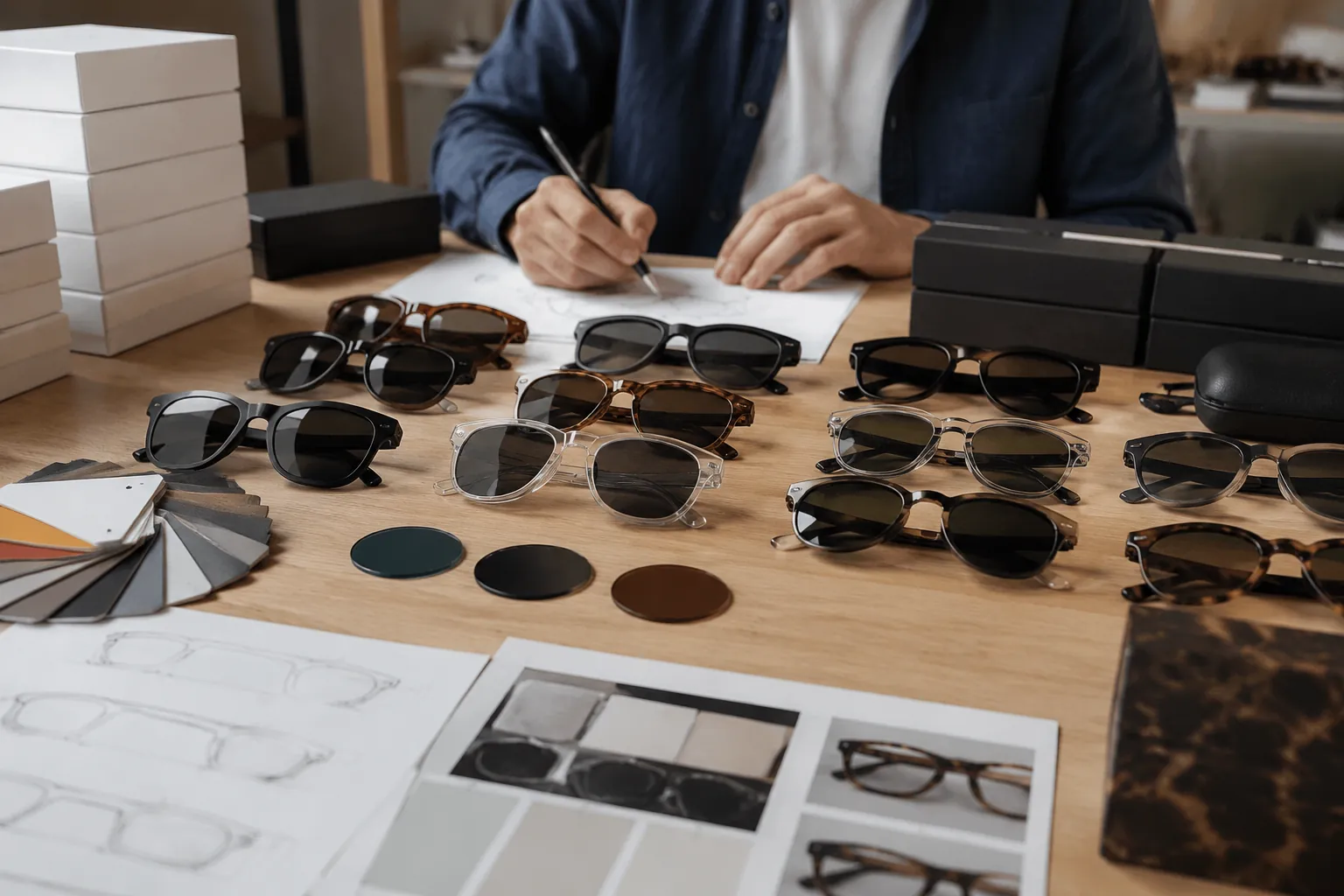
For brands, importers, distributors, and retailers launching private label sunglasses, the hard part is rarely choosing frames. It is deciding how many styles, colors, lens options, and market versions to order without locking cash into slow movers. This guide shows how to structure a first order around practical MOQ bands, use price breaks with intent, and keep the assortment tight enough to produce on time. It also explains how in-house molding, acetate cutting, CNC milling, lens tinting, decoration, and QC affect what you can mix, how fast you can move, and where costs start to change.
Start with launch math, not the catalog
Most first orders fail for the same reason: the buyer starts with style preference and ends with too many SKUs. Start the other way. Define the sell-through window first, then work back into style count, color count, and pack depth. If the goal is a 90-day market test, a 600-pair launch spread across 12 designs looks flexible. It usually is not. It creates thin replenishment and weak production leverage.
A tighter 4- to 6-style launch is easier to buy. It is easier to merchandise too. Reorders become clearer. For private label sunglasses, think in three buckets. Hero styles carry most of the volume and should be the frames you expect to reorder first. Support styles round out the assortment and test face shapes, channels, or price points. Market-specific variants cover regional preferences or compliance differences, such as polarized versus non-polarized, smoke versus brown lenses, or a darker tint for one retail channel.
The key metric is not only total units. It is units per decision. A 1,000-pair order across 20 SKUs gives you only 50 pairs per SKU. That is usually too little to learn much after samples, reseller allocation, and opening stock. The same 1,000 pairs across 5 SKUs gives you 200 pairs per style. That is enough to show a real sell-through pattern and still leave depth for reorder signals.
Rule: keep the first order small in style count, not just in total units. A 1,000-pair order spread across 20 designs is usually less useful than 1,000 pairs across 5 designs.
If your supplier accepts low starting quantities, that helps with testing. It is not the same as efficient production depth. Smaller runs buy flexibility. Deeper runs usually improve carton efficiency, decoration consistency, and scheduling stability. A practical launch target is often 4 to 6 styles, 1 to 2 frame colors per style, and one lens specification per market. Broad enough to read demand. Not so broad that the factory is guessing.
Use a style-color-market matrix
The fastest way to overcomplicate a launch is to treat every color as a separate product. Some should be separate. Most should not. Build a matrix before requesting samples so the factory can quote the real assortment instead of a fantasy lineup full of one-offs. Every added frame color, lens tint, logo method, or case type increases setup work. One clean SKU can become several production variants fast.
| Launch choice | Pros | Cons | Best use |
|---|---|---|---|
| Many styles, one color each | Wide visual range, easier merchandising | Less volume per design, higher unit cost | Broad retail test with uncertain buyer taste |
| Few styles, multiple colors | Better tool amortization, stronger replenishment | Color mix can complicate inventory | Core assortment for distributors and chains |
| One style, multiple markets | Simple QC, strong unit economics | Limited audience coverage | Price-led launch or fast re-order program |
| Few styles, region-specific lens builds | Cleaner compliance path, easier channel planning | More documentation and labeling work | Multi-market launch with different standards |
For sunglasses, color is not only cosmetic. Frame color, lens tint, and mirror finish all affect perceived value and buyer demand. Matte black with a smoke lens is still the safest first-run combination. It is broadly acceptable. It is easy to stock. It does not feel locked to one trend. Tortoise, clear, and translucent colors can work well, but they raise inventory risk if sell-through is unknown.
Lens decisions matter just as much. Standard tint, polarized lenses, mirrored coatings, and UV protection should match the channel and region. If a retailer wants a premium look, a mirrored lens or deeper tint can support that. If a distributor wants broad sell-through, a neutral smoke lens is usually easier to move. Different destinations need different versions. Do not force one universal mix and hope it works everywhere.
In practice, the matrix has three columns: style, color, and market. One style can be split into a domestic version and an export version. That only works if the approval path, labeling, and carton marks are defined before production starts.
Where the MOQ really sits
MOQ is not just a factory number. It is the point where tooling time, setup time, color change, assembly labor, and QC effort stop making the order efficient. A low MOQ can make sense for first-time testing. Once you have a winner, it is usually better to move volume into fewer designs than to keep too many tiny runs open. The real question is not whether a factory can accept a small order. It is whether the order is large enough to produce cleanly without repeated changeovers.
In eyewear production, MOQ reflects several physical constraints. Injection frames need mold time, material stabilization, and color consistency. Acetate frames require sheet selection, cutting, barrel polishing, and more visual QC because pattern and gloss variation are more visible. Metal and hybrid frames add soldering, pad alignment, and plating checks. Decoration, packaging, and lens insertion each add setup time. Once those steps are combined, the smallest feasible order is rarely the most efficient order.
Here is a practical ladder for launch planning:
- 50 pairs/design: commercial test quantity, useful for first market reads, reseller previews, and style validation.
- 300 pairs/design: enough volume to start improving unit cost and stabilize packing, labeling, and carton planning.
- 1,000 pairs/design: better for chain stores, distributors, and repeatable replenishment with less production churn.
- 5,000+ pairs/design: where material efficiency, labor balance, and packaging optimization become clearer in landed cost.
The lowest unit price is not always the best business choice. If a style is unproven, a smaller run protects cash. If the style is already selling, consolidating into fewer SKUs at higher depth usually lowers setup friction enough to justify the bigger buy. Mixed orders can still work. The real cost often shows up in changeovers, approvals, and rework risk, not just the MOQ line.
How to split a first order without dead stock
A sensible launch split follows demand confidence. Put the highest share into the styles closest to your current channel, then use smaller bets for trend pieces. If your buyers prefer classic silhouettes, do not force a large share into experimental shapes just to make the assortment look broader.
- Identify 2 to 3 core styles that sit in the same price tier and customer profile.
- Add 1 to 2 test styles with a different shape, bridge, or material to learn what sells.
- Keep colors disciplined; if you need breadth, use one or two frame colors per style first.
- Limit logo treatments so the order does not fragment into tiny sub-runs.
- Reserve budget for re-order speed instead of overbuying every option in the first PO.
This works because distributors and retailers do not need equal depth in every SKU. They need enough variety to cover shelf appeal. They do not need so much that the best style gets underordered while weak styles sit in stock. A common mistake is to equalize depth across every design. In practice, the hero style should often receive 35% to 50% of total units, with the rest split across support and test styles.
Material behavior should also shape the split. Injection styles usually support quicker repeatability and more predictable unit cost. Acetate styles can show more variation in color saturation, polishing, and surface feel. If you are launching both, put the more stable process in the core styles and reserve the more expressive material for smaller test runs.
If you are selling into multiple markets, separate the assortment by channel rules. A domestic boutique channel may want fashion-first colors and a slightly higher perceived-value finish. An export distributor may want conservative colors, clear compliance labeling, and fewer lens experiments. One PO can cover both. Only if the matrix is defined up front and each version is tagged to the right destination.
Price breaks matter more than people admit
Private label buyers often focus on unit price and ignore how price changes assortment decisions. That is a mistake. If moving from 50 to 300 pairs drops your cost enough to absorb extra freight, packaging, or testing, you may want fewer styles at higher depth. If the price gap is small, broader testing is safer. Compare the cost of a style decision, not just the cost of one pair.
Use landed cost. A style that saves a small amount per pair at a higher quantity can still matter across the full order, especially once freight, duties, packaging, and handling are included. If the deeper run also reduces carton splits, approval loops, or rework risk, the total effect is larger than the unit price alone suggests.
| Order level | Typical buyer goal | What improves | Main risk |
|---|---|---|---|
| 50 pairs/design | Test market fit | Flexibility, low exposure | Higher unit cost, lower leverage |
| 300 pairs/design | Validate winners | Better pricing, easier replenishment | Still not deep enough for large chains |
| 1,000 pairs/design | Build volume | Lower cost, better production planning | Higher inventory commitment |
| 5,000+ pairs/design | Scale proven SKUs | Best cost structure | Demand error becomes expensive |
The useful question is not "What is the cheapest MOQ?" It is "At what depth does this design justify the stock risk?" On a style that turns quickly, 1,000 pairs can be safer than three separate 300-pair runs because the factory can keep the specification stable, reduce setup churn, and pack consistently. That also helps with carton labels, inner-box counts, and reorder forecasting.
Do not force every SKU to hit the same margin target on the first order. Use the strongest styles to carry the assortment. Weak styles should earn their place through learning value, not by pretending to be stars. Let winners subsidize experiments. Not the other way around.
Check process capability before you choose the mix
The assortment you can order depends on what the factory actually does in-house. If a supplier has injection molding, acetate cutting, CNC milling, lens tinting, decoration, and QC under one roof, it usually has more control over variation than a trading-only operation. That matters when you are mixing materials or decoration methods in one launch, because each process route has different setup time, yield, and inspection pressure.
Injection styles are usually the best choice when you want repeatability, stable color, and lower-cost frame structures. Acetate styles need more attention to sheet selection, edge finishing, polishing, and color consistency, especially on transparent or patterned stock. CNC-milled details help on higher-touch frames or precise structural parts. If the frame includes metal cores, inserts, or decorative cutouts, tolerances matter more because alignment errors are visible at the temple and hinge line.
Decoration choice changes the production path too. Pad printing is efficient for flat or gently curved logo zones, but it can lose sharpness if the surface curvature is aggressive. Laser engraving creates a cleaner permanent mark on compatible materials, but it depends on contrast and substrate behavior. Metal logo plates can feel premium and may support a higher perceived value, but they add part sourcing and adhesion or rivet alignment checks. A logo that looks simple in a mockup can create several QC checkpoints in the factory.
For a first order, choose one primary frame process and one primary decoration method if possible. Add a second method only for a clear commercial reason. More process types mean more moving parts, more lead-time risk, and more chances for a small artwork change to trigger a reset. In production terms, a tiny revision after approval is not tiny. It can require reproofing, tooling reset, or a new inspection pass.
Ask the factory about color tolerance and cosmetic standards before you approve. Frame color variation is often acceptable within a defined range, but only if both sides agree on the range. Hinge tension, temple symmetry, and lens seating should also be confirmed before bulk starts. If these controls are not documented, the order is exposed to avoidable disputes later.
Build compliance into the assortment from day one
Compliance should not sit at the end of the process. For sunglasses, the applicable standard depends on the target market, product type, and any claims made in marketing or packaging. Use only the certifications and registrations that are real and relevant to the destination: CE EN ISO 12312-1, ANSI Z80.3, AS/NZS 1067, REACH, FDA registration, ISO 9001, and BSCI. No single document covers every country or every claim.
For a multi-market launch, separate compliance by region. A pair intended for one market may need a different test path, labeling format, or carton marking than a pair intended for another. Check that the frame, lens, tint category, and labeling match what you are shipping. If you are selling polarized lenses, confirm that the performance and labeling language align. If you are shipping to an EU buyer, verify the documentation and material expectations required for that destination. If a channel demands a particular eyewear standard, build that into the spec before final approval.
Compliance also affects decoration and packaging. A print position that looks fine on a style board may conflict with required lens markings or frame marks. Carton labels, barcode placement, and warning text may need to change by destination. It is much cheaper to lock this before production than to relabel a finished lot.
Practical advice: freeze compliance before decoration. A logo plate or print is easy to change on paper, but a bad compliance plan is expensive to unwind after cartons are packed and freight is booked.
Use the sample phase to remove risk
Samples in 7 to 10 days are useful only if they validate the process. Do not treat samples like showroom pieces. They should confirm fit, finish, lens color, temple tension, logo placement, and packaging compatibility. If the sample only looks good in photos but fails in handling, it is not a valid launch sample.
In the sample round, inspect the details that often get ignored until bulk production exposes them. Check temple opening force and hinge feel across multiple pairs, not just one. Compare lens tint consistency by looking at pairs under the same light. Inspect pad print sharpness and adhesion after light rubbing. Confirm laser engraving depth and position so the mark remains visible without damaging the surface. On acetate and translucent materials, look for surface marks, sink points, and polish haze. Those are the problems that show up at retail.
A useful sample checklist looks like this:
- Temple opening force and hinge symmetry
- Lens tint consistency across pairs
- Pad print sharpness and adhesion
- Laser engraving depth and position
- Metal logo plate alignment and adhesion
- Surface marks, polish haze, and lens seating
Bulk production at 25 to 35 days is realistic only if the sample is approved cleanly and the order is frozen. If colors, logos, or packaging are still changing after approval, the schedule will slip. That is not the factory being slow. It is the order not being ready. One clean approval is worth more than several rounds of cosmetic debate.
For retailers and distributors, the best use of samples is internal sell-in. Put the sample set in front of the people who will actually reorder it. If they cannot rank the styles quickly, the first PO is too broad. A good sample round should tell you which SKUs deserve depth, which should remain test quantities, and which should be cut before production starts.
Have a custom sunglasses project in mind?
Send us your styles, target market and quantities and we will return a detailed quote with MOQ, lead time and a sample plan.
Get a QuoteWhy source this from Wenzhou with LumiShades
Wenzhou in Zhejiang Province is widely regarded as China’s eyewear manufacturing capital, producing a large share of the world’s sunglasses. That concentration matters to buyers: a deep local supply chain for acetate sheet, hinges, lens blanks, plating and packaging means shorter component lead times, easier color and material matching, and a workforce with decades of eyewear-specific skill. LumiShades has manufactured in this ecosystem since 2009, and our vertical integration — in-house injection molding, acetate cutting, CNC milling, lens tinting, decoration and quality control — means no part of your order is quietly subcontracted to a workshop you cannot audit.
For international buyers, that vertical control translates into accountability. When a single factory owns every step, defects are traced and fixed at source rather than bounced between vendors, and your specifications survive intact from first sample to bulk. We back this with 15+ years of experience, shipments to 60+ countries, more than 5 million pairs produced per year and a 98.5% on-time delivery rate. Our certifications — CE EN ISO 12312-1, FDA registration, ANSI Z80.3, AS/NZS 1067, REACH, ISO 9001 and BSCI audit — mean the compliance documentation your market requires already exists. Explore our manufacturing capabilities and quality control process to see how this works in practice.
Frequently asked questions
How many styles should I include in a first private label sunglasses order? A practical starting point is 4 to 6 styles. That gives you enough assortment to test buyer preference without splitting volume so thin that pricing, packing, and replenishment become inefficient. If you already know your best-selling shape or channel, concentrate more units in that hero style and use the rest for testing.
Should I order 50 pairs of everything to stay flexible? Only if your goal is a very early market test. If you already have a clear winner, moving that style to 300 or 1,000 pairs usually gives better unit economics and a cleaner production plan. A better rule is to use 50 pairs to learn, then move proven styles into deeper runs quickly.
Can I mix injection and acetate frames in one PO? Yes, but keep the mix deliberate. Mixing process routes is manageable when the style count is controlled and the approvals are frozen. The risk rises when the order combines many frame colors, lens options, and decoration methods, because every extra variation adds setup and QC work.
What should I confirm before approving samples? Confirm fit, hinge feel, lens tint consistency, logo placement, decoration quality, and packaging fit. For region-specific orders, also confirm the labeling and compliance version match the destination. If any of those points are unclear at sample stage, bulk production will likely repeat the problem.
Which certifications should I ask for? Ask only for the certifications or registrations that apply to your market and product: CE EN ISO 12312-1, ANSI Z80.3, AS/NZS 1067, REACH, FDA registration, ISO 9001, and BSCI. Do not assume one document covers every country, and do not request certifications that are not relevant to your destination or product claim.
How do I lower unit cost without overbuying? Concentrate volume into fewer winning styles, increase depth on the designs that show real demand, and reduce unnecessary color, lens, and logo variants. Moving a proven style from 50 to 300 or 1,000 pairs usually improves the production plan more effectively than spreading the same budget across many tiny SKUs.
Ready to start?
Explore our wayfarer sunglasses or request a quote — our sales team replies within 12 hours.
Request a Quote