
ODM Sunglasses Molds vs Exclusive Tooling
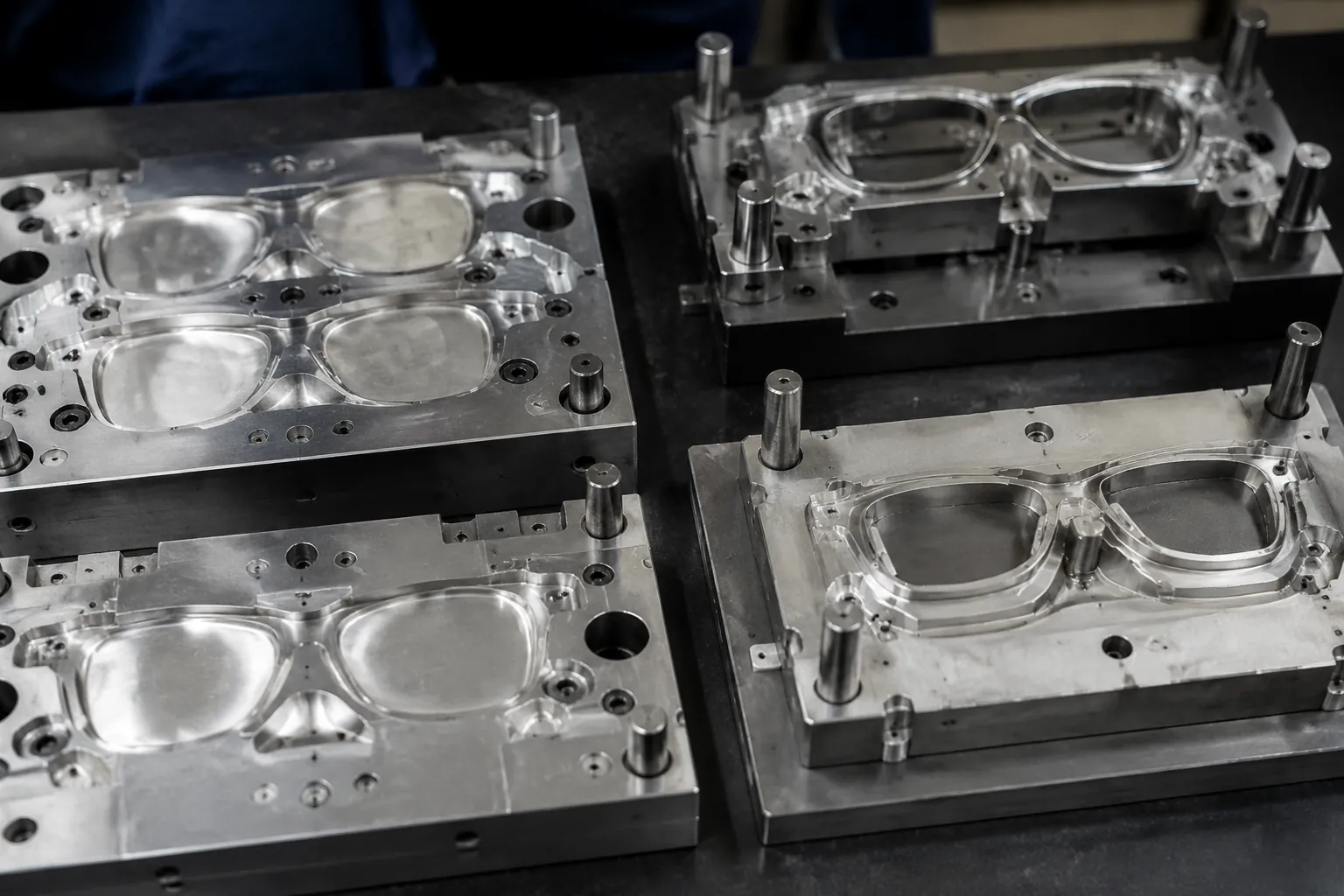
This guide is for brands, importers, distributors, and retailers choosing between an existing ODM sunglasses mold and exclusive custom tooling. The aim is simple: reduce sampling risk, set realistic MOQs, control hidden costs, and match design goals with factory reality. Small choices matter. A lens-groove change, transparent custom color, new logo jig, metal logo plate, or retail label can affect sampling time, unit price, and inspection work. Use this guide to decide whether your next 50, 300, 1,000, or 5,000+ pairs should start from a proven ODM mold, a modified tool, or a fully owned frame design.
The First Decision: Market Test or Signature Frame?
Most buyers should not start with exclusive tooling. That is not a sales pitch. It is risk control.
If you are testing a retail channel, festival range, influencer capsule, corporate promotion, resort program, or seasonal private-label line, an existing ODM sunglass mold usually gives the best mix of speed, cost, and predictability.
A proven mold has already passed the factory's basic checks: injection flow, shrinkage, demolding, hinge fitting, lens edging, temple opening angle, assembly sequence, and packing method. The production team already knows whether the front holds the lens curve, whether the temple wall near the hinge barrel is strong enough, and whether the parting line remains visible after finishing. That knowledge cuts sampling loops.
Exclusive tooling makes sense when the frame shape has brand value. If your front profile, bridge geometry, hinge detail, temple volume, lens shape, or fit architecture must not appear in another buyer's catalog, you need modified or fully new tooling. The trade-off is direct: more design control and clearer IP boundaries, but higher upfront cost, longer engineering time, and more approval steps.
Factory rule: use ODM molds to prove sell-through. Use exclusive tooling when repeat orders and visible brand difference justify the investment.
Cost, MOQ, and Lead-Time Comparison
The table below shows how factories often frame the discussion with overseas buyers. Exact quotations depend on frame material, lens specification, logo method, packaging, testing, inspection level, order quantity, and exchange rate. Use these figures for planning, not as fixed offers.
| Launch path | Practical MOQ | Sample lead time | Bulk lead time | Typical cost logic | Best fit |
|---|---|---|---|---|---|
| Existing ODM mold, standard color | 50 pairs per design may be accepted on selected styles | 7-10 days when materials and processes are available | 25-35 days after approval and deposit | No new tooling; cost driven by material, lens, logo, and packing | Small drop, promotion, market test |
| Existing ODM mold, custom color and logo | 300+ pairs is usually more practical | 7-14 days after color and artwork confirmation | 25-35 days after approval and deposit | Color batching, logo setup, fixtures, QC records, and packing labor spread over more units | Private-label launch with fast delivery |
| Modified mold from existing base | Usually 1,000+ pairs | 2-4 weeks depending on modification scope | 30-45 days after approval and deposit | Tool insert change, re-sampling, lens-fit testing, and engineering adjustment | Known style with owned bridge, temple, or decoration detail |
| Fully exclusive injection tooling | Usually justified at 3,000-5,000+ pairs | 4-8 weeks for tooling and first samples | 35-50 days after sample approval and deposit | 3D modeling, mold cutting, trial shots, corrections, fit and lens verification | Long-term brand frame or protected distributor program |
| Acetate custom development | Often 300-1,000+ pairs depending on complexity | 3-6 weeks | 35-55 days after approval and deposit | Sheet selection, CNC cutting, tumbling, polishing, hinge embedding, and hand assembly | Premium collection, richer color laminations, boutique retail |
Low MOQ helps with market testing. It rarely gives the best unit cost. Pricing usually improves at 300, 1,000, and 5,000+ pairs because machine setup, color mixing, lens cutting, logo alignment, QC sampling, and packing labor are spread across more units.
Polarized lenses, acetate construction, metal logo plates, retail packaging, extra inspection, and exclusive tooling all add cost. Ask the factory to separate one-time tooling or fixture charges from the unit price. Then you can compare quotes without guessing.
What You Can Really Customize on an ODM Frame
An existing mold does not always mean a generic product. The frame architecture is fixed, but many buyer-visible details can still change. The key split is cosmetic customization versus structural change. Cosmetic changes keep the mold stable. Structural changes may require inserts, re-cutting, or a new tool.
- Frame color: standard black, tortoise, clear, smoke, and solid colors are fastest. Custom Pantone-style targets need masterbatch matching and physical approval. Transparent colors are tricky. Wall thickness affects perceived shade, so a thin temple and a thicker front may not look identical even from the same resin batch.
- Lens: smoke, brown, green, gradient, mirror, and polarized options are common. Lens thickness, curve, and material must match the frame groove and the destination-market standard. Do not approve a lens by color alone.
- Logo: laser engraving works well for subtle, durable marks on temples and lens corners. Pad printing works for one- or two-color logos but needs jigs to control position. Metal logo plates add a premium look but require a recess, stable adhesive process, or accurate placement control.
- Hardware: hinge type, screw finish, rivet detail, and small metal trims may be adjustable if the frame has enough wall thickness and assembly space. If the hinge structure changes, treat it as engineering work.
- Packaging: pouch, microfiber cloth, folding case, paper box, barcode label, warning card, importer label, and master-carton marks can be customized without touching the frame tool. Approve packaging artwork before bulk production. Late labels delay shipments.
Factory controls are more concrete than a rendering suggests. Logo position needs an agreed tolerance. Temple opening angle should match left to right. Lens edging must hold the lens without forcing stress into the groove. Hinge screws should pass opening-and-closing checks before packing.
Ask which steps are done in-house and which are outsourced, especially lens tinting, mirror coating, logo application, plating, packaging, and third-party testing.
Where Exclusive Tooling Earns Its Money
Exclusive tooling is not just a new silhouette. It gives control over fit, structure, repeatability, and commercial protection. For a brand building a long-term sunglass line, those points can matter more than the first tooling bill.
For a full custom injection frame, the process usually starts with drawings, reference samples, or 3D files. Engineers review lens base curve, bridge width, end-piece geometry, temple length, pantoscopic tilt, hinge position, screw boss strength, wall thickness, parting line position, and expected plastic shrinkage.
A frame can look clean in a rendering and still fail in production. The temple may be too thin near the hinge barrel. The lens groove may be too shallow. The front curve may force distortion into the lens. Fix it early. Fixing it after mold cutting costs more.
Material choice also changes the route. PC is used where impact resistance and dimensional stability matter, but its hand feel and finish must match the retail target. TR90 is light and flexible, useful for comfort or sport-inspired styles, but processing control is critical because flexibility can affect fit recovery. Other injection plastics can work for cost-sensitive fashion programs when premium hand feel is not required.
Acetate is different. Sheet color selection, CNC cutting, tumbling, polishing, hinge embedding, and hand assembly create a richer appearance but a longer labor route. Over-polishing can soften crisp edges or change bevels.
Exclusive tooling earns its money when you need a protected front shape, proprietary hinge or temple design, specific bridge fit for your market, premium acetate construction, or a model you expect to reorder for several seasons. For a one-off 300-pair promotion, do not overbuild the project. For a multi-season program with repeat colors and distributor exclusivity, tooling can become a strategic asset.
Compliance Starts With the Lens
A sunglass sample can look good and still be wrong for the selling market. Compliance starts with the lens, but the finished product must be controlled as a complete article: lens category, UV protection, frame material, labeling, warnings, and documentation all matter.
State the destination market before sample approval. Not after production.
Common requirements include CE EN ISO 12312-1 for Europe, ANSI Z80.3 for the United States, FDA registration for U.S. market handling where applicable, AS/NZS 1067 for Australia and New Zealand, REACH for restricted substances, plus ISO 9001 and BSCI when buyers require management-system or social-compliance documents from the supplier. These are not interchangeable. A factory certificate does not replace product testing. A UV meter reading does not replace a proper test report for a regulated market.
UV400 claims must be verified, not assumed from lens darkness. Visible light transmission and UV protection are separate measurements. Category 0 or 1 fashion lenses are not the same as Category 3 sun lenses. Very dark lenses can still fail if UV blocking is poor. Driving restrictions may apply to certain colors or transmittance levels depending on the market.
Ask for the test basis at quotation stage. For the EU, confirm CE EN ISO 12312-1 documentation before mass production. For the United States, clarify ANSI Z80.3 requirements and FDA registration status where relevant. For Australia and New Zealand, specify AS/NZS 1067 early. If a retailer requires REACH documents, barcode labels, importer details, or warning text, include those items in the purchase order package before production starts.
A Decision Framework Before You Pay a Deposit
Use this process before approving an ODM mold or exclusive tooling project. It prevents a common error: choosing the cheapest launch path, then expecting it to behave like a protected custom brand program.
- Define the selling window. If goods must ship within six weeks, start with existing molds unless tooling is already completed and validated.
- Set quantity by design honestly. For 50-300 pairs per design, ODM is usually practical. At 1,000+ pairs, modified tooling can be discussed. At 3,000-5,000+ pairs, exclusive tooling becomes more realistic.
- Confirm the target standard. EU, U.S., Australia, and New Zealand requirements affect lens choice, labeling, warnings, and test documents.
- Choose customization level. Decide whether frame color, lens, logo, and packaging are enough. If not, define the physical feature that must be exclusive and confirm whether it requires tooling.
- Approve fit on real faces. Check bridge comfort, temple pressure, lens coverage, tilt, and whether eyelashes touch the lens. A frame that photographs well can fit badly.
- Lock decoration details. Provide vector artwork, size, color, position, and finish. A large temple logo may look balanced on one frame and crowded on another. Approve artwork on the actual sample frame.
- Agree inspection criteria. Define acceptable limits for scratches, lens marks, hinge tightness, print alignment, color variation, screw finish, pouch quality, barcode readability, and carton labeling.
This is not paperwork for its own sake. It keeps sampling from becoming guesswork and reduces arguments after goods are packed. Pay the deposit only after both sides agree on the specification sheet, sample target, delivery schedule, payment terms, testing responsibility, and packaging approval process.
Common Failure Modes and How to Avoid Them
Most sunglass launch problems are predictable. They happen when a buyer approves a visual sample but does not control the production details behind it.
Color drift: custom injection colors can vary if the masterbatch ratio, resin lot, or drying condition changes. Keep an approved color chip and signed production sample. Transparent colors are especially sensitive because thicker areas look darker.
Lens stress: forcing a lens into a front curve it does not match can create edge stress, optical distortion, or popping during heat exposure. Confirm base curve, groove depth, and lens edging before bulk cutting.
Loose hinges: screws may feel fine on day one but loosen after repeated opening and closing. QC should include cycling checks, screw-tightness control, and temple alignment review.
Logo inconsistency: pad printing on curved temples needs stable fixtures. Without jigs, the mark can drift more than the buyer expects. Laser engraving is more repeatable for some materials, but contrast may be subtle on clear or light frames.
Packaging delays: many buyers approve the frame and forget barcode format, warning text, pouch material, carton marks, retailer labels, and importer information. Packaging can delay shipment if artwork, labels, or compliance wording are not approved before production.
Unclear ownership: an ODM sample does not become exclusive because a buyer adds a logo or custom color. If exclusivity matters, write it into the quotation, tooling agreement, and purchase order before sampling or mold work begins.
What to Put in Your RFQ
A vague RFQ produces a vague quotation. If you send only a photo and ask for the best price, the factory must assume material, lens, logo method, testing, and packing. Those assumptions usually break later.
Send a compact but complete RFQ. Include quantity by design, frame material preference, reference shape or mold number, lens color and function, logo method, packaging, destination market, required certifications or test standards, target ship date, and whether exclusivity is required.
If price pressure is high, state which elements can be simplified. A standard smoke lens and laser logo may be enough. A metal logo plate or polarized lens may be non-negotiable. Say so.
For existing molds and available processes, sampling is often possible within 7-10 days. Normal ODM bulk production is commonly planned at 25-35 days after sample approval and deposit. The schedule still depends on material availability, packaging approval, testing requirements, factory capacity, and order complexity.
Buyers control several schedule risks: late artwork, late packaging approval, changing lens color after sampling, unclear compliance requirements, and delayed deposit confirmation.
The best RFQs are not long. They are specific. One page with the right details is more useful than ten pages of mood images. Ask the supplier to return a written specification with the quotation so both sides are pricing the same product.
Have a custom sunglasses project in mind?
Send us your styles, target market and quantities and we will return a detailed quote with MOQ, lead time and a sample plan.
Get a QuoteWhy source this from Wenzhou with LumiShades
Wenzhou in Zhejiang Province is widely regarded as China’s eyewear manufacturing capital, producing a large share of the world’s sunglasses. That concentration matters to buyers: a deep local supply chain for acetate sheet, hinges, lens blanks, plating and packaging means shorter component lead times, easier color and material matching, and a workforce with decades of eyewear-specific skill. LumiShades has manufactured in this ecosystem since 2009, and our vertical integration — in-house injection molding, acetate cutting, CNC milling, lens tinting, decoration and quality control — means no part of your order is quietly subcontracted to a workshop you cannot audit.
For international buyers, that vertical control translates into accountability. When a single factory owns every step, defects are traced and fixed at source rather than bounced between vendors, and your specifications survive intact from first sample to bulk. We back this with 15+ years of experience, shipments to 60+ countries, more than 5 million pairs produced per year and a 98.5% on-time delivery rate. Our certifications — CE EN ISO 12312-1, FDA registration, ANSI Z80.3, AS/NZS 1067, REACH, ISO 9001 and BSCI audit — mean the compliance documentation your market requires already exists. Explore our manufacturing capabilities and quality control process to see how this works in practice.
Frequently asked questions
Should I start with 50 pairs per design or go straight to 300 pairs? Start with 50 pairs per design only for market testing, photography, buyer presentation, a small promotion, or channel validation. Expect a higher unit cost and fewer process options. Move to 300 pairs when the style, frame color, lens, logo, packaging, and destination market are confirmed. Setup time, color batching, QC, and packing labor can then be spread across more units.
Can an ODM mold be exclusive to my brand? Usually no. An existing ODM mold belongs to the factory's mold library unless a separate written exclusivity agreement is negotiated. A logo, custom color, or packaging change does not create shape ownership. If exclusivity matters, ask before sampling whether the mold can be blocked for your market, whether a modified tool is possible, or whether fully exclusive tooling is required.
What information is needed before a factory can quote accurately? Send quantity by design, frame material, reference shape or mold number, lens type and color, polarization requirement if any, logo method, packaging, destination market, required standards such as CE EN ISO 12312-1, ANSI Z80.3, AS/NZS 1067, or REACH, target ship date, inspection requirements, and any exclusivity requirement. Also state whether tooling, testing, packaging, and freight should be quoted separately.
Is choosing polarized lenses enough for compliance? No. Polarization is a lens function. It can reduce glare, but it does not prove UV protection, visible light transmission category, labeling compliance, or market suitability. Ask for the applicable test basis before production: CE EN ISO 12312-1 for Europe, ANSI Z80.3 for the United States, AS/NZS 1067 for Australia and New Zealand, and REACH documentation when restricted-substance evidence is required.
When does exclusive tooling become financially sensible? Exclusive tooling becomes sensible when you expect repeat orders, need a protected shape, require a proprietary fit or hinge detail, or plan quantities around 3,000-5,000+ pairs over the life of the model. For a one-time small order, ODM customization is usually safer. Before paying for tooling, confirm who owns the mold, where it will be stored, whether it can be used for other buyers, and what happens if rework is required.
Can acetate frames use the same timeline as injection frames? Not always. Acetate requires sheet selection, CNC cutting, tumbling, polishing, hinge embedding, lens fitting, and hand assembly. These steps add labor and can extend sampling and bulk production compared with a standard injection ODM frame. If the launch date is tight, confirm acetate sheet availability, sample timing, polishing standard, hinge type, and bulk schedule before approving the development plan.
Ready to start?
Explore our sport wrap sunglasses or request a quote — our sales team replies within 12 hours.
Request a Quote