
Private Label Sunglasses Specs for Resort Retail
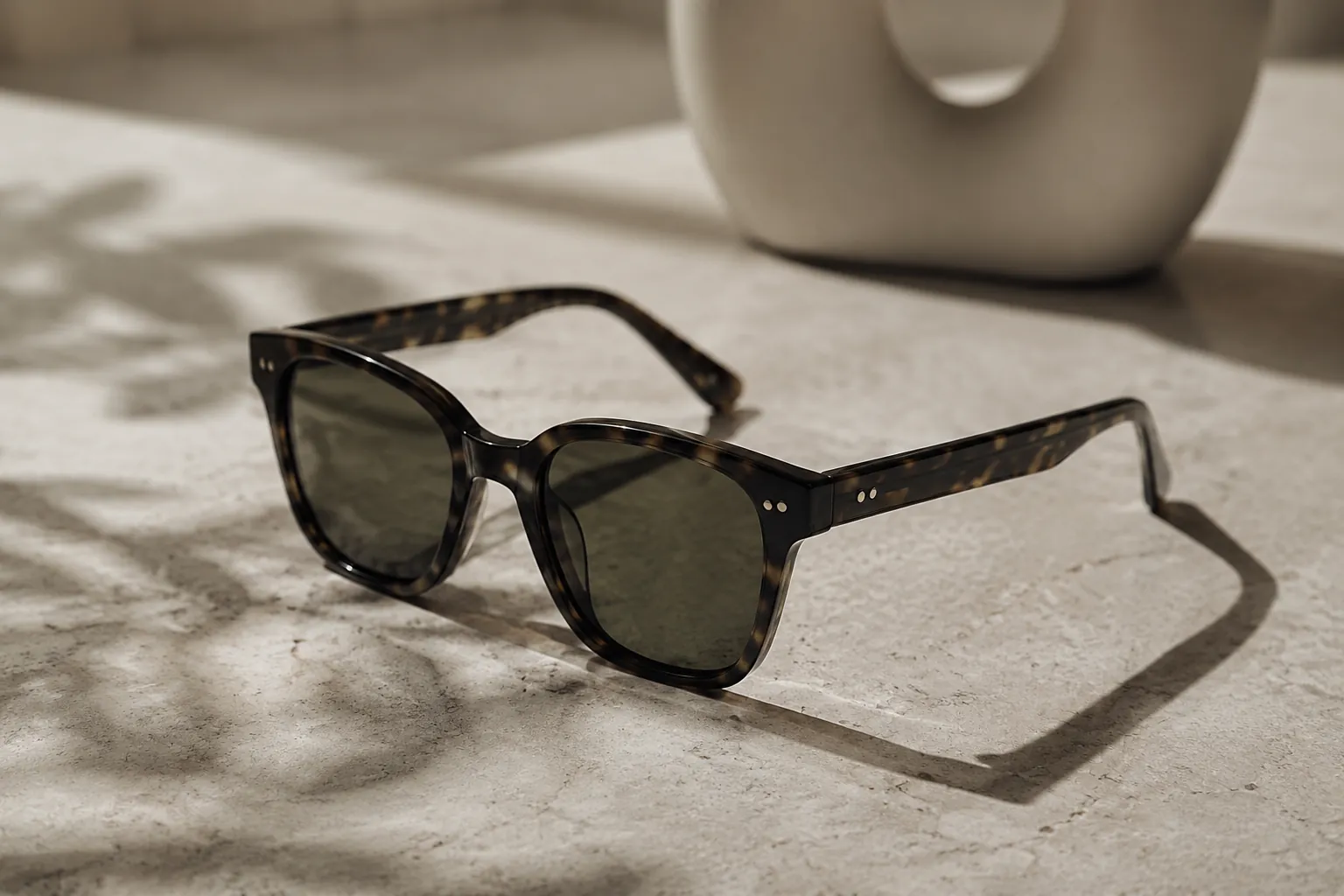
This guide is for buyers sourcing private label sunglasses for resort boutiques, beach shops, pool clubs, hotel gift stores, and other destination retail. In these channels, sunglasses get dropped on hard surfaces, left in direct sun, handled with sunscreen on guests' hands, and opened over and over by people who may never buy. The best spec is usually not the one with the most decoration. It is the one that handles heat, abrasion, hinge cycling, shelf exposure, and repeat reorders while still fitting the target retail price and margin.
Start With the Retail Job, Not the Artwork
Hospitality eyewear usually has to do one of three jobs. First, the entry-price impulse pair sold near the pool, beach hut, or front desk. Second, the core branded program in the resort shop, where the buyer wants stronger perceived value without fragile details. Third, the boutique or premium souvenir pair, where finish, packaging, and richer materials may justify a more complex build.
Those jobs should not share the same bill of materials by default. For the impulse tier, the commercial priority is broad fit acceptance, low return risk, and repeatable unit cost. That usually points to an injected frame, a simple hinge construction, and a lens spec that performs in bright sun. For the boutique tier, buyers may consider acetate fronts, metal trim, or upgraded packaging, but only after confirming the frame still holds alignment in hot, humid conditions.
A common sourcing mistake is spending margin on decoration before the structure is locked. Buyers approve a sample with a mirrored lens, large temple print, and premium box, then find later that the print wears, the mirror marks easily, or the hinge loosens on display stock. That is avoidable. In resort retail, the better question is not "Does this sample look premium on day one?" It is "Which component is most likely to fail after repeated handling, sun exposure, and normal store use?"
Rule of thumb: for high-turn, sun-heavy retail, prioritize frame stability, hinge reliability, and lens surface durability before adding extra branding or packaging.
Frame Materials: What Works, What Warps, What Costs More
For many resort programs, injection-molded plastic is still the most practical volume choice. The benefit is not just cost. It is repeatability across reorders when tooling and process control are solid. A molded frame with sensible wall thickness and reinforcement around the hinge area is usually more forgiving in hot retail conditions than a delicate fashion profile.
Acetate can be a strong premium option, but it is not automatically better. It brings richer color depth, stronger hand feel, and higher perceived value. It also brings higher material cost, more labor in cutting and polishing, and more lot-to-lot variation. In humid or beachside conditions, poorly processed acetate can shift if the temples are too thin, the bridge is underbuilt, or production conditioning is inconsistent. It also adds weight. That can increase fit complaints if the style is already front-heavy.
Metal frames can work for fashion capsules, but they carry more risk in resort programs than many buyers expect. Salt air exposes weak plating fast. Nose pads can discolor or loosen. Small alignment issues are also more visible on a thin wire profile than on a fuller plastic frame. Metal is not off the table. It simply belongs in tighter, better-controlled assortments where the price point supports extra quality control and careful merchandising.
| Material | Best Use | Commercial Strengths | Typical Risks |
|---|---|---|---|
| Injection-molded plastic | Impulse retail, core resort programs, broad-size assortments | Lower cost, strong repeatability, good impact resistance, efficient for volume production | Can feel low-value if texture, gloss level, paint, or wall thickness are poorly specified |
| Acetate | Premium boutique lines, branded souvenir styles, higher-ticket assortments | Richer finish, stronger perceived value, better color lamination options | Higher cost, more labor, more weight, potential warp if thickness control and polishing are poor |
| Metal with plastic tips | Fashion-led capsules, lower-volume statement styles | Clean visual profile, refined branding options, lighter visual appearance | Plating weakness in salt air, pad issues, alignment sensitivity, higher return risk in rough handling |
| Combination frame | Premium mixed-material programs | Can raise perceived value without going full metal | More assembly points, longer development, tighter tolerance management required |
For mixed-guest hospitality traffic, avoid very flat fronts, very narrow temples, and ultrathin temple roots unless the style is tightly targeted. They may look sharp on display. They create fit stress and hinge distortion once large numbers of shoppers start trying them on.
Lens Specs That Hold Up in Heat and Heavy Handling
Lens specification is where many private label programs quietly succeed or fail. In beach and pool retail, dark tint alone is not enough. Buyers should ask for lens material, filter category where applicable, UV performance, hard-coat presence, and any mirror or flash coating details in plain language. If the supplier cannot describe the lens construction clearly in the quotation or tech pack, the product is under-specified.
For broad resort use, smoke, brown, and green tints remain the safest commercial choices. They work across bright-light conditions and create fewer complaints than fashion-first color effects. Very pale tints may look strong under indoor lighting, but they often disappoint customers who expect practical outdoor protection. Mirror lenses can sell well in destination retail, especially at beaches, but low-grade mirror coatings show scratches, edge wear, and fingerprint damage faster than standard tinted lenses.
The lens material matters too. Polycarbonate is common because it is impact resistant and economical, but it scratches easily if the hard coat is weak. Polarized constructions can add value for boating, marina, or golf-adjacent retail, but they raise cost and require tighter quality control to avoid distortion, bonding problems, or cosmetic defects. For many high-volume resort programs, a hard-coated non-polarized lens is the cleanest balance of cost, durability, and merchandising simplicity.
- Confirm the target market and required compliance standard before production starts.
- Request the lens category and UV performance in writing, not as a sales claim on a sample card.
- Approve a retained standard sample for tint color and density before bulk production.
- Ask how the supplier checks shade variation between lots and between left and right lenses.
- If mirrored, ask what abrasion and adhesion checks are completed before packing.
For buyers selling into multiple regions, keep the paperwork market-specific. Common references include CE EN ISO 12312-1 for applicable CE markets, ANSI Z80.3 for the US market, AS/NZS 1067 for Australia and New Zealand, and REACH where material restrictions apply. FDA registration may be relevant in importer documentation for the US, but it is not a substitute for sunglass performance testing. In rough retail environments, lens hard-coat performance usually matters more to customer satisfaction than novelty lens effects.
Branding Methods: What Lasts and What Wears First
In destination retail, sunglasses are both utility product and souvenir. Branding matters. But some branding methods fail exactly where hospitality handling is heaviest. The outer temple is touched constantly during try-on, basket shopping, wiping, and pouch storage. Buyers need to think about friction, lotion exposure, and repeated cleaning.
Pad printing is still common in entry-price programs. It can work well when the substrate, surface preparation, ink system, and curing process are matched properly. On oily plastics or high-rub textured areas, large pad-printed logos are often the first decoration to wear. Laser marking can hold better where the material and finish create enough contrast. It gives a cleaner look for understated branding, but on some glossy plastics the visual result is lighter than expected.
Metal logo plates or inserts create a stronger premium signal and can outlast simple print, but they also add tooling detail, assembly labor, and more failure points if adhesive selection or fitment is weak. They make sense only when the retail price can absorb the added cost and the buyer is prepared to review assembly quality closely.
The most durable resort branding strategy is usually restraint. One visible brand hit on the outer temple, plus required inside legal marking, is often enough. More marks mean more failure points.
- For entry-price programs, use a small outer-temple pad print or simple laser mark.
- For mid-tier retail, keep outside branding modest and make sure inside legal text stays clean and legible.
- For premium programs, add metal logo plates only after hinge build, material choice, and lens quality are already approved.
Where Resort Programs Usually Fail
Most returns in hospitality eyewear come from basic failures, not rare ones. One common issue is hinge loosening. A display sample at a busy resort can be opened and closed dozens of times before it sells through. If screw retention is weak, hinge leaves are misaligned, or temple angle is inconsistent at assembly, the product starts to look defective while most of the inventory is still on the shelf.
Another common issue is lens scratching. This gets worse when sunglasses are displayed loose in acrylic bins, wire baskets, or open trays without sleeves or microfiber pouches. At a low enough price point, some cosmetic attrition may be commercially acceptable, but it should be built into the margin model rather than treated as a surprise quality problem later.
Logo wear is also frequent. Buyers often blame the ink alone, but the root cause usually appears earlier: poor surface cleaning before decoration, an incompatible ink system, insufficient curing, or a texture that does not hold crisp print edges. Heat deformation is another repeat problem. Frames left in parked cars, direct storefront sun, or beach kiosks can shift if wall thickness is too thin or material quality is inconsistent.
This is where factory process control matters more than brochure language. If molding, lens processing, decoration, and quality control are managed well, the supplier can catch problems earlier and correct them before packed goods are affected. Ask specific questions about inspection points, retained samples, and corrective-action handling. General quality claims are not enough.
Common buyer mistake: approving a sample after a visual check only, then skipping simple pre-production abuse checks such as repeated open-close cycles, sunscreen contact, logo rub checks, and basic heat exposure.
The Commercial Sweet Spot: MOQ, Cost, and Lead Time
For many multi-location resort or beach retail programs, the best commercial result comes from a middle-spec build rather than the cheapest or most decorative option. That often means an injected frame with moderate front thickness, standard hinges, a dark neutral lens tint, hard-coated lenses, and one durable brand application. This part of the market usually gives the best balance between complaint rate, margin protection, and reorder consistency.
MOQ logic matters here. A low minimum can be useful for one-property pilots, event drops, or seasonal tests, but it is not automatically where unit economics are strongest. As quantities rise, setup cost, decoration setup, and packaging preparation are spread across more units. Buyers should ask suppliers for breakpoints that show how price changes with quantity and with each added feature. Do not assume every upgrade has only a small effect.
Price moves fast once extra features are added. A basic injected private label pair can stay relatively low cost, but the number climbs quickly with polarized lenses, mirrored coatings, acetate, metal logos, custom pouches, individual boxes, or tighter pack-out requirements. Every upgrade needs a commercial reason tied to retail price, expected sell-through, or brand positioning.
| Program Type | Typical Spec | MOQ Fit | Commercial Notes |
|---|---|---|---|
| Entry resort impulse | Injected frame, standard tinted lens, simple pad print logo | Low-MOQ pilot or value program | Best for tests, seasonal fills, and value-led retail; keep packaging simple |
| Core branded program | Injected frame, hard-coated lens, cleaner branding, pouch or upgraded pack | Mid-volume reorder program | Often the lowest overall risk and strongest reorder logic for hospitality groups |
| Premium boutique line | Acetate or upgraded construction, richer finish details, metal logo plate | Higher-volume or higher-margin assortment | Needs higher retail support and tighter approval discipline to protect margin |
| Large seasonal rollout | Proven injected construction with locked lens and packaging spec | Volume program after validation | Best cost efficiency, but only after the style is validated through an earlier run |
Lead-time discipline matters just as much. Sample development and bulk production timing depend on construction, decoration method, packaging, approval speed, and factory capacity at the time of order. Buyers should request a written timeline that separates sampling, sample revision, approval, bulk production, and shipment. In practice, late artwork, unresolved legal markings, and packaging changes often cause more delay than the base manufacturing process.
What to Put on the PO and Pre-Production Checklist
A capable factory can still build the wrong sunglasses if the purchase order is vague. Resort eyewear orders often drift because the buyer sends a logo file and a target color but leaves too much else open to interpretation. That is how repeat orders start going sideways.
- Frame material and finish: injected plastic, acetate, metal, or combination construction; gloss or matte; texture reference; and target color standard.
- Lens specification: lens material, base color, tint category where applicable, hard-coat requirement, mirror or polarization if any, and intended compliance market.
- Branding method: pad print, laser marking, or metal logo plate, plus exact size and placement reference.
- Markings: inside temple text, market-specific legal requirements, barcode or SKU rules.
- Packaging: polybag, pouch, box, sticker placement, master carton quantity, and pack-out method.
- Approval gate: who signs off the retained sample, what color variation is acceptable, and how print-position tolerance will be judged.
Buyers should also ask how quality control is staged. For sunglasses, final random inspection alone is not enough. Useful checkpoints include incoming material review, frame forming or molding checks, lens inspection, decoration verification, hinge and alignment control, and a final inspection before packing. That sequence matters because defects found after packing are slower and more expensive to correct.
If the selling season is fixed, count backward from the in-store date and protect time for sample revision, not just production. In hospitality programs, delays often come from unresolved artwork, packaging indecision, or unclear legal marking requirements rather than from the production line itself. Buyers who document those points clearly up front usually get more reliable repeat orders.
The Short Answer for Most Hospitality Buyers
If you need private label sunglasses that hold up in clubs, resorts, and beach retail, keep the build disciplined. A stable injected frame, controlled lens tint, hard-coated lenses, and restrained branding will usually outperform a more decorative style that looks premium only on the first delivery.
Use acetate, mirror lenses, metal details, or richer packaging only where the retail price supports them and the supplier can control the extra process steps consistently. Keep compliance paperwork specific to the destination market, and request it before mass production. Most important, approve the program based on repeatability, not on the sample alone. In seasonal hospitality retail, the winning specification is the one your supplier can reproduce cleanly on the second and third order with the same fit, finish, and timing as the first.
Have a custom sunglasses project in mind?
Send us your styles, target market and quantities and we will return a detailed quote with MOQ, lead time and a sample plan.
Get a QuoteWhy source this from Wenzhou with LumiShades
Wenzhou in Zhejiang Province is widely regarded as China’s eyewear manufacturing capital, producing a large share of the world’s sunglasses. That concentration matters to buyers: a deep local supply chain for acetate sheet, hinges, lens blanks, plating and packaging means shorter component lead times, easier color and material matching, and a workforce with decades of eyewear-specific skill. LumiShades has manufactured in this ecosystem since 2009, and our vertical integration — in-house injection molding, acetate cutting, CNC milling, lens tinting, decoration and quality control — means no part of your order is quietly subcontracted to a workshop you cannot audit.
For international buyers, that vertical control translates into accountability. When a single factory owns every step, defects are traced and fixed at source rather than bounced between vendors, and your specifications survive intact from first sample to bulk. We back this with 15+ years of experience, shipments to 60+ countries, more than 5 million pairs produced per year and a 98.5% on-time delivery rate. Our certifications — CE EN ISO 12312-1, FDA registration, ANSI Z80.3, AS/NZS 1067, REACH, ISO 9001 and BSCI audit — mean the compliance documentation your market requires already exists. Explore our manufacturing capabilities and quality control process to see how this works in practice.
Frequently asked questions
What is the safest frame material for beach and resort retail? For most volume programs, injection-molded plastic is the safest commercial starting point because it usually offers better repeatability, lower cost, and good durability under frequent handling. Buyers should still confirm the actual resin type, hinge construction, wall thickness, and finish quality with the supplier, because material category alone does not guarantee performance. If the program is premium and the retail price supports it, acetate can work well, but it needs tighter control on thickness, polishing, and alignment.
Are mirror lenses a good idea for resort programs? They can be, especially in beach destinations where reflective looks sell well, but buyers should treat mirror as a durability decision as much as a style decision. Ask the supplier to specify the base lens material, hard-coat presence, mirror application method, and any abrasion or adhesion checks used before packing. For high-turn core programs, standard tinted hard-coated lenses are usually the lower-risk option because they show handling wear less quickly.
What MOQ works for testing a new resort design? There is no universal MOQ, because it depends on the supplier, tooling status, decoration method, and packaging complexity. For a new resort design, buyers should ask for at least three quoted quantity breaks: a pilot quantity, a mid-volume reorder quantity, and a larger rollout quantity. That lets you compare not only unit cost, but also whether upgrades such as pouches, boxes, or metal logos become more practical at higher volume. The practical step is to request a price matrix before approving the design.
How long should I allow for samples and bulk production? Do not rely on a generic lead-time promise. Ask the supplier for a written schedule that separates sample making, sample revision, approval, bulk production, and shipment. Standard constructions usually move faster than acetate, metal, or custom packaging programs, but the actual timing depends on artwork readiness, legal marking approval, and factory capacity when the order is placed. For seasonal hospitality retail, buyers should also build in buffer time for one correction round, because approvals often change after the first sample review.
Which certifications and compliance documents should buyers ask for? Ask for documents that match the market where the sunglasses will be sold. Common references include <strong>CE EN ISO 12312-1</strong> for applicable CE markets, <strong>ANSI Z80.3</strong> for the United States, <strong>AS/NZS 1067</strong> for Australia and New Zealand, and <strong>REACH</strong> documentation where restricted substances compliance is required. <strong>FDA registration</strong> may be requested for importer paperwork in the US, but it does not replace sunglass performance compliance. On the factory side, <strong>ISO 9001</strong> and <strong>BSCI</strong> can help buyers assess management systems and social compliance, but they are not substitutes for product-specific testing. The practical step is to request the exact test reports and declarations before mass production and confirm that they match the final material and lens specification, not an earlier sample.
Ready to start?
Explore our wayfarer sunglasses or request a quote — our sales team replies within 12 hours.
Request a Quote