
Private Label Sunglasses for Sports Venues
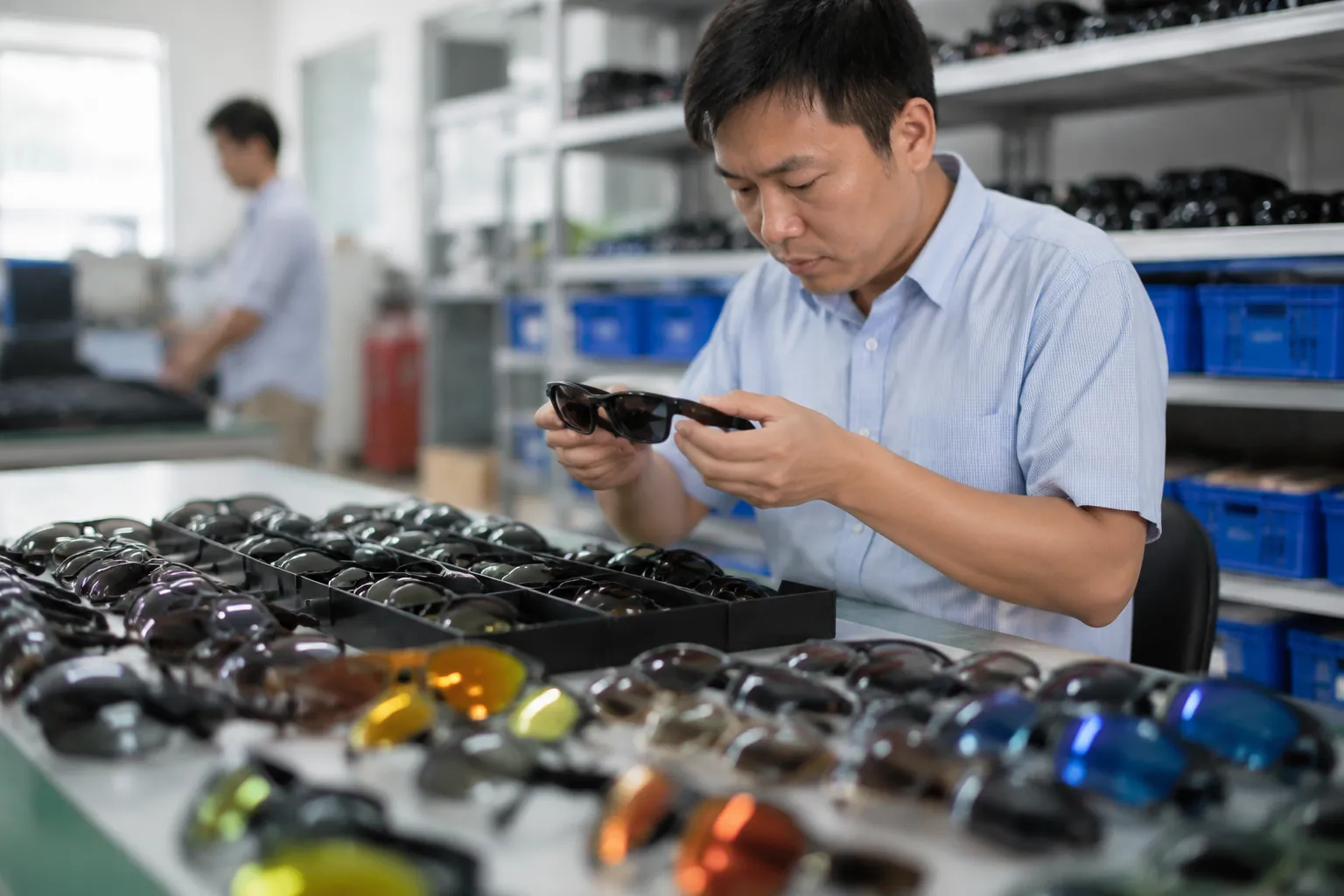
Gyms, golf clubs, outdoor event operators, importers, and retail buyers need branded sunglasses that can be specified, tested, priced, and delivered without guesswork. This guide shows how to define the frame, lens, logo method, packaging, compliance route, and order quantity before bulk production starts. The focus is practical private label eyewear for outdoor training, golf shops, tournaments, races, festivals, resorts, patios, and venue retail. Not runway fashion. Not vague catalog browsing.
Start with the venue, not the frame catalog
Many non-fashion buyers make the same early mistake. They choose a frame shape before they define how the sunglasses will be used. Start with the venue and the wearer. Sunglasses sold in a golf pro shop carry different risks than sunglasses handed out at a beach run or sold beside a hotel pool.
Gym buyers may need lightweight frames for outdoor classes, branded retail shelves, trainer kits, or member gifts. The frame should stay comfortable during movement, but it should not look like safety eyewear unless that is the intended position. Golf clubs need lens clarity, low distortion, and a restrained retail look. Outdoor event operators usually care about speed, simple decoration, controlled unit cost, and sizing that works for many face shapes.
That choice changes the specification. A high-wrap sports frame may suit cycling-style events but feel wrong in a club shop. A flat promotional frame can hit a low unit cost, but it may feel cheap at a paid retail price. A TR90-style flexible frame with polarized lenses may be too costly for giveaway volume. For tournament merchandise or a higher-priced pro shop item, it can make sense.
Buyer rule: if the sunglasses will be sold, specify for perceived value and return risk. If they will be given away, specify for fit consistency, logo visibility, and cost control. If they will be worn during sport, specify for grip, lens retention, optical quality, and compliance first.
Match frame material to activity and margin
Private label sunglasses for venues usually fall into four material groups: PC injection frames, TR90-style flexible nylon frames, acetate frames, and metal or combination frames. Each can work. The wrong choice wastes budget or creates complaints after delivery.
| Option | Best use | Buyer advantage | Watch point |
|---|---|---|---|
| PC injection frame | Events, gyms, pool retail, low to mid price points | Lower unit cost, repeatable production, strong logo area | Can feel basic if mold shape, hinge fit, or surface finish is weak |
| TR90-style flexible nylon frame | Running clubs, golf, outdoor training, higher retail | Lightweight feel, better flex, useful for active wear | Higher cost than basic PC and fewer easy decoration positions on some models |
| Acetate frame | Golf shops, resort retail, premium member gifts | Better hand feel, richer color options, higher perceived value | Requires good cutting, polishing, hinge setting, and warpage control |
| Metal or combination frame | Club retail, hospitality retail, lifestyle programs | More adult retail look, suitable for subtle logo details | Hinge quality, plating quality, and nickel or restricted substance requirements must be checked |
Ask the supplier which production steps are handled in-house and which are outsourced. Small process errors add up fast: molding or cutting, lens tinting, logo application, hinge assembly, packing, and inspection all affect the final product. A process map shows where samples, tests, and inspections should happen.
For PC event sunglasses, request frame weight, hinge type, lens thickness, lens material, and packaging dimensions before comparing quotes. For acetate, ask how the front and temples are cut, polished, adjusted, and checked for warpage. For sports frames, confirm that the lens stays secure after normal flex and handling checks. A loose lens is not a minor defect. It is a predictable complaint.
Specify lenses before approving color
Lens specification is where many branded sunglasses programs get weak. Do not approve a lens by color name only. Brown, smoke, green, mirror blue, and gradient gray can all be produced at different visible light transmission levels. Buyers need a target filter category, a UV requirement, and a compliance route for the sales market.
For general outdoor sunglasses, UV400 protection is commonly expected. An import or retail program should connect that claim to the relevant standard for the destination market. Common documents and requirements include CE EN ISO 12312-1 for Europe, ANSI Z80.3 and FDA registration considerations for the United States, AS/NZS 1067 for Australia and New Zealand, and REACH for restricted substances in the EU. ISO 9001 and BSCI relate to management systems and social compliance. They do not replace product testing for lens performance.
- Gyms and outdoor training: smoke or brown lenses, secure fit, stable hinges, anti-slip temple tips where available, and an appropriate sunglass filter category for bright outdoor conditions.
- Golf clubs: brown, amber, green, or contrast-focused tints may be more useful than very dark fashion lenses. Low optical distortion matters because players read ground slope, distance, and ball flight.
- Festivals and outdoor events: smoke, mirror, or colored lenses may support the event look, but lens compliance, wearer comfort, and tint consistency should come before novelty.
- Waterfront venues: polarized lenses can support a higher retail price when glare reduction matters. Check polarization quality on physical samples and look for uneven color, stress marks, or distortion.
For lenses, request UV test information, filter category or visible light transmission range, lens thickness, base curve, lens material, and confirmation that the sample lens matches the planned bulk lens. A good-looking sample is not enough if bulk production uses a different lens material, coating, tint process, or supplier.
Choose logo methods by wear conditions
Decoration is not just branding. It affects how the product ages. Gyms, clubs, resorts, and event venues expose sunglasses to sweat, sunscreen, repeated handling, and heat inside bags or cars. A logo can look sharp on day one and rub off quickly if the method is wrong for the surface.
| Logo method | Good for | Typical position | Risk to control |
|---|---|---|---|
| Laser engraving | Subtle branding, acetate or metal parts | Temple outside, metal plate, selected lens or hardware areas depending on model | Low contrast on some colors unless size, depth, and position are tested |
| Pad printing | Event logos, gym names, colorful marks | Temple, frame front, pouch, sleeve, or case | Ink adhesion on glossy, coated, or flexible surfaces |
| Metal logo plate | Golf clubs, resort retail, premium programs | Temple inset or outer temple | Plate alignment, plating finish, edge comfort, and glue strength |
| Lens logo | Giveaways, sponsor programs, short-term event use | Upper lens corner | Can distract wearers if too large or placed in the field of view |
Before bulk production, compare logo size and placement on a physical sample. A logo that looks balanced in a PDF can look oversized on a narrow temple. Ask for the logo size in millimeters, the approved position from a fixed reference point, and the print or engraving color.
For retail product, subtle branding usually performs better than a large mark that makes the item feel promotional. For a race giveaway or sponsor activation, high visibility may be the point. For golf clubs, a small temple mark or metal plate often supports a higher perceived value than a large lens logo. Always request an adhesion check for printed logos, especially on rubberized, glossy, or coated temple surfaces.
Check MOQ, price breaks, and retail math
MOQ and pricing must be confirmed against the exact frame, lens, logo method, packaging, and compliance requirement. A supplier may support a low starting quantity for selected existing models. The practical MOQ can still rise when the order needs custom color, special lenses, new packaging, or multiple logo positions. Ask whether the MOQ is per design, per color, per lens option, or per logo version.
Price breaks often shift around common production quantities: small pilots, club season buys, event quantities, and multi-location programs. Do not treat a low advertised unit price as the price for every specification. Polarized lenses, acetate, metal plates, mirror coating, custom packaging, barcode labeling, inspection requirements, and multi-color production can all change cost.
Think in retail tiers before confirming the spec. A gym selling sunglasses at a low counter price needs a different landed cost than a golf club selling polarized sunglasses at a higher pro shop price. The factory price is only one part. Add packaging, freight, duty, inland transport, payment cost, inspection, defect allowance, and retailer margin.
| Program type | Likely order size | Spec direction | Retail logic |
|---|---|---|---|
| Single gym pilot | Low-volume test order | Existing PC frame, one logo, simple pouch or sleeve | Test sell-through before adding colors or premium packaging |
| Golf club season buy | Moderate seasonal order | Better lens, restrained logo, microfiber pouch or retail box | Higher shelf price needs better hand feel and clearer product presentation |
| Outdoor race or festival | Event-volume order | Injection frame, clear logo visibility, bulk packing or simple pouch | Cost control matters because units move quickly and deadlines are fixed |
| Multi-location retail program | Repeat or high-volume order | Locked model, color standards, approved sample, repeat QC file | Unit cost may improve, but consistency and replenishment control become the main risks |
For seasonal buyers, avoid over-customizing the first run. Start with one proven frame, one or two lens options, and one packaging format. Extra colors, mixed cartons, and multiple logo versions create more changeovers and inspection points. Add complexity after sell-through data is available.
Use samples as a control point
The sample stage is a buying control point, not a formality. Do not approve by photo only unless the item is a true repeat order and the approved production reference is already clear. A physical sample should be checked for fit, optical quality, decoration, packaging, and compliance alignment.
- Fit and pressure: wear the frame for at least 20 minutes. Check nose pressure, temple squeeze, and whether the frame slides when you look down.
- Lens clarity: look at straight lines through the lens and rotate the frame. Distortion, waves, uneven tint, or visible stress marks are warning signs.
- Logo scale: compare the logo against the real temple width, not the artwork file. Confirm the size and position in millimeters.
- Hinge feel: open and close both temples repeatedly. Loose hinges at sample stage should be corrected before bulk approval.
- Packaging fit: put the sunglasses into the pouch, box, or sleeve. Tight packaging can scratch lenses, deform frames, and slow packing.
- Compliance match: confirm that the tested lens, frame material, coating, and color match the planned bulk order, especially if any lens color changes after sampling.
For private label sunglasses, tolerances should be written before production. Ask what variation is acceptable for logo position, frame color, lens tint, temple alignment, hinge tension, and packaging print position. A good QC file should define the approved sample, acceptable range, and defect classification. Without that, the inspector has too much room to interpret.
Plan timing from the in-hand date
Production timing should be planned from the required in-hand date, not from the factory start date. Buyers need time for model selection, quotation, artwork confirmation, sample making, sample review, payment, packaging approval, compliance documentation, inspection, export documents, and transport.
For a May golf season launch, work backward. If goods are needed in the warehouse by mid-April, sample approval must happen early enough to allow production and transport without emergency air freight. For outdoor events, the deadline is fixed. Sunglasses that arrive after the event lose most of their value.
A practical sourcing timeline should include several days for model selection and quotation, several days for artwork and packaging confirmation, the supplier's stated sample lead time, buyer review time, the supplier's stated bulk production lead time, inspection, and freight. Ocean freight may add several weeks depending on route and port conditions. Air freight is faster, but sunglasses packaging can create bulky cartons.
Control avoidable risks early. Freeze artwork before sample approval. Avoid last-minute lens color changes. Approve packaging dimensions before cartons are made. Confirm carton marks if goods ship directly to a distributor, event site, retail warehouse, or third-party logistics provider. If the order is tied to a fixed event date, ask the supplier to state the latest safe approval date in writing.
Request compliance and QC files early
Compliance depends on destination market, product type, and product claim. For sunglasses sold in Europe, CE EN ISO 12312-1 is central. For the United States, ANSI Z80.3 and FDA registration considerations may be relevant. For Australia and New Zealand, AS/NZS 1067 applies. REACH matters for restricted substances in materials for the EU market. ISO 9001 and BSCI can support supplier evaluation, but they do not prove that a specific lens meets sunglass performance requirements.
Ask for documents that match your exact product. A report for a different frame, different lens color, different coating, or old material stack may not support your shipment or retailer file. If your retailer requires a current test report or a report under its own company name, state that before production. Testing after goods are packed creates risk you do not need.
- Approved physical sample with signed date, sample number, or clear sample reference.
- Final artwork file showing logo size, color, method, and placement in millimeters.
- Material and lens specification, including lens material, tint category or visible light transmission range, and UV requirement.
- Applicable compliance documents: CE EN ISO 12312-1, ANSI Z80.3, AS/NZS 1067, REACH, FDA registration, ISO 9001, and BSCI as needed for the market and buyer requirement.
- Packaging specification with barcode, warning text, pouch or box material, polybag requirements, and carton quantity.
- Inspection checklist covering frame defects, lens scratches, lens security, logo position, hinge function, color match, labeling, and packing.
For AQL inspection, define major and minor defects before production starts. A scratched lens, loose hinge, wrong logo color, failed UV requirement, sharp edge, or incorrect warning label should not be treated as a small cosmetic issue. Misaligned pouch printing may be minor depending on the retail channel. Write the standard down before the inspector arrives.
Have a custom sunglasses project in mind?
Send us your styles, target market and quantities and we will return a detailed quote with MOQ, lead time and a sample plan.
Get a QuoteWhy source this from Wenzhou with LumiShades
Wenzhou in Zhejiang Province is widely regarded as China’s eyewear manufacturing capital, producing a large share of the world’s sunglasses. That concentration matters to buyers: a deep local supply chain for acetate sheet, hinges, lens blanks, plating and packaging means shorter component lead times, easier color and material matching, and a workforce with decades of eyewear-specific skill. LumiShades has manufactured in this ecosystem since 2009, and our vertical integration — in-house injection molding, acetate cutting, CNC milling, lens tinting, decoration and quality control — means no part of your order is quietly subcontracted to a workshop you cannot audit.
For international buyers, that vertical control translates into accountability. When a single factory owns every step, defects are traced and fixed at source rather than bounced between vendors, and your specifications survive intact from first sample to bulk. We back this with 15+ years of experience, shipments to 60+ countries, more than 5 million pairs produced per year and a 98.5% on-time delivery rate. Our certifications — CE EN ISO 12312-1, FDA registration, ANSI Z80.3, AS/NZS 1067, REACH, ISO 9001 and BSCI audit — mean the compliance documentation your market requires already exists. Explore our manufacturing capabilities and quality control process to see how this works in practice.
Frequently asked questions
What is the smallest practical order for a gym or golf club private label test? Ask the supplier to confirm the MOQ for the exact model, color, lens, logo method, and packaging. A very small test may be possible on selected existing frames, but a useful sell-through test usually needs enough units to cover the counter, staff use, one event, or multiple locations. For a first buy, keep the specification simple: one proven frame, one lens color, one logo position, and one packaging format.
Can we use one sunglasses model for both golf retail and outdoor events? Yes, but choose a neutral model and separate the retail presentation if needed. A comfortable PC or TR90-style frame with smoke, brown, or green lenses can work across both channels. For golf retail, prioritize optical clarity, subtle branding, and better packaging. For outdoor events, prioritize fit consistency, logo visibility, deadline control, and cost. Do not use a lens tint or logo placement that interferes with vision during sport.
How long should we allow from first inquiry to delivery? Build the schedule from the in-hand date. Include time for model selection, quotation, artwork, sample production, sample shipping, buyer review, deposit or payment, bulk production, inspection, export documents, and freight. For seasonal programs using ocean freight, starting 8 to 12 weeks before the required delivery date is a practical planning range. Tight event orders should have a written latest approval date and a backup freight option.
Which certifications should we ask for? Ask based on the selling market and product claim. For Europe, request documentation aligned with CE EN ISO 12312-1 and REACH where applicable. For the United States, ask about ANSI Z80.3 and FDA registration considerations. For Australia and New Zealand, request AS/NZS 1067 documentation. ISO 9001 and BSCI can help assess supplier systems, but they are not substitutes for product-level sunglass testing. The report should match the actual frame, lens color, material, and coating used in your order.
Is polarized worth it for venue sunglasses? Polarized lenses are worth considering for golf clubs, marinas, resorts, fishing programs, driving-related retail, and waterfront events where glare reduction supports the value proposition. They may not be worth the added cost for low-price giveaways. Before approving polarized bulk production, check the sample outdoors, look for uneven polarization or color stress, confirm the lens category and UV claim, and make sure the retail price can absorb the added cost.
What should we lock before mass production starts? Lock the frame model, frame color, lens color, lens category or visible light transmission range, UV requirement, logo method, logo size, logo position, packaging, barcode or warning text, carton marks, compliance requirement, approved sample reference, inspection standard, and latest delivery requirement. Any change after approval should trigger written confirmation of cost, lead time, and whether a new sample or test report is needed.
Ready to start?
Explore our aviator sunglasses or request a quote — our sales team replies within 12 hours.
Request a Quote