
Polycarbonate Hinge Reinforcement for Sunglasses
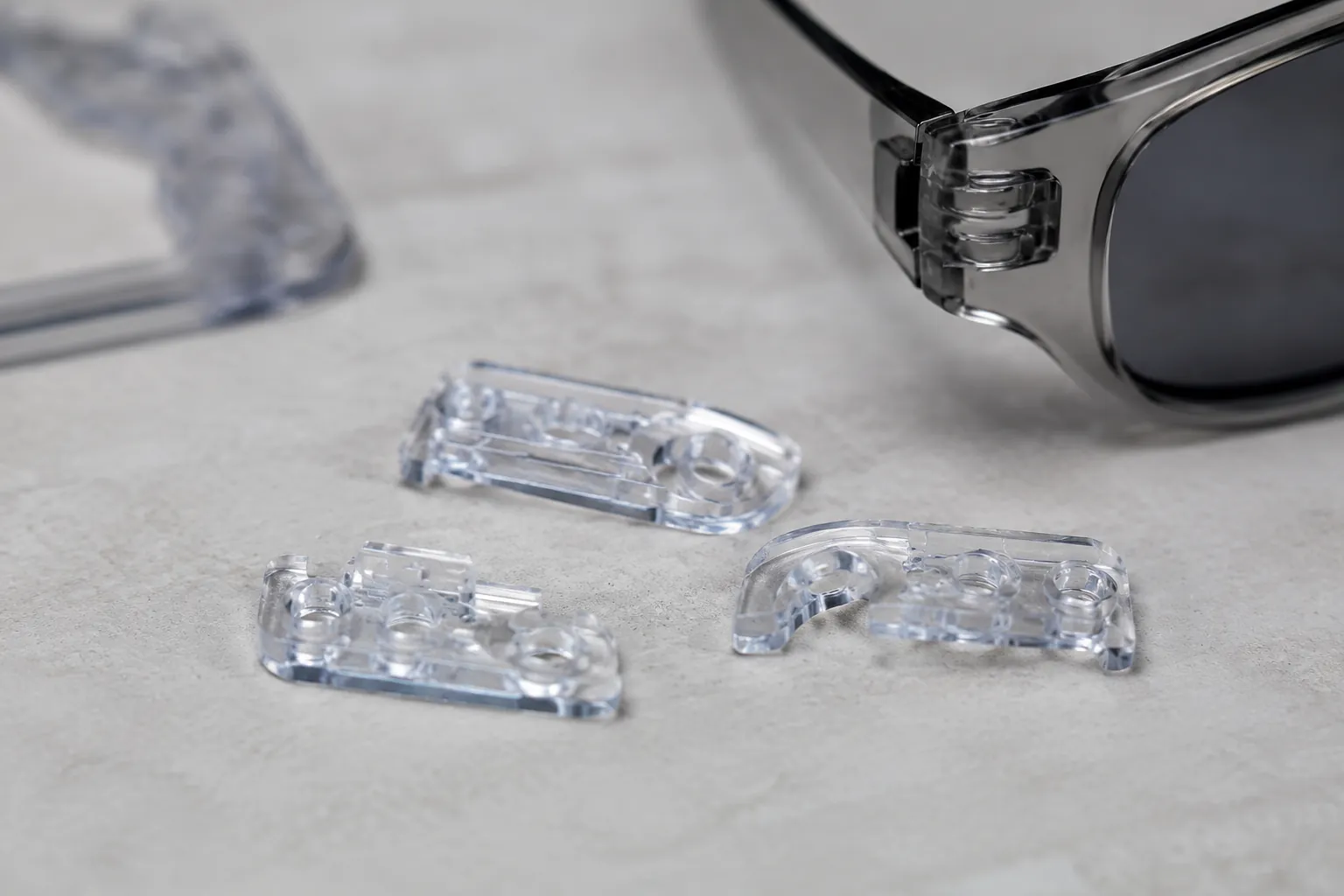
If you buy sunglasses for travel, promo, or mass retail, the hinge is not a small detail. It is usually one of the first places a frame loosens, cracks, or comes back as a return. This guide shows what to inspect in polycarbonate hinge areas and reinforcement points, what to ask suppliers for, and how to specify the build clearly for development and production.
Why the hinge fails first
Most high-use sunglasses do not fail because the lens was poor or the color missed the target. They fail at the hinge zone. That is where repeated opening loads concentrate into a small area of plastic, metal, and fastener. The highest-risk points are the hinge boss, the screw hole, the temple root, and the seat where the hinge meets the front frame. If any of those areas are too thin, poorly formed, or over-stressed during assembly, the frame loosens long before the lens becomes a problem.
Polycarbonate helps because it offers high impact resistance and better toughness than more brittle plastics. That matters. It survives more abuse in bags, pockets, and travel kits. But polycarbonate is not a cure for weak geometry. Wall thickness alone does not guarantee durability. A hinge area that is too thin can deform or ovalize around the screw hole. A hinge area that is too thick can create sink, internal stress, or cooling variation if the mold is not balanced. Durability comes from the full structure: thickness, rib support, screw retention, and assembly control.
Field abuse matters too. A travel pair may be opened and closed many times over its service life, then squeezed in a case or backpack. A promo pair may be handled less carefully, tossed into a car door pocket or desk drawer, and bent past its natural stop. Once the hinge is over-opened, the material can show whitening, creep, or crack initiation. One bend check does not tell you enough. You need a design that survives repeated cycle loading, normal torque variation, and real user handling.
The right approach is simple. Design the hinge area for repeated load first, then verify that molding, assembly, and QC match the design intent. A clean-looking sample is not enough if the torque drifts after repeated use or the boss starts whitening after flexing.
The structural weak points to inspect
There are four places to inspect first on any sunglass frame. They show quickly whether the product was designed for volume use or only for a photo sample.
- Hinge boss thickness: Too thin and the screw hole can elongate, the threads lose grip, and the hinge arm starts to wobble. Too thick and you can create sink, internal stress, or visible cooling marks, especially on glossy black frames.
- Temple root: This is the transition from the hinge into the side arm. Sharp inside corners or abrupt section changes can create a crack starter. A small radius is usually better than a hard corner where the design allows it.
- Front frame hinge seat: If the hinge sits on a narrow pad, load transfers into a small area and the front frame can loosen faster. A broader pad or pocket helps spread the force and stabilize the screw axis.
- Bridge and upper rim ribs: On full-rim and wrap designs, these ribs help resist flex from moving into the lens groove and deforming the front geometry.
For acetate frames, the weak point is often the metal hinge embed and the interface where the plastic is cut, pinned, or polished around it. For injection-molded polycarbonate frames, the weak point is usually the molded geometry itself: wall thickness, gate location, and cooling balance. Different failure, same result: returns, claims, and avoidable margin loss.
Do not accept a design where the screw alone carries the load. The surrounding plastic should support the hinge, the boss should guide the screw, and the temple root should resist twist. If the hinge is decorative and not structural, it will fail in the field. Ask how the part behaves after torque, cycle, and drop stress. Not just how it looks on a flat table.
Reinforcement options that actually work
Reinforcement should match the channel. A promo frame does not need the same build as a premium travel pair, but it still needs enough structure to survive distribution, shelf handling, and basic abuse. The best choice is usually the simplest one that still protects the hinge under expected use.
| Option | Where it helps | Trade-off | Best for |
|---|---|---|---|
| Thicker molded PC hinge boss | Screw retention, load spread, slower wear | Can add weight and increase sink risk if cooling is uneven | Mass retail, promo, entry price points |
| Metal hinge insert | Higher cycle life, stronger screw grip, better alignment retention | Higher part cost, tighter assembly control, more QC checks | Travel, premium retail, frequent-use SKUs |
| Temple rib reinforcement | Reduces twist and side cracking in long temples | Less flex, stiffer feel if overbuilt | Sport-inspired and utility frames |
| Acetate with metal core support | Strength in thicker temples and better form stability | More cutting, polishing, and fit-up steps | Retail frames with heavier styling |
In production, the details matter more than the label. A thicker boss only works if the mold gate and cooling path are balanced. Otherwise, you get sink, gloss variation, or a local weak spot. A metal insert only works if hole position is consistent and the screw is not over-torqued during assembly. In many factories, the useful torque range for small eyewear screws is low enough that operators need a controlled process rather than hand feel alone. The exact target should be defined and verified by the factory and buyer for the specific hardware used.
The process chain matters because the hinge zone depends on several upstream steps working together. If the cut depth is off, the screw axis shifts. If milling leaves burrs, the hinge seat may sit proud. If polishing rounds the edge too much, the insert can lose purchase. The hinge is only as strong as the process chain behind it.
How design choices change price and lead time
Buyers often ask for a stronger frame without wanting the tooling or assembly changes that make it strong. Reinforcement is never free. If you want a durable hinge seat, the factory may need a revised mold insert, a different wall thickness, more precise drilling, or a hardware stack that adds labor and inspection time.
As a practical sourcing guide, basic molded PC frames can often start with low minimums, especially for promo orders with simple decoration. Small runs may be possible when the colorway is standard and the build is straightforward. Once you move to reinforced molded bosses, the order usually works better at a higher volume because the tooling adjustment and process tuning need enough quantity to justify the setup. Metal insert builds are usually more efficient at larger volumes, where assembly setup and QC can be spread across a bigger lot. Higher-spec retail programs generally make the most sense at still higher volumes if you want better unit economics on a repeated style.
| Build level | MOQ logic | Indicative price trend | Lead time impact |
|---|---|---|---|
| Basic molded PC hinge area | Possible from small orders for simple programs | Lowest cost, suitable for promo and test launches | Samples often 7-10 days; bulk about 25-35 days |
| Reinforced molded boss | Better at higher volumes | Moderate increase due to tooling and cooling control | May add time for tool adjustment and approval |
| Metal hinge insert / logo plate mix | Best at larger volumes | Improved unit economics at volume, but higher assembly cost | Assembly and QC usually need extra time for alignment checks |
| Higher-spec retail build | Best at large, repeat programs | Higher cost per pair, but more stable quality potential | Usually still within 25-35 days if materials and decoration are locked |
Lead time also depends on what you change. A color-only project can move quickly. A reinforced hinge with a new mold insert, custom logo plate, and added torque testing takes longer because each step has a failure point. Separate sample time from bulk time. A clean development sample in 7-10 days does not guarantee the same pace on production quantities if the hinge architecture changed. Build for the abuse you expect, not the sample you admire.
What to specify on the PO
If you want the supplier to get it right, be precise. Vague instructions create vague frames. Your PO or tech pack should cover the hinge and reinforcement details, not just the frame color and lens tint.
- State the frame material and finish: injection PC, acetate, mixed material, matte, glossy, rubberized, or painted.
- Call out hinge type: standard screw hinge, metal insert, spring hinge if used, or reinforced plastic hinge seat.
- Specify target open/close feel and any stop angle requirement. Many buyers target a stable open angle around 95 to 115 degrees, with no over-extension past the designed stop.
- Define cosmetic limits around hinge areas: sink, gate marks, weld lines, whitening, and visible parting lines.
- Ask for torque and cycle checks in QC, especially for retail and travel programs.
- Specify screw type, length, and locking method if relevant, because thread engagement changes retention.
- Confirm whether the hinge area gets painted, UV-coated, or laser-marked, since decoration can affect local strength.
Decoration placement matters more than many buyers realize. Laser engraving, pad printing, or soft-touch coatings too close to the hinge can weaken the local wall or create a crack line after repeated flexing. A metal logo plate also needs room. If it sits on a flex zone, the frame may look perfect in the carton and fail later in the store. Keep high-contrast graphics, engraving, and hard decorative edges away from the temple root and hinge seat.
For custom work, ask the supplier to confirm the drawing tolerance on hinge location and hole position. A practical target should be defined in the tech pack for the exact hardware and process used. If a factory cannot discuss tolerances clearly, it probably cannot hold them consistently.
Testing that tells you something useful
For high-use frames, the test must match the buyer channel. A quick visual check is not enough. The real question is whether the hinge stays tight, aligned, and free of cracks after repeated use, transport, and temperature swings.
Useful checks include hinge torque feel, temple symmetry, screw retention, and stress whitening around the boss after repeated opening. If the frame is polycarbonate, look for whitening at the temple root after flexing. That is an early warning that the part is approaching its elastic limit. If the hinge is metal-reinforced, check for loosening at the interface and for spinning screws after cycle testing. Many buyers also want a retention check after the frame has been opened and closed several hundred times, because that reveals drift better than a single inspection.
One practical test plan is to sample at three stages: pre-production, after 100 to 200 open-close cycles, and after a rest period. That catches both immediate assembly issues and slower relaxation. Drop tests matter too, especially for travel and promo frames, because a frame that survives cycles may still crack if it hits a hard floor corner-first. Ask for test results tied to the standard your market needs, not a generic internal sheet.
For eyewear, that usually means CE EN ISO 12312-1, ANSI Z80.3, or AS/NZS 1067, plus REACH and FDA registration where applicable to the market and product scope.
Any quality system claim should be supported by the supplier's actual certification status. ISO 9001 and BSCI relate to management systems and social compliance, not product performance, so they do not replace product testing. The buyer still needs to ask the right questions: which parts were tested, how many cycles, what happened at failure, and whether the tested sample matches production hardware. A report is only useful if it reflects the real build, not a hand-picked preproduction part.
Failure modes by channel
Different sales channels break frames in different ways. That matters because the same hinge that works in a boutique rack can fail quickly in a travel kit or promo box.
| Channel | Common abuse | Failure mode | Best reinforcement choice |
|---|---|---|---|
| Travel retail | Frequent packing, squeezing, pocket carry, temperature swings | Temple looseness, hinge misalignment, screw back-out | Metal insert or reinforced boss |
| Promo | Bulk distribution, low handling care, cartoning pressure | Cracked hinge seat, stripped screw, cosmetic rejection | Thicker molded boss, simpler hardware |
| Mass retail | High volume, mixed user behavior, variable handling | Random return spikes from weak batches | Standardized QC with torque and fit checks |
| Value retail | Price pressure, less careful use, more over-opening | Over-opened temples, whitening, visible stress marks | Visible reinforcement only if it does not push cost too high |
If your channel includes children's or rough-use buyers, strengthen the hinge seat and reduce sharp internal corners. A slightly more forgiving temple root often prevents sudden cracks, which are the complaints that escalate fastest. For sports-leaning styles, rib reinforcement and a controlled stop angle help protect the hinge from being forced past its design range. For airport or commuter use, the best design is often the one that survives repeated folding without visible drift.
The deeper lesson is simple. Failure mode is channel-specific. If the end user is likely to stuff the frame into a bag, prioritize retention and alignment. If the frame is a giveaway item, prioritize simple structural robustness and predictable assembly. If the frame is retail-facing, prioritize durability plus appearance, because sink marks and whitening can hurt sell-through even before the frame breaks.
A buyer checklist before approval
Use this before you confirm a production run.
- Check hinge thickness in the CAD or sample and compare left/right symmetry.
- Confirm whether the hinge area is molded, inserted, or mechanically reinforced.
- Inspect for sink marks, whitening, burrs, or stress at the temple root.
- Ask for sample timing: 7-10 days is normal for a clean development cycle.
- Lock bulk lead time: 25-35 days is realistic if materials, decoration, and packing are confirmed.
- Match compliance to the destination market: CE EN ISO 12312-1, ANSI Z80.3, AS/NZS 1067, REACH, and FDA registration where relevant.
- Confirm torque targets, screw type, and whether the factory uses thread-lock or friction-fit retention.
One more blunt point: if the supplier cannot explain how the hinge is held together, do not buy on price alone. Cheap frames that return are expensive frames. A good supplier should be able to explain the section thickness, the cycle target, the assembly torque, and the inspection gate in plain language.
The most useful supplier answer is specific to the actual build. Ask for the hinge construction, the critical dimensions, the testing method, and the production controls used to keep those dimensions stable. That gives you a basis for approval that is tied to the real frame, not a sales description.
Have a custom sunglasses project in mind?
Send us your styles, target market and quantities and we will return a detailed quote with MOQ, lead time and a sample plan.
Get a QuoteWhy source this from Wenzhou with LumiShades
Wenzhou in Zhejiang Province is widely regarded as China’s eyewear manufacturing capital, producing a large share of the world’s sunglasses. That concentration matters to buyers: a deep local supply chain for acetate sheet, hinges, lens blanks, plating and packaging means shorter component lead times, easier color and material matching, and a workforce with decades of eyewear-specific skill. LumiShades has manufactured in this ecosystem since 2009, and our vertical integration — in-house injection molding, acetate cutting, CNC milling, lens tinting, decoration and quality control — means no part of your order is quietly subcontracted to a workshop you cannot audit.
For international buyers, that vertical control translates into accountability. When a single factory owns every step, defects are traced and fixed at source rather than bounced between vendors, and your specifications survive intact from first sample to bulk. For procurement review, buyers can request process records, approved samples, quality checkpoints and project-specific compliance files before placing a bulk order. Required testing and documentation are confirmed against the destination market and product specification rather than assumed from a generic certificate list. Explore our manufacturing capabilities and quality control process to see how this works in practice.
Frequently asked questions
For high-use sunglasses, should I choose a metal hinge insert or a reinforced plastic hinge boss? Choose a metal hinge insert when the frame is expected to see frequent folding, tighter torque retention, or heavier channel abuse such as travel retail and premium retail. Choose a reinforced plastic boss when cost, simplicity, and faster assembly matter more, but only if the boss geometry, screw fit, and QC checks are strong enough to hold alignment. If you are unsure, ask the supplier for a cycle test on both options and compare torque retention, screw looseness, and whitening at the hinge root before approval.
What should I ask for in samples to judge hinge durability? Ask the supplier to show opening and closing feel, left/right symmetry, screw retention, and any whitening or sink around the hinge boss. Request a small cycle check on production-like samples, then inspect the frame again after the test for looseness, misalignment, or cracks. Also confirm that the sample uses the same hardware, screw length, and finish as the planned bulk order, because a hand-built sample can hide production issues.
How does reinforcement affect price and lead time? Reinforcement usually raises cost because it adds tooling complexity, assembly steps, or extra QC. A simple molded frame is typically faster and cheaper than a reinforced boss or metal insert build. If you want a reliable timeline, separate sample timing from bulk timing, confirm whether any mold inserts or hardware changes are needed, and lock the decoration and packaging before production starts.
Can decoration weaken the hinge area? Yes. Decoration placed too close to the hinge or temple root can reduce local wall strength or create a crack initiation point after repeated flexing. Keep laser engraving, pad printing, hard edges, and metal plates away from the highest-stress transition areas unless the design has been validated with the final finish in place. The safest approach is to approve decoration placement only after checking the final structural drawing and the production sample together.
Which compliance documents matter for export eyewear? Use the standard required by the destination market and product type: CE EN ISO 12312-1, ANSI Z80.3, or AS/NZS 1067, plus REACH and FDA registration where applicable. Ask the supplier for the exact test basis, report scope, and product version covered by the documents. ISO 9001 and BSCI can support supplier quality and social compliance, but they do not replace product testing or market-specific conformity requirements.
Ready to start?
Explore our cat-eye sunglasses or request a quote — our sales team replies within 12 hours.
Request a Quote