
Rimless Sunglasses Manufacturing: QC for B2B Buyers
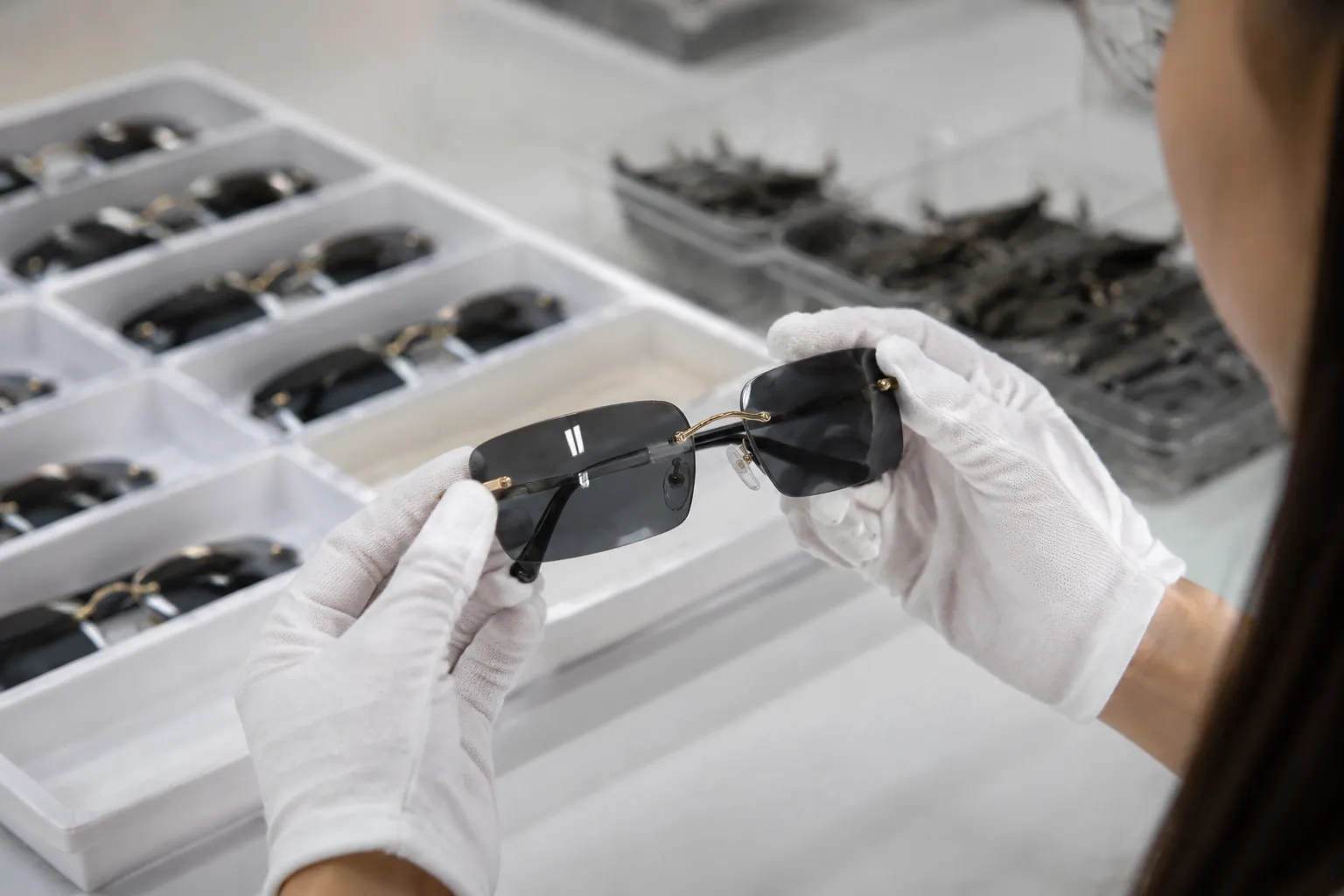
This guide is for eyewear brands, importers, retailers, and distributors buying rimless or semi-rimless sunglasses in volume. These styles look simple on a line sheet. They are not simple in production. In rimless construction, the lens carries part of the mechanical load, so small errors can become cracks, loose temples, or warped alignment. Before bulk production starts, define the lens material, hole position, screw stack, torque control, packing pressure, inspection points, and market compliance requirements.
The Failure Modes Buyers See First
Rimless and semi-rimless sunglasses fail in predictable ways. Most problems do not come from one bad screw or one careless worker. They come from stacked tolerances: lens material, hole position, drilling method, screw torque, bridge geometry, temple tension, and packing pressure.
The common failures are easy to spot if buyers know where to look:
- Cracks starting at the drill hole: usually linked to rough hole edges, excessive screw pressure, poor hole alignment, or too little distance between the hole and lens edge.
- Loose temples after repeated opening: often caused by weak thread engagement, poorly matched screws and bushings, soft insert material, or inconsistent tightening.
- Lens chipping during assembly: tied to dull bits, uncontrolled feed speed, overheating, poor deburring, or forcing hardware through a tight hole.
- Frame twist: common in some semi-rimless metal styles when brow-bar alignment, groove position, nylon wire tension, or bridge angle is not controlled.
- Comfort complaints: the product may pass a visual check but still pinch, rock, or sit unevenly because bridge and temple loads pass through the lens and small fixing points.
A full-rim frame can hide small tolerance issues. The frame surrounds and supports the lens. Rimless designs cannot hide as much. A small hole-position error may still allow assembly, but it can leave residual stress in the lens. That stress may show up later during shipping, retail handling, or early consumer use.
Treat rimless sunglasses as a controlled mechanical product, not only as a fashion item. During sample review, check for warning signs: a screw head sitting proud, a temple that opens unevenly, a lens that rocks in the assembly, or whitening around a drilled hole under angled light. Small signs matter.
Material Choice: Polycarbonate, TAC, Nylon, or CR-39
The lens material sets the design limit. Do not choose only by clarity, tint, polarization, or cost. Ask how the material behaves during drilling, under localized screw pressure, and after repeated opening and closing of the temples.
| Lens material | Rimless suitability | Main advantage | Main risk | Buyer note |
|---|---|---|---|---|
| Polycarbonate | Good for many commercial rimless styles | Light weight and strong impact performance | Can show stress whitening, edge cracking, or local deformation if drilled or tightened poorly | Often a practical starting point when hole finishing and screw pressure are controlled |
| TAC polarized | Limited for true drilled rimless | Cost-effective polarized option with thin construction | Layer separation, edge damage, and tear-out risk near fasteners | Usually safer in full-rim or conservative semi-rimless designs than in delicate drilled rimless styles |
| Nylon | Good for higher-durability lightweight styles | Tough, flexible, and resilient under movement | Higher material cost and tighter processing requirements | Useful for premium, sport, or active-lifestyle designs where flexibility matters |
| CR-39 | Moderate, design-dependent | Good optical clarity and stable tint appearance | More brittle than polycarbonate or nylon | Use conservative hole spacing, adequate thickness, and controlled hardware pressure |
For drilled rimless sunglasses, the fixing area must have enough lens thickness and edge distance to carry the hardware load. Exact limits depend on lens material, base curve, hole diameter, screw system, bridge geometry, and end use. Do not leave these limits to an operator at the bench. Ask the factory to state the minimum lens thickness at the fixing zone and the minimum distance from the hole edge or hole center to the lens edge.
Polycarbonate is often practical for commercial orders because it balances weight, impact performance, cost, and production efficiency. TAC polarized lenses can help on price, but they are risky when the design requires drilling close to the edge or high point pressure. Nylon can improve durability in active-use styles, but it needs tighter process control. CR-39 can work in selected designs, but the drilling and hardware layout must be conservative.
If tinting, drilling, edging, and final assembly are handled by different workshops, late-stage mismatch becomes more likely. Ask who performs each process, where inspection takes place, and who owns corrective action if drilled lenses do not assemble cleanly.
Drilling Is Not Just Making Holes
For rimless sunglasses, drilling is a controlled machining process. A weak supplier treats it as a simple task. A stronger supplier treats every hole as a stress point with defined tolerance, edge finish, and inspection.
A controlled process should include these steps: confirm lens shape, thickness, base curve, and drilling drawing; prepare left and right drilling jigs to reduce position drift; use a bit type and diameter matched to the lens material; control feed speed to limit heat; deburr both sides of the hole; check diameter, edge distance, and alignment before hardware assembly; and inspect for stress marks under strong angled light.
Request a drilling drawing for every true rimless project. The drawing should show hole diameter, hole center position, lens thickness at the drill zone, bridge fixing points, temple fixing points, hardware stack order, and required hole-edge finish. Without that drawing, bulk QC becomes guesswork.
Do not approve drilling only by looking at assembled samples. Screws, washers, sleeves, and decorative plates can hide rough hole edges or minor chipping. During sample approval or first-article production, ask to inspect a small number of drilled lenses before assembly.
Heat control matters. Overheated drilling can create micro-cracks or stress whitening that may not fail right away. The problem can appear later when screws are tightened, when temples are opened repeatedly, or when the product faces heat and pressure in transit. Add an oblique-light stress check around drilled points during first-article approval. Make it written. Make it repeatable.
Screws, Bushings, and Torque Control
The screw system is a major risk point in rimless sunglasses. The design may look clean, but a weak screw stack can cause cracking, wobble, or loosening after limited handling.
Common assembly choices include direct screws through the lens, screws with plastic bushings, sleeved screw systems, metal load-spreading plates, and semi-rimless groove systems with nylon wire. The right choice depends on target price, lens material, durability target, and available space around the fixing point.
| Assembly option | Best use | Cost effect | Risk if poorly controlled |
|---|---|---|---|
| Direct screw through lens | Low-cost fashion rimless designs with conservative geometry | Lowest | Point stress, cracking, loosening, or lens deformation |
| Screw with plastic bushing | Many commercial rimless sunglasses | Small increase | Bushing deformation, poor fit, or uneven compression if material and size are wrong |
| Sleeved screw system | Higher-durability lightweight styles | Moderate increase | Incorrect sleeve length can still compress the lens or leave the assembly loose |
| Semi-rimless groove with nylon wire | Metal or plastic upper-frame designs | Moderate | Lens pop-out, rattling, or edge stress if groove depth and wire tension are inconsistent |
Torque control should be defined, not guessed. The correct tightening force depends on screw size, thread form, bushing material, sleeve length, lens material, and the number of parts in the stack. Ask the factory to define the tightening method, inspection method, and acceptance criteria for loose or over-compressed assemblies.
A controlled screwdriver or documented hand-tightening standard is safer than relying only on operator feel. Thread-locking treatment may reduce loosening, but it will not fix poor hole alignment, wrong sleeve length, weak thread engagement, or incompatible materials. If the screw stack is wrong, adhesive only delays the failure.
Decoration must not interfere with the mechanical assembly. Laser marking on metal parts is usually lower risk than bulky adhesive logos near drilled points. Pad printing, UV printing, epoxy domes, hot stamping, and enamel details should sit where they do not add pressure, restrict flex, or block screw seating.
Semi-Rimless Styles Have Different Risks
Semi-rimless sunglasses are often less fragile than true rimless styles because part of the lens is supported by a frame. Still, they bring their own failure modes. The lens may be held by an upper rim, a groove, nylon wire, side clamps, small screws, or a mix of these features.
The main QC points are groove depth, groove consistency, wire tension, lens seating, and bridge symmetry. If the groove is too shallow, the lens can pop out during flexing. If it is too deep, the lens edge may weaken or look uneven. If wire tension is too high, the lens is pre-stressed. If it is too low, the lens may rattle or shift.
For semi-rimless metal frames, alignment can change during soldering, polishing, plating, and assembly. A small distortion becomes obvious on the face: one lens sits higher, one temple opens wider, or the frame rocks on a flat table. A simple in-line check helps. Place the frame on a level surface and compare left-right lift, temple spread, lens angle, and bridge contact before final packing.
For acetate or mixed-material semi-rimless designs, CNC accuracy and groove control are critical. Request measurable groove requirements in the drawing. Do not approve only a visual sample. If groove width or depth drifts across production, lens fit can drift even when the outer frame shape looks acceptable.
During sample review, do more than shake the product once. Open and close the temples repeatedly. Press lightly at the lens edge. Check whether the lens shifts in the groove. Inspect the edge for chips or whitening after handling.
QC Checkpoints to Put in the Purchase Order
Final inspection is not enough for rimless and semi-rimless sunglasses. Build QC into production stages and write it into the purchase order, tech pack, or inspection checklist. The supplier should know what must be checked, when it must be checked, and what happens if the result is outside the agreed limit.
- Incoming lens inspection: check lens material, thickness at the fixing zone, tint consistency, polarization if applicable, surface scratches, base curve, and edge quality.
- First-article drilling or grooving approval: approve the first finished left and right lenses before the full batch is processed.
- Hole diameter and position check: use gauges, templates, or measuring tools instead of visual judgment only.
- Edge and hole finish check: inspect for chips, burrs, white stress marks, rough drilled surfaces, and layer damage on laminated lenses.
- Hardware stack check: confirm screw, washer, sleeve, bushing, and decorative plate order matches the approved sample and drawing.
- Assembly tightness check: confirm screws are secure without visible lens compression, whitening, or deformation around fixing points.
- Open-close cycle check: test hinge movement and screw loosening on assembled units during pilot or in-line inspection.
- Flatness and symmetry check: place frames on a flat surface and compare temple spread, lens angle, bridge balance, and left-right alignment.
- Packing pressure check: confirm the pouch, case, tray, or carton does not press against screw heads, bridge arms, or exposed lens fixing points.
For higher-risk designs, request a small pilot run before full bulk production. A pilot run is not a sales sample. It should use production tooling, production workers, real packaging, and the planned inspection method. This is where repeatability problems surface.
Packaging needs its own review. Rimless sunglasses should not be packed in a way that creates hard pressure on the lens fixing points. A molded tray, suitable pouch, protective case, or carton insert can reduce movement and pressure during transport. If the case presses on a screw head or bridge arm, the product may leave the factory looking fine and arrive cracked or distorted.
MOQ, Lead Time, Decoration, and Cost
Rimless sunglasses can look minimal, but they are not automatically cheaper to produce. They may use less frame material than full-rim designs. They also require controlled drilling, more small hardware, careful assembly, extra inspection, and sometimes higher setup scrap during sampling.
MOQ and price depend on the supplier, tooling status, lens material, hardware availability, decoration method, packaging, and compliance requirements. A low MOQ can help with market testing, retailer trials, influencer drops, or colorway validation. The tradeoff is clear: unit cost is usually higher because setup, sampling, decoration, and QC time are spread across fewer pairs.
| Order size | Typical buyer use | Price behavior | Production note |
|---|---|---|---|
| 50 pairs/design | Test order, sample selling run, or small retailer trial | Highest unit cost | Useful for validating fit, styling, packaging, and market response before scaling |
| 300 pairs/design | Small brand launch or limited colorway | Improved pricing versus very small runs | Enough quantity to reveal repeatability issues in drilling, grooving, and assembly |
| 1000 pairs/design | Importer, distributor, or online retail order | Better pricing if specs are stable | Worth defining in-line QC, carton specs, and a retained golden sample |
| 5000+ pairs/design | Volume retail or seasonal program | Most favorable pricing on suitable specifications | Requires locked drawings, approved materials, confirmed packaging, and documented inspection points |
Confirm sample and bulk lead times project by project. Break the schedule into design confirmation, material sourcing, sample making, decoration approval, testing or document review, bulk production, final inspection, and packing. New hardware, custom logo plates, special plating, custom packaging, or repeated drilling adjustments can push the timeline.
Decoration can change cost and yield. Pad printing, laser engraving, UV printing, hot stamping, soft enamel, epoxy domes, and PVD-coated accents each have different setup requirements and failure risks. Approve decoration on the same material, color, surface finish, and part geometry that will be used in bulk.
Freeze the approved sample before production begins. Keep one signed golden sample with the buyer and one with the factory. Record every approved deviation in writing. This protects both sides when the order scales or when an inspector compares bulk goods against the approved reference.
Compliance and Export Documentation
Rimless construction does not reduce compliance responsibility. Buyers still need correct product documentation for the destination market, including UV protection, lens category, labeling, material restrictions, and applicable test standards.
Common documents and standards requested for sunglasses include CE EN ISO 12312-1 for many European-market sunglasses, ANSI Z80.3 for the United States, AS/NZS 1067 for Australia and New Zealand, REACH for restricted substances in the EU, FDA registration where applicable for U.S. distribution, ISO 9001 for quality management systems, and BSCI for social compliance audits. Requirements vary by product and market. Confirm current obligations with your compliance team or test lab.
Ask for actual documents, not verbal promises. Check the product name, model number, lens material, lens color, lens category, factory name, test date, test standard, and report holder. If the lens color, material, polarization structure, coating, or supplier changes, confirm whether the existing report still covers the updated product.
Documentation should match the purchase order and the shipped goods. If the approved sample uses one lens category and bulk production uses another tint, labeling and test coverage may need review. If a frame decoration introduces new paint, plating, adhesive, or coated metal parts, restricted-substance compliance may also need confirmation.
Use a simple buyer checklist: define the destination market, name the required standards in the purchase order, request valid documents before shipment, keep copies with the shipment file, and retain the approved sample for comparison if a customer, customs authority, or retailer asks for verification.
Have a custom sunglasses project in mind?
Send us your styles, target market and quantities and we will return a detailed quote with MOQ, lead time and a sample plan.
Get a QuoteWhy source this from Wenzhou with LumiShades
Wenzhou in Zhejiang Province is widely regarded as China’s eyewear manufacturing capital, producing a large share of the world’s sunglasses. That concentration matters to buyers: a deep local supply chain for acetate sheet, hinges, lens blanks, plating and packaging means shorter component lead times, easier color and material matching, and a workforce with decades of eyewear-specific skill. LumiShades has manufactured in this ecosystem since 2009, and our vertical integration — in-house injection molding, acetate cutting, CNC milling, lens tinting, decoration and quality control — means no part of your order is quietly subcontracted to a workshop you cannot audit.
For international buyers, that vertical control translates into accountability. When a single factory owns every step, defects are traced and fixed at source rather than bounced between vendors, and your specifications survive intact from first sample to bulk. For procurement review, buyers can request process records, approved samples, quality checkpoints and project-specific compliance files before placing a bulk order. Required testing and documentation are confirmed against the destination market and product specification rather than assumed from a generic certificate list. Explore our manufacturing capabilities and quality control process to see how this works in practice.
Frequently asked questions
What lens material is safest for rimless sunglasses? Polycarbonate and nylon are generally safer choices for drilled rimless sunglasses because they handle impact and localized stress better than more brittle materials. TAC polarized lenses can work in some semi-rimless or full-rim designs, but they are higher risk for true drilled rimless construction because laminated structures can be damaged around holes. CR-39 can work only when the design is conservative: adequate lens thickness, generous hole spacing, smooth hole finishing, and controlled screw pressure.
What tolerances should I ask for on drilled rimless lenses? Do not rely on a generic tolerance. Ask the supplier to define hole diameter, hole center position, left-right symmetry, lens thickness at each fixing point, and minimum distance from the hole to the lens edge. These values should appear on the drilling drawing and be checked with gauges, templates, or measuring tools during first-article approval. If the factory cannot measure the holes before assembly, it cannot reliably control breakage risk.
Should I approve a rimless sample after checking only appearance? No. Appearance approval is not enough. Check hole position, hole-edge finish, screw seating, bushing or sleeve fit, hinge movement, bridge alignment, temple spread, and any whitening or stress marks around drilled points under angled light. Ask to review drilled lenses before assembly when possible. Keep a signed golden sample and require first-article approval before the full batch is drilled or assembled.
Can rimless sunglasses be produced at 50 pairs per design? Some suppliers can support 50 pairs per design, especially for test orders or market validation. At that level, unit cost is usually higher because setup, sampling, decoration, hardware preparation, and QC time are spread across fewer pieces. For a 50-pair order, keep the design conservative, avoid unnecessary custom hardware, confirm packaging pressure, and use the order to validate fit, styling, and breakage risk before scaling.
How long should I allow for custom rimless sunglasses? Lead time depends on design complexity, material availability, hardware, decoration, testing, and packaging. Ask the supplier to separate sample lead time from bulk lead time and to identify likely delays. New screws, custom bridge plates, PVD parts, special plating, custom cases, or repeated drilling corrections can add time. Do not start bulk production until the lens material, drilling drawing, hardware stack, decoration, packaging, and golden sample are approved.
What should I put in the tech pack for a semi-rimless style? Include lens material, lens thickness, base curve, lens category, groove position, groove depth target, groove width target, screw or nylon-wire system, bridge width, temple length, hinge type, decoration method, packaging, destination market, required compliance documents, and inspection checkpoints. Add drawings for lens shape, groove details, and hardware placement. The goal is to make lens fit measurable instead of leaving it to visual judgment.
What documents should I request for export compliance? Request documents that match the destination market and the actual product being shipped. Common sunglasses documents include CE EN ISO 12312-1, ANSI Z80.3, AS/NZS 1067, REACH documentation, FDA registration where applicable, ISO 9001, and BSCI. Check that reports or certificates match the model, lens material, lens color or category, factory, and test standard. If you change lens material, tint, coating, polarization, plating, paint, or adhesive, confirm whether the existing documentation still applies.
Ready to start?
Explore our round sunglasses or request a quote — our sales team replies within 12 hours.
Request a Quote