
OEM Rubber Nose Pads & Temple Grips for Sport Sunglasses
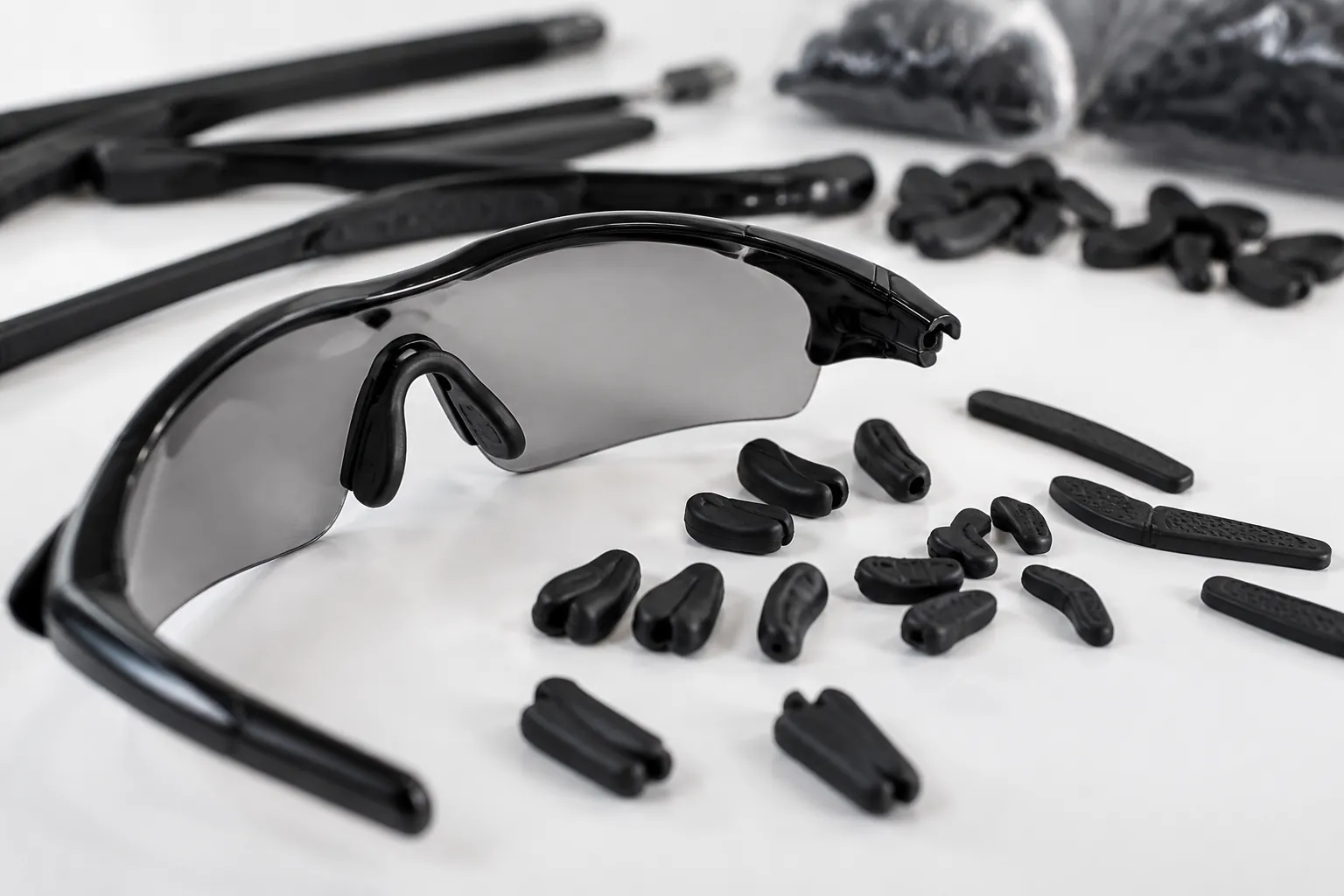
This guide is for brands, importers, distributors, and retailers specifying active-use sunglasses for cycling, running, fishing, golf, tennis, hiking, workwear, and outdoor retail programs. Rubber nose pads and temple grips are small parts. They affect fit stability, perceived quality, inspection time, and after-sales complaints. Use this guide to decide when soft-touch grip parts are worth adding, which materials to specify, what tolerances and tests to control, and what to write into an OEM specification before sampling starts.
Use grip parts only where they solve a fit problem
Rubberized nose pads and temple grips are functional parts. Not decoration. They can improve stability and comfort, but they also add material cost, mold detail, assembly steps, color-matching work, inspection points, and sometimes extra chemical or durability checks.
On a fashion frame sold mainly for casual wear, they may be unnecessary. On a sports frame, they can decide whether the sunglasses stay stable during sweat, vibration, and repeated head movement.
Use soft-touch components when the sunglasses will be marketed for running, cycling, fishing, golf, hiking, tennis, gym training, children's active use, or outdoor work. These uses involve sweat, sunscreen, helmets, caps, quick head movement, and frequent one-hand handling. A hard plastic bridge may feel fine in a showroom. It may slip after 30 minutes outdoors.
Do not add rubber to every SKU by default. A full-length temple sleeve can increase assembly labor and slow final inspection if alignment, sleeve gaps, or flash must be checked pair by pair. First define the problem: nose slip, temple bounce, ear pressure, low-bridge fit, helmet contact, or wet handling.
Discuss grip parts during the first drawing review. Do it before injection mold steel, CNC acetate fixtures, or logo tooling is confirmed. Changing grip geometry after sample approval can require mold insert changes, revised electrodes, re-cut temple pockets, or new pad tooling. Even a small change to nose-pad projection can affect the seating surface, lens-to-eye distance, and overall fit.
Choose the material: TPR, silicone, TPU, or soft PVC
Many buyers write "rubber" on a tech pack. That is not enough. The factory needs the material family because each option behaves differently in molding, bonding, color matching, odor control, chemical resistance, and storage.
| Material | Typical use | Practical hardness range | Strengths | Buyer cautions |
|---|---|---|---|---|
| TPR | Inserted temple grips, co-molded grip zones, fixed nose pads | 45-75 Shore A | Good friction, cost-effective, easy to color, suitable for many mid-volume sports frames | Check odor, surface oiliness, and color migration on white, crystal, and light tortoise frames |
| Silicone | Premium nose pads, replaceable pads, soft skin-contact parts | 30-60 Shore A | Soft skin feel, good temperature stability, strong comfort perception | Higher tooling and molding cost; very soft grades can fold, deform, or feel unstable on wrap frames |
| TPU | Thin temple sleeves, durable grip inserts, transparent or translucent parts | 60-85 Shore A | Good abrasion resistance, stronger surface, useful where temples rub helmets, caps, or cases | Usually more expensive than basic TPR; translucent color matching needs physical sample approval |
| Soft PVC | Low-cost sleeves, decorative soft zones on budget frames | 50-80 Shore A | Low material cost, simple processing | Use cautiously for strict chemical-compliance programs; plasticizer, odor, and REACH review are important |
For many sports sunglasses, TPR is the practical starting point. It balances grip, moldability, color options, and cost. Silicone works well for replaceable nose pads or premium comfort lines where skin feel matters more than the lowest unit price. TPU is useful where the grip is thin, exposed to abrasion, or needs a cleaner translucent look.
Always specify Shore A hardness. A common target range is 50-70 Shore A for temple grips and 40-60 Shore A for nose pads. The right value still depends on pad area, frame weight, bridge angle, and intended activity.
Softer is not always better. A very soft nose pad may feel good at first touch, then deform under pressure, collect skin oil, and reduce stability. For performance wrap frames, a medium-soft pad often supports better than an extremely soft one.
Control grip geometry before you chase softness
Material alone does not create comfort. Geometry often matters more. A firmer pad with the right angle and contact area can feel better than a soft pad placed too high, too narrow, or too steep.
For nose pads, specify pad width, height, thickness, projection from the frame, contact angle, left-right spacing, and attachment method. Sports pad dimensions vary by bridge design, but projection and angle should be treated as fit-critical dimensions.
Adding projection can improve low-bridge fit. Too much projection can lift the frame away from the face, increase light leakage, change lens-to-eye distance, and alter the intended silhouette.
For low-bridge or Asian-fit versions, the pad normally needs more projection and a flatter contact angle. For high-bridge markets, excessive projection can make sunglasses sit too high or concentrate pressure. If one frame will be sold globally, consider two pad options instead of forcing one compromise geometry.
For temple grips, define grip length from the temple tip, wall thickness, surface texture, edge radius, and whether the grip covers the bend area behind the ear. A raised grip that ends with a sharp step can irritate the ear during extended wear. Use a tapered transition or a small edge radius to reduce pressure points.
- Nose pad symmetry: control left-right pad height, angle, and projection closely; for fit-critical pads, use a written tolerance and a measurement method.
- Temple sleeve seating: require tight mechanical seating; visible sleeve movement after bending or hand pulling should trigger sample review.
- Texture depth: fine textures are usually easier to clean; deep ribs can trap sweat, sunscreen, dust, and lint.
- Contact area: increase pad area or adjust angle before simply reducing hardness if pressure marks appear.
- Lens clearance: recheck cheek contact, eyelash clearance, fogging tendency, and side coverage after any pad change.
For wrap sunglasses, review base curve, bridge width, temple pressure, pad projection, and lens clearance together. A pad can improve nose comfort and still cause complaints if it pushes the lenses too far forward, reduces ventilation, or changes the intended fit.
Pick the right construction method
Soft grip parts can be inserted, overmolded, glued, screwed, or pushed in. The right choice depends on order volume, durability target, frame material, replacement needs, and tooling budget.
Inserted parts are molded separately and pressed into a pocket, groove, or channel. This is common for temple grips and some nose pads. Inserted parts allow contrast colors and easier replacement during assembly if a part fails QC. The pocket should include a mechanical lock, such as an undercut, dovetail, rib, pin, or end stop. A plain smooth channel is risky. Heat, bending, and repeated handling can let the grip creep or slide.
Overmolding applies the soft material directly onto a rigid frame component, often by second-shot injection or by placing the rigid part into a separate overmold tool. Bonding can be strong and the appearance can look premium, but tooling cost, material compatibility, and process control are more demanding. This route is usually best for repeat programs where the design will stay in the line long enough to justify tooling.
Glued pads are cheaper to start but should be used carefully for active-use sunglasses. Sweat, sunscreen, heat, and temple flexing can weaken some adhesive systems. If adhesive is used, specify adhesive type, surface preparation, minimum curing time, and a pull test after heat or humidity exposure. Do not approve glue-only temple sleeves for high-sweat use unless test results support the construction.
Screwed or push-in nose pads work well when buyers want replaceable parts, fit kits, or after-sales service. They add screws, metal pad arms, inserts, or receiving holes. QC must check screw tightness, thread damage, pad alignment, missing hardware, and sharp edges. For children's or sports use, screw loosening should be part of the inspection plan.
The frame process also matters. Injection frames can be designed with molded grip pockets and overmold planning from the start. Acetate frames usually need CNC-cut seats, pressed inserts, glued pads, or separate metal pad-arm assemblies. Metal frames require attention to pad-arm geometry, screw retention, and corrosion resistance around skin-contact areas.
Keep decoration simple on soft parts
Soft grip parts can carry branding, but they are not always the best place for fine logos. TPR and silicone stretch, shrink, and release from molds differently from rigid PC, TR90, nylon, metal, or acetate. A small raised logo that looks crisp in artwork may become rounded, shallow, or affected by flash in production.
Safer branding choices include larger debossed marks, simple raised icons, or a repeated texture pattern. Avoid deep debossing where dirt and sunscreen can collect. If the logo must stay sharp, place it on the rigid temple, lens corner, metal logo plate, hangtag, case, or packaging instead.
Common decoration routes include pad printing on rigid frames, laser engraving on suitable coated surfaces, hot stamping or metal plates for premium temples, and molded logos on rubber grips. Pad printing over flexible TPR or TPU may work, but adhesion and abrasion must be tested. A logo on the outside of a temple grip may rub against helmets, hair, caps, and storage bags. Test it before approving production.
Color matching also needs restraint. The same Pantone target can look different on matte TPR, glossy plastic, translucent TPU, painted metal, and acetate. For approval, request physical color chips or a pre-production sample under controlled lighting, such as D65 daylight and typical retail lighting.
Black is usually easier to approve than neon colors, translucent smoke, safety orange, and light grey. For white or light frames, test dark grip parts for migration after heat and humidity exposure.
Understand cost, MOQ, and lead-time drivers
Soft grip parts add cost through material, mold cavities, secondary assembly, color matching, slower QC, scrap risk, and packaging protection. The increase may be modest at scale. On low-MOQ orders or designs that need new tooling, it can be significant.
For small market tests, avoid unnecessary custom tooling unless the design is strategically important or likely to repeat. Standard pad shapes, existing temple sleeves, and simple inserted parts usually reduce risk. Fully custom rubber tooling, dedicated overmold tools, and complex multi-material constructions make more sense when the SKU has confirmed demand and a stable design.
| Order situation | Practical grip approach | Cost logic | Timing considerations |
|---|---|---|---|
| Low-MOQ market test | Existing nose pad or temple grip shape; limited custom color if material is available | Lowest tooling risk but higher unit cost due to setup, sourcing, and labor | Confirm whether standard parts fit the frame before quoting bulk timing |
| First retail run | Standard geometry with custom color, inserted grip parts, simple texture | Moderate add-on cost for molding, assembly, and QC | Allow time for color chip approval and pre-production sample review |
| Seasonal program | Custom pocket design, specified Shore hardness, controlled texture and locking ribs | Better unit cost if quantities justify engineering and sampling | Approve a pre-production sample before bulk molding or frame cutting |
| Repeat OEM line | Dedicated tooling, optimized inserts, or overmolded construction | Tooling can be justified if the design is stable and repeat orders are likely | First order depends on tooling and validation; repeat orders are typically more predictable once approved |
When comparing quotations, ask the supplier to separate tooling, component cost, assembly labor, packaging changes, and testing. A cheaper quote may omit migration testing, pull tests, replacement spares, or pre-production color approval. A more expensive construction may be worth it if it reduces grip movement, customer complaints, or rework during final inspection.
Write measurable OEM specifications
A serious OEM spec sheet prevents vague sampling. Do not write only "black rubber grips." That gives the factory no measurable target and creates room for disputes after sampling. Define the function, dimensions, material, appearance, and test method.
- Material: TPR, silicone, TPU, soft PVC, or approved equivalent; state whether substitution requires buyer approval.
- Hardness: target Shore A range, such as 55 ±5 Shore A for temple grips or 50 ±5 Shore A for nose pads, if suitable for the design.
- Color: Pantone, physical chip, or approved master sample; note that soft materials may not match rigid frame plastic exactly.
- Dimensions: nose pad width, height, projection, contact angle, temple grip length, thickness, edge radius, and any fit-critical tolerances.
- Attachment: inserted, overmolded, glued, screwed, or push-in; include locking rib, undercut, adhesive, screw, or retention requirements.
- Surface: matte, smooth, pebbled, ribbed, debossed logo, raised logo, or no logo.
- Tests: pull test, twist test, sweat resistance, sunscreen rub, heat aging, flexing, color migration, and visual flash limits.
- Compliance: CE EN ISO 12312-1, ANSI Z80.3, AS/NZS 1067, FDA registration where relevant, REACH, ISO 9001, and BSCI if required by the buyer or market.
Lens compliance still matters. A frame with excellent grip and poor lens category labeling is not ready for shipment. For EU sunglasses, CE EN ISO 12312-1 is the key standard. For the U.S., ANSI Z80.3 is commonly requested, and FDA registration may be relevant for eyewear import handling. Australia and New Zealand buyers should check AS/NZS 1067.
Chemical control should include REACH review for applicable markets, especially when soft PVC, dark pigments, or skin-contact parts are used.
ISO 9001 and BSCI are not product-performance certifications. ISO 9001 relates to quality management systems. BSCI relates to social-compliance auditing. If a retailer requires them, ask for valid certificates or audit documents and confirm the factory name, scope, and expiry date.
Review samples like the product will be used
The sample stage is where grip problems are cheapest to fix. Do not approve rubber nose pads or temple grips from photos only. A grip part must be reviewed for fit, retention, surface finish, odor, color, and compatibility with the frame material.
Start with fit. Put the sample on several face shapes if possible. Check whether the pads sit flat or touch only at one edge. Shake the head, bend forward, wear the frame with a cap or helmet, and test it with damp skin if the product is for sport, fishing, or outdoor work. For wrap frames, check lens fogging, cheek contact, eyelash clearance, and side coverage.
Then test the parts. Pull temple grips by hand and look for sliding, lifting, or end gaps. Rub the surface with a damp cloth, then with a small amount of sunscreen or skin oil. Leave one sample in a warm environment and check odor, tackiness, color transfer, pad deformation, and sleeve movement. These checks do not replace laboratory testing, but they can catch obvious failures before bulk approval.
Common failures are predictable. Temple grips slide when the channel lacks locking ribs, the sleeve tolerance is loose, the material is too soft, or the adhesive system is unsuitable. Nose pad pressure marks usually come from narrow pads, wrong angle, excessive hardness, or poor left-right symmetry. Sticky surfaces after storage may indicate compound selection, plasticizer behavior, coating interaction, or packaging compatibility. Color bleeding appears fastest when black, red, or blue grips contact white, clear, or light tortoise frames under heat and humidity.
Practical approval rule: approve the sample only after at least one realistic active-use wear session, not after a five-minute desk check.
For bulk QC, define inspection points clearly: grip color, left-right pad position, bond strength or insertion tightness, visible flash, dirt inside texture, sleeve end gaps, screw tightness, pad symmetry, and packaging contact marks. A small rubber flash line may look minor in a factory lightbox. On a retail shelf, it can make the product look cheap.
Have a custom sunglasses project in mind?
Send us your styles, target market and quantities and we will return a detailed quote with MOQ, lead time and a sample plan.
Get a QuoteWhy source this from Wenzhou with LumiShades
Wenzhou in Zhejiang Province is widely regarded as China’s eyewear manufacturing capital, producing a large share of the world’s sunglasses. That concentration matters to buyers: a deep local supply chain for acetate sheet, hinges, lens blanks, plating and packaging means shorter component lead times, easier color and material matching, and a workforce with decades of eyewear-specific skill. LumiShades has manufactured in this ecosystem since 2009, and our vertical integration — in-house injection molding, acetate cutting, CNC milling, lens tinting, decoration and quality control — means no part of your order is quietly subcontracted to a workshop you cannot audit.
For international buyers, that vertical control translates into accountability. When a single factory owns every step, defects are traced and fixed at source rather than bounced between vendors, and your specifications survive intact from first sample to bulk. For procurement review, buyers can request process records, approved samples, quality checkpoints and project-specific compliance files before placing a bulk order. Required testing and documentation are confirmed against the destination market and product specification rather than assumed from a generic certificate list. Explore our manufacturing capabilities and quality control process to see how this works in practice.
Frequently asked questions
Should I choose silicone or TPR for sports sunglass nose pads? Choose TPR when you need a cost-effective grip part with good friction, color options, and straightforward molding. Choose silicone when the line is positioned around comfort, replaceable pads, or a softer skin-contact feel. In either case, specify Shore A hardness, pad geometry, attachment method, and color-migration testing. Do not approve only by touch; review fit after sweat or damp-skin use.
Can rubberized grips be added at only 50 pairs per design? Yes, if the supplier has standard grip parts or existing pad tooling that fits the frame. For very low quantities, avoid fully custom overmolding unless you are willing to pay tooling cost for a test order. Ask the supplier to quote two options: standard inserted grips for the first run and custom tooling for repeat orders.
What tolerances should I control for rubber nose pads and temple grips? Control the dimensions that affect fit and retention: nose pad projection, left-right pad height, contact angle, pad spacing, temple grip length, sleeve wall thickness, end gaps, and seating tightness. The exact tolerance should be agreed with the factory based on the construction and measurement method. Treat visible sleeve movement, uneven pad height, sharp grip edges, or inconsistent projection as sample-revision points.
Do grip parts affect compliance testing? They can affect chemical compliance, skin-contact safety, color migration, and durability, but they do not replace sunglass lens compliance. For the relevant market, confirm CE EN ISO 12312-1, ANSI Z80.3, AS/NZS 1067, FDA registration where relevant, and REACH requirements. If the supplier claims ISO 9001 or BSCI, ask for current documents and check the factory name, scope, and expiry date.
What lead time should I expect for samples and bulk production? Lead time depends on whether the design uses existing parts, custom colors, new tooling, or overmolding. Existing pads or sleeves can usually be sampled faster than new molded parts. Before placing an order, ask the supplier to confirm separate timelines for color chips, tooling, first sample, pre-production sample, bulk production, lab testing if required, and final inspection.
How do I prevent temple grips from loosening after use? Specify mechanical retention, not just a smooth sleeve. Use an undercut, locking rib, dovetail, pin, end stop, or other positive seating feature. Control sleeve tolerance and material hardness, then verify with pull, twist, flex, heat, sweat, and sunscreen exposure checks. For high-sweat sports frames, do not rely on glue alone unless the adhesive system passes the agreed tests.
Ready to start?
Explore our sport wrap sunglasses or request a quote — our sales team replies within 12 hours.
Request a Quote