
Polarized vs. Non-Polarized Sunglass Lenses
If you buy sunglasses for retail, wholesale, or private label, polarized and non-polarized are not interchangeable choices. The lens type changes landed cost, perceived value, sell-through, display behavior, and the channel where the SKU actually moves. This guide breaks down where each lens type sells better, how buyers should spec them, and what that means for MOQ, lead time, QC, and compliance. The goal is simple: choose the right lens for the right customer and stop paying for features that do not convert.
The split buyers actually care about
Polarized lenses reduce glare from reflective surfaces such as water, roads, glass, and snow. Non-polarized lenses reduce brightness and UV exposure, but they do not cancel glare in the same way. That is the practical difference. Nothing more.
Commercially, the choice is about fit. Polarized sells a functional story. Non-polarized sells a style story. If the channel pays for a problem-solver, use polarized. If the channel buys on shape, color, and price, keep it simple.
For sourcing teams, "better" is the wrong question. A fishing retailer, a driving accessories brand, and a fashion chain each have different price ceilings. At $8 to $15 retail, the extra polarization cost may not return anything. At $28 to $60 retail in a use-case-driven channel, it is easier to charge for.
Production is different too. Polarized lenses usually add a polarizing film layer or a polarization process to the lens stack. That raises material cost and increases the risk of orientation mistakes during assembly. Non-polarized lenses are simpler. Faster to scale. Easier to keep consistent across a large seasonal run.
In most OEM programs, both lens types can be built in TAC, PC, or nylon-based setups. TAC is common for polarized fashion and mid-range performance styles because it balances clarity, weight, and cost. PC is often used for impact resistance in sport and youth programs. Nylon tends to show up in performance frames that need flexibility and a more technical feel. The frame design, target price, and compliance market should decide the stack, not just the lens label.
Where polarized sells better
Polarized lenses sell best when the benefit is obvious in one second. If the buyer can see glare reduction immediately, the SKU has a chance to earn its price increase. If the benefit needs a long explanation, sell-through usually slows.
Polarized performs especially well in channels where the consumer already has a practical problem to solve:
- Outdoor sports and activity retail: fishing, boating, skiing, golf, cycling, and hiking all support a clear anti-glare story.
- Driving and travel assortments: road glare is easy to understand, and polarized lenses feel premium with dark tints and good packaging.
- Beach, resort, and destination shops: water reflection is visible, seasonal, and easy for staff to demo.
- Performance private label: brands can justify a technical spec and use polarization as a margin anchor.
Polarized also works online because the benefit is simple to explain. Product pages can show a before-and-after glare story. That helps conversion. More than many buyers think.
But the rest of the product has to match the promise. Tight lens tint control. Clean frame finishing. Strong hinge feel. Better color matching between samples and bulk. A polarized lens on a sloppy frame still reads cheap. A polarized lens in a well-finished frame reads technical.
Typical premiumization logic is straightforward: if the customer pays specifically for visual comfort, polarization can support a 15% to 40% higher retail price than a comparable non-polarized SKU, depending on market and frame design. The feature does not guarantee the markup. It just makes the price story easier to defend.
Where non-polarized moves faster
Non-polarized lenses win in fashion-led, volume-led, and price-led programs. They are easier to price aggressively, easier to replenish, and easier to keep visually consistent across multiple colorways. If the customer is buying sunglasses as an accessory rather than a tool, polarization is often unnecessary.
This is common in:
- Fashion retail chains: trend-driven styles with short merchandising windows.
- Promotional and seasonal programs: lower landed cost matters more than glare control.
- Youth and teen assortments: the purchase driver is usually shape, color, and frame decoration.
- Marketplace and high-turn ecommerce: the lowest acceptable price often beats feature complexity.
Non-polarized styles also simplify inventory planning. There is less material cost, fewer steps in the lens build, and fewer customer questions about LCD screen distortion in cars, phones, or dashboard displays. Some consumers actively dislike the visual effect polarized lenses can create on screens. So non-polarized can be the safer default when the use case is mixed.
For large seasonal buys, the savings are often better spent on frame decoration, case upgrades, branded wipes, or extra colorways. In many retail programs, that has more impact than a technical feature the shopper may not fully use. A frame with better acetate polish, a cleaner hinge, or more attractive plating can outperform a feature-heavy lens in style-first channels.
Use a simple rule: non-polarized works best when the selling point is "looks good and costs less." Polarized works best when the selling point is "solves a problem."
Side-by-side cost and channel fit
Here is the practical view buyers use in sourcing meetings.
| Lens type | Best-selling channels | Typical buyer priority | Cost impact | Common risk |
|---|---|---|---|---|
| Non-polarized | Fashion retail, promo, youth, high-volume ecommerce | Lowest landed cost and fast sell-through | Lower base cost; simpler assembly and fewer QC steps | Weak value story if priced too high |
| Polarized | Driving, fishing, outdoor, resort, performance | Glare reduction and functional premium | Higher lens cost, tighter assembly control, more inspection time | Retail staff must explain the benefit clearly |
| Polarized with premium frame | Mid-premium private label, specialty retail | Higher perceived value and margin | Highest total build cost across lens, frame, decoration, and packaging | Overpricing can slow reorders |
| Non-polarized with fashion detailing | Fast fashion, seasonal, accessory wall programs | Visual appeal and price accessibility | Moderate cost; budget shifts to decoration and presentation | Style fatigue if the assortment is too repetitive |
In a typical OEM quote, the lens choice explains only part of the final price. Frame material, hinge type, surface finish, lens color, and decoration method all affect landed cost. As a reference point, many buyers see MOQ starting at 50 pairs per design, with better unit pricing at 300, 1000, and 5000+ pairs. On larger runs, pricing can drop to around $2.10 per pair depending on the exact build, but polarized versions usually sit above a comparable non-polarized style because of material cost and added QC.
That price ladder matters. A buyer may pay more than expected at 50 pairs because setup and handling are spread across a tiny run. At 300 or 1000 pairs, the economics usually improve once tooling, color matching, and line setup settle down. If the channel can absorb the feature, polarization is worth it. If the channel needs a low opening price, non-polarized usually wins.
What changes in production and QC
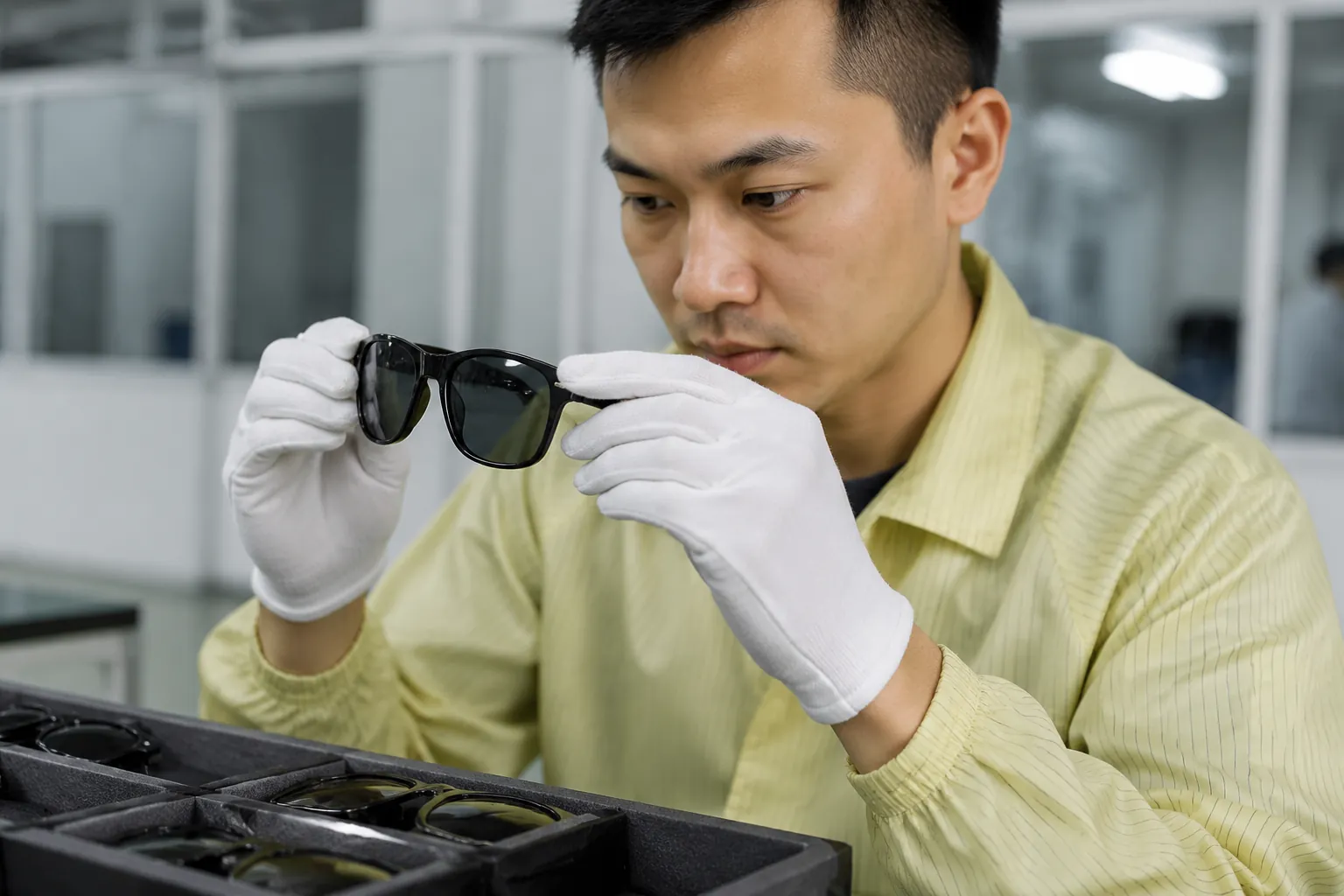
Polarized lenses are not just more expensive lenses. They need stricter handling because the polarizing film must stay correctly oriented, flat, and protected during lamination, trimming, or final insertion. If the axis is off, glare reduction drops. The customer notices fast.
Most problems are not dramatic failures. They are small tolerances stacking up. A frame groove that is too shallow. A front curve that is too aggressive. A lens blank that is slightly oversized. Each one can create stress marks, lens pop-out risk, or visible distortion.
Before bulk approval, the factory should verify the basics:
- Confirm frame geometry and lens-seat compatibility first. Front curve, temple spread, and groove tolerance should match the lens shape before the style is released.
- Lock lens color and darkness early. Category and tint density should be chosen for the market, not guessed from a sample photo.
- Check polarization alignment during insertion. Even a small angular deviation can create inconsistent performance across pairs.
- Test insertion stress on wrap frames and thicker acetate fronts. These styles are more likely to show tension lines or edge lift.
- Inspect finish quality under daylight and direct lamp light for haze, scratches, coating irregularity, and color mismatch.
LumiShades runs injection molding, acetate cutting, CNC milling, lens tinting, decoration, and QC in-house. That reduces drift between sample and bulk. It matters because many failures happen at the interface between frame and lens, not in the lens alone. A clean sample can still fail in bulk if the groove depth changes or the decoration process deforms the lens bed.
The practical rule is blunt: polarized programs need stricter sample approval than non-polarized programs. Approve the actual frame, lens, and temple combination in real light, with reflective surfaces, and with final packaging if the display story matters. A desk sample is not enough for a functional lens sell.
Materials, decoration, and finish choices
Lens type is only one part of the spec. Material behavior and decoration choices often decide whether the product feels premium or disposable. A good buyer looks at how the lens, frame, and decoration interact under heat, humidity, and retail handling.
For frames, acetate gives a more premium hand-feel and usually supports richer color depth, but it can require more care in cutting and polishing. Injection-molded frames are better for cost control and scale, especially in high-volume seasonal programs. Metal frames can look sharper and thinner, but they bring different tolerance challenges around nose pads, temple balance, and finish durability.
Decoration also affects sell-through. Common methods include hot stamping, pad printing, laser marking, UV printing, enamel fill, and plating variants. Hot stamping and pad printing work for logos and low-cost branding, but they need good surface prep and adhesion. UV printing allows more color complexity, but it can add process time and needs careful cure control. Laser marking gives a crisp premium look on metal or coated parts, while enamel fill can raise perceived value but adds labor and QC scrutiny.
Lens finishing matters too. Mirror coatings, gradient tints, smoke, brown, green, and amber all tell different stories. Mirror finishes can raise shelf appeal, but they are more sensitive to coating quality and scratch handling. Gradient lenses look more fashion-led. Dark solid tints usually support performance or driving stories. Buyers should match the finish to the channel instead of picking from a catalog by habit.
Heat and humidity matter as well. PC lenses and some coating systems can show more susceptibility to surface scratches or coating wear if packaging is poor. TAC polarized lenses often perform well for everyday sunglasses because of clarity and weight balance, but they still need careful storage and carton protection to avoid pressure marks. For bulk orders, simple protective pouches, lens films, and partitioned cartons reduce damage better than trying to fix problems later in packing.
Compliance is part of the buying decision
Compliance is not an afterthought. It shapes where the product can be sold and how the buyer writes the specification sheet. A lens type may be marketable, but if the finished sunglasses do not meet the target standard, the risk is bigger than the margin gain.
LumiShades holds certifications and registrations including CE EN ISO 12312-1, FDA registration, ANSI Z80.3, AS/NZS 1067, REACH, ISO 9001, and BSCI. Those matter because each channel asks for different evidence. The buyer should ask for the correct test package at the quoting stage, not after production starts.
- CE EN ISO 12312-1: important for EU sunglasses compliance and consumer safety expectations.
- ANSI Z80.3: relevant for U.S. optical testing expectations and retail sell-in.
- AS/NZS 1067: important for Australia and New Zealand channel requirements.
- REACH: helps control restricted substances in frames, coatings, and inks.
- FDA registration: part of the U.S. regulatory context for eyewear manufacturing and import workflows.
Polarized and non-polarized styles can both be compliant. The issue is not the lens category by itself. It is whether the finished product passes the target market requirements for transmission, labeling, materials, and construction. A buyer should specify the destination market, the required standard, and the intended use case before selecting the lens type.
One more point matters in practice: some distribution channels want the same base frame sold across multiple markets with different lens sets. In that case, build a compliance matrix early. The lens may change by region, but the frame construction, labeling, and pack-out still need to support the strictest destination.
How to choose by buyer scenario
If you buy for more than one channel, separate the logic by SKU rather than forcing one lens type across the whole assortment. That is usually where margins improve and inventory gets cleaner.
| Buyer scenario | Better choice | Why it sells | What to specify |
|---|---|---|---|
| Fishing or outdoor specialty retail | Polarized | Glare reduction is visible immediately | Polarized lens, UV protection, darker tint, secure frame fit |
| Fashion chain with low price ceiling | Non-polarized | Lower cost supports fast sell-through | Frame trend, color options, basic sun protection |
| Driving accessory brand | Polarized | Clear consumer benefit in road glare | Lens darkness, screen-visibility note, strong packaging copy |
| Seasonal promo program | Non-polarized | Better margin control at high unit volumes | Simple SKUs, fewer decoration steps, efficient carton pack-out |
| Mid-premium private label | Polarized | Feature supports margin and brand story | Better finish, tighter QC, premium pouch or case |
If you are unsure, sample both. Compare them in the actual channel environment: store lighting, outdoor light, driving conditions, or ecommerce photography. A small sample run is cheaper than committing to 5,000 pairs that do not match buying behavior.
Use polarization like a revenue feature, not a default feature. If it increases conversion or raises average selling price, keep it. If it only increases cost, cut it and put the money into frame presentation instead.
A buyer checklist before placing the order
Use this before sending the PO. It keeps the conversation factual and reduces later change orders.
- Define the channel clearly: fashion, outdoor, driving, promo, or mixed.
- Set target retail price and maximum landed cost.
- Choose polarized or non-polarized based on the actual customer use case.
- Confirm target market compliance: CE, ANSI, AS/NZS, REACH, FDA if needed.
- Lock frame material, lens color, and decoration method early.
- Approve samples in real light conditions, not just on a desk.
- Confirm lead time: LumiShades samples in 7-10 days, bulk in 25-35 days.
- Check order economics against MOQ 50 pairs per design and price steps at 300, 1000, and 5000+ units.
- Specify packaging, pouch type, and carton partitioning for lens protection.
The blunt version: if the buyer cannot explain why the lens type helps the end customer, the SKU probably needs to be simplified. Polarized is not automatically the smarter buy. Non-polarized is not just the cheap option. Each one has a lane. Put the right product in the right lane, and the order becomes easier to sell, easier to replenish, and easier to repeat.
Have a custom sunglasses project in mind?
Send us your styles, target market and quantities and we will return a detailed quote with MOQ, lead time and a sample plan.
Get a QuoteWhy source this from Wenzhou with LumiShades
Wenzhou in Zhejiang Province is widely regarded as China’s eyewear manufacturing capital, producing a large share of the world’s sunglasses. That concentration matters to buyers: a deep local supply chain for acetate sheet, hinges, lens blanks, plating and packaging means shorter component lead times, easier color and material matching, and a workforce with decades of eyewear-specific skill. LumiShades has manufactured in this ecosystem since 2009, and our vertical integration — in-house injection molding, acetate cutting, CNC milling, lens tinting, decoration and quality control — means no part of your order is quietly subcontracted to a workshop you cannot audit.
For international buyers, that vertical control translates into accountability. When a single factory owns every step, defects are traced and fixed at source rather than bounced between vendors, and your specifications survive intact from first sample to bulk. We back this with 15+ years of experience, shipments to 60+ countries, more than 5 million pairs produced per year and a 98.5% on-time delivery rate. Our certifications — CE EN ISO 12312-1, FDA registration, ANSI Z80.3, AS/NZS 1067, REACH, ISO 9001 and BSCI audit — mean the compliance documentation your market requires already exists. Explore our manufacturing capabilities and quality control process to see how this works in practice.
Frequently asked questions
Do polarized lenses always sell better than non-polarized lenses? No. Polarized sells better in use-case-driven channels like fishing, driving, and outdoor retail. Non-polarized usually sells better in fashion, promo, and low-price volume programs.
Should I pay extra for polarized lenses on every SKU? Not usually. Pay for polarization where the buyer will understand and value glare reduction. For fashion-led SKUs, the extra cost often hurts sell-through more than it helps margin.
Can both lens types meet CE, ANSI, and AS/NZS requirements? Yes, if the full finished product is built and tested to the relevant standard. Compliance depends on the complete sunglasses, not just the lens type.
What should I sample first: polarized or non-polarized? Sample both if the channel is unclear. Compare them in real use conditions, then choose based on customer feedback, price ceiling, and margin.
How do MOQ and lead time change between the two? At LumiShades, MOQ starts at 50 pairs per design. Samples take 7-10 days, and bulk production takes 25-35 days. Polarized styles may need tighter sample approval and QC, which affects development discipline more than calendar time.
Ready to start?
Explore our square sunglasses or request a quote — our sales team replies within 12 hours.
Request a Quote