
Polarized Sunglasses OEM Sourcing Guide
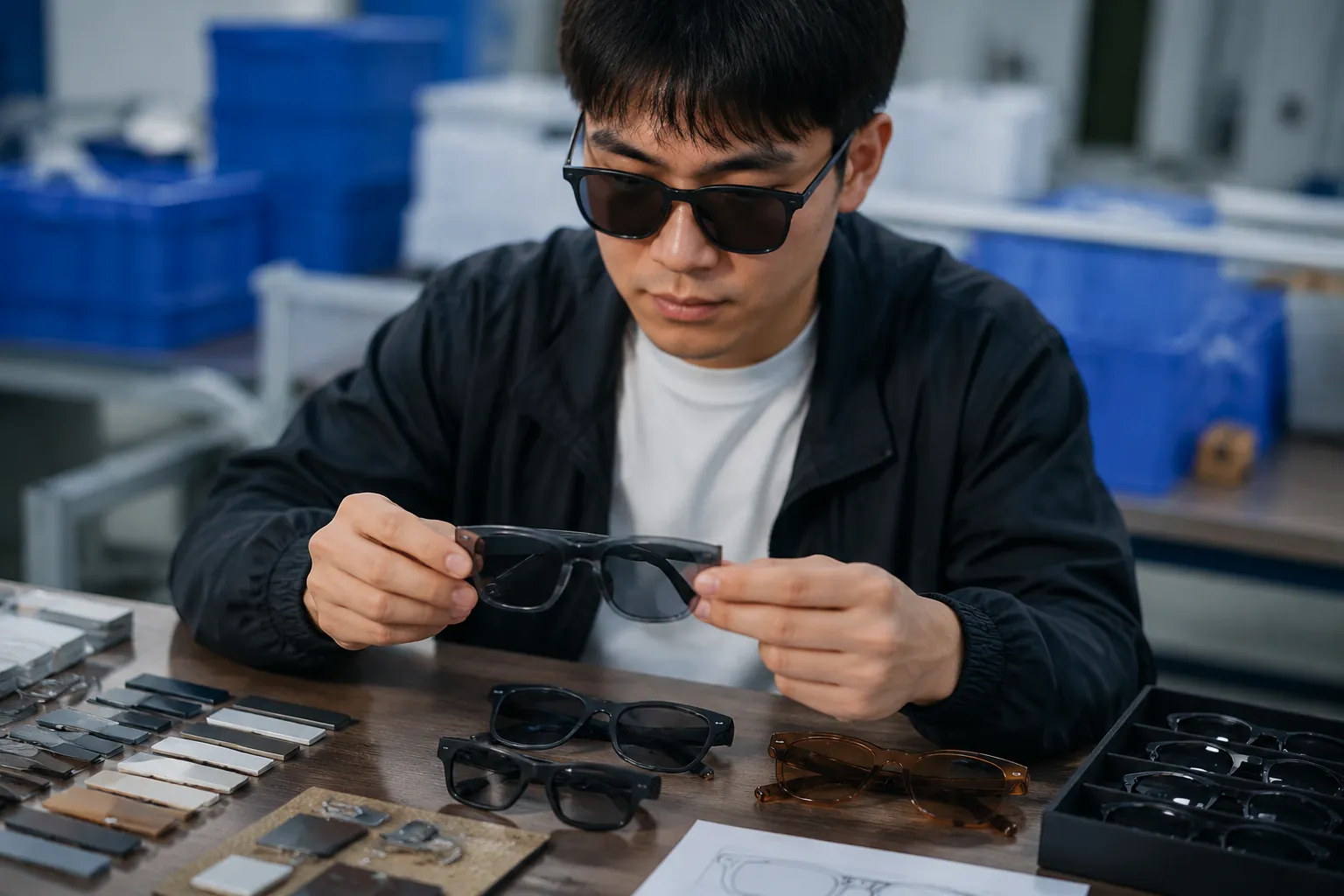
This guide helps brands, importers, distributors, and retail buyers decide whether polarized lenses justify the extra cost in a custom sunglasses order. It covers lens constructions, cost drivers, sample and production timing, inspection methods, and the specifications a factory needs before tooling and sampling. Use it to reduce vague quotes, failed polarization claims, and shipment disputes.
Where polarization makes sense
Polarized sunglasses are not the right answer for every SKU. They make sense when glare control is part of the product promise and the sales channel can support a higher price. Fishing, boating, driving, marina retail, ski resorts, golf accessories, and outdoor private-label programs are the clearest fits. Fashion-only frames sold on color, silhouette, or influencer appeal often do not need polarized lenses.
The extra cost comes from the polarizing film and the process control needed to laminate, cut, tint, edge, and inspect the lens without damaging the polarization axis. On low-price promotional sunglasses, even a small increase can hurt margin. On mid-market retail programs, the upgrade is easier to justify because the consumer can see the benefit on water, wet roads, car glass, or an LCD screen.
Use polarization only when the product page, packaging, and sales staff can explain it clearly. If the SKU is mainly a color accessory and the only claim is UV protection, non-polarized UV400 lenses usually make more sense. If the order is for outdoor, travel, driving, coastal, or sports channels, ask for a real quotation and a real inspection plan.
LumiShades handles polarized and non-polarized programs in Wenzhou, with injection molding, acetate cutting, CNC milling, lens tinting, decoration, and QC in-house. That matters because polarized-lens failures can come from frame fit, heat during assembly, edging errors, coating mismatch, or the wrong tint process. The supplier needs control across the build chain. Otherwise, defects show up late.
For buyer economics, compare retail uplift against landed cost. A polarized upgrade may add only a modest factory cost, but packaging, testing, and scrap risk can increase the landed delta on high-wrap or low-ASP programs. If the consumer cannot see or use the benefit, the feature is hard to recover in price.
Lens constructions to compare before quoting
Most OEM polarized sunglasses use TAC polarized lenses because they are light, cost-efficient, and suitable for large-volume fashion and outdoor eyewear. TAC, or triacetate cellulose, is typically built as a laminated structure with the polarizing film sandwiched between layers. That gives solid glare control at a lower price point, but lamination quality and heat control matter. If the factory overheats the lens during tinting or edging, the laminate can warp, bubble, or show edge stress.
Polycarbonate polarized lenses cost more, but they offer higher impact resistance and are common in sport styles, kids' sunglasses, and channels that want tougher lenses. Scratch resistance depends heavily on coating quality. Nylon polarized lenses sit higher on the performance ladder. They are flexible, light, and optically strong, but they require tighter process control and usually higher order volumes. CR-39 polarized lenses appear in some optical-style sunglasses and thicker fashion designs, where optical clarity matters more than impact resistance.
Do not ask a supplier only for "polarized UV400." That is too vague for OEM production. Specify lens material, thickness, base curve, color, coating stack, light transmission category, mirror finish if any, and the target compliance market. A Category 3 grey polarized TAC lens for the EU is not the same buying decision as a brown polycarbonate driving lens for the U.S. market. If you want quote accuracy, include exact details such as 1.0 mm or 1.1 mm lens thickness, whether the lens is flat or curved, and whether the frame requires a 6-base or 8-base fit.
| Lens option | Typical use | Buyer advantage | Watch point |
|---|---|---|---|
| TAC polarized | Fashion, beach, driving, outdoor retail | Best cost balance; light weight; many tint options | Can delaminate, warp, or haze if heat control and film quality are weak |
| Polycarbonate polarized | Sport, cycling-style, kids, active use | Higher impact resistance and better toughness | Needs good hard coating and careful optical QC to control scratches and stress marks |
| Nylon polarized | Premium sport and performance eyewear | Good flexibility and optical clarity | Higher material cost, tighter process control, and less room for pricing mistakes |
| CR-39 polarized | Optical-style sunglasses and thicker lens designs | Good optical performance and stable tinting | Heavier than polycarbonate and less impact resistant for active use |
For most first polarized OEM orders, TAC is the most practical starting point. Move to polycarbonate or nylon only when the channel, retail price, or performance requirement supports the added cost and manufacturing complexity.
What changes the unit price
Polarization adds cost, but it is only one line in the price sheet. Final unit price is shaped by frame material, lens material, curve, coatings, decoration, packaging, testing, and quantity. At LumiShades, MOQ starts at 50 pairs per design for custom sunglasses. That works for sampling, market testing, or a small launch. Pricing usually improves as quantities increase because tooling amortization, setup time, and QC handling are spread across more units. On larger volumes, some simple styles can move toward lower unit prices depending on frame, lens, and packing specification.
Polarized TAC lenses are usually the lowest-cost polarized route. Mirror coating, gradient tint, hydrophobic coating, anti-scratch coating, special lens colors, and high-wrap curves all add cost or risk. So does an oversized shield lens, because yield loss during cutting and edge finishing is higher. A standard smoke Category 3 polarized lens is straightforward. A red mirror polarized lens on a high-base wrap frame with tight cosmetic tolerance is not. The more layered the specification, the more likely you are to see scrap, rework, or lead-time drift.
Quantity affects price in a mechanical way. On 50 pairs, the factory still has to confirm materials, prepare tooling, set up tinting, print or engrave logos, and run QC, so those fixed costs are spread over very few units. On 300 pairs, the setup burden is already lower per unit. On 1000 pairs and above, the factory can batch work more efficiently, reduce changeovers, and negotiate better packaging and logistics terms. That is why a serious RFQ should request a quote ladder rather than a single number.
- Quantity: 50 pairs is viable for samples or tests, but the unit price is materially higher than 300, 1000, or 5000+ pairs.
- Lens material: TAC is normally cheaper than polycarbonate, nylon, or CR-39.
- Coatings: mirror, anti-scratch, hydrophobic, and gradient finishes add cost and inspection points.
- Frame fit: high-curvature frames need better lens matching and can increase scrap if the curve is off by even a small amount.
- Decoration: laser engraving, pad printing, heat transfer, and metal logo plates all require setup and add handling risk.
- Packaging: pouch, microfiber cloth, retail box, barcode labels, and instruction cards change landed cost in a measurable way.
Ask for pricing at 300, 1000, and 5000 pieces on the same specification, with the same packaging and the same decoration method. If the supplier cannot explain where the cost changes, you cannot judge whether the quote is competitive.
Spec fields that prevent sample confusion
A polarized lens order should be written like a technical purchase, not a mood board. Photos help with style, but they do not control production. The spec sheet should tell the factory exactly what to build and what to test, including the target market, the acceptable variation, and the final packaging.
Good specs reduce arguments about what was promised versus what was approved. They also keep the sample process from drifting. If the frame is approved but the lens color is vague, the supplier may choose a gray that is technically acceptable but commercially wrong. If the logo is not positioned with a dimensional reference, the factory may place it where it fits the mold rather than where it fits the brand.
- Frame: material, color code or Pantone reference, finish, size, hinge type, temple length, bridge width, and logo position.
- Lens: material, polarized yes/no, color, light transmission category, UV requirement, thickness, base curve, mirror or coating, and edge finish.
- Compliance market: EU, U.S., Australia/New Zealand, or mixed markets, with the required standards named.
- Packaging: unit bag, pouch, case, cloth, box, barcode, warning card, and country-of-origin marking.
- Inspection: polarization check, UV test, cosmetic AQL, hinge function, lens retention, logo position, and packing check.
For sunglasses, common compliance references include CE EN ISO 12312-1 for the EU, ANSI Z80.3 for the U.S., AS/NZS 1067 for Australia and New Zealand, REACH for chemical restrictions, and FDA registration context for U.S. import documentation. Ask the supplier to show current documents for any certification or registration they claim, and make sure the scope actually covers sunglasses.
Two details buyers often forget are tolerance and finish. Lens thickness tolerance should be agreed up front, especially if the frame groove is tight. Cosmetic tolerance should also be defined, because tiny edge chips, coating pinholes, or mild tint variation may be acceptable on a budget SKU but not on a premium retail program. If you care about exact appearance, say so in writing.
"UV400" on artwork is not a certificate. It is a product claim that must be backed by testing. The same applies to "polarized." Print only what the inspected product can support.
Sampling and lead time
For a normal polarized sunglasses OEM project, samples usually take 7 to 10 days after the specification is confirmed and artwork is workable. Bulk production is typically 25 to 35 days after sample approval and deposit. That assumes standard materials, no late packaging changes, and no repeated color corrections. If you change the lens color after sample approval, you can add several days because tint matching and rechecking start again.
The slowest step is often not molding or assembly. It is decision time. Buyers lose time by approving the frame but not the lens color, or by changing logo placement after the sample is made. Polarized lenses make this more sensitive because tint, mirror, and polarization performance must be checked together. The factory cannot treat them as separate choices if the final product needs to be consistent.
A realistic production calendar has more than one checkpoint. The factory reviews the RFQ, confirms materials, prepares the sample, waits for buyer feedback, adjusts details if needed, then freezes the golden sample before bulk starts. From there, bulk production is usually a sequence of lens preparation, frame forming, assembly, logo application, cleaning, inspection, packing, and carton audit. If one step is delayed, the whole shipment slides.
| Stage | Typical time | Buyer action needed | Risk if skipped |
|---|---|---|---|
| RFQ and spec review | 1 to 3 days | Confirm material, lens, quantity, packing, market | Wrong quote or missing test requirement |
| Sample production | 7 to 10 days | Approve frame, lens color, logo, fit | Bulk starts from an unverified sample |
| Pre-production confirmation | 1 to 2 days | Sign off golden sample and packing file | Factory uses outdated artwork or lens spec |
| Bulk production | 25 to 35 days | Keep changes frozen | Delay, rework, mixed lots |
| Final inspection and shipment prep | 1 to 3 days | Review inspection report and carton marks | Disputes after goods leave factory |
Lead times still depend on specification complexity, order volume, and whether the buyer changes details after confirmation. Freezing the approved spec is the fastest way to protect the schedule.
Checks before bulk production
Polarized lenses are easy to claim and easy to check. Every buyer should approve a physical sample and run simple verification before giving bulk approval. The factory should also test during incoming lens inspection, in-process assembly, and final QC. The goal is not to overcomplicate the order; the goal is to catch a defect before it ships in cartons.
The basic polarization check uses a polarized tester, a known polarized reference lens, or a suitable LCD screen. Rotate the lens against the tester. At the correct angle, transmission should darken strongly. Weak darkening can indicate low polarization efficiency or a wrong lens mixed into the lot. Check both lenses in the same frame. A single non-polarized replacement lens can slip through if inspection is casual.
UV protection should be checked with a UV transmission meter, not by looking at lens darkness. A very dark lens can still fail UV requirements if the base material is wrong or the coating stack is poor. For category and traffic-signal recognition requirements, use the applicable standard for the target market, such as CE EN ISO 12312-1, ANSI Z80.3, or AS/NZS 1067. Verify the actual lens performance, not just the print on the lens card.
- Axis alignment: compare left and right lenses to reduce visual discomfort and customer returns.
- Optical distortion: view a grid through the lens and move it slowly; wavy lines suggest stress or poor lens quality.
- Delamination: inspect lens edges and drilled or notched areas under good light.
- Cosmetic defects: look for coating pinholes, scratches, dust, color variation, and mirror spots.
- Lens retention: flex the frame gently and confirm the lens stays seated without gaps or popping.
For production orders, ask the factory to keep a signed golden sample, a pre-production sample, and retained samples from bulk. If there is a later dispute, those samples decide the conversation. Agree an AQL standard in advance. Otherwise cosmetic disputes become subjective after shipment.
Failure modes that trigger returns
Most polarized sunglass failures come from preventable process errors. The first is lens stress. If the lens is forced into a frame groove that is too tight, the polarized film can show distortion. Consumers may describe it as strange vision, rainbow patches, or a slight wobble when they look through the lens. That is a fitting issue as much as a lens issue, which is why the frame and lens spec must be matched, not guessed.
The second is coating mismatch. Mirror coatings make color differences more visible. If the factory mixes lens lots or coating batches, the left and right lens can look slightly different. That pair will be rejected at retail even if it technically blocks glare. For brands selling through boutiques or chain stores, even a small tint drift can trigger a return or a chargeback.
The third is the wrong lens category for the market. A dark lens may look attractive in photos but still fail practical use or labeling requirements. For EU sunglasses under CE EN ISO 12312-1, the filter category and use limitations must be part of the spec early. For Australia and New Zealand, AS/NZS 1067 requirements should be built in from the start, not checked at the end when the cartons are already packed.
The fourth is chemical and material oversight. REACH matters for frame materials, coatings, inks, and components that contact skin. Decoration can also create problems. Pad printing ink, metal logo plates, and some plated finishes should be controlled, especially for children's products or high-contact lifestyle eyewear. If the decoration process uses heat, pressure, or solvents, it can also affect lens coating and frame finish.
A good factory catches these issues before packing. Ask suppliers whether they operate under ISO 9001 and, where relevant, BSCI. Those systems do not replace product testing, but they are useful signals that the factory has documented process control and social compliance procedures. Quality still depends on the actual sample, test report, and final inspection record.
RFQ wording to copy into a brief
A clear RFQ saves days. It also filters suppliers who are guessing. Use direct wording and request evidence, not adjectives. The more specific the request, the better the quote and the lower the chance of sample confusion.
Please quote polarized sunglasses based on the attached frame reference and artwork. Lens requirement: TAC polarized, smoke grey, UV400, Category 3 target, standard base curve to match frame, anti-scratch coating if available as an option. Please quote 300, 1000, and 5000 pairs, including unit polybag, microfiber pouch, barcode label, and export carton. Target markets: EU and U.S.; please confirm support for CE EN ISO 12312-1 and ANSI Z80.3 related testing documentation. Provide sample lead time, bulk lead time, MOQ by design, mold or setup fees if any, and decoration cost for temple logo by laser engraving and pad printing.
If your program needs Australia or New Zealand, add AS/NZS 1067 from the beginning. If the product will enter the U.S., ask what FDA registration or import documentation context applies to the shipment. For chemical compliance, name REACH and ask what materials or components are covered. If you need a specific look, add visual references, but keep the technical requirements in the text.
Ask for the inspection plan. A good answer should mention polarization check, UV test, lens color and coating inspection, frame function, logo position, packing, and retained samples. If the reply only says "QC passed," ask again. Good suppliers can tell you exactly what they inspect, what they measure, and what they reject.
If you want a cleaner cost model, ask the factory to separate unit price, decoration cost, packaging cost, and test or certification cost. That makes it easier to compare options such as laser engraving versus pad printing, or standard pouch versus retail box. It also shows where the quote is genuinely competitive and where it is padded with vague bundled fees.
Have a custom sunglasses project in mind?
Send us your styles, target market and quantities and we will return a detailed quote with MOQ, lead time and a sample plan.
Get a QuoteWhy source this from Wenzhou with LumiShades
Wenzhou in Zhejiang Province is widely regarded as China’s eyewear manufacturing capital, producing a large share of the world’s sunglasses. That concentration matters to buyers: a deep local supply chain for acetate sheet, hinges, lens blanks, plating and packaging means shorter component lead times, easier color and material matching, and a workforce with decades of eyewear-specific skill. LumiShades has manufactured in this ecosystem since 2009, and our vertical integration — in-house injection molding, acetate cutting, CNC milling, lens tinting, decoration and quality control — means no part of your order is quietly subcontracted to a workshop you cannot audit.
For international buyers, that vertical control translates into accountability. When a single factory owns every step, defects are traced and fixed at source rather than bounced between vendors, and your specifications survive intact from first sample to bulk. We back this with 15+ years of experience, shipments to 60+ countries, more than 5 million pairs produced per year and a 98.5% on-time delivery rate. Our certifications — CE EN ISO 12312-1, FDA registration, ANSI Z80.3, AS/NZS 1067, REACH, ISO 9001 and BSCI audit — mean the compliance documentation your market requires already exists. Explore our manufacturing capabilities and quality control process to see how this works in practice.
Frequently asked questions
How much more do polarized lenses cost than non-polarized lenses? The premium depends on lens material, coating stack, curve, packaging, and order quantity. TAC polarized lenses are usually the lowest-cost polarized option, while polycarbonate and nylon generally cost more. Ask for the same specification at 300, 1000, and 5000+ pairs so you can compare the real premium and see how setup costs change with volume.
Is TAC polarized good enough for retail sunglasses? Yes, for many fashion, beach, driving, and outdoor retail programs. TAC is light, cost-efficient, and easy to scale. If the product needs higher impact resistance, stronger performance positioning, or a tougher lens story, compare polycarbonate or nylon instead and ask for a sample against your frame.
Can I verify polarization without lab equipment? Yes, for a basic pass/fail check. Use a polarized tester, a known polarized reference lens, or an LCD screen and rotate the lens to confirm strong darkening. For UV claims and market compliance, use proper test equipment or a qualified third-party lab so the result is defensible.
Which certifications should I request for polarized sunglasses? Match the destination market and ask the supplier to show current documents for each claim. Common references are CE EN ISO 12312-1 for the EU, ANSI Z80.3 for the U.S., AS/NZS 1067 for Australia and New Zealand, REACH for chemical restrictions, and FDA registration context for U.S. import documentation. If the factory claims ISO 9001 or BSCI, request the current certificate or audit evidence and confirm the scope applies to the facility you are buying from.
What is a realistic lead time for custom polarized sunglasses? A practical planning range is 7 to 10 days for samples after the spec and artwork are confirmed, and 25 to 35 days for bulk after sample approval and deposit, assuming standard materials and no late changes. If you change lens color, logo placement, coating, or packaging after approval, expect the schedule to move. To protect timing, freeze the golden sample before bulk starts and keep all changes documented.
What MOQ should I plan for? Plan around the factory's actual MOQ by design and by specification, because it changes with lens type, decoration, and packaging. For this program, a 50-pair starting point can work for sampling or a small market test, while better unit pricing normally requires larger quantities. Ask for pricing at 300, 1000, and 5000 pieces so you can see where the setup cost is absorbed and where the quote becomes commercially workable.
Ready to start?
Explore our round sunglasses or request a quote — our sales team replies within 12 hours.
Request a Quote