
Polarized vs Mirrored vs Gradient Lens Mix That Sells
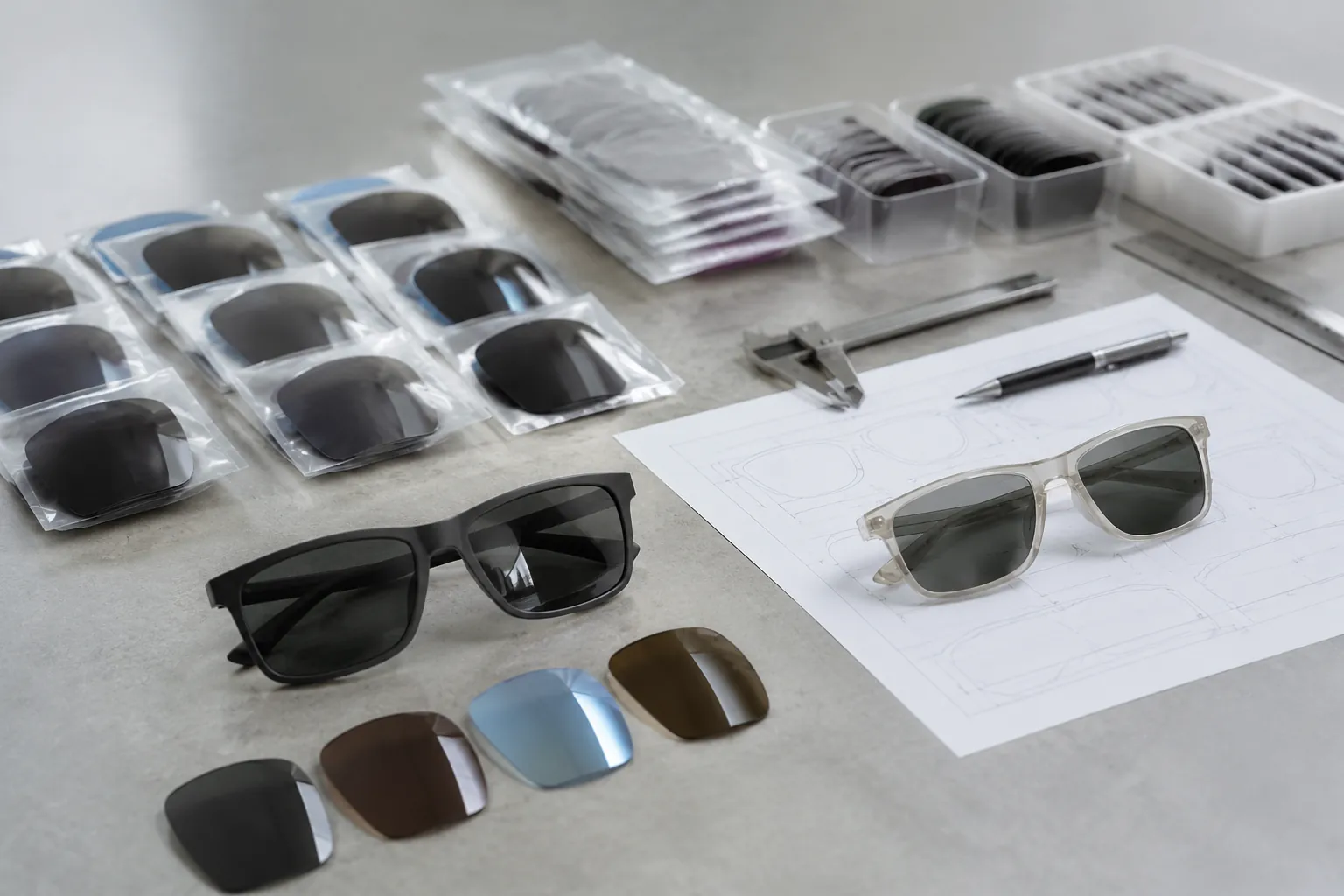
This guide is for brands, importers, distributors, and retailers buying sunglasses in volume. If your range has too many slow movers, the fix is often not more frame shapes. It is a tighter lens mix, fewer speculative colors, and clearer reorder rules. The goal is simple: choose the right balance of polarized, mirrored, and gradient lenses so you improve sell-through, protect margin, and reduce dead stock. In bulk eyewear programs, lens choice affects demand, unit cost, coating yield, QC complexity, compliance testing, and replenishment speed. Start with the job each SKU must do. Then work back into lens type, tint, coating, and production volume.
1) Start with the buying job, not the lens label
Most teams ask which lens type is best. That is the wrong start. Ask what the SKU needs to do in that channel, for that customer, at that price.
Polarized lenses reduce reflected glare. They fit driving, boating, fishing, beach use, and outdoor travel. The benefit is easy to explain: less glare, more comfort in strong light. Mirrored lenses sell on appearance. They create shelf impact and photograph well. They work in youth, beach, and fashion-led retail. Gradient lenses are the broad all-rounder. The darker upper portion cuts brightness, while the lighter lower portion keeps the look softer and easier to wear.
A line built too heavily around mirrored fashion colors can sell in first order and then stall. A line built too heavily around polarized dark lenses can feel too technical or too safe for gift, resort, or fashion accounts. Gradient-only assortments are safer, but they can lack urgency unless the frame itself carries enough design value.
Assign each lens type a commercial role. Usually that means one volume driver, one visual driver, and one low-risk support option. Lens type should support the SKU. Not the other way around.
- Use polarized when function must justify the price.
- Use mirrored when shelf impact matters most.
- Use gradient when broad acceptance and lower risk are the priority.
2) Lens type comparison: demand pattern, margin logic, and stock risk
| Lens type | Best channel use | Typical cost effect | Main QC risks | Typical reorder behavior |
|---|---|---|---|---|
| Polarized | Outdoor, travel, auto, fishing, sun-safe lifestyle retail | Usually higher than standard tinted lenses because of the polarizing film and added process control | Delamination, poor lamination alignment, inconsistent visual clarity, weak glare reduction | Steady when paired with neutral frames and dark lens colors such as grey, brown, or green |
| Mirrored | Fashion chains, beach, promo, youth retail | Usually higher than plain tint because of reflective coating or film steps and harder finish control | Banding, pinholes, uneven edge coverage, color shift between lots, scratch sensitivity | Can spike in season, then fall quickly if trend color changes |
| Gradient | General retail, travel, lifestyle, private label | Often close to standard tint cost; sometimes lower than polarized and simpler than mirror-coated builds | Uneven fade height, left-right mismatch, harsh transition line, top darkness inconsistency | Usually the safest base item for repeats and wide distribution |
Polarized is usually the easiest feature to defend at a higher retail price because the benefit is concrete. Mirrored is often the easiest to merchandise because it creates instant impact online and at shelf level. Gradient is usually the lowest-risk inventory play because it works across more ages, channels, and frame shapes.
Margin planning should follow channel behavior, not just ex-factory cost. A polarized style may cost more, but if it supports a better ticket and fewer markdowns, it can outperform a cheaper mirrored style that stalls after the first sell-in. Mirrored lenses often generate stronger initial reaction but also more color risk. Gradient is less flashy, but it is more forgiving if the forecast is wrong.
Material choice matters too. TAC polarized lenses are common in fashion and casual sunwear because they are lightweight and work well in polarized builds. PC lenses improve impact resistance but can scratch more easily without a hard coat. CR-39 can offer good optical quality in some programs, but it changes cost and frame compatibility. Mirror coatings can behave differently across lens materials, so coating yield should be discussed before you confirm large-volume fashion colors.
3) Build the assortment by SKU role, not by personal taste
Do not spread volume evenly across every style and every lens finish. That is how a clean program turns into an expensive SKU maze. Give each lens version a job in the line.
- Hero SKU: usually polarized. This is the item that carries the functional sales story and supports replenishment.
- Traffic SKU: usually mirrored. This is the attention-grabber that pulls buyers into the range.
- Safe SKU: usually gradient. This is the broader, easier item for general retail and mixed accounts.
A workable launch split for many overseas buyers is 50% polarized, 30% gradient, 20% mirrored. That is a starting point, not a rule. Outdoor-heavy channels often push polarized higher. Fashion-led channels may increase mirrored share if frame colors, price, and forecast discipline are strong enough.
Control color count early. For a first run, two lens colors per frame is often enough. For polarized, common volume colors are grey, brown, and green. For gradient, grey gradient and brown gradient usually carry the lowest objection rate. For mirrored, silver, blue, and gold are common commercial options, but every extra mirror color adds matching risk between batches.
Also think in price ladders. A mirrored lens on an injected frame can serve as an entry SKU. A polarized lens on acetate or mixed-material frames can support a more premium offer. Gradient often sits in the middle, especially when the frame front is design-led but the lens still needs to stay commercially safe.
Blunt rule: if you cannot explain in one sentence why a lens type exists in the line, cut it before sampling.
4) How lens choice changes cost, MOQ, and production planning
Lens decisions change the economics of the program fast. MOQ, unit price, and lead time should be confirmed with the supplier before you build the assortment. A smaller development order can help you test the market, but it does not guarantee the same price, coating yield, or schedule priority as a larger replenishment order.
Polarized lenses usually add cost because of the polarizing film layer and the extra control needed to keep visual quality consistent. Mirrored lenses add finishing cost through reflective coating or film steps, plus hard-coat requirements if scratch performance matters. Gradient lenses are usually less expensive than polarized, but tight fade consistency can raise reject risk if the color standard is strict.
SKU count is where buyers often lose control. A three-frame launch with three lens types and four lens colors creates 36 SKUs before packaging variations. If each SKU must hit a minimum, inventory builds quickly. Most first programs work better with one or two frame winners and tightly controlled lens variants.
| Order level | Recommended lens strategy | Commercial logic | Operational caution |
|---|---|---|---|
| 50 pairs/design | Sample one lens type, maximum two colors | Low-risk development and faster decision making | Do not treat sample feedback as market proof |
| 300 pairs | Test the best two lens types on the strongest frame | Enough volume to compare actual sell-through by channel | Keep packaging and branding simple to reduce setup cost |
| 1000 pairs | Back the winner; cut weak colorways | Better unit price and cleaner replenishment planning | Lock lens code, tint code, and coating reference before PO release |
| 5000+ pairs | Standardize lens recipe, packaging, and QC limits | Best scale pricing and most efficient reorders | Avoid late aesthetic changes that disrupt coating and assembly scheduling |
Typical sample lead time is around 7-10 days, while bulk production often runs around 25-35 days depending on frame material, lens treatment, decoration, and packaging complexity. Confirm timing with the supplier for each order. These figures move with factory load and spec complexity.
5) What to test in the sample round: appearance, performance, and tolerances
Sample approval should not be style-only. The lens is a specification item. Treat it that way.
- Check left-right lens color match under daylight and white light.
- Measure gradient fade height and confirm the transition line sits at the intended level.
- Inspect mirror coating for pinholes, streaking, edge loss, and visible color shift.
- Review lens fit in the frame under strong light for gap, stress, or uneven bevel seating.
- Test polarized performance outdoors, especially on road glare and water reflection.
- Confirm scratch resistance expectations if the lens is mirrored or high-gloss.
- Verify logo or foil decoration after final assembly, not before.
Where possible, lock basic appearance tolerances in the approval file. Examples include allowable left-right color deviation, acceptable mirror reflectivity range, and gradient fade position tolerance. Even simple internal rules help, such as rejecting obvious lens mismatch at arm's-length viewing or requiring stable logo placement within a defined visual standard. Without a fixed reference sample and signed lens code, repeat orders drift fast.
Decoration method matters as well. Temple logos may be printed, hot-stamped, laser engraved, pad printed, or foil applied. Mirror lenses can overpower weak branding, so logo contrast should be checked on the final assembled sample. If metal parts or mixed-material temples are used, check decoration alignment after curing and assembly. Heat, pressure, and handling can shift the finish.
One common failure pattern is simple. The buyer approves a dark blue mirror sample, later swaps in a different lens source or coating line, and receives a batch with a different reflectivity level or visible color cast. On shelf, the mismatch shows at once. Keep lens color codes, coating references, and approved retain samples tied to the PO.
6) Compliance and channel planning should be built together
Compliance should not be checked after design approval. Build it into the lens plan from the start, because different markets ask different questions.
For Europe, CE EN ISO 12312-1 is central for sunglasses and sun glare filters. For the U.S., FDA registration may be relevant, and many buyers also expect testing aligned with ANSI Z80.3. For Australia and New Zealand, AS/NZS 1067 is a key reference. Chemical compliance such as REACH also matters for many import programs, especially where coatings, plastics, inks, or decorations are involved.
Supplier certifications should be verified directly through the factory's current documents and test reports. Common business credentials in eyewear sourcing include ISO 9001 and BSCI, but buyers should still confirm scope, validity, and whether the certificate covers the relevant site and process.
Channel planning should then follow compliance and use case:
| Channel | Recommended mix | Why it works |
|---|---|---|
| Outdoor / sport / travel | Polarized 60-70%, gradient 20-30%, mirrored 10% | Function drives conversion; mirror acts as limited style support |
| Fashion retail | Mirrored 35-40%, gradient 35-40%, polarized 20-25% | Visual impact matters more, but broad wearable options still protect sell-through |
| General distributor program | Polarized 40%, gradient 40%, mirrored 20% | Balanced risk profile across mixed accounts |
| Promotional / private label | Gradient 50%, mirrored 30%, polarized 20% | Price control, broad acceptance, and simpler forecasting usually matter most |
If you are unsure, start with gradient as the broad-base item and polarized as the upgrade path. Use mirrored as a controlled style variant, not the center of the range.
7) Reorder logic: what to repeat, what to trim, and what to kill fast
The first reorder should be driven by sell-through data, not by internal preference or the fact that one sample looked premium. Track performance by lens type, frame color, account type, and complaint rate. Total units sold alone is not enough.
- Repeat the lens type that sells in more than one channel and holds margin without unusual returns.
- Trim versions that depend on one account, one climate window, or one aggressive promotion.
- Kill the variant that needs markdown support before the next replenishment cycle.
In practice, polarized often wins the reorder test because the benefit survives price pressure. Gradient often wins because it is easy to restock and works across more customer types. Mirrored needs tighter management. Keep only the mirror colors that moved early, and cut weak fashion colors before they age out.
On the factory side, repeat orders become safer when the specification is stable. That means fixed lens material, fixed tint code, fixed coating reference, fixed logo placement, and fixed pack-out standard. If buyers change all of those at once, QC risk rises. In-house QC helps here because lens appearance, frame finish, assembly fit, and decoration can be checked as one finished product.
The commercial lesson is plain: the best lens mix is not the one with the most options. It is the one with the clearest role for each SKU, the lowest avoidable complexity, and the fastest learning loop between first order and repeat order.
Have a custom sunglasses project in mind?
Send us your styles, target market and quantities and we will return a detailed quote with MOQ, lead time and a sample plan.
Get a QuoteWhy source this from Wenzhou with LumiShades
Wenzhou in Zhejiang Province is widely regarded as China’s eyewear manufacturing capital, producing a large share of the world’s sunglasses. That concentration matters to buyers: a deep local supply chain for acetate sheet, hinges, lens blanks, plating and packaging means shorter component lead times, easier color and material matching, and a workforce with decades of eyewear-specific skill. LumiShades has manufactured in this ecosystem since 2009, and our vertical integration — in-house injection molding, acetate cutting, CNC milling, lens tinting, decoration and quality control — means no part of your order is quietly subcontracted to a workshop you cannot audit.
For international buyers, that vertical control translates into accountability. When a single factory owns every step, defects are traced and fixed at source rather than bounced between vendors, and your specifications survive intact from first sample to bulk. We back this with 15+ years of experience, shipments to 60+ countries, more than 5 million pairs produced per year and a 98.5% on-time delivery rate. Our certifications — CE EN ISO 12312-1, FDA registration, ANSI Z80.3, AS/NZS 1067, REACH, ISO 9001 and BSCI audit — mean the compliance documentation your market requires already exists. Explore our manufacturing capabilities and quality control process to see how this works in practice.
Frequently asked questions
Should I launch with polarized or gradient first? Choose by channel. If you sell into outdoor, travel, marine, or driving-related accounts, launch with polarized first because the benefit is easy to explain and usually supports a higher price point. If the channel is general retail, resort, gift, or fashion-led, start with gradient as the base SKU and add polarized as the upgrade option. In either case, approve one reference sample and keep the lens code fixed for the first reorder.
Are mirrored lenses a good core item? Usually not as the only core item. Mirrored lenses work well as traffic drivers because they create shelf impact and photograph well, but trend colors can change fast. Use mirrored as a controlled variant supported by a more stable polarized or gradient base, and limit mirror colors until you see repeat demand.
How many lens types should I carry on one frame? At launch, two lens types on one frame is usually enough. Three can work if each version has a clear role, enough projected volume, and a separate reason to exist in the line. If the team cannot explain the function of each version in one sentence, the assortment is probably too complex.
What MOQ makes sense for testing lens mix? Use the supplier's actual MOQ as the starting point, then size the test to the decision you need to make. A small development order can validate appearance and construction, but around 300 pairs is often more useful for commercial testing because it gives enough volume to compare channel response without overcommitting. For the exact MOQ, confirm by design, lens type, and color with the factory before sampling.
Which compliance documents matter for overseas buyers? Match the documents to the destination market and customer requirement. Common references include CE EN ISO 12312-1 for Europe, FDA registration and ANSI Z80.3-related testing expectations for relevant U.S. programs, AS/NZS 1067 for Australia and New Zealand, and REACH for chemical compliance where applicable. Also ask the supplier for current proof of ISO 9001 and BSCI only if those credentials are required in your sourcing policy.
How fast can a reorder move if the lens spec is already approved? A reorder is usually faster when the lens material, tint code, coating reference, logo placement, and pack-out standard are already locked. Sample timing and bulk lead time still depend on factory capacity and spec complexity, so ask the supplier to confirm the current schedule in writing before you commit to a launch date. The practical way to speed reorders is to keep the approved reference sample, artwork file, and color standard attached to the purchase order.
Ready to start?
Explore our shield & oversized sunglasses or request a quote — our sales team replies within 12 hours.
Request a Quote