
Polarized Lens Defects to Catch Before Bulk Production
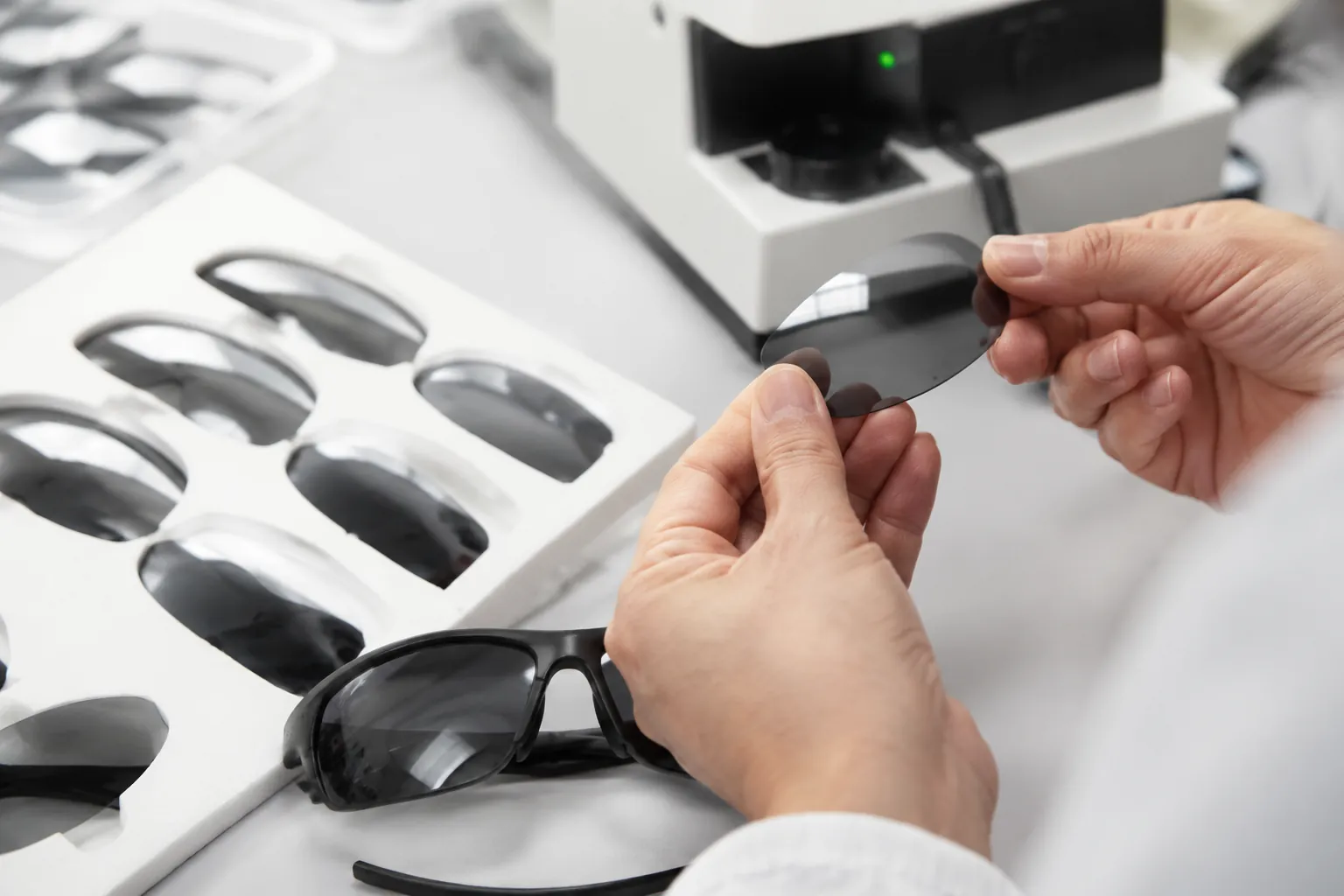
This guide is for overseas brands, importers, distributors, and retailers buying custom polarized sunglasses in volume. It explains which lens defects to check before approving bulk production, how to test them with practical tools, and what details should be written into a sample approval sheet. The point is simple: catch problems before the order leaves the sample stage.
Start With Failure Modes, Not the Sales Sample
A clean sales sample can still hide a weak polarized lens process. The frame may look right. The logo may be sharp. The lens color may even match your reference under office light. None of that proves the polarizing film is aligned, stress is controlled, layers are bonded properly, or the final pair will stay consistent across the order.
The main risk is approving appearance only. Polarized lenses can fail in ways that do not show up clearly in photos: axis misalignment, rainbow stress, delamination, uneven density, left-right shade mismatch, coating scratches, and optical distortion. These are functional defects. They affect use, not just looks.
A proper approval process checks lenses before and after assembly. A typical workflow includes incoming lens or film verification, fit with the frame design, cutting or molding, tint or mirror-coating checks where needed, axis and visual inspection, assembly, cleaning, packaging, and outgoing inspection. For custom sunglasses, the lens standard should be written down before sample approval, even for small runs.
Do not write only "polarized lenses, good quality" on a purchase order. Write the lens material, target color, visible light transmission category or target where relevant, polarizing axis requirement, coating requirement, inspection method, and sealed master sample reference. "Polarized" is not one checkbox. It is a group of production controls.
Axis Misalignment: The Defect That Looks Fine Until Used
The polarizing axis is the orientation that allows the lens to reduce horizontally reflected glare. Many sunglass programs specify a vertical polarizing axis, often around 90 degrees. The exact target and tolerance should be agreed with the manufacturer and recorded in the approval file. If the axis is off, the lens may still look dark, but glare reduction can be weaker or uneven between the left and right lenses.
Axis control matters most when polarization is a core selling claim, such as for fishing, driving, snow, water sports, and outdoor retail. The acceptable tolerance depends on lens material, base curve, production method, inspection equipment, and the buyer's quality level. Some commercial programs use a tolerance range such as ±3 degrees to ±5 degrees in the central viewing zone, but that should never be treated as a universal rule. The buyer and supplier should agree on the target, tolerance, and measurement method before production starts.
Simple buyer check: hold the sample in front of a polarization tester or a known polarized reference such as an LCD screen. Rotate the lens slowly. At the correct angle, the lens should block light strongly and consistently. Check the left lens, right lens, and finished pair. If one lens blacks out noticeably earlier or later than the other, stop approval and ask for a recheck.
- Check each lens separately: left and right lenses may come from different sheet positions or be installed with different orientation errors.
- Check after assembly: a correct loose lens can become a poor finished pair if it rotates in the groove during mounting.
- Check the center first: for curved lenses, edge readings can be less stable than the pupil area, so define the central viewing zone as the decision area unless your standard says otherwise.
- Record the method: LCD checks are useful for quick screening, but production decisions should use a consistent polarization tester, axis fixture, or agreed inspection method.
- Set a reject rule: an obvious left-right blackout difference should be rejected or rechecked before bulk production starts.
Rainbow Stress and Optical Distortion
Rainbow stress appears as colored bands, blotches, or waves when the lens is viewed through another polarized filter or under certain lighting. Consumers may call it an oil-slick effect. It can come from internal stress in the lens material, poor cooling, aggressive forming, uneven pressure during assembly, or interaction between the lens material and polarizing film.
Some stress near drilled holes, screws, sharp corners, or tight groove areas may appear on certain constructions. The real question is simple: does it enter the normal viewing zone? For buyer approval, the central area in front of the pupil should be clean unless a specific exception is documented. If rainbow stress crosses the main field of view, do not approve the sample with a vague note like "improve in mass production." Ask the factory to identify the cause and submit a corrected sample.
Material behavior matters. Injection-molded PC polarized lenses can show stress if molding parameters or cooling are not controlled. TAC laminated polarized lenses can show waves if the sheet is overheated, bent beyond its safe range, or edged poorly. Nylon polarized lenses are often used for higher-performance designs, but forming and color control still need close attention. Acetate, TR, PC, or metal frames can also pinch the lens and create stress after assembly even when the loose lens passed inspection.
Inspect twice: on loose lenses where available and on finished frames. Use a second polarized lens, stress viewer, or polarized inspection panel. Also check for image wobble by moving the lens slowly over a straight printed grid. If straight lines bend, swim, or ripple in the central area, the issue is not only cosmetic. It affects visual comfort.
Buyer rule: Do not accept rainbow stress, waves, bubbles, film lines, or distortion in the central viewing zone unless the buyer has documented a specific, intentional exception.
Delamination, Edge Failure, and Heat Risk
Delamination is the separation of polarized film or lens layers. It may show as edge lifting, bubbles, cloudy patches, whitening, or a line that grows inward from the lens edge. It is a serious defect because it may not appear during a quick sample review or pre-shipment inspection. It can develop later after heat, humidity, saltwater, sunscreen, cleaning chemicals, poor edge finishing, or excessive frame pressure.
The risk depends on the lens structure and production process. TAC polarized lenses are common for fashion, retail, and promotional sunglasses and can perform well when lamination, cutting, and edging are controlled. PC polarized lenses are often selected where impact resistance, molded shapes, or youth and sport use are priorities, but stress and film positioning must be controlled. Nylon polarized lenses may be selected for higher-spec outdoor and sports frames where optical feel, flexibility, and weight matter, but cost and color consistency must still be watched.
For beach, fishing, cycling, driving, and other outdoor-use programs, ask whether conditioning or environmental checks are needed before bulk approval. A practical pre-production check may include controlled heat exposure, humidity exposure, cooling to room temperature, and rechecking the lens edge and viewing zone. The exact time, temperature, humidity, and acceptance criteria should match the product spec, destination market, and buyer requirement. Do not rely only on a clean-looking sample if the product will face heat, sweat, water, or sunscreen in normal use.
Edge quality is critical. Rough cutting, excessive polishing heat, sharp groove corners, solvent exposure, or an over-tight frame fit can start failure at the perimeter. If delamination appears, report it with clear photos, lens material, batch or sample reference, timing, storage condition, cleaning method, and any heat or humidity exposure. That helps the factory trace the likely cause: lamination, edging, coating, assembly pressure, frame fit, or handling.
Uneven Darkness, Color Drift, and Pair Matching
Uneven darkness is easy to miss if you inspect one pair on a desk. It becomes obvious when several pairs are lined up. One lens may be greener, browner, redder, or lighter than the other. Gradient lenses may sit too high or too low. Mirror-coated polarized lenses can make small color differences look worse because the front reflection and rear tint both affect appearance.
Buyers should approve a physical lens color standard, not only a rendering or a photo. Pantone references may help with frame color, logo printing, and packaging, but lens color is affected by base material, polarizing film color, tint bath, lens thickness, coating stack, and light source. A grey lens under cool LED can look different in sunlight. Brown lenses can drift red or yellow. Green lenses can become too dark or too muted for the intended style.
For production, define acceptable variation by sealed master sample and, for larger or regulated programs, by visible light transmission category or measured VLT target. Many general-purpose sunglasses are designed for sun protection categories recognized under applicable sunglasses standards, but the final category must match the destination market, labeling, and product claim. Standards such as CE EN ISO 12312-1, ANSI Z80.3, and AS/NZS 1067 relate to sunglasses performance and labeling; they do not replace buyer approval of color appearance.
| Defect | Quick buyer test | Likely cause | Action before bulk |
|---|---|---|---|
| Left-right shade mismatch | Place pairs on white paper under daylight and indoor LED | Mixed lens batches, tint variation, or coating variation | Set a pair-matching standard and inspect by lot |
| Gradient height variation | Line up multiple samples at the same angle | Inconsistent dipping, positioning, or masking | Approve a marked master sample showing gradient height and transition area |
| Color drift from approved sample | Compare against a sealed physical reference sample | Different film, tint bath, lens material, or coating lot | Require material and process confirmation before mass cutting |
| Too dark or too light | Check visible light transmission category or measured VLT where required | Wrong tint density, coating specification, or lens category | Confirm target category and labeling requirement for the destination market |
| Mirror color instability | View under sunlight, indoor LED, and angled light | Coating thickness variation, contamination, or handling damage | Approve a mirror standard and require scratch-control handling and packaging |
Decoration and Frame Processes That Can Damage Polarized Lenses
Lens defects are not always caused by the lens supplier. Decoration and frame assembly can introduce heat, pressure, scratches, or chemical exposure. This matters in custom sunglasses programs because importers often combine polarized lenses with metal logo plates, laser engraving, pad printing, hot stamping, custom temples, acetate fronts, TR frames, PC frames, or metal components.
Metal logo plates and rivet-style details can change local pressure if the temple or front is not balanced. Laser engraving should be positioned so the heat-affected area does not weaken a thin frame section that later pinches the lens. Pad printing, spray coating, and cleaning processes require controlled materials and drying; solvents should not touch lens edges or sensitive coatings. For mirror polarized lenses, cleaning cloths, trays, and packaging must be scratch-controlled because micro-scratches are easier to see on reflective surfaces.
Assembly fit should be checked before bulk production. If the groove is too tight, the lens may bow, show stress, or pop out after temperature changes. If the groove is too loose, the lens may rotate, rattle, or lose the intended axis position. For acetate frames, heating during lens mounting must be controlled. For injected frames, dimensional consistency of the front is critical because small shrinkage differences can change lens pressure.
Ask the factory to inspect decorated samples after final cleaning and packaging, not only before decoration. A pair that passes lens QC can fail after pouching if abrasive dust, hard tags, unprotected accessories, or poor polybag arrangement scratch the mirror surface during transport.
Pre-Production Approval Sheet: What Buyers Should Put in Writing
A good polarized lens approval sheet is short, specific, and attached to the purchase order or technical file. It should list the lens material, color, polarizing axis target, tolerance or acceptance method, coating, applicable compliance requirement, packaging protection, decoration process, and sealed master sample reference.
The approval sheet should also state whether the sample was made from the intended production material, intended mold or cutting method, intended tint process, and intended coating process. If the development sample was handmade, cut from substitute material, or coated by a different process, request a pre-production sample before releasing bulk. This is especially important for mirror coatings, gradient lenses, high-curve sports lenses, and new frame-lens combinations.
| Lens option | Typical use | Main QC risk | Cost and lead-time note |
|---|---|---|---|
| TAC polarized | Fashion, retail, promotional programs | Delamination, waves, edge quality | Usually cost-effective; performance depends on lamination, heat control, and edging quality |
| PC polarized | Sport, youth, molded lenses | Internal stress, axis control, optical distortion | Good toughness; molding and cooling control affect rejection risk |
| Nylon polarized | Higher-spec outdoor and sports frames | Color consistency, forming control, higher material cost | Use when optical feel, flexibility, or weight benefits justify the specification |
| Polarized mirror | Fishing, fashion, outdoor retail | Coating scratches, color drift, shade mismatch | Needs an approved mirror sample and careful handling, cleaning, and packaging control |
Do not approve a development sample and assume production will match it automatically. Write down what is approved, what is not approved, and what must be rechecked before mass production. The sealed master sample should be labeled with model number, lens material, lens color, coating, approval date, and buyer signature or written confirmation.
Final Approval: Reject Problems Before They Become a Bulk Order
The last useful moment to catch polarized lens defects is before bulk lens cutting and assembly. After that, every correction becomes slower and more expensive. A small sample problem can turn into a full-order problem if the buyer approves without a clear inspection standard.
Before releasing bulk production, inspect samples made by the intended production method, not only hand-made development pieces. Check loose lenses if available, then finished frames. Use a polarization tester or agreed axis-checking method. View lenses against white paper. Check under daylight and indoor LED. Wear the sample outside if it will be sold for outdoor use. Move the lens over straight grid lines to catch distortion. Check the packaged sample after pouching, tagging, and carton handling if packaging could affect the lens surface.
Reject obvious axis mismatch, central rainbow stress, bubbles, film lines, left-right shade mismatch, unstable mirror color, deep coating scratches, early edge separation, or central optical distortion. For minor edge stress outside the viewing zone, decide based on the product design, price point, and target market, then document the decision. Vague approvals create disputes later.
For compliance documentation, request only the standards and records relevant to your destination market and claim. Common references for sunglasses and supplier compliance may include CE EN ISO 12312-1, ANSI Z80.3, AS/NZS 1067, REACH, FDA registration, ISO 9001, and BSCI, depending on the market, product type, and buyer requirement. Ask for current documents, test reports, or declarations as applicable, and confirm that they apply to the product being ordered rather than to an unrelated model or general company profile.
Have a custom sunglasses project in mind?
Send us your styles, target market and quantities and we will return a detailed quote with MOQ, lead time and a sample plan.
Get a QuoteWhy source this from Wenzhou with LumiShades
Wenzhou in Zhejiang Province is widely regarded as China’s eyewear manufacturing capital, producing a large share of the world’s sunglasses. That concentration matters to buyers: a deep local supply chain for acetate sheet, hinges, lens blanks, plating and packaging means shorter component lead times, easier color and material matching, and a workforce with decades of eyewear-specific skill. LumiShades has manufactured in this ecosystem since 2009, and our vertical integration — in-house injection molding, acetate cutting, CNC milling, lens tinting, decoration and quality control — means no part of your order is quietly subcontracted to a workshop you cannot audit.
For international buyers, that vertical control translates into accountability. When a single factory owns every step, defects are traced and fixed at source rather than bounced between vendors, and your specifications survive intact from first sample to bulk. We back this with 15+ years of experience, shipments to 60+ countries, more than 5 million pairs produced per year and a 98.5% on-time delivery rate. Our certifications — CE EN ISO 12312-1, FDA registration, ANSI Z80.3, AS/NZS 1067, REACH, ISO 9001 and BSCI audit — mean the compliance documentation your market requires already exists. Explore our manufacturing capabilities and quality control process to see how this works in practice.
Frequently asked questions
How can I quickly tell if polarized lenses are misaligned? Use a polarization tester if available. For a quick screen, use a known polarized reference such as an LCD screen. Hold each lens in front of the reference and rotate it slowly. The left and right lenses should darken at the same angle and with similar strength. Check loose lenses first if available, then check the finished pair after assembly. If one lens blacks out noticeably earlier or later than the other, stop approval and ask the factory to recheck the polarizing axis with a consistent fixture.
What axis tolerance should I use for polarized sunglasses? There is no single tolerance that fits every product. The tolerance should match the lens material, base curve, intended use, price level, and inspection method. Some commercial sunglass programs use a range such as ±3 degrees to ±5 degrees in the central viewing zone, but that must be agreed in writing. Your approval sheet should state the target axis, tolerance, inspection device or method, viewing zone, sampling plan, and reject rule for left-right mismatch.
Is rainbow stress always a reason to reject polarized sunglasses? Reject rainbow stress if it appears in the central viewing zone, creates visible waves, or affects comfort when looking through the lens. Minor stress near holes, screws, or frame edges may be acceptable on some constructions if it is outside the viewing zone and does not grow after assembly or conditioning. Do not rely on a verbal promise. Mark the acceptable and unacceptable zones on the approval sheet and check both loose lenses and finished frames.
Which compliance standards should I ask for on polarized sunglasses? Match the documents to the destination market and product claim. Common references include CE EN ISO 12312-1 for many European sunglasses requirements, ANSI Z80.3 for the United States, and AS/NZS 1067 for Australia and New Zealand. Depending on the buyer and market, you may also request REACH documentation, FDA registration where applicable, ISO 9001, and BSCI. Ask whether the test report or declaration applies to the exact model, lens category, lens color, and coating you are ordering.
Can I approve lens color from a photo? No. Photos help with discussion, but they are not reliable for final approval because lens color changes with light source, camera settings, screen calibration, lens thickness, and coating reflection. Approve a physical sealed master sample. Check it under daylight and indoor LED, against white paper, and next to the left and right lenses as a pair. For larger or regulated orders, confirm the visible light transmission category or measured VLT target as part of the technical file.
Will a small production run need the same QC checks as a larger order? The core functional checks should still apply: polarization, left-right axis match, visual defects, shade matching, assembly stress, edge condition, coating scratches, and packaging protection. Larger orders may justify more formal sampling, lot records, and measured VLT checks, but small runs should not skip the basic lens tests. A small order can still create returns if the sunglasses do not reduce glare or if the mirror coating scratches during shipment.
What should I do if delamination appears after sampling? Do not approve bulk production until the cause is investigated. Send clear close-up photos and full-pair photos, note whether delamination starts at the edge or center, and record when it appeared. Include storage conditions, heat or humidity exposure, cleaning method, sunscreen or chemical contact if relevant, and whether the sample was worn, packed, or left in a vehicle. Ask the factory to check lens batch, lamination, edge finishing, groove fit, assembly pressure, coating process, and packaging contact points before submitting a corrected sample.
Ready to start?
Explore our aviator sunglasses or request a quote — our sales team replies within 12 hours.
Request a Quote