
Polarized TAC vs PC Lenses: Buyer Guide
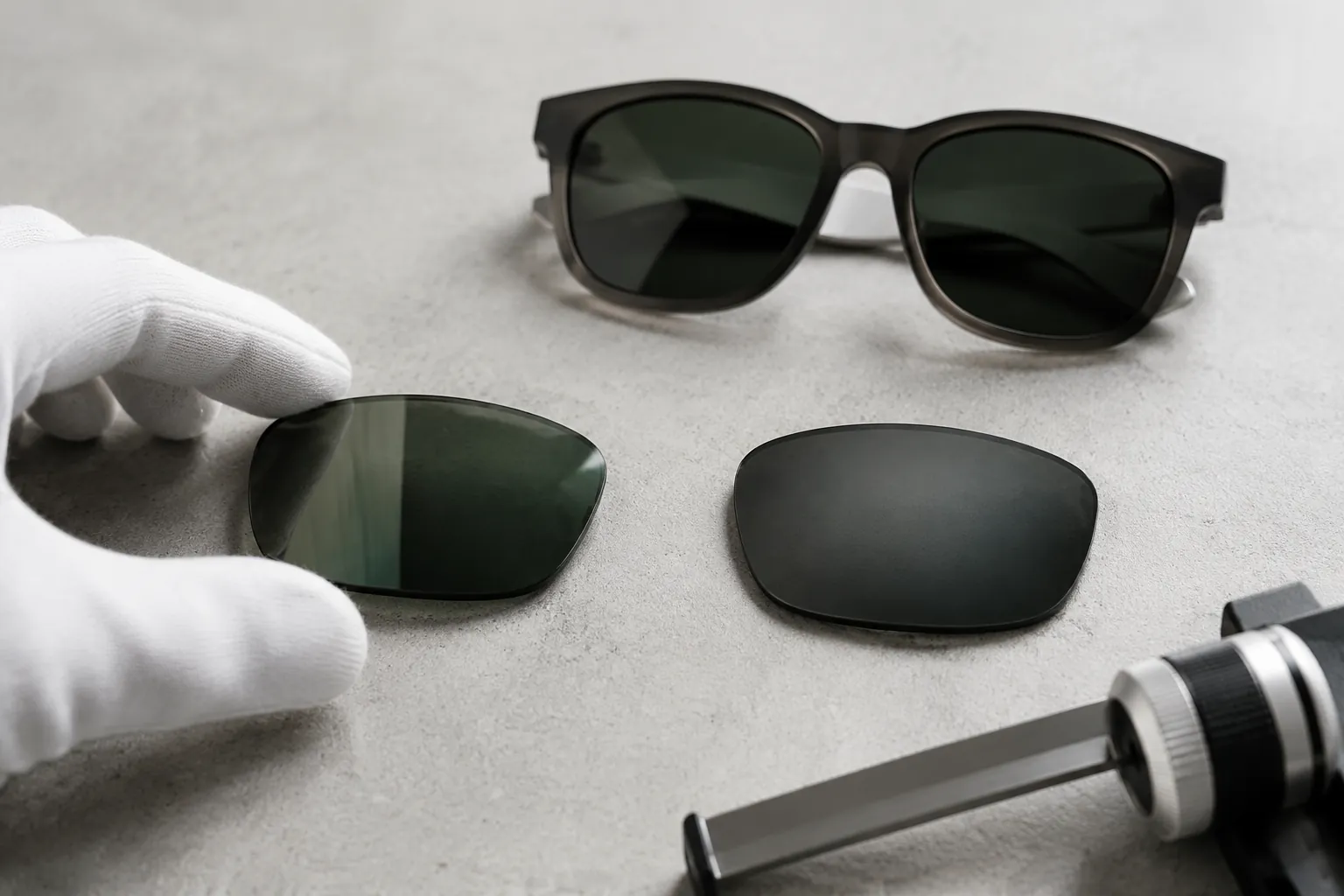
This guide is for buyers sourcing custom sunglasses in volume: brand owners, importers, distributors, and retail chains. Choosing between polarized TAC and polarized polycarbonate (PC) affects more than lens price. It can change durability in transit and use, optical consistency, assembly yield, complaint rates, and the amount of QC needed before shipment. The right choice depends on channel, frame design, product positioning, and the compliance path for the finished sunglasses. This comparison stays practical. It focuses on trade-offs buyers can check through samples, supplier questions, and testing.
Start with channel, use conditions, and product positioning
The first mistake is asking, "Which polarized lens is better?" That is too broad. The useful question is: better for which channel, which frame design, and which failure risk?
In practice, polarized TAC is common in fashion sunglasses, promotional programs, gift programs, tourist retail, and price-sensitive private-label lines. Buyers usually consider it when glare reduction and appearance matter, but the product is not meant for repeated rough handling or high-impact use.
Polarized PC is more often specified for sports, driving, kids' sunglasses, outdoor retail, and programs where breakage risk or returns are more expensive to manage. It is also a common choice for wrap frames and channels where post-delivery failures create real cost.
Look at the whole product, not just the lens line on a quote. A small lens-cost difference may matter less than assembly scrap, transit damage, customer complaints, or repeat compliance work if the build changes.
As a working rule:
- TAC fits style-led, cost-sensitive, lower-abuse programs.
- PC fits durability-led, return-sensitive, higher-abuse programs.
- Neither material guarantees compliance unless the finished sunglasses are built and tested correctly.
That last point matters. CE EN ISO 12312-1, ANSI Z80.3, and AS/NZS 1067 apply to finished sunglasses sold in the relevant markets. Depending on the market and test scope, evaluation may include visible light transmission, UV protection, optical quality, labeling, and construction. The material name alone proves nothing.
What TAC and PC are in eyewear production
Polarized TAC and polarized PC are built differently. They are processed differently too. That leads to different inspection priorities.
TAC in the eyewear trade usually refers to a laminated triacetate cellulose lens construction used in many polarized sunglasses. A typical TAC polarized lens includes multiple bonded layers, such as TAC carrier layers and a polarizing film, with surface coatings added during or after production depending on the supplier's process. Because it is laminated, performance depends on bond quality, material stability, clean cutting, and edge integrity after shaping and insertion.
PC is polycarbonate, a thermoplastic widely used for impact-resistant sunglass lenses. PC lenses are typically injection molded, then coated for scratch resistance and finished with tint, mirror, or other treatments as needed. Polarization can be introduced through different manufacturing methods depending on the lens supplier. Since the substrate is molded, process control around internal stress, optical distortion, and coating adhesion is critical.
That difference drives QC priorities:
- TAC critical controls: lamination uniformity, bubbles, haze, adhesive stability, edge chipping after cutting, and any visible layer separation.
- PC critical controls: molding stress, birefringence-related distortion, warpage, coating adhesion, and real scratch performance of the hard coat.
- Both materials: left-right polarization axis consistency, optical quality, lens category accuracy, UV performance, and low-stress frame insertion.
This is why loose lens swatches are not enough. A raw lens may look fine, while the assembled sunglass shows edge stress, distortion on a high-wrap frame, coating damage from handling, or defects that only appear after production is complete.
Head-to-head comparison: cost, optics, durability, and risk
Most B2B buyers need a direct comparison before approving a lens specification. Here it is.
| Factor | Polarized TAC | Polarized PC | What it means for a buyer |
|---|---|---|---|
| Typical unit cost | Often lower on comparable private-label builds, depending on construction, coating, and source | Often higher | TAC may help on price-sensitive programs, but actual savings should be checked against returns, scrap, and QC burden |
| Impact resistance | Lower than PC in general use | Higher | PC is usually the more conservative choice for active use, kids, travel, and rough handling |
| Optical risk | Lamination defects, haze, edge issues, or separation if process control is weak | Molding stress, birefringence, or distortion if process control is weak | Both materials can fail optically, but the failure modes differ |
| Scratch resistance | Depends heavily on coating system and process quality | Depends heavily on coating system and process quality | Do not assume PC is scratch-proof because it is more impact resistant |
| Frame assembly tolerance | Can be less forgiving in tight or highly curved frame insertions | Often more tolerant in demanding frame geometries | PC may reduce assembly damage on some wrap or performance styles |
| Transit and handling risk | More sensitive to edge damage or lamination-related issues if packing or processing is weak | Generally better suited to rougher handling | PC may be preferred where long shipping chains or repeated handling are expected |
| Best-fit channels | Fashion, promotional, gift, and entry retail | Sport, driving, kids, outdoor, and return-sensitive channels | Choose by use case and failure risk, not by habit |
For many buyers, the practical split is simple. TAC is often chosen for lower first cost. PC is often chosen for higher abuse tolerance. The right choice depends on how the customer will use the product and which kind of failure will cause the most commercial damage.
Where TAC needs tighter process control
TAC is not low quality by definition. It is widely used. But it does need disciplined lamination, cutting, coating, and assembly control.
- Delamination, bubbles, or haze: Weak bonding or unstable materials can create visible defects, especially after heat exposure, humidity, or extended storage.
- Edge cracking or chipping: TAC can be less forgiving during cutting and frame insertion, especially on tighter curves or higher-retention frame designs.
- Polarization inconsistency: If the polarization axis is not controlled correctly between left and right lenses, the finished product may be uncomfortable to wear or fail inspection.
- Surface durability complaints: If the coating system is weak or handling is poor, the lens may show cosmetic wear quickly in retail or consumer use.
Before approving a TAC build, ask direct questions that can be verified:
- What is the exact lens construction and nominal finished thickness?
- How are edges inspected after cutting and before insertion?
- How is polarization axis consistency checked on finished pairs?
- What optical inspection standard is used for haze, wave, and cosmetic defects?
- Has the finished sunglass, or an equivalent build, already been tested to the target market standard?
If the answers are vague, the issue is not just price. It is process control across full production and shipment.
Where PC earns its place in commercial programs
PC is often the safer specification when sunglasses are likely to be dropped, packed loosely, handled repeatedly, or used in tougher conditions. That includes sport, outdoor, driving, kids' programs, and channels where reverse logistics are expensive or product reviews carry outsized weight.
The main reason is impact resistance. In practical use, PC is generally more resistant to cracking from handling and wear than TAC. That does not make it failure-proof. It also does not remove the need for a good hard coat. Impact toughness and scratch resistance are different things.
PC can also suit demanding frame geometries better, especially wrap or performance-inspired shapes that place more stress on the lens during insertion. In those cases, buyers may see benefits in field durability, assembly yield, and lower risk of production damage.
PC is also worth considering when the finished product carries more brand value through decoration or packaging, such as:
- pad printed logos
- laser engraving on temples
- metal logo plates
- foil print on packaging
- custom microfiber pouches and boxes
In those programs, a lens failure does not only affect one component. It can scrap the entire unit or trigger a branded return. Compare lens cost against the total finished value at risk.
Compliance, documentation, and supplier checks before bulk approval
Polarization is a feature. It is not compliance. Before issuing a purchase order, confirm how the finished sunglasses will be evaluated for the destination market and what documents will be available before shipment.
A practical compliance and supplier review should cover:
- Finished-product testing: confirm whether the exact style, or a technically equivalent build, has been tested to CE EN ISO 12312-1, ANSI Z80.3, or AS/NZS 1067 as relevant to the market.
- Chemical compliance: confirm REACH status where applicable for relevant components and finishes.
- Supplier system checks: if relevant to your sourcing policy, ask whether the factory holds ISO 9001 or has passed a BSCI audit, and verify the current status directly rather than relying on old files.
- US regulatory positioning: if a supplier refers to FDA registration, treat it as a supplier-status point only, not as proof that the sunglasses meet performance requirements.
Also request approval against a production-representative sample: same frame, same lens color, same coating type, same logo method, and same packaging configuration. A generic stock sample or loose lens is not enough for a bulk decision.
Finally, ask who controls each production step. Factories with stronger control over molding, lens finishing, decoration, assembly, and QC are often better positioned to trace defects and correct them fast. That does not guarantee quality. It does affect response speed when problems appear.
QC checkpoints and a practical decision framework
Before bulk approval, review a finished sample that matches the final product as closely as possible. No shortcuts.
A practical pre-bulk QC checklist should include:
- Visible light transmission confirmation and lens category verification where required for the market
- UV protection confirmation
- Polarization axis consistency from left lens to right lens
- Optical inspection for wave, haze, and distortion
- Surface cosmetic inspection after coating and after final assembly
- Lens-fit stress check after insertion into the frame
- Hinge function, frame alignment, and packing checks on finished goods
Use this sequence before approving the order:
- Define the channel: fashion, promo, outdoor, kids, driving, or e-commerce.
- Define the use conditions: light seasonal wear, repeated travel use, active outdoor use, or rough handling.
- Define the critical failure mode: optical complaints, cosmetic wear, edge damage, or breakage.
- Review the frame design: especially wrap level, lens retention force, and insertion stress.
- Compare total program risk: include compliance work, QC effort, returns, and replacement handling, not only piece price.
- Confirm the compliance path: target market standard, testing status, and document availability.
- Approve only against a finished sample: same build, same tint, same decoration, same packaging.
If the brief is price-first, style-led, and lower abuse, polarized TAC is often a practical answer. If the brief is durability-first, wrap-friendly, and return-sensitive, polarized PC is often the more conservative choice. Pick the lens that holds up in the intended channel and stands up to verification before shipment.
Have a custom sunglasses project in mind?
Send us your styles, target market and quantities and we will return a detailed quote with MOQ, lead time and a sample plan.
Get a QuoteWhy source this from Wenzhou with LumiShades
Wenzhou in Zhejiang Province is widely regarded as China’s eyewear manufacturing capital, producing a large share of the world’s sunglasses. That concentration matters to buyers: a deep local supply chain for acetate sheet, hinges, lens blanks, plating and packaging means shorter component lead times, easier color and material matching, and a workforce with decades of eyewear-specific skill. LumiShades has manufactured in this ecosystem since 2009, and our vertical integration — in-house injection molding, acetate cutting, CNC milling, lens tinting, decoration and quality control — means no part of your order is quietly subcontracted to a workshop you cannot audit.
For international buyers, that vertical control translates into accountability. When a single factory owns every step, defects are traced and fixed at source rather than bounced between vendors, and your specifications survive intact from first sample to bulk. We back this with 15+ years of experience, shipments to 60+ countries, more than 5 million pairs produced per year and a 98.5% on-time delivery rate. Our certifications — CE EN ISO 12312-1, FDA registration, ANSI Z80.3, AS/NZS 1067, REACH, ISO 9001 and BSCI audit — mean the compliance documentation your market requires already exists. Explore our manufacturing capabilities and quality control process to see how this works in practice.
Frequently asked questions
Is polarized TAC always cheaper than polarized PC? Not always, but it is often quoted lower on comparable private-label sunglasses. The actual difference depends on lens construction, coating type, thickness, color, mirror treatment, and the supplier's source. Ask for a like-for-like quotation that keeps frame, decoration, packaging, and test scope constant. To make the comparison useful, ask the supplier to separate lens cost from other variables and confirm whether any compliance testing or sample remake cost changes with the lens choice.
Which lens is better for sports sunglasses? In many sports and active-use programs, polarized PC is the safer default because polycarbonate is generally more impact resistant and often better suited to wrap-style frames. Still, "better" needs to be verified on the finished product. Ask for a production-representative sample in the exact frame shape, check optical distortion across the viewing area, and confirm the testing path for the destination market before approving bulk.
Can TAC lenses meet CE EN ISO 12312-1 or ANSI Z80.3? Yes. TAC lenses can be used in sunglasses that meet CE EN ISO 12312-1 or ANSI Z80.3, provided the finished product passes the relevant requirements. Compliance is based on the performance of the complete sunglasses, not the lens material name alone. Ask for test reports or a clear test plan tied to the exact style or a technically equivalent build, and verify that the report matches the market, model configuration, and lens category being ordered.
What sample checks should I do before bulk production? Check the finished sample, not just a loose lens. At minimum, review optical clarity, haze, distortion, left-right polarization consistency, edge quality after cutting, coating cosmetics, and stress marks after lens insertion. Then inspect frame alignment, hinge function, and packaging suitability. For compliance-sensitive programs, ask for visible light transmission and UV data, confirm the intended lens category, and verify whether the supplier already has a valid test report for the same or equivalent construction.
Does polycarbonate scratch less than TAC? No. Polycarbonate is generally stronger against impact, but scratch resistance depends mainly on the hard-coat system, application quality, and handling through production and packing. A well-coated TAC lens can outperform a poorly coated PC lens in day-to-day cosmetic durability. Ask how the coating is specified, how lens surfaces are inspected after coating and assembly, and whether the supplier can provide internal scratch-performance data or a defined acceptance standard for cosmetic wear.
Ready to start?
Explore our round sunglasses or request a quote — our sales team replies within 12 hours.
Request a Quote