
Polarized Sunglasses Sourcing: Specs, Costs, and Margin Risks
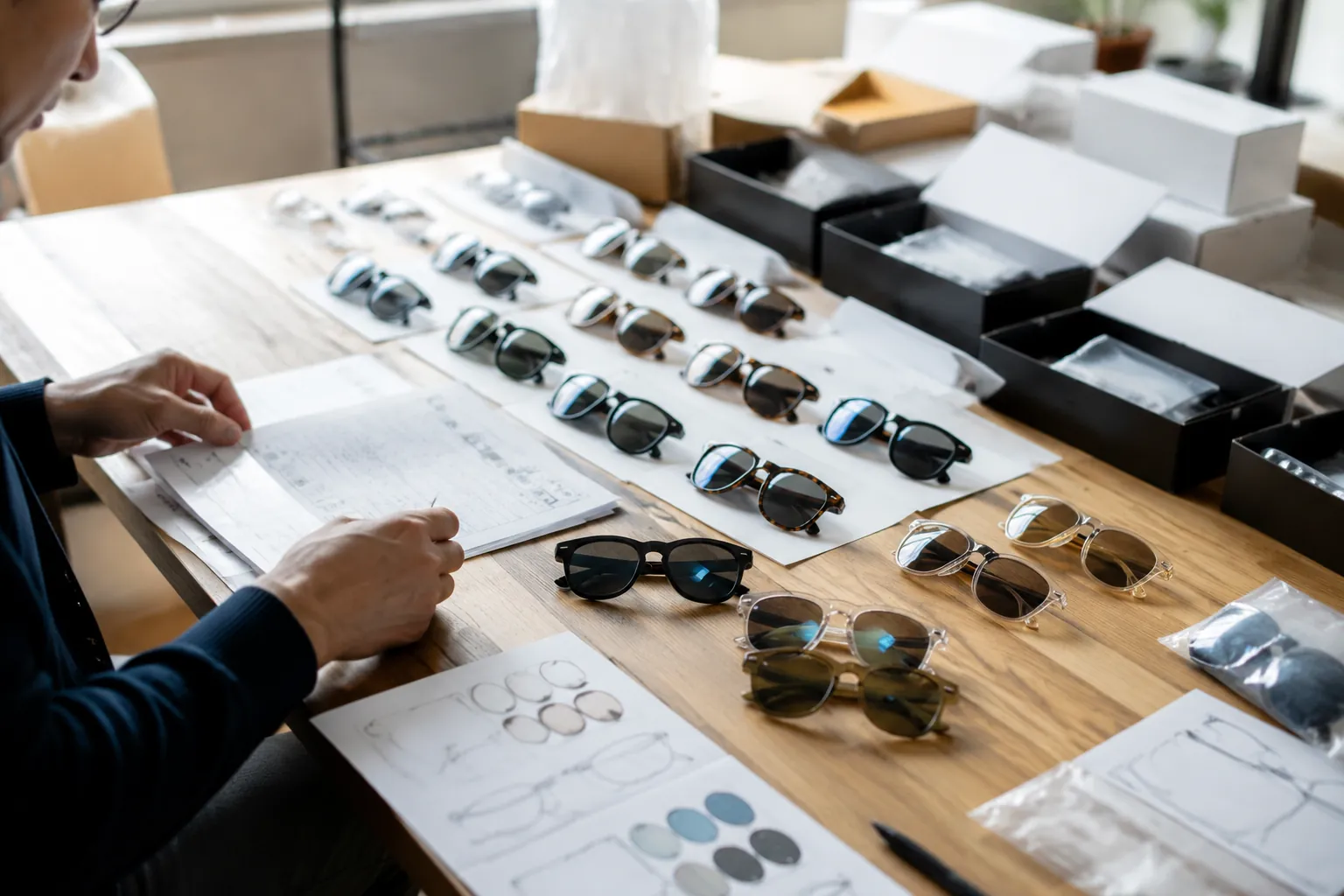
If you buy private label sunglasses for a brand, chain, or distributor, polarization looks simple until the quote lands. The wrong lens build, tint range, or accessory bundle can add cost without adding sell-through. That hits gross margin fast. This guide shows what to specify, how to compare quotes, and where buyers usually lose money.
What polarization should mean on your spec sheet
Do not stop at "polarized lens." That is not a spec. A supplier can still change the polarizing film, lens substrate, tint density, and coating stack. Each choice affects performance and price.
Write measurable targets. Include lens material, polarization type, visible light transmission, UV protection, and the scratch-resistance level you expect after normal retail handling. If the factory cannot build to that level of detail, samples will drift and replenishment orders may not match the first run.
Use plain language. Example: "gray polarized lens, 15% to 20% visible light transmission, UV400, base curve matched to frame, edge polish acceptable, coating to pass the agreed abrasion test without visible haze." Short. Specific. Hard to misread.
The commercial question is simple: does polarization earn its cost? For driving, fishing, boating, outdoor work, and higher-trust retail channels, usually yes. For fashion-first impulse frames, often no. You can end up paying for a feature the shopper never notices.
LumiShades says it manages injection molding, acetate cutting, CNC milling, lens tinting, decoration, and QC in-house in Wenzhou. That can help control fit and timing, but it does not replace a written spec. Lens-to-frame mismatch can still cause edge light leakage, glare, or poor seating even if the polarizer itself is correct.
Lens construction choices that change cost
Margin leakage often starts with the lens stack. A polarized lens is not one thing. It is a substrate, a polarization layer, and usually a coating package. Each layer adds cost. Each layer adds risk.
The main trade-off is not just clarity. It is impact behavior, weight, optics, and how tightly the factory can control the process at your target price. A thin spec that works at 5,000 pairs can fail at 50 pairs if the supplier has to spread setup and testing across too few units.
| Lens option | Typical buyer use | Cost impact | Commercial risk |
|---|---|---|---|
| AC / injected polarized lens | Fashion and value programs | Lowest | More prone to optical distortion, lower scratch resistance, and softer coating performance if the hard coat is weak |
| PC polarized lens | Sport, safety-minded retail, lightweight frames | Mid | Good impact behavior and low weight, but tint consistency and anti-scratch coating control must be tight |
| TAC polarized lens | Core private label retail SKU | Mid | Good optics and weight balance, but lamination quality, edge sealing, and humidity control matter |
| Glass polarized lens | Premium or specialty programs | High | Heavier, slower to ship safely, more breakage risk, and harder to recover margin unless retail price is clearly premium |
In practice, TAC and PC are the most common private label choices. TAC usually gives the best balance for general retail because it keeps weight low, optics clean, and price manageable. PC fits sport or utility positioning because impact resistance is stronger and the lens is less likely to crack in a drop or flex event. Glass can look premium, but freight, breakage, and claims can wipe out the margin advantage.
Ask for the real tolerance stack on lens dimensions. A capable factory should hold lens outline fit to an agreed tolerance on stable programs, with tighter control on premium frames and looser control on fashion shapes. If the lens is oversized or undercut, you can get edge light leakage, stress marks, or uneven seating in the frame groove.
Volume matters too. At 50 pairs per design, the per-pair price will be materially higher than at 1,000 or 5,000 pairs. Setup, coating prep, sample handling, and inspection do not get cheaper just because the order is small. Bulk pricing depends on lens type, frame material, decoration method, packaging, and the number of colors in the order.
Where the retail margin gets lost
Most buyers do not lose margin on one big mistake. They lose it on a stack of small ones. A few extra cents here and there can push landed cost above the shelf-price plan. Then the SKU struggles before it even ships.
Common cost leaks in polarized private label programs:
- Too many lens colors. Every extra tint adds setup time, sorting complexity, and inventory risk.
- Over-spec coating. If the channel will not pay for mirrored, anti-reflective, oleophobic, or premium hard coat, leave it out.
- Frame/lens mismatch. A tighter frame curve can force extra lens shaping, more rework, or scrap.
- Heavy packaging. A rigid box, magnetic closure, or oversized insert can cost more than the feature it protects.
- Low MOQ spread. At small quantities, tooling and setup get diluted badly, so the quote looks fine until freight and duties are added.
- Accessory creep. Microfiber pouch, hard case, cleaning cloth, insert card, barcode sticker, and custom outer box all add cost.
Start from the target retail price and work backward. If your channel wants a 3.0x to 4.0x markup on landed cost, and shelf price is $24.99, your landed cost target may need to sit around $6.25 to $8.30 depending on freight and retail structure. If the quote is already above that before duties and inland freight, the SKU is under pressure.
Visual overdesign is another leak. Buyers add mirrored film, foil stamping, embossed cartons, and a hard case because each item sounds inexpensive on its own. Put together, those extras can kill a simple sunglasses program, especially in discount or promo channels where shoppers do not reward premium packaging.
Use this order: target retail price, planned gross margin, landed cost ceiling, then product features. If the feature does not support the channel price, it does not belong in the spec.
What to specify before you ask for quotes
A good RFQ for polarized sunglasses is narrow. The supplier should not have to guess. If you leave the brief open, you will get quotes that are hard to compare and samples that do not match each other. Undefined inputs usually get filled in by the factory's cost preferences.
At minimum, include the following:
- Frame material: injected, acetate, metal, TR90, or mixed construction.
- Lens material: TAC, PC, AC, or glass.
- Polarization target: standard polarized, mirrored polarized, or gradient polarized.
- Color targets: Pantone reference, physical sample, or approved master standard for frame and lens tint.
- Performance target: UV400, visible light transmission range, and intended use case such as driving, outdoor, or fashion.
- Decoration method: laser engraving, pad printing, metal logo plate, hot stamping, or no decoration.
- Packaging: pouch, hard case, carton, insert card, barcode placement, and outer carton pack-out.
- Compliance market: EU, US, Australia/New Zealand, or mixed distribution.
If you sell into the EU, CE EN ISO 12312-1 and REACH matter. For the US, buyers commonly ask for FDA registration and should align claims with applicable eyewear requirements. ANSI Z80.3 is relevant for performance expectations in the US market. Australia/New Zealand buyers should check AS/NZS 1067. If a supplier cannot explain which documents apply to which market, move on.
Decoration deserves more attention than it gets. Laser engraving is clean and durable on metal temples and some acetate surfaces, but it can look faint if the substrate is too dark or textured. Pad printing is flexible for logos and short runs, but it needs cure control and can wear faster if the abrasion spec is weak. A metal logo plate looks premium, but it adds parts, labor, and adhesive or rivet failure risk. Hot stamping is cheap and sharp for promos, but it is usually the least durable option.
LumiShades says it works to CE EN ISO 12312-1, FDA registration, ANSI Z80.3, AS/NZS 1067, REACH, ISO 9001, and BSCI. Buyers should still request the specific test reports or registration details that match their own product and market.
Cost drivers by volume tier
Pricing moves with volume, but not in a straight line. The first drop comes from setup dilution. The next comes from material and labor efficiency. After that, decoration and packaging matter more than the base frame. So the volume ladder matters. A lot.
| Order tier | Typical cost behavior | Buyer focus | Risk |
|---|---|---|---|
| 50 pairs/design | High unit cost; tooling and setup are heavy | Test design, fit, and sell-through | Margin is thin; too many variants hurt cash flow |
| 300 pairs/design | Better dilution of setup cost | Core colorways and one packaging format | Still vulnerable to spec drift and rework |
| 1,000 pairs/design | Material and process efficiency improve | Stabilize one spec and lock QC checkpoints | Inventory risk if colors are too narrow |
| 5,000+ pairs/design | Best unit economics; lower quoted price possible | Optimize packaging, freight cube, and decoration | Forecast error becomes expensive |
LumiShades says its MOQ is 50 pairs per design, with pricing improving at 300, 1,000, and 5,000+ pairs. That is the right shape for a private label program: use the low MOQ to test the market, then reduce cost once the design proves itself. Do not start with five lens colors and three frame finishes unless you already know the SKU will turn. Every added color increases stocking needs, QC complexity, and the chance that one slow color drags the order.
Sample lead time and bulk production time should be confirmed in writing for each program, because they depend on complexity, materials, and approval speed. The buyer should treat sample timing as conditional on prompt feedback. If comments take two weeks to collect, the real lead time expands immediately.
One rule holds up well: sample cost is about proof of concept, while bulk pricing is about repeatability. A good sample does not guarantee a good margin. The factory still has to hold the same coating, same tint, same logo method, and same packing standard at scale.
Quality checks that catch bad polarized product
Polarization failures are usually visible if you know where to look. A good QC plan should catch more than scratches. The goal is not just cosmetic approval. It is performance, fit, and consistency across the run.
On a practical production line, buyers should ask for incoming material inspection, in-process checks, and final AQL inspection. For a stable program, many buyers use AQL 2.5 for major defects and 4.0 for minor defects, though the exact threshold depends on channel sensitivity. The key is agreement. Buyer and supplier need the same defect definitions before the PO is released.
- Polarization uniformity: check for dead zones, uneven darkening, or visible banding across both lenses.
- Optical distortion: look for waviness when viewing straight lines through the lens at normal head movement.
- Lens-to-frame fit: confirm no edge light leak under normal wear pressure and no popping at the groove.
- Surface finish: inspect for coating haze, dust inclusions, print misregistration, and temple scuffing.
- Color consistency: compare lens tint against the approved master sample under the same light source.
Use the rotate-and-check method. Hold two polarized lenses together and rotate one by 90 degrees. The darkening effect should rise and fall predictably. If it does not, the polarizer orientation or lamination quality is suspect. That is not a cosmetic defect. It means the product does not perform as sold.
Ask for tolerance confirmation on hinge alignment, temple opening force, and lens seating. A strong lens can still feel cheap if the hinge torque is inconsistent or the left and right temples do not open evenly. Small fit issues create returns once the product reaches end consumers.
For export programs, QC should also verify label accuracy, compliance-mark placement, lens marking if required, and carton consistency. A wrong compliance claim, missing batch detail, or mismatched master carton count creates customs and retail headaches that cost far more than a careful pre-shipment check.
How to use a factory like LumiShades
The fastest sourcing projects are the ones where the buyer brings enough data up front. A good factory can still help, but it should not have to reverse-engineer the brief. The most efficient request is specific, numeric, and tied to a clear retail target.
Send one approved reference style, one target retail price, one market list, and one must-have spec list. Then ask for a quote split by frame, lens, decoration, packaging, and shipping assumptions. That shows exactly where the money sits. If the price is off, you can trim one variable at a time instead of guessing.
LumiShades says it runs injection molding, acetate cutting, CNC milling, lens tinting, decoration, and QC in-house. That can reduce handoff risk in polarized programs because every transfer between vendors adds delay and error potential. If the lens is outsourced, the frame is made elsewhere, and decoration happens later, the sample cycle slows and the defect loop widens.
Use the first sample to confirm only three things: fit, lens performance, and visual balance. Do not spend round one debating minor packaging print changes or a second logo position. Lock the product first. Then tune the box. Buyers who spend too long polishing packaging usually delay the SKU that actually sells.
The right factory relationship is not about asking for everything. It is about asking for the right three things, in the right order, and making sure the quote reflects the same assumptions as the sample.
Buyer checklist before PO release
Before you place the order, make sure the PO matches the sample and the business case. This is where many private label programs fail. The approved sample and the written order are not the same document.
- Approved sample number and approval date recorded
- Lens material and polarization type fixed in writing
- Compliance market named on the PO
- Color codes and decoration artwork signed off
- Packaging BOM listed line by line
- Target defect threshold and inspection method agreed
- Lead time split into sample, bulk, and shipping windows
- Freight assumption and incoterm confirmed
If the supplier cannot confirm the above clearly, the quote is not ready. A cheap polarized sunglass that arrives late, shifts tint, or fails retail inspection is not cheap. It is dead stock.
The best sourcing result is boring. The lens works. The frame fits. The paperwork is correct. The margin survives freight and duties. That is the standard. If your program can meet it consistently, you have a scalable private label product, not a one-off order.
FAQ for buyers
These are the questions buyers ask most often when they are trying to turn a polarized concept into a profitable private label SKU.
- What should I buy first? Start with one proven shape, one lens material, and one packaging format. Complexity costs more than most first-time buyers expect.
- Should I launch with multiple tints? Only if your channel already proves demand. Extra colors increase setup and can trap cash in slow-moving stock.
- How tight should fit be? Ask the factory to hold consistent lens seating and hinge symmetry, then verify sample units under normal wear pressure.
- What hurts margin fastest? Overbuilt packaging, low MOQ, and decoration upgrades that do not move selling price.
If you want a program that scales, keep the product simple, the tolerances clear, and the quote tied to the price you can actually sell at.
Have a custom sunglasses project in mind?
Send us your styles, target market and quantities and we will return a detailed quote with MOQ, lead time and a sample plan.
Get a QuoteWhy source this from Wenzhou with LumiShades
Wenzhou in Zhejiang Province is widely regarded as China’s eyewear manufacturing capital, producing a large share of the world’s sunglasses. That concentration matters to buyers: a deep local supply chain for acetate sheet, hinges, lens blanks, plating and packaging means shorter component lead times, easier color and material matching, and a workforce with decades of eyewear-specific skill. LumiShades has manufactured in this ecosystem since 2009, and our vertical integration — in-house injection molding, acetate cutting, CNC milling, lens tinting, decoration and quality control — means no part of your order is quietly subcontracted to a workshop you cannot audit.
For international buyers, that vertical control translates into accountability. When a single factory owns every step, defects are traced and fixed at source rather than bounced between vendors, and your specifications survive intact from first sample to bulk. We back this with 15+ years of experience, shipments to 60+ countries, more than 5 million pairs produced per year and a 98.5% on-time delivery rate. Our certifications — CE EN ISO 12312-1, FDA registration, ANSI Z80.3, AS/NZS 1067, REACH, ISO 9001 and BSCI audit — mean the compliance documentation your market requires already exists. Explore our manufacturing capabilities and quality control process to see how this works in practice.
Frequently asked questions
What lens material is best for private label polarized sunglasses? For most retail programs, TAC is the safest default because it balances clarity, weight, and cost. PC is better when impact resistance matters more, and glass only makes sense when the retail price can absorb the extra weight, breakage risk, and freight cost.
How much should I expect MOQ to affect price? A lot. At 50 pairs per design, setup cost dominates. Pricing usually improves at 300, 1,000, and 5,000+ pairs because tooling, labor, inspection, and material waste are spread across more units.
What compliance documents should I ask for? Match the market. Ask for CE EN ISO 12312-1 and REACH for EU-bound goods, FDA registration for US supply chains, ANSI Z80.3 for US performance expectations, and AS/NZS 1067 for Australia/New Zealand.
How long should samples and bulk orders take? Ask the factory to quote both separately and in writing. Timing depends on design complexity, materials, decoration, and how quickly you approve samples, so do not rely on a generic lead-time promise.
Where do buyers usually lose margin on polarized sunglasses? The common leaks are too many colorways, overbuilt packaging, expensive coatings that do not raise retail price, and low MOQ spreading setup costs across too few units.
What should I confirm before placing a private label order? Confirm the approved sample, lens material, polarization type, compliance market, artwork, packaging BOM, defect threshold, incoterm, and lead time in writing before the PO goes out.
Ready to start?
Explore our sport wrap sunglasses or request a quote — our sales team replies within 12 hours.
Request a Quote