
Polarized Sunglasses QC for Wholesale Buyers
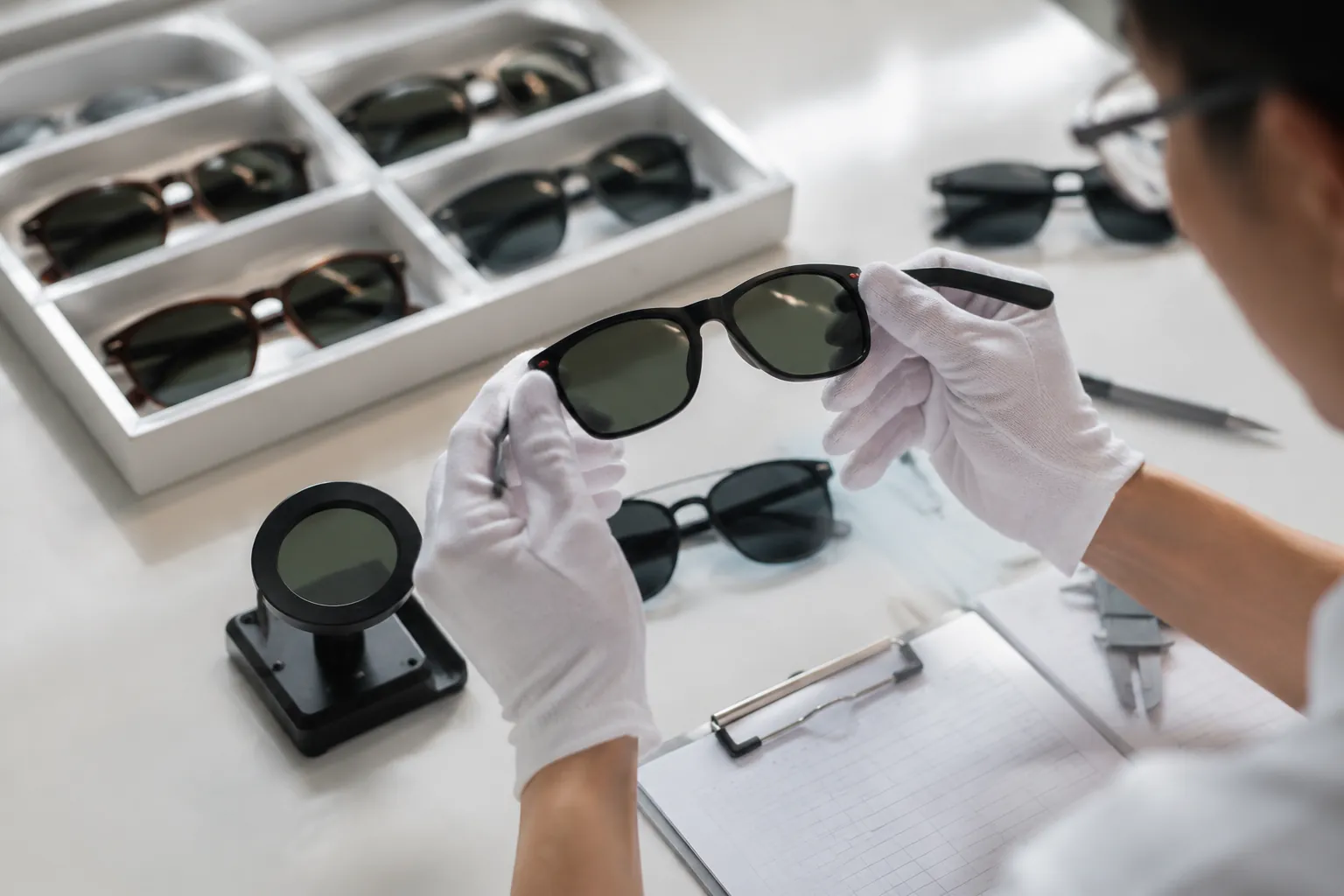
This guide is for importers, retailers, distributors, and brand owners buying polarized sunglasses in bulk. It shows what to check before goods leave the factory: polarization strength, axis alignment, distortion, delamination risk, decoration effects, batch consistency, and compliance. Use it to write clearer specifications, set inspection rules, reduce returns, and catch lens problems that a normal cosmetic check can miss.
Start with what polarization must do
Polarization is not darkness. A dark sunglass lens can reduce visible light and still do little against reflected glare. A polarized lens uses a polarizing filter, often laminated into TAC, PC, nylon, or CR-39 construction, to reduce horizontally reflected light from roads, water, snow, vehicle surfaces, and glass.
For wholesale buyers, the first QC question is simple: does the finished lens reduce glare at the correct wearing angle? The second question matters just as much: do the left and right lenses perform the same way? In most polarized sunglasses, the polarizing axis should sit close to vertical when worn so it can block horizontal glare. If one lens is misaligned, the wearer may notice weak glare control, eye strain, or different vision between eyes.
Do not approve mass production from one loose lens. Check polarization at several stages: incoming lens material inspection, after cutting or edging, after frame assembly, and during final pre-shipment inspection. Heat, rough edging, groove pressure, forced insertion, and rework can damage laminated lenses after an early inspection pass.
A basic factory check needs only three tools: an LCD screen, a known-good polarized reference lens, and a reflective glare surface such as water, glass, or a glossy black tile under strong light. Rotate the sunglass lens in front of the LCD screen. A polarized lens should shift clearly from light to dark. The change should be even, not patchy. Left and right lenses should darken at similar angles.
Use a buyer-side test plan, not guesswork
You do not need expensive optical equipment to catch many weak polarized sunglasses. You do need a fixed method, a control sample, and a sample size. For small custom orders, 100% checking may be realistic. For larger runs, use a written sampling plan, pull from several cartons, and do not inspect only the top layer or factory-selected pieces.
If you use an AQL plan, classify failed polarization, wrong lens category, sharp edges, loose lenses, broken hinges, and incorrect compliance claims as major or critical issues. They are not minor cosmetic defects.
- Screen rotation test: hold each lens in front of a phone, tablet, or LCD monitor showing a white screen. Rotate the frame slowly. The lens should change clearly from lighter to darker. Weak change, blotchy darkening, or different left-right timing should trigger a batch hold and comparison against the approved sample.
- Cross-lens test: place the production lens over a known-good polarized lens and rotate one lens. At the extinction angle, the overlap should become very dark. If it never darkens much, polarization may be weak or the lens may not be polarized as ordered.
- Glare comparison: view a reflective surface with the sample and with a non-polarized lens of similar visible darkness. The polarized lens should visibly reduce reflected glare at the normal wearing angle.
- Axis check: use a level frame position and a consistent rotation reference. Both lenses should reach maximum darkening or glare reduction at nearly the same rotation angle. If axis alignment is a key selling point, ask the factory to record checks by lens lot.
- Left-right matching: compare lens color, visible darkness, mirror coating, and polarization effect. A shade drift that looks small on one loose lens can become obvious in retail display, product photography, or normal wear.
Keep one approved pre-production sample as the golden sample. Mark the frame model, lens material, lens color, filter category, mirror treatment if any, logo method, approval date, and destination market on its bag or box. Photograph it under consistent light. The factory should retain a duplicate. Compare mass production to the control before full assembly and again before shipment.
Distortion is the return problem buyers miss
Lens distortion makes sunglasses feel cheap fast. Consumers rarely call it "optical distortion." They say the glasses make them dizzy. The ground bends. Text looks warped. The view feels tiring after a few minutes.
The risk is higher on high-wrap sports frames, oversized fashion styles, shield fronts, very thin lenses, and low-cost injected lenses with loose process control. Polarized construction adds more variables: film tension, lamination pressure, forming temperature, edging stress, and frame pressure. PC lenses may show stress patterns if the frame squeezes them. TAC polarized lenses are widely used in cost-sensitive programs, but poor lamination or edge processing can create waves, edge whitening, or instability.
Use a grid board test as a practical screen. Place a black-and-white square grid on a wall and view it through each lens at a normal wearing distance. Lines should remain reasonably straight. Reject strong waves, localized blur, pulling, or swimming movement. Move the frame slowly left and right. If the grid ripples heavily, the lens or assembled frame is not suitable for a serious retail product.
Also check for obvious prismatic imbalance. Hold the sunglasses at arm's length and look through both lenses at a vertical line, such as a door frame. The line should not jump sharply when viewed through the left lens versus the right lens. This is only a screen. If your program requires measured optical limits, state the applicable standard and acceptance criteria in the purchase order. Ask the supplier or test lab to identify the equipment and method used.
Distortion control is not only a lens issue. Frame groove depth, bevel accuracy, bridge alignment, screw tension, hinge symmetry, and lens insertion force can all affect the final optical result. Inspect finished sunglasses, not only loose lenses.
Match QC to the polarized lens material
Not all polarized lenses behave the same way. The right QC plan depends on lens material, frame curve, target price, intended use, and sales channel. A beach promotion and a premium acetate style may use different lens packages. Both still need safe UV performance, stable polarization, and consistent appearance.
| Lens option | Typical use | Material behavior | Main QC risk | Buyer check |
|---|---|---|---|---|
| TAC polarized | High-volume fashion, beach, promo, and entry retail programs | Lightweight laminated construction; common where cost and weight matter | Delamination, edge whitening, uneven tint, and sensitivity to heat, moisture, or rough edging | Inspect edges after assembly; add heat screening for summer or high-temperature logistics programs |
| PC polarized | Sports, kids, and impact-focused styles | Impact-resistant and flexible, but can show stress if fitted too tightly | Optical waves, coating scratches, stress marks, and frame pressure effects | Run grid distortion checks, scratch review, frame pressure checks, and hinge alignment review |
| Nylon polarized | Curved sports frames and higher-clarity wrap styles | Flexible and often suitable for higher-base curves when processed correctly | Higher cost, tint variation, forming issues, and axis drift if process control is weak | Compare color lot, axis alignment, curve fit, and optical stability before mass assembly |
| CR-39 polarized | Premium fashion and some acetate styles | Known for good optical quality but less impact-resistant than PC | Chipping, breakage in thin shapes, higher weight, and edge damage | Check edge finish, handling damage, screw pressure, lens fit, and prism balance |
For driving, fishing, boating, resort, or beach retail programs, do not approve lenses by color alone. Specify lens material, lens color, mirror treatment if used, UV claim, filter category, base curve or frame curve, nominal lens thickness, and the standard required for the destination market. If the supplier proposes a material change after sample approval, require a new approval sample or written buyer sign-off.
Catch delamination before it reaches customers
Delamination usually starts at the edge. Later it appears as bubbles, cloudy patches, peeling layers, a silver line creeping inward, or a milky crescent near the bevel. By then, the product may already be in cartons, stores, or customers' hands.
Common causes include weak film bonding, moisture in lens sheets, rough edging wheels, overheating during tinting or forming, aggressive cleaning solvents, poor mirror-coating adhesion, and excessive frame pressure on the lens rim. One worker forcing a lens into a tight frame can create a stress point that fails later. Heat during storage or transport can speed up the failure.
Ask for heat and humidity screening on production samples where the risk is relevant, especially for TAC polarized lenses, mirror lenses, and summer or beach assortments. A practical pre-shipment screen is controlled heat exposure followed by inspection under bright white light. Some buyers also request warm-water exposure followed by edge inspection after cooling. These screens do not replace formal lab testing. Agree on temperature, duration, sample size, and pass/fail criteria before production.
- Reject bubbles, cloudy patches, edge peeling, film separation, or silver lines near the rim.
- Reject uneven mirror coating, especially thinning, cracking, or lifting near the bevel.
- Flag delamination that appears only after lens insertion; this points to frame groove pressure, lens-size tolerance, or assembly force.
- Check packed goods as well as display samples, because carton heat and compression can reveal weak lamination.
- Avoid direct contact between lenses and oily printing, soft PVC accessories, fresh solvent-based ink, or untested packaging materials unless compatibility has been checked.
Packaging can reduce risk or create it. Use clean pouches, dry cartons, and suitable moisture control where needed. Do not compress sunglasses so the lens rubs against temple tips, logo plates, metal trims, or printed inserts during transit.
Control batch changes, MOQ, price, and lead time
Small MOQs help brands test a style. They also make batch control more important. Lens lots, frame colors, and decoration materials may be split across short runs. Before ordering, confirm the supplier's MOQ by frame type, colorway, lens option, logo method, and packaging setup. A supplier may support small custom runs for standard materials but require higher quantities for new molds, custom acetate, special lenses, private packaging, or metal components.
Unit price is quote-specific. It depends on frame material, lens material, lens coating, polarization type, decoration, packaging, inspection level, test requirements, and order quantity. If the price looks low, ask what is included: lens material, UV claim, filter category, logo process, pouch or case, barcode labels, carton marks, compliance documents, and third-party testing.
Lead time also depends on the project. Existing molds, standard frame colors, standard lens colors, and simple logos usually move faster. New molds, custom acetate, special metal trims, unusual mirror coatings, and complex packaging take longer. Put the sample approval date, deposit date, material approval date, production start date, inspection date, and shipment date into the purchase order or production schedule.
At small quantities, 100% visual and polarization inspection may be practical. At larger quantities, require carton-based sampling and records showing lens lot, frame color lot, logo method, packing date, inspector name, and rework notes. In high-volume programs, one bad lens lot can become a large claim. Document incoming lens inspection before assembly begins.
Decoration affects QC. Laser engraving can overheat acetate or coated surfaces if settings are wrong. Pad printing needs adhesion testing after curing. Metal logo plates can scratch lenses if packed too tightly. Hot stamping, foil logos, and temple inlays can delay assembly and increase handling. Decoration is not separate from lens quality. Factory flow, storage, and rework discipline matter.
Practical rule: approve one golden sample per colorway and keep one factory-retained duplicate. If production uses a new lens lot, frame color lot, logo process, or packaging material, compare it to the approved control before mass assembly.
Tie compliance documents to the actual lens
Compliance is not just paperwork. It must match the sunglasses you approve. If the purchase order says UV400, polarized, category 3, smoke lens with silver mirror, the report, production sample, carton label, invoice description, and online claim should not describe a different product.
For the EU, sunglasses are commonly assessed against EN ISO 12312-1 for CE marking. For the U.S., ANSI Z80.3 is commonly used for non-prescription sunglasses. FDA registration may be relevant for eyewear import administration, but it is not FDA product approval. For Australia and New Zealand, AS/NZS 1067 applies. REACH is relevant to restricted substances in plastics, coatings, paints, metals, and packaging components for the EU market. ISO 9001 and BSCI are management and social-compliance indicators. They do not prove UV protection, polarization performance, or lens category.
Do not ask a supplier to "send all certificates" and assume the shipment is covered. Ask for reports or declarations that match the product type, lens material, lens category, lens color, mirror coating if any, and destination market. Check the test date, applicant or manufacturer name, model coverage, standard version, product description, and whether the tested item was polarized or non-polarized. If a report covers a different lens material, different filter category, or unrelated frame family, it may not support your shipment.
Acceptable compliance evidence may include CE EN ISO 12312-1 documentation, ANSI Z80.3 test information, AS/NZS 1067 documentation, REACH-related material declarations or test reports, FDA registration details where relevant, ISO 9001, and BSCI. Still, tie every document back to the purchase order: frame model, lens type, tint, mirror coating, logo treatment, packing method, and intended sales region.
Pre-shipment inspection checklist
Do not wait until the final production week to define inspection criteria. Put measurable checks into the purchase order, approved specification sheet, or QC agreement before materials are ordered. Clear standards make it easier to stop weak goods before shipment.
A solid pre-shipment inspection for polarized sunglasses should include:
- Polarization: LCD rotation, cross-lens extinction, glare comparison, axis alignment, and left-right matching.
- Optics: grid distortion test, prism jump check, haze review, and short wearing comfort check.
- Lens condition: scratches, coating pinholes, mirror uniformity, bubbles, edge whitening, cracks, and delamination.
- Assembly: lens fit, frame symmetry, hinge movement, screw tightness, temple alignment, nose pad position, and sharp-edge review.
- Decoration: laser engraving position, pad print adhesion, logo plate alignment, foil or hot-stamp cleanliness, and color matching.
- Packing: barcode accuracy, pouch or case cleanliness, carton marks, mixed-color ratio, moisture protection, and compression risk.
- Documents: invoice description, packing list, compliance reports or declarations, approved sample reference, lens lot record, and inspection report.
Be specific on rejection limits. "Good quality" is not an acceptance standard. State that failed polarization, wrong lens color, incorrect filter category, visible delamination, sharp frame edges, loose lenses, broken hinges, mixed left-right tint, incorrect markings, or missing compliance documents are major defects. For retail programs where product claims appear on packaging or online listings, treat incorrect UV, polarization, or filter category claims as critical because they create consumer-safety and regulatory risk.
Have a custom sunglasses project in mind?
Send us your styles, target market and quantities and we will return a detailed quote with MOQ, lead time and a sample plan.
Get a QuoteWhy source this from Wenzhou with LumiShades
Wenzhou in Zhejiang Province is widely regarded as China’s eyewear manufacturing capital, producing a large share of the world’s sunglasses. That concentration matters to buyers: a deep local supply chain for acetate sheet, hinges, lens blanks, plating and packaging means shorter component lead times, easier color and material matching, and a workforce with decades of eyewear-specific skill. LumiShades has manufactured in this ecosystem since 2009, and our vertical integration — in-house injection molding, acetate cutting, CNC milling, lens tinting, decoration and quality control — means no part of your order is quietly subcontracted to a workshop you cannot audit.
For international buyers, that vertical control translates into accountability. When a single factory owns every step, defects are traced and fixed at source rather than bounced between vendors, and your specifications survive intact from first sample to bulk. For procurement review, buyers can request process records, approved samples, quality checkpoints and project-specific compliance files before placing a bulk order. Required testing and documentation are confirmed against the destination market and product specification rather than assumed from a generic certificate list. Explore our manufacturing capabilities and quality control process to see how this works in practice.
Frequently asked questions
Can I test polarized sunglasses without laboratory equipment? Yes. Use an LCD screen, a known-good polarized reference lens, a reflective glare surface, and a grid board. The LCD and cross-lens tests help confirm polarization. The glare comparison checks real-use performance. The grid board helps reveal obvious distortion. These are practical pre-shipment screens, but they do not replace formal testing when a market standard or retailer requires measured results.
What tolerance should I request for polarized lens axis alignment? State the tolerance in your specification instead of leaving it to judgment. Tighter retail programs often need narrow axis tolerance and close left-right matching. Value programs may accept a wider tolerance if both lenses perform consistently. Ask the supplier to define the measurement method, record results by lens lot, and hold the batch if left and right lenses reach maximum extinction at noticeably different angles.
What is the main cause of polarized lens delamination? There is rarely one cause. Common causes include weak film bonding, moisture in lens sheets, rough edging, overheating, solvent exposure, poor coating adhesion, and excessive frame pressure during lens insertion. Inspect the lens edge after assembly, then re-check samples after controlled heat or humidity screening if the product will face summer retail, beach use, or hot logistics conditions.
Should every pair be checked in a small wholesale order? For a small custom order, 100% visual and polarization checking is often practical and gives the buyer better control. For larger runs, use a written sampling plan, pull from multiple cartons and production points, and require records for lens lot, frame color lot, inspector, packing date, and rework. Do not let the factory inspect only loose lenses or only top-carton samples.
Which compliance standards should I request for polarized sunglasses? Match the destination market and product claim. For the EU, request CE documentation linked to EN ISO 12312-1. For the U.S., ANSI Z80.3 is commonly used for non-prescription sunglasses, and FDA registration may be relevant for import administration. For Australia and New Zealand, request AS/NZS 1067 documentation. For EU material safety, request REACH-related evidence where applicable. ISO 9001 and BSCI can support supplier evaluation but do not prove lens performance.
How early should I approve polarized lens quality? Approve it at the pre-production sample stage before bulk materials are committed. Approval should cover lens material, color, filter category, mirror coating if any, polarization effect, axis consistency, distortion, and assembled frame fit. Then require the factory to compare mass-production lens lots against the golden sample before full assembly and again during pre-shipment inspection.
Does lower price always mean poor polarized lens quality? No. Higher quantities, standard materials, efficient frame designs, and simple packaging can reduce unit cost without making the lens poor. But low pricing usually limits lens options, coating choices, decoration complexity, inspection time, and packaging. Ask the supplier to list exactly what is included in the quotation. Do not remove polarization, UV, lens category, or safety checks to save cost.
Ready to start?
Explore our aviator sunglasses or request a quote — our sales team replies within 12 hours.
Request a Quote