
Spec UV400, Polarization, and Tint by Sales Channel
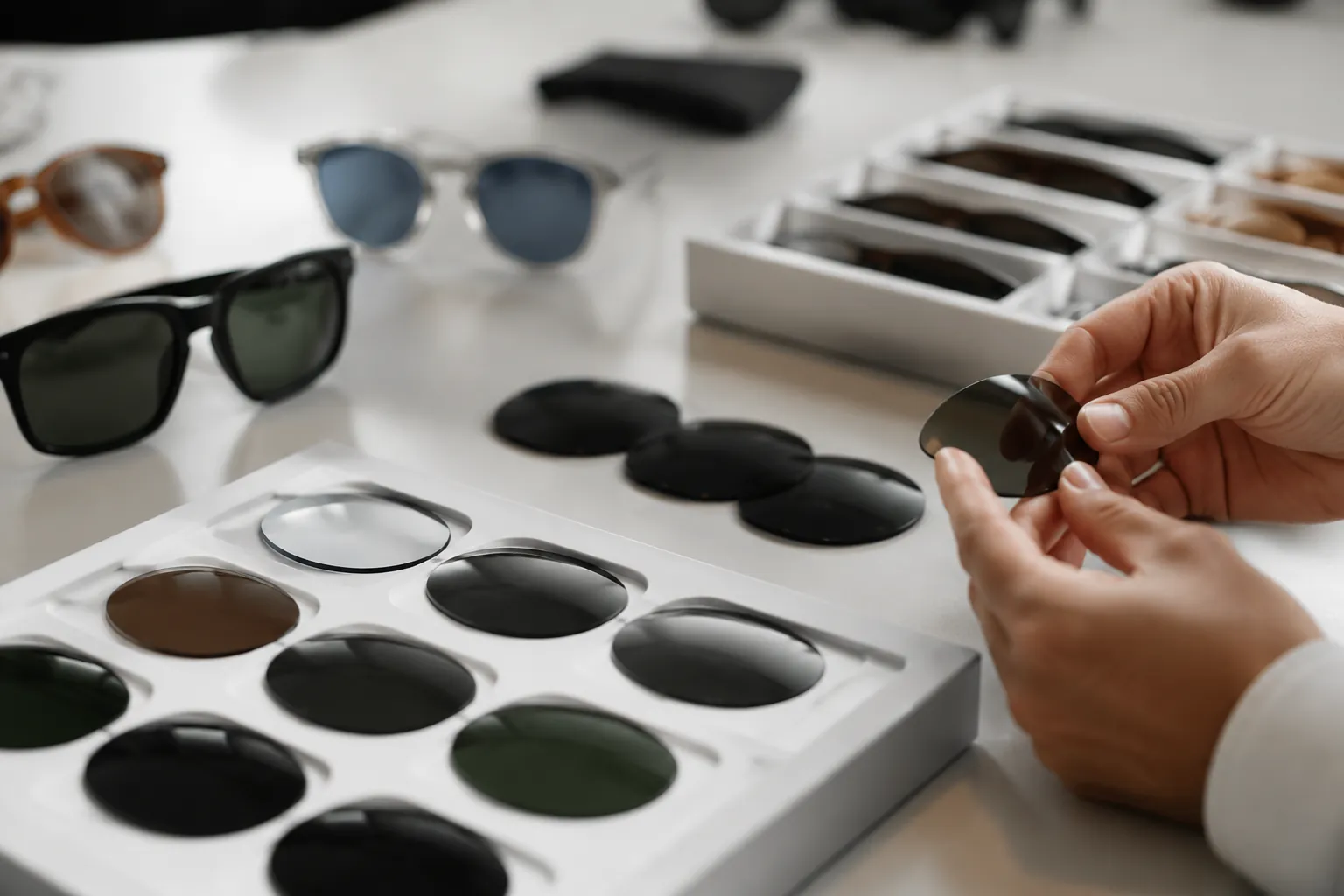
This guide is for brands, importers, distributors, and retailers buying custom sunglasses in volume. The mistake is simple: treat lens choice as a styling detail and assume the rest will sort itself out. It will not. The right mix of UV400, polarization, and tint density changes by channel, and the wrong mix shows up fast as returns, complaints, or dead stock. Start with the shelf, the user, and the use case. Then lock the lens spec before production starts.
Start With the Channel, Not the Lens
Weak sunglass specs usually start with a vague brief. A buyer asks for something darker, more premium, or better at cutting glare, and the factory fills in the gaps. That is backwards. Fashion retail, outdoor sport, promo, and value retail punish different mistakes.
Fashion buyers usually want a lens that still looks good under store lighting. Outdoor buyers care more about glare control and visual comfort. Promo buyers often care about logo visibility and landed cost. Value retail needs repeatability and compliance more than feature claims. Keep that straight.
Before you ask for samples, define the use case in plain terms. Where will the customer wear the glasses, for how long, and in what light? Will the style be tried on indoors, worn on water or snow, or handed out at events? Also decide whether screen readability matters. Polarization can make some LCDs, phones, dashboards, and POS screens harder to read at certain angles.
A good brief names the destination market, target user, preferred lens color, expected visible light transmission, and whether you want non-polarized, polarized, or mirrored lenses. If your supplier controls molding, cutting, tinting, and QC in-house, you can lock the lens spec earlier and reduce late-stage changes. That matters. Lens changes after sampling usually create avoidable cost and delay.
- Fashion retail: appearance first, moderate tint, and low risk of a lens that feels too dark indoors.
- Outdoor: glare control and UV protection first, often with polarization.
- Promo: cost, logo visibility, and broad comfort usually matter more than optical extras.
- Value retail: compliance and consistency usually matter more than premium lens claims.
UV400 Is the Baseline, Not the Whole Spec
UV400 means the lens is intended to block UVA and UVB radiation up to 400 nm. That is the baseline for serious sunglasses. It does not tell you how dark the lens is, and it does not tell you whether the lens is polarized. A clear lens can still be UV400. A very dark lens can still be a poor product if the protection claim is not supported properly.
For overseas buyers, the compliance target should match the destination market. CE EN ISO 12312-1 is the key product standard for sunglasses sold in the EU. ANSI Z80.3 is the main U.S. sunglasses standard. AS/NZS 1067 applies in Australia and New Zealand. REACH matters for material restrictions in the EU supply chain, and FDA registration is part of the U.S. supplier-side compliance picture. Put the destination market on the purchase order and ask for the matching document set, not a generic compliance letter.
Ask for spectral transmittance data from 280-400 nm, not just a marketing statement. If the product is for the EU, also ask which lens category it falls into. Category 0 is above 80% VLT, Category 1 is 43-80%, Category 2 is 18-43%, Category 3 is 8-18%, and Category 4 is 3-8%. Category 4 is not suitable for driving. A fashion style meant for indoor try-on usually sits in Category 1 or 2. An outdoor style often sits in Category 3 if the channel expects strong sun. UV400 protects the eye. It does not make the product right for the channel.
Pick the Lens Package by Sales Channel
Channel choice should drive the lens stack, not the other way around. Start with the use case, then decide on material, tint, and polarization. TAC is a common choice for polarized outdoor styles because it works well as a laminated polarized lens. PC is impact resistant and lightweight, which can suit promo and sport programs, but it usually needs a hard coat if you want better scratch resistance. CR-39 can offer clean optics, but it is less common in aggressive low-price programs because it is heavier and less impact tolerant.
| Channel | Recommended lens package | Practical VLT target | Main risk if you miss |
|---|---|---|---|
| Fashion retail | UV400, non-polarized or light polarized, gray or brown tint, optional gradient | 20-40% | Lens feels too dark in stores or loses try-on appeal |
| Outdoor / sport | UV400, polarized, gray or brown tint, optional mirror coat | 8-20% | Glare complaints and weak perceived performance |
| Promo / corporate gift | UV400, non-polarized, simple smoke or blue-tint options | 30-60% | Cost rises faster than the program can support |
| Value retail | UV400, usually non-polarized unless the price tier supports polarization | 15-35% | Returns from lenses that feel too dark or inconsistent |
Use the table as a starting point, not a rulebook. Polarization helps on water, roads, and snow, but it can make some screens harder to read at certain angles. That is why some fashion and promo programs should stay non-polarized even when the buyer likes the idea of better performance. If the customer mostly wants style or daily light reduction, a clean UV400 non-polarized lens often sells better. If the buyer wants a premium look without going fully dark, a light mirror over a medium tint can help, but it adds cost and production complexity.
Color matters too. Gray keeps color perception the most neutral. Brown generally increases contrast and can feel more comfortable in mixed light. Green sits between the two. If you are buying one style for many markets, gray is usually the safest default. If the channel is outdoor-heavy, brown often gives users the contrast they want.
Use VLT to Control Tint Density
Buyers often say light tint or dark tint, but that is too vague for production. Ask for visible light transmission, or VLT. It tells you how much visible light passes through the lens. Lower VLT means a darker lens. That is the number your sample should hit, and it is the number that should guide the bulk run. If you want repeatable production, write the target VLT and the acceptable tolerance into the spec sheet, not only into an email.
Practical tolerances depend on the channel and the brand position. For fashion and value retail, a VLT window of plus or minus 3 percentage points is often a reasonable working target. For higher-end outdoor styles, plus or minus 2 points gives tighter consistency across reorders. On paired lenses, keep the left and right lenses visually matched. Buyers notice mismatch faster than they notice a small shift in shade. If you use a gradient lens, define the top and bottom VLT separately so the factory knows what to match.
- 40-60% VLT: useful for promo and mixed indoor-outdoor fashion use; the lens still looks approachable on display.
- 20-40% VLT: a common middle range for fashion retail; enough tint to feel like sunglasses without making try-ons harsh.
- 8-20% VLT: better for outdoor and sport, especially when paired with polarization.
- Below 10% VLT: only if the channel expects very dark sun protection and the buyer has validated market response.
Tint density is not the same thing as UV protection. A dark lens with weak UV blocking is not acceptable. A lighter lens with proper UV400 can be completely valid. If the frame is acetate or CNC-cut, edge finish and tint consistency matter because buyers notice color mismatch more easily when the lens is more visible against a thicker frame profile.
Match the Lens to the Frame and Decoration
The lens spec cannot be separated from the frame build. Injection-molded frames usually suit faster color changes and lower-cost programs. They work efficiently for TR90, PC, and mixed-material front pieces when you need a clean, light frame at scale. Acetate fits fashion pieces that need a richer look and more visible edge depth. CNC milling is useful when the shape needs tighter geometry, sharper bevels, or a more premium finish.
Decoration also affects lens decisions. Laser engraving, pad printing, hot stamping, and metal logo plates should be locked before final bulk, because you do not want to find out late that the logo placement fights the lens edge or changes the visual balance. Pad print is usually the lowest-cost route for one or two spot colors. Laser engraving is cleaner for fine lines and can hold detail well on temples or metal parts. Metal plates create a premium feel but add assembly time and can force a thicker temple section.
For QC, inspect both lenses as a pair, not as separate parts. Check tint consistency, polarization orientation where applicable, lens centering, and visible flaws such as haze, scratches, edge chips, or coating defects. If the lens stack includes polarization, the axis should match across the pair so the end user does not get uneven glare behavior or uneven screen performance. If you need a supplier check, ask whether they hold current ISO 9001 and BSCI documentation; those documents help assess factory systems, but they do not replace product test reports.
Write Compliance Into the Purchase Order
Do not leave compliance as a generic must-pass line. Write the destination market, lens category, VLT target, and artwork text into the purchase order. That reduces disagreement later if a sample looks right but the label, test report, or packaging copy is wrong. One incorrect line on the carton can delay a shipment even when the eyewear itself is acceptable.
The PO should say exactly what you want the factory to deliver: UV400 claim, lens color, polarization yes or no, mirror yes or no, coating type, and the destination standard. If you are shipping to the EU, specify CE EN ISO 12312-1 and REACH. If you are shipping to the U.S., specify ANSI Z80.3 and the supplier-side FDA registration documents. If you are shipping to Australia and New Zealand, specify AS/NZS 1067. If you are selling to more than one region, use modular artwork or region-specific inserts so one base frame can serve multiple markets without reprinting everything.
Best practice: define the lens claim, the destination standard, and the artwork text before sample approval.
Also be careful with consumer-facing claims. If the program includes polarized lenses, say so clearly. If it does not, do not use language that suggests glare control you are not supplying. That mismatch is one of the fastest ways to trigger complaints after launch.
Sample It, Then Scale It
Use the sample stage to answer the questions that matter in the field, not in the office. Test under store lighting and daylight if possible. Hold the sample against neutral daylight or a D65 light source so you can compare tint consistency properly. Keep one sealed golden sample as the production reference. If the program includes a new frame, ask for first article approval before the full run, especially if the logo sits close to the lens edge or the temple curve changes the fit.
During review, compare the sample against the brief, not against a memory of what the style should be. Check these points before approving bulk:
- Does the lens feel too dark under store lighting?
- Does polarization improve the use case enough to justify the added cost?
- Does the tint still look clean next to the chosen frame color?
- Does the logo remain readable against the lens and frame finish?
- Do the labels, markings, and packaging match the destination market?
For a serious buyer, the first sample should be a decision tool, not a souvenir. Approve the lens package, the frame finish, and the compliance marking together. That is how you keep reorders stable and avoid reworking a program after the first shipment.
Have a custom sunglasses project in mind?
Send us your styles, target market and quantities and we will return a detailed quote with MOQ, lead time and a sample plan.
Get a QuoteWhy source this from Wenzhou with LumiShades
Wenzhou in Zhejiang Province is widely regarded as China’s eyewear manufacturing capital, producing a large share of the world’s sunglasses. That concentration matters to buyers: a deep local supply chain for acetate sheet, hinges, lens blanks, plating and packaging means shorter component lead times, easier color and material matching, and a workforce with decades of eyewear-specific skill. LumiShades has manufactured in this ecosystem since 2009, and our vertical integration — in-house injection molding, acetate cutting, CNC milling, lens tinting, decoration and quality control — means no part of your order is quietly subcontracted to a workshop you cannot audit.
For international buyers, that vertical control translates into accountability. When a single factory owns every step, defects are traced and fixed at source rather than bounced between vendors, and your specifications survive intact from first sample to bulk. For procurement review, buyers can request process records, approved samples, quality checkpoints and project-specific compliance files before placing a bulk order. Required testing and documentation are confirmed against the destination market and product specification rather than assumed from a generic certificate list. Explore our manufacturing capabilities and quality control process to see how this works in practice.
Frequently asked questions
Is UV400 enough for sunglasses sold in Europe? No. UV400 is only the lens protection claim. For EU sell-in, the product also needs to comply with CE EN ISO 12312-1, and the materials should be checked against REACH restrictions. Ask for the test report and keep it with the technical file.
Should I choose polarized lenses for a promo program? Only if the target user needs glare control and the budget can support the extra cost. For general events and giveaways, a non-polarized UV400 lens is usually easier to price and explain. If you do use polarization, test whether the audience needs to read phones, dashboards, or screens.
What VLT should I ask for if one style must work across channels? Start by deciding which channel matters most. If you need one lens for mixed retail, a Category 2 lens in the 18-43% VLT range is usually the safest middle ground. Then review the sample in store lighting and daylight, because the right number still has to work visually in the real channel.
Can the same frame be built as polarized and non-polarized? Yes. Keep the frame geometry, finish, markings, and packaging fixed, then change only the lens stack and the claims on the artwork and test documents. That is often the cleanest way to compare two price tiers without changing the whole program.
Which documents should I ask for on a US, EU, and AU mixed order? Ask for the product support that matches each destination: CE EN ISO 12312-1 and REACH for the EU, ANSI Z80.3 and FDA registration details for the U.S., and AS/NZS 1067 for Australia and New Zealand. If you also want a factory-system check, request current ISO 9001 and BSCI documents, but do not treat them as product compliance.
Ready to start?
Explore our sport wrap sunglasses or request a quote — our sales team replies within 12 hours.
Request a Quote