
Polarized Sunglasses QC Before Bulk Production
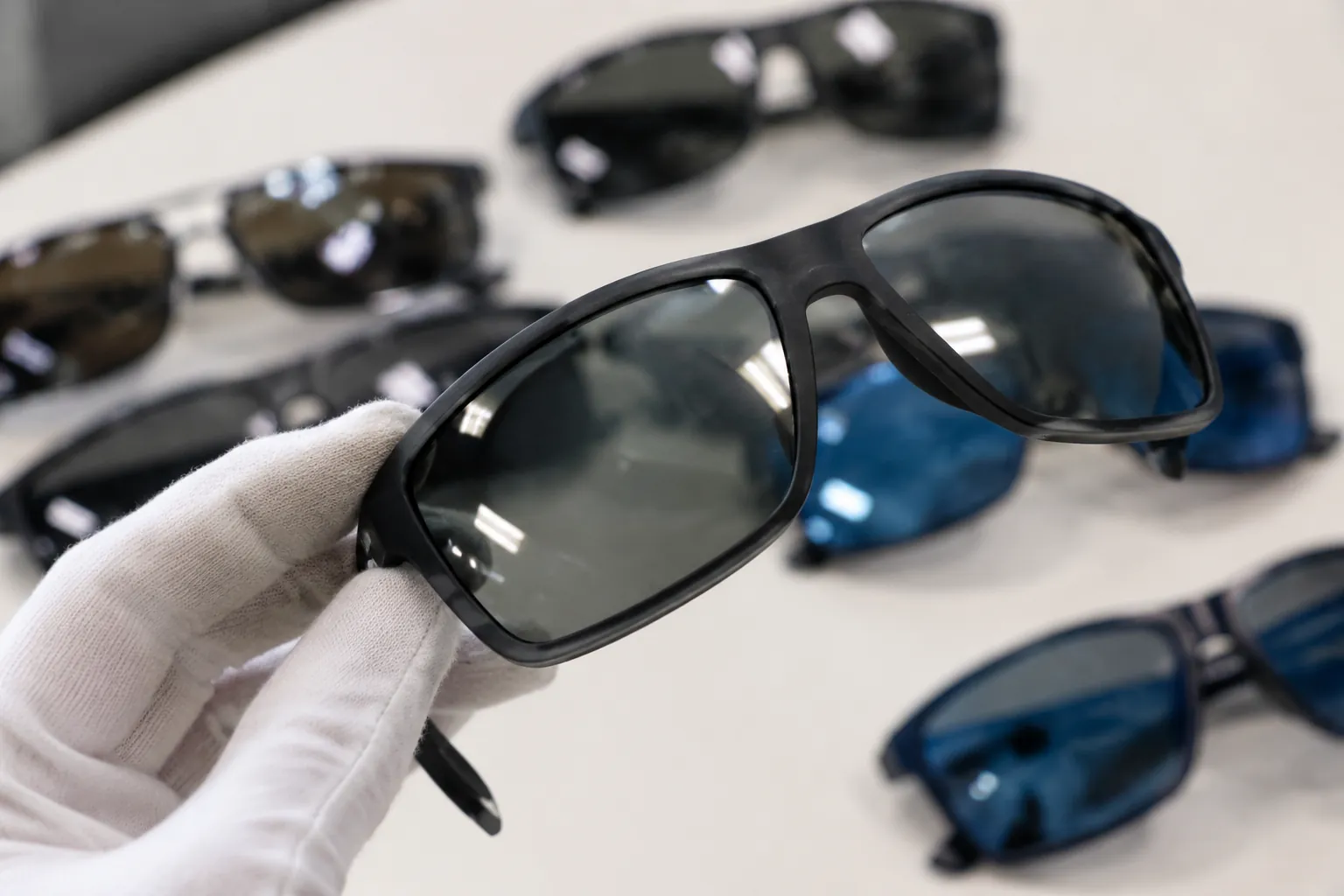
This guide is for brands, importers, distributors, and retail buyers approving polarized sunglasses before a wholesale run. It explains how to find lens, frame, decoration, labeling, packaging, and compliance problems at sample stage, before the order is cut, assembled, packed, and shipped. Use it to write clearer specifications, test pre-production samples, classify defects, and decide what must be corrected before LumiShades or any custom eyewear factory starts bulk production.
Start With a Written Lens Approval Standard
Polarized sunglasses fail in predictable ways: weak polarization, inconsistent polarization between left and right lenses, rotated polarizing axis, haze, uneven tint, optical distortion, coating scratches, heat deformation, edge delamination, stress marks near the rim, and incorrect labeling. Most of these defects are easier to prevent when the buyer defines the lens standard before the first sample is made.
A line such as “polarized UV400 smoke lens” is not a production specification. Your purchase order, tech pack, or sample approval sheet should state the lens material, nominal lens thickness, lens thickness tolerance, base curve, color reference, VLT range, polarization requirement, polarizing axis tolerance, UV protection requirement, coating type, mirror color if any, logo position, packaging text, carton marks, barcode rules, and destination-market standard.
For LumiShades projects, sample and bulk lead times should be confirmed in the quotation and purchase order. Lead time depends on frame material, lens construction, decoration method, packaging complexity, testing requirements, sample revision count, and order quantity. Do not rely on a general website lead-time statement as a production commitment. The approved sample, written specification, artwork, packaging file, and compliance file should match before the factory releases materials for bulk production.
Buyer rule: never approve only a photo. Approve the physical sample and the written inspection criteria together. If one is missing, production is not controlled.
| Specification item | Weak wording | Better wording for production control |
|---|---|---|
| Lens material | Polarized lens | TAC polarized lens, 1.1 mm nominal thickness, smoke grey, approved supplier lot required |
| VLT | Dark lens | VLT target and tolerance agreed by buyer and factory; category and warning text tied to destination standard |
| Polarization | Good polarized effect | Polarization performance must meet written requirement; both lenses checked against golden sample and recorded |
| Axis | Normal direction | Polarizing axis tolerance stated in degrees with reference direction, tool, and reject rule |
| Color | Same as sample | Physical master lens retained; color checked under controlled light, including front and 45-degree views for mirror lenses |
| Packaging | Standard box | Approved dieline, barcode, model number, country of origin, warning text, importer details, and carton marks |
Know the Lens Material Before You Test It
Polarized performance and production risk depend on lens material and construction. TAC, PC, nylon, and CR-39 do not behave the same in cutting, tinting, coating, mounting, heat exposure, or storage. A QC checklist that treats every polarized lens as identical can miss the main failure mode for the product.
TAC polarized lenses are common in fashion and promotional sunglasses because they are lightweight and economical. They can be sensitive to heat, moisture, poor edge finishing, and delamination if lamination, cutting, or storage is not controlled. PC lenses are more impact-resistant than many common sunglass lens materials and are often used in sports or kids’ styles, but they can show stress patterns, birefringence, coating adhesion problems, or optical distortion if the frame groove is too tight. Nylon is often used for higher-curvature sports eyewear because it can perform well in wrap frames, but color and optical consistency still need lot control. CR-39 is valued for optical clarity in many eyewear applications, but thickness, weight, edge chipping, and impact requirements must be considered.
| Lens material | Typical use | QC risk | Buyer specification point |
|---|---|---|---|
| TAC polarized | Fashion, promotional, mid-volume retail | Edge haze, delamination, film bubbles, heat warping, moisture sensitivity | Define thickness, storage condition, edge quality, lamination quality, and heat-aging check |
| PC polarized | Sports, kids, impact-conscious designs | Stress marks, optical distortion, rainbow patterns under polarized light, coating adhesion issues | Check finished-frame distortion, stress patterns, coating durability, and groove pressure |
| Nylon polarized | Premium sports, wrap frames, higher base curves | Batch color variation, higher material cost, curve mismatch, tint drift | Lock lens lot, curve, VLT range, color reference, and cutting orientation before bulk |
| CR-39 polarized | Optical-style sunglasses and clarity-focused projects | Thickness, weight, edge chipping, impact suitability, frame balance | Confirm minimum thickness, frame compatibility, edge finishing, and required impact test |
Specify nominal lens thickness and allowable tolerance instead of using the phrase “standard thickness.” Confirm the base curve as well. A high-wrap frame fitted with a mismatched lens curve can pass a simple appearance check and still create distortion complaints outdoors.
Ask the factory whether the polarized film is laminated in-house or purchased as finished sheets. Ask whether loose lenses will be cut from the same batch used for the approved sample. If the factory changes the lens supplier, polarizing film, coating supplier, sheet thickness, or tint process after approval, require a new sample and updated measurement record before bulk release.
Polarization Efficiency: Do Not Accept a Guess
Polarization describes how the lens filters light in a specific orientation, especially reflected glare from horizontal surfaces such as water, wet roads, snow, and dashboards. A dark lens is not automatically a good polarized lens. A lens can look dark and still provide weak glare reduction if the polarizing film, lamination process, or coating stack is poor.
For a B2B order, write the polarization requirement into the specification. If your retailer, importer, or destination-market program has a defined requirement, use that requirement and require the factory to record the result. If no numeric requirement has been provided, agree on a measurable target with the supplier before sample approval and keep the test method consistent from golden sample to final inspection.
The basic factory screen is fast: place the lens over a polarized test card or an LCD screen, rotate it, and check for a clear light-to-dark change. This confirms that a polarizing effect is present, but it does not quantify performance. For larger orders, retailer programs, driving styles, fishing styles, or sports styles, request recorded measurements using a defined method, such as transmission readings through parallel and crossed polarizers, and keep the records with the production file.
| Check item | Basic method | Better method for bulk orders | Reject if |
|---|---|---|---|
| Polarization presence | Rotate lens over LCD or polarized test card | Compare both lenses against the approved golden sample | No clear bright/dark change or inconsistent change between lenses |
| Polarization performance | Use a factory polarized-lens tester | Record transmission values with a defined measurement method | Result is below the written specification or outside the approved sample range |
| Left-right consistency | Check both lenses together in the finished frame | Record readings on inspection samples using the same fixture and method | One lens is visibly weaker, lighter, darker, or different in color |
| Heat stability | Visual check after controlled heat exposure | Use a documented aging condition agreed before production | Bubbles, waves, delamination, coating failure, haze, or color shift appears |
| Lot consistency | Compare first production pieces with golden sample | Record readings by lens lot, shift, and inspection date | New lot drifts outside approved performance, color, or VLT range |
Do not accept “polarized” as a verbal claim. Ask how the factory verifies it, where the result is recorded, which sampling level is used, and whether the same method will be used during first article, in-process, and final inspection.
Axis Alignment: Small Rotation, Big Complaint
The polarizing axis must be aligned correctly in the finished frame. If the axis is rotated too far, glare reduction can drop and the wearer may notice dark bands, uneven brightness, or unusual changes when looking at car windows, phone screens, dashboard displays, or laminated glass. Some display effects can occur even with correctly made polarized lenses, so the QC question is whether the product matches the approved reference and written specification.
Define an axis tolerance before production. Sports, fishing, and driving-focused products usually need tighter control than low-cost promotional styles. The tolerance should be a written engineering decision, not an operator’s guess. The same reference direction and measurement method should be used at sample approval, loose-lens inspection, first article inspection, in-process inspection, and final inspection.
Axis errors often happen after the lens blank is correct. The cutting layout may be rotated, left and right lenses may be nested in the wrong direction, an operator may flip the sheet, or the assembly team may install lenses from mixed lots. Rimless and semi-rimless styles can make axis mistakes more visible because there is less frame material hiding the lens edge.
- Mark the polarizing direction on the lens blank. Use arrows, labels, or batch marks before cutting.
- Lock the CAD cutting layout. Do not change nesting direction without engineering approval.
- Check loose lenses before assembly. Rejecting loose lenses is cheaper than disassembling finished frames.
- Check finished frames again. Assembly swaps, frame pressure, and mixed lens lots can still create problems.
- Record the golden sample angle. Use it as the reference for first article and final inspection.
- Segregate lens lots. Keep cut lenses in labeled trays by model, color, side, axis direction, and production lot.
If the factory manages injection molding, acetate cutting, CNC milling, lens tinting, coating, cutting, and assembly in-house, axis control should be built into each process step. The final inspector should not be the first person to discover that the lens layout was rotated incorrectly.
Haze, Tint, VLT, and Color Matching Need Numbers
Haze makes lenses look cloudy or low quality. It can come from polarizing film quality, adhesive layers, dirty handling, coating defects, polishing residue, moisture, heat damage, or edge finishing problems. For buyers, haze is both an optical problem and a shelf-appearance problem. Two pairs from the same carton should not look like different products.
Visible light transmission, or VLT, should be specified as a measured range. Do not approve only the word “dark.” Sunglass lens categories and labeling depend on the applicable destination-market standard. In many standards-based systems, category 3 lenses are commonly used for strong sunlight, while category 4 lenses are very dark and normally require a warning that they are not suitable for driving. Confirm the exact category, warning language, symbol use, user information, and label format against the market standard before packaging is printed.
Tint consistency should be checked under a controlled light source, preferably a consistent inspection lamp or daylight-simulation setup, not only beside a window. Grey, brown, green, smoke gradient, blue mirror, silver mirror, and red mirror lenses all shift with angle. Gradient polarized lenses are sensitive because film, dye, and coating layers interact.
- Set a physical master sample. Keep one approved lens pair in a labeled bag, away from heat, moisture, and direct sunlight.
- Define a VLT range. Use a target and tolerance agreed by buyer and factory, and connect it to the required lens category.
- Approve mirror color by angle. Check front view, approximately 45-degree view, and side reflection under the same lighting.
- Inspect left-right matching in the frame. Loose lens approval is not enough because assembly pressure can change appearance.
- Reject cloudy edges. Edge haze often appears after cutting, polishing, cleaning, or frame insertion.
- Control cleaning materials. Solvents, alcohol wipes, polishing compound, and glove contamination can mark lenses or coatings.
| Lens appearance item | Where to inspect | Typical defect | Control method |
|---|---|---|---|
| Center haze | Normal viewing zone | Cloudy film, adhesive haze, coating contamination | Controlled light inspection and comparison with approved lens |
| Edge haze | Lens perimeter and groove area | White edge, delamination, polishing residue | Check after cutting, after cleaning, and after frame insertion |
| Gradient transition | Upper-to-lower lens area | Uneven fade or mismatched left-right gradient | Use orientation marks and compare both lenses in finished frame |
| Mirror coating | Front surface and angled reflection | Color shift, pinholes, scratches, coating thin spots | Inspect under fixed lamp at front and angled views |
| VLT/category | Measured optical zone | Wrong darkness, wrong category, wrong warning | Record VLT and match packaging before printing |
For retailer programs, keep measured VLT, color reference, lens category, and packaging warning in one approval file. This prevents a common failure: the lens is changed during production, but the label and compliance documents still describe the earlier sample.
UV Protection and Market Claims Must Match the Report
Polarized does not mean UV-protective. Polarization reduces glare; UV protection is a separate performance requirement. A buyer should specify the UV claim and verify that supporting documents match the exact product or product family. The words “UV400,” “100% UV protection,” and “blocks UVA/UVB” have compliance and labeling implications, so they should not be added to packaging without support.
Ask the factory to provide a test report or certificate that reasonably matches the order: lens material, lens color, lens category, coating, model family, frame material if relevant, and destination market. A report for a smoke TAC lens does not automatically support a blue mirror gradient lens, a different material, or a different lens category.
| Claim or document | What to verify | Common mistake |
|---|---|---|
| UV400 | Test method, wavelength range, result pages, product description | Using a generic claim without a matching report |
| CE / EN ISO 12312-1 | Lens category, warnings, user information, product scope | Report covers a different tint, category, or construction |
| ANSI Z80.3 | Buyer requirement, product scope, optical and transmittance results | Assuming US retail programs accept any factory certificate |
| AS/NZS 1067 | Category, labeling, warnings, and market-specific format | Printing EU-style labeling for Australia/New Zealand without checking requirements |
| REACH-related documents | Restricted substances, materials, coatings, inks, metal parts | Checking only lenses and ignoring nose pads, paints, metal logos, and pouch prints |
Keep the compliance file with the approved sample file. If the lens, coating, frame material, supplier, or packaging claim changes, review whether the report still supports the product before shipping.
Distortion and Frame Pressure Must Be Tested on Finished Sunglasses
Lens distortion can cause eye fatigue, a swimming effect, or wavy vision. It is common on high base-curve sports frames, thin lenses, poorly controlled lens sheets, and frames that squeeze the lens too tightly. A lens can pass a polarization check and still be uncomfortable to wear.
Use a grid board test at sample stage. Hold the finished sunglasses at a fixed distance from a printed grid and move them slowly across the lines. Straight grid lines should remain acceptably straight through the normal viewing zone. Pay close attention to the nasal side, lower rim, and outer edge of wrap frames because these are common stress areas.
For injection frames, shrinkage control affects lens fit. For acetate frames, CNC milling accuracy, groove depth, heating, adjustment, and hand-polishing consistency matter. If the groove is too tight, the lens may be forced into shape. If the lens curve does not match the frame curve, an assembler may still make it fit. That is not quality control; it hides a defect until the customer wears the product.
| Failure mode | Likely cause | How to check before bulk | Corrective action |
|---|---|---|---|
| Wavy grid lines | Lens stress, curve mismatch, or poor sheet quality | Grid board test through finished sunglasses | Adjust lens curve, material, cutting size, or groove fit |
| Blur near edges | Lens too thin, high wrap geometry, or forced mounting | Inspect nasal, lower, and temporal zones | Increase thickness if suitable, revise lens shape, or modify frame groove |
| Left-right visual mismatch | Mixed lens blanks, mixed tint lots, or inconsistent coating | Wear test and side-by-side comparison under controlled light | Use approved lens lot controls and segregate materials by batch |
| Stress marks | Over-tight screws, tight frame, poor groove geometry, or rough assembly | Use a stress viewer where available and inspect under polarized light | Reduce pressure, adjust groove, revise screw torque, and retrain assembly staff |
| Lens popping out | Groove too loose, lens undersized, poor frame recovery after heating | Flex, handling, and drop simulation agreed before bulk | Revise lens size, groove depth, frame material, or assembly process |
Always test distortion on finished sunglasses, not only on loose lenses. The final product is what the customer wears, and frame pressure is often the source of the defect.
Decoration, Packaging, and Compliance Are Part of QC
Decoration can damage a good product if it is approved too late. Common custom sunglasses decoration methods include laser engraving, pad printing, hot stamping, metal logo plates, temple inlays, printed microfiber pouches, custom boxes, hang tags, barcode labels, and carton marks. Each method has its own QC risk.
Laser engraving on temples should be checked for depth, position, burn marks, and coating damage. Pad printing should be tested for adhesion after curing, using an agreed tape test or rub test. Metal logo plates should be checked for glue overflow, sharp edges, corrosion risk, and alignment. For lens logos, confirm whether the mark is printed, etched, or sticker-applied, and make sure it does not interfere with the normal viewing zone.
Compliance must match the sales market and exact product type. Relevant eyewear and factory documents may include CE EN ISO 12312-1, ANSI Z80.3, AS/NZS 1067, REACH, FDA registration, ISO 9001, and BSCI. Use only the documents that apply to the product, destination, and claim being made. FDA registration is not the same as FDA product approval. ISO 9001 and BSCI relate to management system or social compliance; they do not replace product testing for sunglasses.
Before bulk production, check the report or certificate scope, not just the logo. The document should reasonably match the lens type, frame material, tint category, product family, and intended market in your order. A report for one smoke TAC lens construction does not automatically prove a mirrored gradient polarized lens in a different construction.
- EU: confirm CE marking basis, EN ISO 12312-1 lens category, warnings, user information, and REACH-related material requirements.
- US: confirm FDA registration information where applicable and ANSI Z80.3 alignment for non-prescription sunglasses if required by the buyer or program.
- Australia/New Zealand: confirm AS/NZS 1067 requirements, lens category, warnings, and labeling format.
- Packaging: verify barcode, model number, country-of-origin text, lens category, warnings, importer details, recycling marks if used, and carton marks before printing.
- Retail channel: attach marketplace, retailer, or distributor compliance checklists to the purchase order instead of relying on email comments.
| Custom item | QC check | Reject if |
|---|---|---|
| Temple laser logo | Position, depth, edge sharpness, color contrast, surface damage | Logo is crooked, burned, shallow, mislocated, or damages coating |
| Pad print | Artwork size, color, curing, tape/rub resistance | Ink lifts, smears, cracks, or differs from approved Pantone/reference |
| Metal logo plate | Alignment, glue control, edge safety, corrosion risk | Plate is loose, sharp, stained, tilted, or has visible glue overflow |
| Lens logo | Viewing-zone clearance, position, durability, reflection | Logo blocks vision, scratches easily, or differs between lenses |
| Barcode label | Scan result, model match, placement, adhesive | Barcode fails scan, uses wrong SKU, peels, or covers required warnings |
If a retailer, marketplace, or importer has its own compliance checklist, attach it to the purchase order. Do not assume a factory’s general certificate package satisfies every channel requirement.
Use Defect Classification and Sampling Before Shipment
Sample approval prevents many problems, but final shipment inspection still needs a clear defect classification. Without defect classes, the factory and buyer may argue about whether a scratch, axis error, loose hinge, wrong barcode, or cloudy lens is acceptable. Define critical, major, and minor defects before production starts.
Use a sampling plan that matches order value, retailer requirement, and risk level. Many buyers use AQL-based inspection for finished goods, but the AQL level and defect limits should be agreed in the purchase order or quality agreement. For polarized sunglasses, do not rely only on carton-level visual checks. Inspect finished pairs, inner packaging, retail packaging, labels, and master cartons.
| Defect class | Examples for polarized sunglasses | Typical decision |
|---|---|---|
| Critical | No UV support for claimed product, unsafe sharp edge, broken lens, wrong mandatory warning, product not matching regulated category, foreign object that creates safety risk | Stop shipment, investigate root cause, sort or rework 100% where appropriate |
| Major | Weak polarization, axis outside tolerance, wrong VLT/category, visible haze, severe distortion, lens color mismatch, loose hinge, logo in wrong position, barcode wrong or unscannable | Reject lot if over agreed limit; require corrective action and reinspection |
| Minor | Small cosmetic mark outside normal viewing area, slight packaging scuff, minor print variation within approved tolerance | Accept only within agreed limit; monitor trend |
Inspection should include both function and appearance. A pair can look clean in a tray but fail polarization, axis, barcode, hinge tension, temple alignment, or packaging checks. Record the inspection date, inspector, lot number, model, color, sample size, defect count, and disposition.
- Check cartons first. Confirm carton marks, quantity, model, color, PO number, and destination.
- Check retail packaging. Scan barcodes and verify model, color, lens category, warnings, importer information, and country-of-origin text.
- Check finished sunglasses. Inspect frame alignment, hinge movement, lens fit, scratches, haze, distortion, polarization, axis, and decoration.
- Separate defects by class. Do not mix critical, major, and minor defects into one general defect count.
- Hold failed lots. Do not ship failed goods while waiting for rework instructions or buyer waiver.
Sample Approval and Pre-Bulk QC Checklist
Sample approval should be a controlled gate, not a message saying “looks good.” This matters because many buyers start with a small test order and then reorder at higher volume once a style sells. Inspection discipline should increase as commercial risk increases.
| Order stage | Buyer focus | Recommended approval proof | Risk if skipped |
|---|---|---|---|
| Initial sample or small trial | Fit, appearance, first lens and color check | Physical sample, basic polarization check, packaging mockup | Trial batch may not define a repeatable production standard |
| Repeat order | Repeatability against the approved sample | Golden sample, axis check, lens color reference, artwork file | New batch may drift in lens color, axis, or decoration position |
| Retail or distributor order | Batch control and documentation | Pre-production sample, QC checklist, compliance file, packaging approval | Defects may spread across multiple cartons before detection |
| Large-volume program | Process stability and shipment acceptance | First article inspection, in-process QC records, final inspection plan | Large rework, shipment delay, chargeback, or retailer rejection |
A complete approval pack includes one buyer-retained physical sample, one factory-retained golden sample, lens measurements, axis readings, VLT range, polarization result, controlled-light photos, decoration artwork, packaging artwork, barcode position, compliance file, and a written defect classification list.
Use this checklist before releasing bulk production:
- Lens material confirmed: TAC, PC, nylon, CR-39, or other specified material matches the order sheet.
- Lens construction locked: thickness, base curve, tint, coating, mirror layer, and supplier lot are approved.
- Polarization confirmed: both lenses meet the agreed requirement and match the golden sample.
- Axis checked: left and right lenses are within the written tolerance and measured using the agreed method.
- VLT category confirmed: measured VLT, lens category, warning text, and packaging label match the destination market.
- UV protection documented: support is tied to the required market file, such as CE EN ISO 12312-1, ANSI Z80.3, or AS/NZS 1067 where applicable.
- Haze and cloudiness checked: center, edge, gradient area, and mirror surface are clear under controlled light.
- Distortion checked: grid board test is completed on finished sunglasses, not only on loose lenses.
- Frame fit verified: lens groove, hinge tension, temple alignment, nose pad position, and wearing comfort meet the approved sample.
- Decoration approved: laser engraving, pad printing, logo plates, or lens marks meet position, appearance, and adhesion requirements.
- Packaging verified: model number, barcode, warnings, lens category, importer information, country of origin, and carton marks are correct.
- Inspection plan agreed: sampling level, defect classification, AQL or acceptance rule, and rework process are written.
- Production release documented: bulk production starts only after sample, specification, artwork, packaging, payment terms, and compliance requirements are approved in writing.
Be direct if a lens issue appears in the sample. Ask for the root cause and a corrected sample. Do not approve bulk with a note saying “please improve in production.” Production normally follows the approved sample. That is the purpose of sample approval.
Have a custom sunglasses project in mind?
Send us your styles, target market and quantities and we will return a detailed quote with MOQ, lead time and a sample plan.
Get a QuoteWhy source this from Wenzhou with LumiShades
Wenzhou in Zhejiang Province is widely regarded as China’s eyewear manufacturing capital, producing a large share of the world’s sunglasses. That concentration matters to buyers: a deep local supply chain for acetate sheet, hinges, lens blanks, plating and packaging means shorter component lead times, easier color and material matching, and a workforce with decades of eyewear-specific skill. LumiShades has manufactured in this ecosystem since 2009, and our vertical integration — in-house injection molding, acetate cutting, CNC milling, lens tinting, decoration and quality control — means no part of your order is quietly subcontracted to a workshop you cannot audit.
For international buyers, that vertical control translates into accountability. When a single factory owns every step, defects are traced and fixed at source rather than bounced between vendors, and your specifications survive intact from first sample to bulk. For procurement review, buyers can request process records, approved samples, quality checkpoints and project-specific compliance files before placing a bulk order. Required testing and documentation are confirmed against the destination market and product specification rather than assumed from a generic certificate list. Explore our manufacturing capabilities and quality control process to see how this works in practice.
Frequently asked questions
Can I verify polarization without lab equipment? Yes, for a basic screen. Rotate the sunglasses in front of an LCD screen or a polarized test card. The lens should clearly darken and lighten as it rotates. Check the left and right lenses separately and together. This confirms a polarizing effect, but it does not measure performance. For wholesale approval, ask the factory to record the agreed polarization test result and keep it with the golden sample file.
What tolerance should I use for polarized axis alignment? Use a written tolerance that matches the product and buyer requirement. Sports, fishing, and driving-focused products normally need tighter control than low-cost promotional styles. Define the reference direction, measurement tool, tolerance, and rejection rule before sample approval, then use the same method for loose lenses, finished frames, first article inspection, and final inspection.
Should I approve lens color from photos? No. Photos are useful for records, but tint and mirror color change with lighting, camera settings, background, and viewing angle. Approve a physical golden sample, define the VLT range, and compare production under controlled lighting. For mirror or gradient lenses, approve the front view, angled view, and left-right matching in the finished frame.
Which compliance standards should I request for polarized sunglasses? Match the destination market and product claim. For the EU, check CE marking support, EN ISO 12312-1 category and warnings, and REACH-related material requirements. For the US, confirm FDA registration where applicable and ANSI Z80.3 alignment if required by your program. For Australia and New Zealand, check AS/NZS 1067 labeling and category requirements. ISO 9001 and BSCI can support factory evaluation, but they do not replace product testing.
What should I check on a sunglasses test report or certificate? Check the report holder, issuing lab or certification body, report date, standard used, product description, lens material, lens color or category, frame material if listed, model or product family, and test result pages. The report should reasonably match the product you are buying. If your order uses a different lens color, mirror coating, frame material, or construction, ask whether additional testing or an updated report is needed.
When should bulk production start after sample approval? Bulk production should start only after the physical sample, written lens specification, decoration proof, packaging artwork, barcode and labeling information, payment terms, inspection plan, and compliance file are approved in writing. If any item is still open, release only the process steps that are safe to begin, such as material reservation, and do not cut final lenses or print final packaging until the open item is closed.
Is UV400 the same as polarized? No. UV400 refers to ultraviolet protection, while polarization refers to glare reduction. A lens can be polarized but still require UV documentation, and a UV-protective lens can be non-polarized. Treat them as separate specification and test items.
What is the biggest sample approval mistake for custom polarized sunglasses? The biggest mistake is approving appearance without locking measurable criteria. A buyer should approve the physical sample together with lens material, VLT range, polarization method, axis tolerance, UV support, decoration artwork, packaging files, barcode data, and defect classification. Without those controls, the factory has no clear production target.
Ready to start?
Explore our square sunglasses or request a quote — our sales team replies within 12 hours.
Request a Quote