
Polarized Sunglasses QC Tests Before Shipment
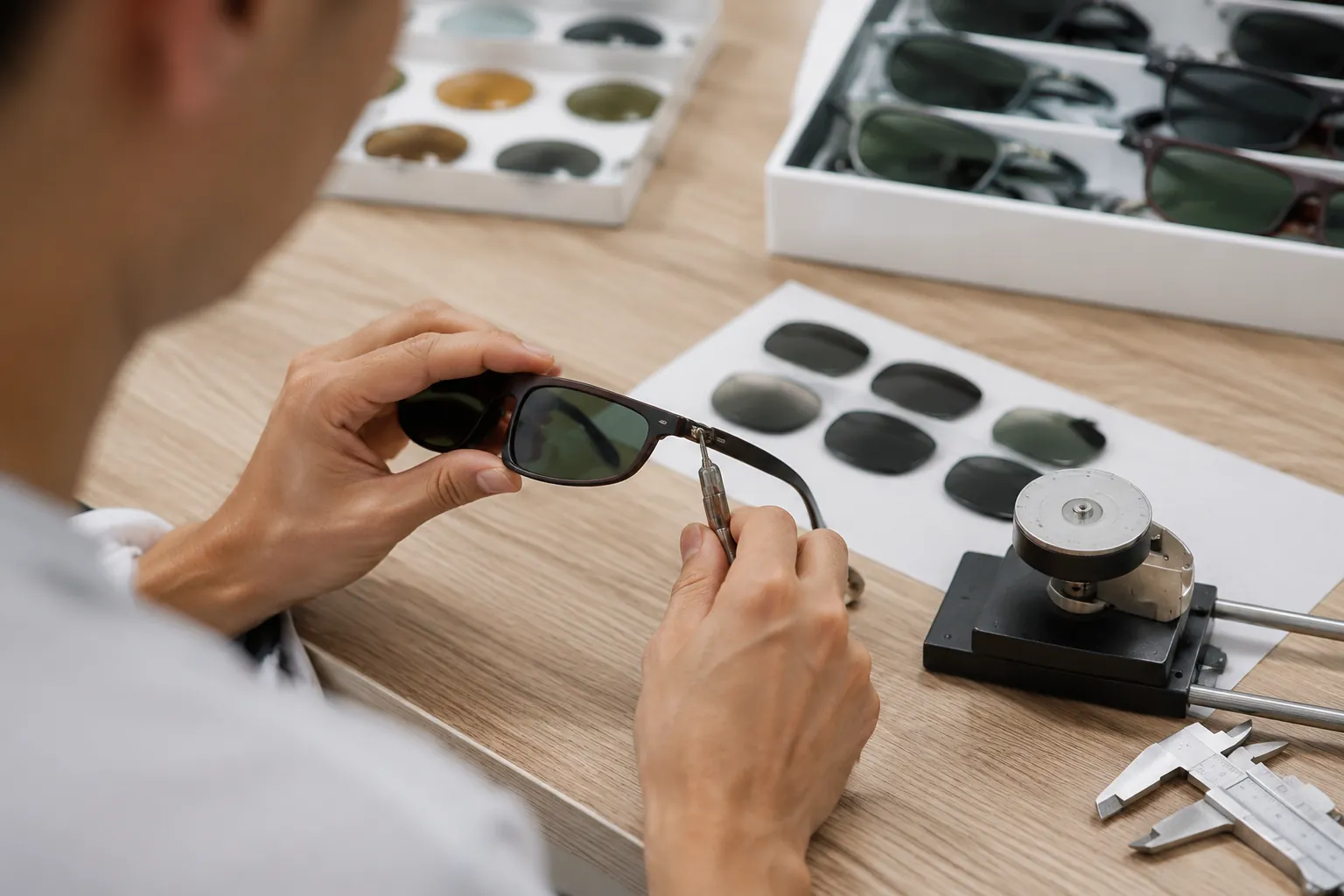
This guide is for brands, importers, distributors, and retailers buying polarized sunglasses in bulk. It explains the checks to define before shipment: polarization performance, axis orientation, lens clarity, haze, optical strain, coating condition, markings, and frame-lens assembly. The aim is plain: fewer returns, fewer complaints, and purchase orders with measurable acceptance criteria. "Good quality polarized lenses" is not a specification.
The first QC failure buyers notice: poor polarization
Polarized sunglasses are sold on one main promise: less reflected glare. If that promise fails, customers notice fast. They notice while driving, fishing, skiing, cycling, or looking at water. A frame can look correct in catalogue photos and still fail in use because one lens has weak polarization, the axis is rotated, or the left and right lenses do not match.
For OEM and private-label orders, do not accept a supplier statement that only says "polarized lens used." Put the inspection method, acceptance criteria, and defect classification into the purchase order. At minimum, the QC plan should cover polarization verification, axis orientation, left-right matching, haze, visual distortion, coating condition, edge finish, required markings, and assembly stress.
Polarized lens defects do not only come from raw lens sheets. They can be introduced during tinting, coating, CNC cutting, edging, heat forming, lens insertion, screw mounting, ultrasonic cleaning, logo printing, and final packing. Check more than once. Waiting until goods are packed is risky and expensive.
Define defects before production starts. Non-polarized lenses in a polarized order should be a critical defect. Axis deviation beyond the agreed tolerance should be major, unless the product claim or market requirement makes it critical. Small cosmetic marks outside the viewing zone may be minor if they do not affect vision, safety, compliance, or retail presentation. Without this language, inspectors guess. That is not control.
Set the lens specification before inspection
QC fails quickly when the product specification is vague. "Black polarized lens" is not enough. State the lens material, lens category or visible light transmission range, polarization axis definition, mirror or coating treatment, logo requirements, required markings, packaging, and applicable market standard.
| Spec item | What to write in the PO | Practical tolerance or note |
|---|---|---|
| Lens material | TAC, PC, nylon, CR39, or other approved material | TAC is common for cost-sensitive polarized fashion sunglasses. PC has high impact resistance but can show stress if processed poorly. Nylon is often used for sports styles where optical quality and flexibility matter. |
| Visible light transmission | Example: ISO filter category 3 with agreed VLT range | Under EN ISO 12312-1, category 3 sunglasses are typically 8% to 18% VLT. Confirm the required category and any driving restrictions for the destination market. |
| Polarization axis | Define the reference position and required transmission axis, normally vertical in wearing position | Do not rely only on "90 degrees" unless the measurement convention is defined. Many buyers use ±3° for standard programs and tighter limits such as ±2° for performance claims. |
| Left-right matching | Color, darkness, mirror appearance, and polarization response must match the approved sample | Use an approved golden sample. Where instruments are available, define VLT and color difference targets. Otherwise require visual matching under controlled light. |
| Surface treatment | Mirror, flash mirror, back-side AR coating, hard coating, hydrophobic or oleophobic coating, or no coating | Mirror shade, pinholes, scratches, and coating bands should be checked under angled light, not only flat on a white table. |
| Compliance | CE EN ISO 12312-1, ANSI Z80.3, AS/NZS 1067, REACH, FDA registration, ISO 9001, and BSCI where applicable | Documents should match the product type, model, lens category, materials, and production batch where possible. FDA registration, ISO 9001, and BSCI are not substitutes for product testing. |
For OEM orders, cost and risk depend on frame material, lens material, decoration, packaging, inspection level, and compliance documents. Do not reduce cost by leaving lens details open. Ambiguity costs more after shipment because the buyer and supplier may disagree on what was approved.
Polarization verification: quick checks, fixtures, and records
The simplest quick check uses a known polarized reference lens, a polarized test card, or an LCD screen. Hold the sample lens in front of the reference and rotate it. At the correct relative angle, the view should darken strongly. This works for sample approval, warehouse receiving, and first-article review. It is not enough for controlled production release.
For production approval, use a polarimeter or a defined inspection fixture with a stable light source and reference orientation. Test both lenses in normal wearing position. Do not test only one loose lens taken from the line. Record results by order number, model, color, lens batch or lot, production date, inspection stage, and inspector.
- Confirm the reference lens, test card, or polarimeter is identified and suitable for use before inspection.
- Place the finished frame or lens in the fixture in normal wearing orientation.
- Check the blackout or extinction response at the required axis orientation.
- Repeat the check on both right and left lenses.
- Compare left-right darkness and color in the same lighting condition.
- Inspect the assembled pair as a wearer would: straight ahead, then tilted slightly up, down, left, and right.
- Segregate any pair with weak extinction, rotated axis, cloudy appearance, obvious color mismatch, or visible optical distortion.
For small custom runs, 100% polarization checking is often practical. For larger production, AQL sampling may be used for final visual inspection. Still, polarization process checks should happen at incoming lens inspection, after cutting or edging, after assembly, and before shipment release. If the order uses a new lens color, wrap shape, coating, or rimless construction, inspect more heavily on the first batch.
Axis consistency: small rotation, big complaint
Polarization axis is a common hidden defect. A lens can be genuinely polarized but installed with the axis rotated. The wearer may see glare leakage, uneven brightness between the two eyes, or odd dark patterns when looking through laminated glass, some vehicle windows, phone screens, or instrument displays.
Axis errors usually happen in four places: wrong sheet orientation before cutting, lens-shape nesting rotated to save material, left and right lenses mixed after edging, or manual insertion into the frame without checking orientation. Large wrap frames add another issue. The lens curve and wearing angle can affect how the lens sits in the inspection fixture.
Agree the tolerance before production. For many general fashion programs, ±3° from the agreed axis is practical. For sunglasses marketed for driving, fishing, water sports, cycling, or other performance uses, buyers may request ±2° or define a minimum extinction ratio if suitable measuring equipment is available. If no instrument is available, specify a strong blackout requirement against an approved reference at the correct orientation. Keep the approved sample.
Check the axis twice: after lens cutting or edging and after final assembly. The second check is essential. Rim tension, wrong lens orientation, forced insertion, screw pressure, or deformation during assembly can turn an acceptable cut lens into a defective finished pair. For semi-rimless and rimless styles, also check drill holes, screw pressure, nylon cord tension, and micro-cracks around mounting points.
Haze, distortion, material behavior, and stress
Haze is not tint darkness. A dark polarized lens can still look milky, dirty, or wavy. Require inspection under controlled lighting with a white background and printed grid. Do not rely only on a packing table under mixed factory lighting.
Common haze sources include low-grade polarizing film, poor lamination, moisture in layered lenses, residue after tinting, contaminated coating, overheated forming, and micro-scratches from handling. TAC polarized lenses are widely used, but edge sealing, moisture control, and delamination checks matter. PC lenses can offer strong impact resistance, but injection stress and coating stress must be controlled. Nylon lenses are often selected for sports or higher optical requirements, but they still need careful coating and forming control.
- White background check: hold both lenses over white paper to compare color, haze, specks, and left-right darkness.
- Grid distortion check: view a printed grid through the lens and move the frame slowly. Wavy, jumping, or bent lines indicate optical distortion.
- Edge inspection: check for chips, whitening, delamination, rough CNC marks, sharp edges, and incomplete polishing near the rim.
- Stress check: use a stress viewer or crossed polarizers to identify pressure marks after assembly, especially around screws, drill holes, and tight rims.
- Coating check: inspect mirror coating for pinholes, color bands, fingerprints, scratches, rub marks, and shade inconsistency under angled light.
- Cleaning check: inspect for oily film, lint, glue marks, pad-print overspray, polishing compound, and residue near hinges or lens grooves.
Do not inspect only the front surface. Look through the lens as a wearer would, then tilt it. Some coating defects, strain marks, and cleaning residue appear only at an angle. For premium programs, define a central viewing zone where scratches, bubbles, haze, or coating defects are not allowed.
Inspection points by production stage
The best QC plan does not wait until packed cartons are ready. By then, rework is slow and may create new defects. A polarized sunglasses order needs staged checks, especially if it includes custom tinting, mirror coating, laser engraving, pad printing, metal logos, injected temples, acetate fronts, rimless mounting, or retail gift-box packaging.
| Stage | QC check | Typical problem caught |
|---|---|---|
| Incoming lens material | Material, tint, polarization response, surface defects, sheet orientation, batch identification | Wrong lens batch, weak polarization, mixed color, damaged sheet, missing traceability |
| After tinting or coating | Color match, VLT if equipment is available, haze, specks, mirror shade, coating appearance, adhesion where specified | Cloudy lens, uneven tint, coating pinholes, poor mirror consistency, contamination |
| After CNC cutting or edging | Shape, size, edge chips, axis direction, left-right sorting, drill-hole position where applicable | Rotated axis, rough edge, wrong lens size, cracking during insertion, mixed lenses |
| After frame assembly | Lens fit, frame alignment, hinge tension, stress marks, gaps, screw tightness, lens popping risk | Lens pressure, optical strain, loose lens, temple imbalance, unstable fit |
| After decoration | Pad print, hot stamping, laser logo, metal logo, temple print, pouch print, barcode and hangtag content | Wrong logo position, poor adhesion, color error, overspray, crooked branding, SKU mix-up |
| Final inspection | AQL visual check, polarization confirmation, markings, barcode, hangtag, packaging, carton labels, carton quantity | Mixed models, scratched lenses, wrong SKU, missing warning label, wrong carton mark, packing shortage |
If a supplier controls more processes in-house, such as lens cutting, frame assembly, decoration, and QC, it may be easier to stop production and correct a defect before the full batch is affected. But do not rely on capability claims alone. Require written inspection records and approved samples. In-house control only helps when it is documented.
AQL sampling for bulk orders: where not to compromise
For a small order, many buyers request deeper review because the batch is small enough to inspect pair by pair. For larger orders, AQL sampling is often more efficient. Critical defects must still be defined separately. Some failures should never be treated like small cosmetic marks.
A common approach is to use ISO 2859-1 sampling with general inspection level II and AQL limits such as Critical 0, Major 2.5, and Minor 4.0. This is only an example. The final plan should match the product claim, retail channel, destination market, and buyer risk tolerance. Premium retail, children's products, performance eyewear, and regulated-market shipments may require tighter limits, additional laboratory testing, or third-party inspection.
Critical defects for polarized sunglasses usually include non-polarized lenses in a polarized order, wrong lens category, sharp edges, missing required compliance markings, severe optical distortion, cracked frames, and lenses that do not stay seated. Major defects usually include axis mismatch beyond tolerance, obvious haze, visible scratches in the main viewing area, wrong logo, poor hinge function, loose screws, and left-right color mismatch. Minor defects may include small cosmetic marks outside the viewing zone, slight packaging scuffs, or tiny molding flow marks if they do not affect function, safety, compliance, or retail presentation.
Buyer rule: polarization failure is not cosmetic. Classify it as critical or major based on the product claim, PO requirement, and destination market.
Ask the supplier to keep inspection records by SKU, production date, lens batch if available, and carton range. If receiving inspection finds a problem, carton traceability helps isolate the affected goods instead of holding or disputing the entire shipment.
Documents, samples, and shipment release checklist
Before bulk shipment, request a QC package tied to the order number, model, lens color, frame color, quantity, and carton range. It does not need to be long. It must be complete enough for receiving inspection and dispute resolution.
- Approved pre-production sample showing lens color, frame finish, logo, temple fitting, markings, and packaging.
- Polarization verification record for the production batch or inspected lot.
- Axis or blackout inspection result after final assembly.
- Visual inspection report covering haze, scratches, specks, stress, distortion, edge condition, and coating condition.
- AQL final inspection report showing sampling plan, sample size, defect list, defect classification, and pass/fail result.
- Applicable compliance documents, such as CE EN ISO 12312-1, ANSI Z80.3, AS/NZS 1067, REACH, FDA registration, ISO 9001, and BSCI where relevant to the product, factory, or market.
- Carton list showing SKU, quantity, color, barcode, carton numbers, gross weight, net weight, and dimensions.
- Photos of finished goods, inner packing, retail packaging, warning labels, carton marks, and sealed cartons.
Confirm lead time in writing and link it to sample approval, material availability, decoration approval, testing requirements, and packaging readiness. Do not release shipment just because the goods are finished. Release shipment when the approved sample, inspection results, compliance documents, carton list, and packing evidence match the purchase order.
Have a custom sunglasses project in mind?
Send us your styles, target market and quantities and we will return a detailed quote with MOQ, lead time and a sample plan.
Get a QuoteWhy source this from Wenzhou with LumiShades
Wenzhou in Zhejiang Province is widely regarded as China’s eyewear manufacturing capital, producing a large share of the world’s sunglasses. That concentration matters to buyers: a deep local supply chain for acetate sheet, hinges, lens blanks, plating and packaging means shorter component lead times, easier color and material matching, and a workforce with decades of eyewear-specific skill. LumiShades has manufactured in this ecosystem since 2009, and our vertical integration — in-house injection molding, acetate cutting, CNC milling, lens tinting, decoration and quality control — means no part of your order is quietly subcontracted to a workshop you cannot audit.
For international buyers, that vertical control translates into accountability. When a single factory owns every step, defects are traced and fixed at source rather than bounced between vendors, and your specifications survive intact from first sample to bulk. For procurement review, buyers can request process records, approved samples, quality checkpoints and project-specific compliance files before placing a bulk order. Required testing and documentation are confirmed against the destination market and product specification rather than assumed from a generic certificate list. Explore our manufacturing capabilities and quality control process to see how this works in practice.
Frequently asked questions
Should I test every pair in a polarized sunglasses order? For small custom runs, 100% polarization checking is practical and recommended. For larger runs, use AQL sampling for final inspection, but keep mandatory process checks at incoming lens inspection, after cutting or edging, after assembly, and before shipment. If any sampled pair fails polarization, stop and investigate the affected lens batch, production time, and carton range before release.
What axis tolerance should I specify for polarized sunglasses? Define the measurement method first: frame position, reference axis, and whether the value is reported as transmission axis or rotation from an approved reference. Many general fashion orders use ±3° from the agreed vertical axis. Performance, driving, fishing, and sports styles may use ±2° or a defined extinction ratio if proper equipment is available. Put the tolerance and defect classification in the PO.
What is the easiest way to verify polarization before approving samples? Use a known polarized reference lens, polarized test card, or LCD screen. Rotate the sample lens against the reference. It should darken strongly at the correct relative angle. Check both lenses in the finished frame, not only a loose lens. For bulk approval, require fixture or polarimeter checks and keep records by model, color, batch or lot, date, and inspector.
Can polarized lenses pass material inspection but fail after assembly? Yes. A lens can pass incoming inspection and later fail because of wrong orientation during cutting, rotated insertion, rim pressure, forced assembly, screw pressure, heat, cleaning damage, or coating scratches. Require checks after lens cutting or edging and again after final assembly. For rimless and semi-rimless styles, pay close attention to drill holes, screws, nylon cord tension, and stress marks.
Which compliance documents should buyers ask for? Ask based on the destination market and product claim. Common documents include CE EN ISO 12312-1 for Europe, ANSI Z80.3 for the United States, AS/NZS 1067 for Australia and New Zealand, REACH restricted-substance documentation for Europe, and FDA registration where applicable. ISO 9001 and BSCI may support factory management review, but they do not replace product testing or shipment inspection.
What should be treated as a critical defect? Treat non-polarized lenses in a polarized order, wrong lens category, sharp edges, severe optical distortion, missing required markings, cracked frames, and lenses that do not stay seated as critical defects. These failures can affect safety, compliance, or the core product claim. Axis errors, haze, visible scratches in the viewing zone, wrong logos, loose screws, and left-right mismatch are usually major defects unless the PO or market requirement classifies them as critical.
Ready to start?
Explore our round sunglasses or request a quote — our sales team replies within 12 hours.
Request a Quote