
Polarized Sunglasses QC: Bulk Buyer Checklist
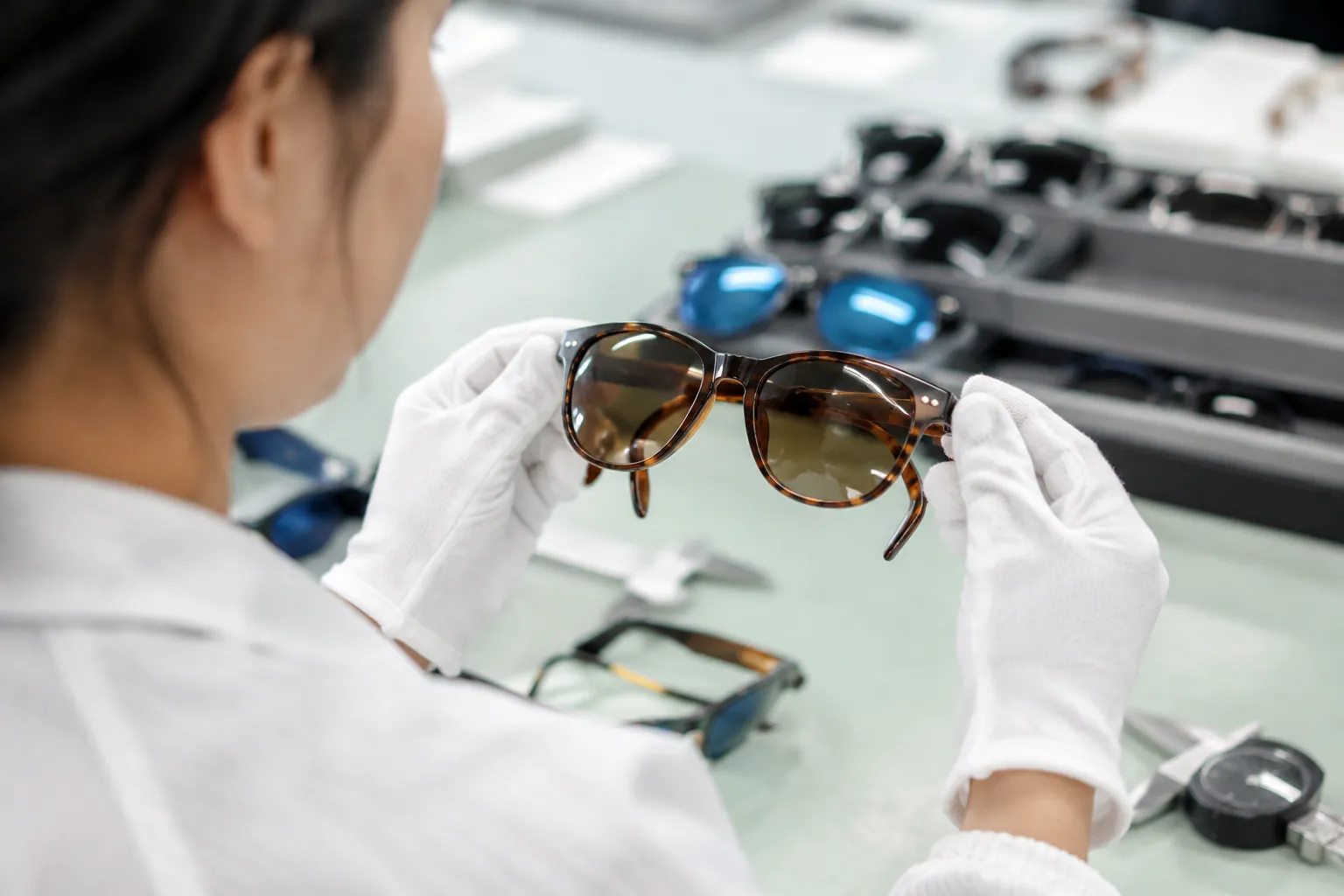
This guide is for eyewear brands, importers, distributors, promotional buyers, and retail chains ordering polarized sunglasses in volume. It covers the inspection points that prevent the usual complaints: weak polarization, uneven color, cloudy lenses, stress marks, loose lenses, and mixed batches. Use it to write tighter purchase specifications, review samples with fewer assumptions, and stop defects before cartons leave the factory.
Failure Mode 1: Polarization Axis Is Off
Polarized sunglasses reduce glare because the polarizing filter transmits light mainly in one orientation and blocks reflected glare in the opposing orientation. If the polarizing film rotates during blank preparation, lens cutting, edging, drilling, or assembly, the lens may still look dark. It may still react to a demo card. But glare reduction can be weak.
There is no single commercial tolerance for every polarized sunglass design. For many standard plano polarized sunglasses, buyers specify an agreed axis tolerance such as ±3 degrees from the approved reference axis. Premium sport, shield, rimless, semi-rimless, and high-wrap designs need project-specific control. Curvature, lens shape, drill position, and assembly pressure can make the axis harder to hold and harder to measure.
State the required axis in the purchase specification. Include the measurement method. The factory should check the axis after lens cutting and again after final assembly. A practical method is to use a calibrated polarized reference plate, a suitable polarized light source, or an approved inspection fixture. The inspector rotates the lens to the defined extinction or reference position and records whether it falls within tolerance. Check both lenses. A left-right mismatch can cause discomfort even when each lens looks acceptable alone.
- Buyer spec: state the required polar axis, reference convention, and allowed deviation, for example "axis per approved golden sample, tolerance ±3 degrees."
- Sample review: test the right and left lenses. Do not test only one side.
- Production control: check axis after edging, after drilling if applicable, and after final assembly.
- Reject condition: no polarization, obvious left-right mismatch, axis outside the agreed tolerance, or inconsistent measurement results that cannot be explained.
Failure Mode 2: Haze, Milkiness, and Poor Clarity
Haze is not tint darkness. A dark lens can still look milky if the polar film, adhesive layer, coating, dyeing, curing, or storage process is not controlled. Buyers often notice the problem only after comparing cartons from different lots under warehouse lighting. At that point, rework is costly or impossible.
Common causes include poor lamination, contaminated blanks, coating incompatibility, overheating during forming, uneven curing, and exposure to unsuitable humidity or heat before packing. TAC polarized lenses are common in fashion and promotional sunglasses because they are cost-effective. They can be more sensitive to moisture and heat than some other materials. PC polarized lenses are used for impact resistance and lightweight performance, but high-curve PC lenses can show optical distortion or coating stress if processing is weak. Nylon polarized lenses suit sport and wrap designs because they balance optical performance and flexibility, though they usually cost more. CR39 can offer good clarity, but it is heavier and slower to process than many plastic sunglass lens materials.
Inspect under consistent conditions. Do not inspect one lot beside a window and another under yellow warehouse lamps. Use an agreed light source, a white background, a black background, and angled light. Inspectors should look for cloudy zones, rainbow patches, flow lines, bubbles, edge delamination, coating pinholes, surface scratches, and color inconsistency. For export programs, visual checks should be paired with UV and visible light transmission testing against the standard and market claim stated on the purchase order.
| Lens material | Typical use | QC risk | Buyer note |
|---|---|---|---|
| TAC polarized | Fashion, promotional, entry retail | Moisture sensitivity, delamination, haze after poor storage or unsuitable processing | Good cost option; require controlled storage, clean handling, and protective packing before assembly |
| PC polarized | Sports, kids, safety-style designs where impact resistance is important | Coating stress, optical distortion on high curves, sensitivity to processing conditions | Define the exact impact, optical, and compliance claims before sampling |
| Nylon polarized | Premium sport and wrap sunglasses | Higher material cost; color matching and coating control need tighter management | Useful for curved lenses; approve pre-production samples made from actual bulk material |
| CR39 polarized | Optical-quality plano sunglasses | Heavier lens, longer processing time, different breakage and handling profile than PC | Good clarity option; less suitable for very low-cost, fast-turn promotional programs |
Failure Mode 3: Stress Marks from Frame Assembly
Stress marks often appear as rainbow patterns, bright corners, or warped zones when polarized lenses are viewed with a polariscope or between crossed polarized filters. A lens blank can pass incoming inspection and fail after assembly. The usual causes are a tight groove, an over-tightened metal eyewire, an inaccurate frame front, or drilling that lacks process control.
Stress can come from a lens pattern that is too large for the frame, inconsistent groove depth, uncontrolled screw torque, uneven heating, or frame fronts that move after adjustment. Acetate fronts can change shape after heating. TR90 and other injected frames can flex and pinch the lens if the fit is wrong. Metal frames can concentrate pressure near the screw block. Heat during transport or warehousing may make marginal stress more visible.
Prevention depends on two controls: lens edging and frame tolerance. Buyers should ask the factory how it controls the production lens pattern, groove dimensions, eyewire closure, screw tension, and final lens seating. If different vendors supply lenses and frames, the purchase specification should state who investigates fit-related stress defects. Do not leave that question open.
- Check bare lenses under crossed polarization before assembly.
- Measure lens size against the approved production pattern, including A/B dimensions, edge thickness, and drilled-hole positions where applicable.
- Assemble using normal production tools and normal line workers, not a hand-adjusted sample-room shortcut.
- Check stress again after assembly, especially at corners, screw blocks, drilled holes, and high-pressure rim areas.
- Open and close temples several times, then recheck pressure points and lens seating.
- For acetate or heat-adjusted frames, agree on a short conditioning or heat-exposure check before approving full production.
Stress in the effective viewing area should be rejected unless the buyer has approved another limit in writing. Minor stress hidden near the rim may be acceptable only if the location, size, and visibility limit are defined before production starts.
Failure Mode 4: Batch-to-Batch Drift
A buyer approves a smoke grey polarized sample. Bulk goods arrive. One carton looks neutral grey; another looks slightly green or brown. The lenses may still meet UV and polarization requirements, but retail presentation suffers. For chain stores, distributors, and replenishment orders, that inconsistency creates complaints fast.
Batch drift can come from different lens blank lots, tint bath time, dye concentration, coating thickness, polar film variation, mirror coating variation, or poor segregation during packing. Mirror coatings add risk. A small process change can shift the final color visibly. Brown, amber, and green bases are often less forgiving than very dark grey or black.
Treat the approved sample as a control object. Keep one sealed golden sample with the buyer and one sealed golden sample at the factory. For larger orders, require a pre-production sample made from actual bulk lens material, frame material, logo process, and packaging. Compare first-off production against the sealed sample before the line continues.
- Small custom runs: suitable for boutique tests, events, or market validation; 100% manual QC is realistic and should include functional polarization checks.
- Mid-size orders: require clearer batch records for lens lots, frame lots, decoration lots, and packaging components.
- Large retail or distributor orders: define color standard, inspection method, defect limits, carton segregation, and retained samples from each production lot.
- Repeat orders: compare new production against the latest approved reference sample and confirm whether the original lens or frame material lot is still available.
Discuss MOQ, unit price, and QC depth together. A lower MOQ does not automatically mean lower quality. A larger order does not automatically mean better consistency. The real risk is vague specification. The purchase order should define which items are fixed by the golden sample and which items may vary within an agreed tolerance.
What to Put in the Spec Sheet
A purchase order that says "polarized UV400, good quality" is not enough for bulk production. A usable spec sheet defines lens material, base color, lens category, visible light transmission range, polarization requirement, axis tolerance, coating, frame material, decoration, target sales market, packaging, and inspection method.
A stronger line item would read: "TAC polarized smoke grey lens, sunglass category and labeling suitable for the EU market under EN ISO 12312-1, UV protection claim supported by test report, polar axis per approved golden sample with ±3 degrees tolerance, hard coat, no visible haze in the effective viewing area, black acetate frame, metal logo plate on temple, pouch packing." This gives the factory, inspector, and buyer a shared reference. Adjust the wording to the target country and the test method used.
Decoration needs limits too. Pad printing is economical but can rub if the ink and surface coating are not compatible. Laser engraving can look clean on metal and some frame materials, but depth, position, and heat effect must be controlled. Metal logo plates look premium but can loosen if the recess, adhesive, or mechanical fixing is poor. Hot stamping and foil logos need abrasion checks. Lens logos should stay outside the main viewing area unless the design has been tested and approved for visual interference.
| Spec item | What to define | Why it matters |
|---|---|---|
| Lens material | TAC, PC, nylon, CR39, or another approved material | Affects price, curve, clarity, coating risk, processing route, and lead time |
| Polar axis | Axis reference, measurement method, and deviation, such as approved sample ±3 degrees | Prevents weak glare blocking, left-right mismatch, and inconsistent inspection decisions |
| Lens category and market | Applicable sunglass category and target standard, such as CE EN ISO 12312-1, ANSI Z80.3, or AS/NZS 1067 | Controls darkness, labeling, warning statements, and legal sales requirements |
| Coating | Hard coat, mirror, anti-scratch, hydrophobic, oleophobic, or other agreed coating | Changes haze risk, scratch resistance, color appearance, adhesion requirements, and unit cost |
| Decoration | Pad print, laser logo, metal plate, hot stamp, lens logo position, logo tolerance, and abrasion requirement | Prevents coating damage, rubbing, loose logos, and marks entering the viewing zone |
| Packaging | Pouch, case, carton quantity, separator, desiccant if needed, polybag, barcode, and carton mark | Reduces rub marks, deformation, moisture issues, barcode errors, and retail relabeling work |
Incoming, In-Process, and Final QC
Polarized sunglasses QC works best in layers. If the factory waits until final inspection, correction is expensive. Reworking assembled sunglasses can scratch frames, loosen hinges, damage logos, introduce dust, or create a second defect while fixing the first one.
Incoming QC should verify lens blank lot, tint color, polar effect, UV performance where tested in-house or by lab, scratches, bubbles, coating surface, and frame components before cutting or assembly. For frame parts, check front width, bridge, temple length, hinge alignment, groove condition, plating or color finish, and match against the approved sample.
In-process QC should check lens size, axis orientation, edging quality, drilling position, lens seating, screw tension, frame alignment, and stress after assembly. For acetate sunglasses, check whether heating and adjustment deform the frame or increase lens pressure. For injected frames, confirm that mold lot, shrinkage, and frame cooling do not change the lens fit.
Final QC should verify appearance, polar effect, lens cleanliness, frame balance, temple opening, screw tightness, hinge movement, logo placement, barcode if used, pouch or case condition, carton marks, and quantity. Inspectors should pull samples from different cartons, production dates, and packing positions. Not just from the top of one master carton.
Confirm lead time after the full specification is locked. Sampling and bulk production timing depend on frame material, lens material, color development, mirror coating, decoration, packaging, compliance testing, and factory capacity. If the buyer changes lens color, mirror coating, logo process, or packaging after sample approval, review the schedule again. The approved process has changed.
Practical rule: do not approve mass production from a hand-polished or hand-adjusted sample if bulk goods will be made by normal production tooling. Approve what the line can repeat.
Sampling Plan: Small Runs to Retail Orders
The inspection plan should match order size, sales channel, and compliance risk. A small capsule order does not need the same paperwork as a national retail rollout. Both still need functional polarization checks. The difference is depth, documentation, and statistical control.
For small custom runs, inspect every pair for polar effect, obvious axis issue, haze, scratches, frame alignment, lens seating, and packaging. The labor is easier to justify because the quantity is limited, and early customer complaints can damage the launch. For medium orders, many buyers require 100% functional polarization confirmation plus sampled appearance inspection. For large orders, define the sampling plan, defect classification, acceptance rules, production records, and retained samples before production starts.
A common structure is to classify defects as critical, major, and minor. The exact acceptance level depends on the buyer's market, risk tolerance, brand position, and legal obligations. Critical defects should normally have zero acceptance because they affect safety, function, or legal sale.
- Critical defects: no polarization when polarization is claimed, failed UV requirement, wrong lens category or labeling for the target market, cracked lens, sharp edge, unsafe frame breakage, or any condition that creates a safety risk.
- Major defects: axis outside agreed tolerance, visible haze in the effective viewing area, heavy stress marks, left-right color mismatch, loose lens, crooked frame, unstable hinge, poor logo adhesion, or incorrect retail barcode.
- Minor defects: small cosmetic mark outside the viewing area, slight logo position drift within tolerance, minor pouch wrinkle, small carton scuff, or another appearance issue that does not affect function or saleability.
Request first-article approval before full production. The factory should produce a small number of units using bulk materials, production tooling, normal assembly workers, and real packaging. If the first article fails, stop. Correct the root cause before the factory makes the full quantity.
Pre-Shipment Checks That Reduce Returns
Pre-shipment inspection should not be a quick glance at open cartons. Polarized sunglasses need function, appearance, fit, and consistency checks. Pull units from different cartons and, where possible, different production dates. Compare lens color against the sealed golden sample. Check axis on both lenses. Inspect under black and white backgrounds. View stress under crossed polarization.
Packaging is part of product quality. Polarized lenses can be scratched by loose accessories, rough pouch fabric, hard case pressure, or stacked frames pressing into each other. Mirror lenses need extra protection because vibration during transport can create rub marks. For moisture-sensitive lenses and heat-adjusted frames, storage and packing conditions matter. Clean polybags, suitable separators, controlled carton loading, and desiccant where justified by material and shipping route can reduce later delamination, corrosion, or deformation.
Before release, confirm that the documents match the target market and the claims made on the product. For Europe, sunglasses are commonly assessed against requirements linked to CE marking and EN ISO 12312-1. For the United States, ANSI Z80.3 is a relevant sunglass standard, and FDA establishment registration or device listing requirements may apply depending on the role of the manufacturer, importer, and product type. FDA registration is not FDA product approval. For Australia and New Zealand, AS/NZS 1067 is relevant. REACH may apply to chemical substances in frames, coatings, paints, inks, and packaging for products sold in the EU. If a supplier states ISO 9001 or BSCI status, ask for the current certificate or audit record and verify the scope, issuing body, and validity date.
Do not request random certificates that do not apply to sunglasses. Irrelevant paperwork creates noise without improving product quality. Useful documents support the actual product claim, target market, factory management system, chemical compliance, or buyer-specific audit requirement.
A clean shipment is built before final inspection. It starts with a precise specification, real production samples, controlled lens lots, documented axis checks, defined decoration limits, and clear rejection of visible stress in the viewing area. That is how buyers reduce the expensive complaint: "The customer says they are not really polarized."
Have a custom sunglasses project in mind?
Send us your styles, target market and quantities and we will return a detailed quote with MOQ, lead time and a sample plan.
Get a QuoteWhy source this from Wenzhou with LumiShades
Wenzhou in Zhejiang Province is widely regarded as China’s eyewear manufacturing capital, producing a large share of the world’s sunglasses. That concentration matters to buyers: a deep local supply chain for acetate sheet, hinges, lens blanks, plating and packaging means shorter component lead times, easier color and material matching, and a workforce with decades of eyewear-specific skill. LumiShades has manufactured in this ecosystem since 2009, and our vertical integration — in-house injection molding, acetate cutting, CNC milling, lens tinting, decoration and quality control — means no part of your order is quietly subcontracted to a workshop you cannot audit.
For international buyers, that vertical control translates into accountability. When a single factory owns every step, defects are traced and fixed at source rather than bounced between vendors, and your specifications survive intact from first sample to bulk. For procurement review, buyers can request process records, approved samples, quality checkpoints and project-specific compliance files before placing a bulk order. Required testing and documentation are confirmed against the destination market and product specification rather than assumed from a generic certificate list. Explore our manufacturing capabilities and quality control process to see how this works in practice.
Frequently asked questions
What axis tolerance should I write for polarized sunglasses? Write the tolerance as a production requirement, not a vague quality request. For many standard plano polarized sunglasses, buyers use an agreed reference axis with a tolerance such as ±3 degrees. For sport, shield, rimless, semi-rimless, or high-wrap designs, confirm the measurement method with the factory before sampling because curvature and irregular lens shapes affect cutting and inspection. Always require both right and left lenses to be checked.
Should I test every pair for polarization in bulk production? For small runs, yes. A 100% functional polarization check is practical and helps prevent early complaints. For larger runs, many buyers still require 100% confirmation that each pair is polarized, then use a defined sampling plan for appearance, packaging, and dimensional checks. Treat "no polarization" or a false polarization claim as a critical defect.
Can polarized sunglasses meet CE EN ISO 12312-1, ANSI Z80.3, and AS/NZS 1067 requirements at the same time? They can be designed and tested for multiple markets, but the target sales countries must be stated before sampling. Lens category, visible light transmission, UV protection claim, labeling, warnings, test reports, and documentation must match the applicable market. Do not assume one test report or one label covers every country.
Why did my approved sample look clear but bulk lenses look hazy? Common causes include a different lens blank lot, coating variation, poor curing, heat exposure, contamination, unsuitable storage humidity, or assembly stress. To control this, require a sealed golden sample, a pre-production sample from bulk material, incoming lens-lot inspection, and first-off approval before full production continues. Inspect haze under consistent lighting with both black and white backgrounds.
Does a lower MOQ increase QC risk? Not automatically. Small orders can be inspected closely because the quantity is manageable. The bigger risk is treating a small order casually and using vague specs such as "good quality polarized." Even for low-MOQ projects, define lens material, axis tolerance, lens category, color standard, decoration method, packaging, and defect limits.
What compliance documents should I request before shipment? Request documents that match the selling market and product claim. For EU sales, check CE-related documentation and testing against EN ISO 12312-1, plus REACH information where relevant. For U.S. sales, ANSI Z80.3 may be relevant, and FDA registration or listing obligations should be reviewed for the responsible parties. Registration is not product approval. For Australia/New Zealand, check AS/NZS 1067. If the supplier claims ISO 9001 or BSCI, ask for current evidence and verify the scope and validity.
Ready to start?
Explore our square sunglasses or request a quote — our sales team replies within 12 hours.
Request a Quote