
Polarized Lens Specs Buyers Should Ask For
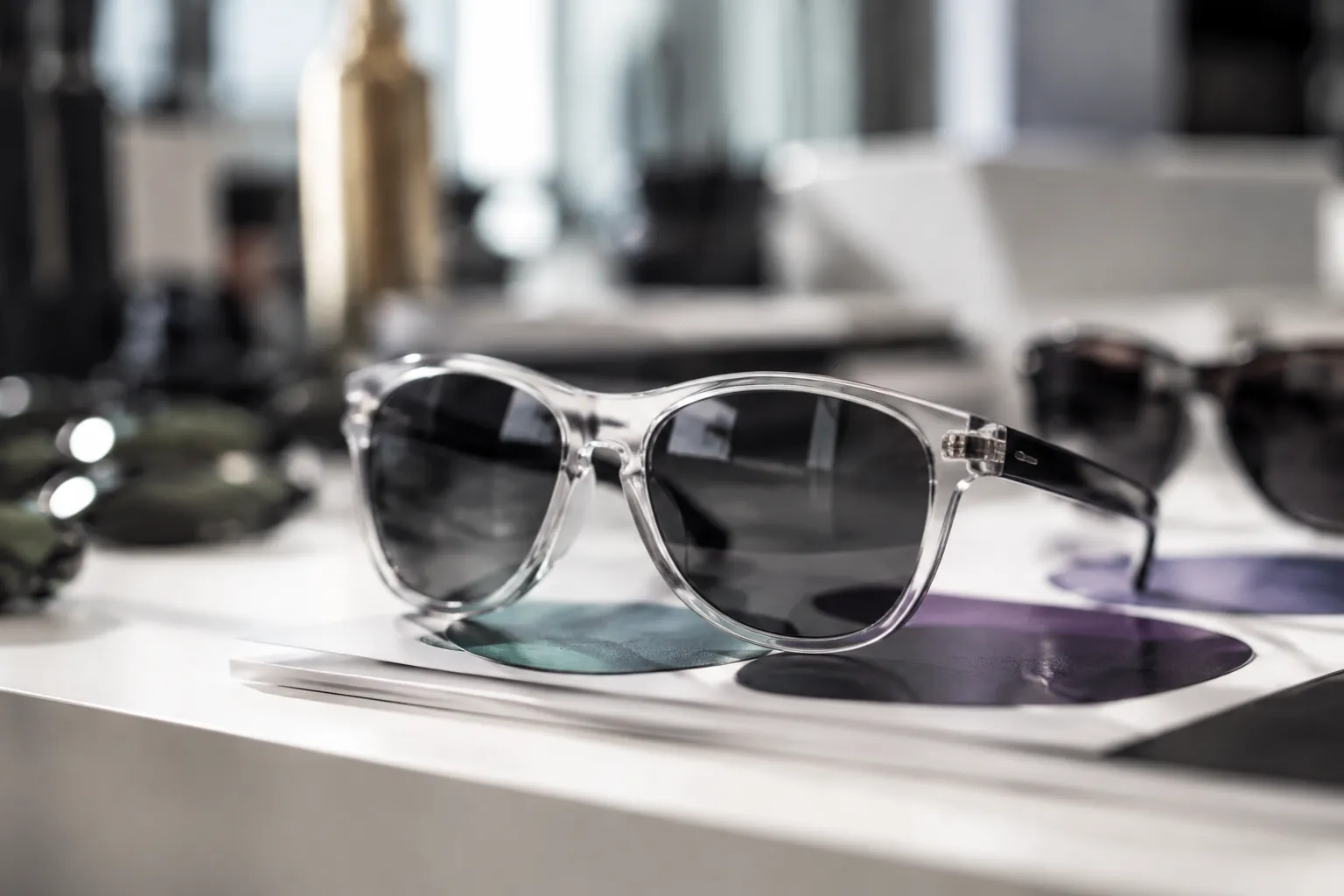
This guide is for eyewear brands, importers, distributors, and retailers buying polarized sunglasses in volume. The goal is simple: fewer glare complaints, fewer color complaints, and a spec sheet a factory can actually build against. A polarized sticker is not enough. Buyers need measurable lens requirements, approval samples, and a QC method that holds up in bulk production.
Start With the Failure Modes
Most complaints about polarized sunglasses do not sound technical. They sound like this: the lenses look too yellow, phone screens go black, one lens is darker than the other, the mirror finish looks uneven, or the glasses still feel harsh near water and on windshields. Those are specification failures. Not sales problems.
Buyers should treat polarization as a system, not a label. The result depends on base lens material, polarizing film quality, tint recipe, mirror coating, lens curve, heat exposure, assembly pressure, and inspection method. Change one variable and the wearing experience changes. A gray polarized lens and a brown polarized lens may both meet UV requirements, but they will not look or behave the same in a store demo or on the road.
The weak points are usually handoffs: film storage, lamination, edging, frame assembly, and final inspection. Polarizing film should be stored dry and away from excessive heat and humidity, following the supplier's handling instructions. If the supplier cannot explain where polarization is checked, what the reject criteria are, and who signs off at each stage, the process is too loose for a volume order.
A good factory should be able to trace a lens issue to a specific step, such as raw film, tint bath, lamination temperature, edging, or final assembly stress. That traceability matters more than a marketing claim on the carton.
Put Three Numbers on the Spec
For B2B orders, the purchase spec should not stop at "polarized lens, UV400." Ask for three measurable items: polarization efficiency, visible light transmission, and color tolerance. These three define how the lens behaves in stores, on the street, and during claims review.
| Spec Item | What It Controls | Recommended Buyer Request | Typical Tolerance / Check | Risk If Ignored |
|---|---|---|---|---|
| Polarization efficiency | How much horizontally reflected glare is blocked | State a minimum, such as 95%+ for standard retail and a higher target for premium outdoor styles if the product design supports it | Test finished lenses; do not rely only on raw film | Product carries a polarized label but still feels bright on water, snow, or roads |
| Visible light transmission (VLT) | How dark the lens appears to the wearer | Define a target range by category, often Cat. 3 for general sunglasses | Keep batch variation within an agreed band on repeat orders | Retailers receive lenses that are too light, too dark, or inconsistent between batches |
| Color tolerance | How close the tint is to the approved sample | Approve a physical golden sample and judge under a D65 light box or another agreed lighting condition | Set left-right pair matching and batch-to-batch limits before mass production | Brown turns green, gray turns blue, or the left and right lens do not match |
| UV protection | Blocking of UVA and UVB radiation | Require the market standard tied to your sales region | Ask for the report number, test standard, and the exact lens build tested | Compliance failure, border risk, and product return exposure |
Do not over-spec every style. A low-cost promotional pair and a premium nylon shield lens should not carry the same cost structure. But both need a written target. Vague specs create arguments later, especially when a buyer assumes "polarized" means identical visual performance across all materials and curves.
Verify Polarization Efficiency
Polarization efficiency is the percentage of polarized light blocked in the glare direction. In buyer terms, higher is usually better, but only if the lens stays stable after tinting, edging, and frame assembly. A common request is a minimum efficiency target for standard retail and a stricter target for premium outdoor styles, provided the lens construction and manufacturing process can support it.
Ask the factory exactly where the measurement happens. Good practice is to check incoming film, pre-production samples, and finished lenses. If a supplier only tests raw film, the number can look excellent while finished curved lenses still fail because heat or stress shifted the axis. Finished-product testing is the one that matters.
Basic shop-floor verification is fast: rotate the test lens against a known polarized reference and check extinction. That catches obvious failures. For bulk QC, use a polarization tester or other agreed measurement method, and record the result by style code and production date. On higher-risk programs, ask for a sampling plan that includes final inspection plus visual screening for obvious axis or image defects.
Lens curve matters. A high-wrap shield can expose uneven extinction at the edges if the film is distorted or stretched during lamination. Heat matters too. If the process uses thermal forming or high-temperature decoration, the lens should be rechecked after the last heat step. A lens that passed before edging can fail after assembly if the frame stresses it too hard.
- For low-risk fashion styles: request a clear pass/fail polarization check, UV compliance, and an approved tint sample.
- For fishing, driving, and outdoor retail: request a stated minimum efficiency target and written inspection records from bulk production.
- For shield or high-wrap lenses: check the full lens area, not only the optical center, because edge distortion is common.
Control Color Shift Early
Polarizing film is not neutral by itself. It interacts with tint, mirror coating, base material, and lens thickness. That is why gray polarized lenses can read slightly green, brown lenses can drift warmer, and mirrored lenses can look different once the backing tint is adjusted. Even a small change in dye concentration or curing time can create a visible shift in a pair.
Approve color under controlled light, not only by phone photo. Use a physical golden sample. For production, specify the judgment condition: D65 light box, daylight, or another defined lighting standard. If your sales channel is mostly outdoor retail, daylight judgment matters more than showroom lighting. If the style is sold through chain stores, a D65 box gives more repeatable decisions.
Pair matching matters as much as batch matching. A consumer may not notice a small shift between lots, but they will notice one lens being warmer than the other. For larger orders, require left and right lenses from the same tint batch and a final pair-match check. A practical target is no visible mismatch at arm's length under the agreed light source.
Decoration can also influence perceived color. Pad print near the lens edge, back-side mirror layers, laser engraving near the optical zone, or heavy logo plates can all alter how the customer reads the lens in hand. For custom sunglasses orders, samples are normally prepared in a short approval cycle, then bulk production follows after the sample is signed off. Use that stage to approve lens color, polarization behavior, logo placement, frame fit, and packaging before bulk starts.
Choose the Right Lens Material
Polarized lenses are commonly made in TAC, PC, nylon, or CR-39 depending on price point and use case. The material does not create polarization by itself; the polarizing film does. But the substrate changes clarity, impact behavior, weight, curve stability, and coating adhesion. That is why two polarized lenses with the same tint can still feel very different in the hand and on the face.
| Lens Material | Best Use | Buyer Advantage | Watch Point |
|---|---|---|---|
| TAC polarized | General fashion, promo, private label volume | Cost-effective, light, common for general-purpose sunglasses | Lower impact resistance than PC; edge quality and delamination control matter |
| PC polarized | Sports, kids, active outdoor | Good impact resistance and light weight | Can stress under certain frame designs; coating adhesion must be checked |
| Nylon polarized | Higher-wrap sports and shield lenses | Better optical stability on curved lenses | Higher cost; needs tighter tooling and forming control |
| CR-39 polarized | Optical-style sunglasses, premium casual lines | Good optical clarity and scratch resistance potential | Heavier and less impact resistant than PC; not ideal for all sports uses |
Material choice also affects reject risk. TAC is popular because it is affordable and easy to spec, but it is more sensitive to edge finishing and heat if the lamination is poor. PC can be a better impact story, but coating adhesion must be checked carefully, especially for anti-scratch or anti-reflective coatings. Nylon is better for curve stability, but tooling and forming control need to be tighter, which raises cost and may extend sampling time. CR-39 can deliver a clear optical look, but it is not the right answer for every sports program.
For price planning, quote based on the exact lens build, decoration method, and packaging requirements. Better unit pricing usually comes with higher quantities, but cost depends on more than volume. Premium lens material, mirror coating, special logo plates, or tighter testing will push cost up. The quotation should explain the cost step, not just the final price.
Glare Control Needs More Than Polarization
Polarization reduces reflected glare from flat surfaces such as water, snow, wet roads, and car hoods. It does not solve every brightness problem. Lens darkness, tint color, mirror coating, backside reflection, and frame coverage all change perceived glare. A good polarized lens can still feel weak if the frame leaves too much side light exposure.
A brown polarized lens can improve contrast for some outdoor users but may create more color complaints for buyers who expect a neutral look. A gray polarized lens is usually safer for natural color perception. Green-gray is a common classic outdoor choice. Blue or red mirror on top of polarized lenses needs careful approval because the outside color the customer sees is not the same as the wearer's inside view.
Frame geometry matters too. A flat fashion frame with smaller lenses may pass polarization testing but still allow side light. A wrap frame blocks more stray light, but high wrap can introduce optical distortion if the curve and material are wrong. For driving styles, check dashboard screen visibility, LCD readability, and instrument reflections. For fishing styles, test near water if possible. A lab pass is necessary, but a use-case test is smarter.
Buyers should also ask about backside reflection control. If the lens has no backside anti-reflection treatment, the wearer may see distracting internal bounce in bright conditions. That does not always fail QC, but it can cause complaints. A practical rule is to define the wearing scenario before choosing the lens. Beach retail, fishing, driving, cycling, and fashion are not one identical product.
Practical rule: define the wearing scenario before choosing the lens. Polarized sunglasses for beach retail, fishing, driving, cycling, and fashion are not the same product.
Match Compliance to the Market
Polarized lenses still need sunglass compliance. For Europe, buyers should reference CE EN ISO 12312-1. For the United States, ANSI Z80.3 is commonly used, and FDA import-related requirements may also matter. For Australia and New Zealand, reference AS/NZS 1067. For chemical control, REACH is important for the EU market, especially frame, coating, and decorative materials.
Use only certifications and compliance claims that the supplier can document. Ask for the test standard tied to your sales market, the exact lens build tested, and whether the test report covers the same frame family and decoration method. If the article, lens material, or coating changes, ask for a new sample and, where relevant, a new compliance review before production continues.
Repeat orders can drift if a factory substitutes a different film, coating, or tint process without approval. Put an approval requirement in writing so material or process changes cannot happen silently.
- State destination market on the RFQ.
- State lens category and intended use, such as general purpose sunglasses or sports use.
- Ask whether the test report applies to the same lens material, tint, coating, and frame type.
- Keep approved samples and test documents under the same style code.
- For repeat orders, confirm whether material or lens supplier has changed.
Build a QC Plan That Catches Returns
A workable QC plan does not need to be complicated. It needs checkpoints before the goods are packed. For a custom sunglasses order, start with sample approval, then pre-production material confirmation, then in-line checks, then final random inspection. If the style uses mirror coating, laser engraving, or metal logo plates, add extra inspection around decoration because cosmetic defects often show up there first.
For a small order, visual and functional checks may be enough if the design is simple. For larger orders, require written inspection records for polarization, UV, lens color, assembly, decoration, and packaging. If your spec includes tight color matching or premium mirror, ask for a golden sample retained by the factory and one held by the buyer so disputes can be compared later.
Decoration methods deserve their own checks. Pad printing should be tested for abrasion resistance and alignment. Laser engraving should be checked for depth, edge crispness, and whether the mark is visible from the wearer's side. Metal logo plates need adhesion checks and visual review for glue squeeze-out. If a factory uses hot stamping or foil, ask whether the process happens before or after final assembly, because heat can affect lens or frame finish.
- Sample stage: approve frame color, lens tint, polarization effect, logo, hinge tension, and packaging.
- Material stage: confirm polarized film or lens blank, frame material, and any REACH-related declaration needed for your market.
- In-line stage: check lens insertion stress, left-right color match, temple alignment, screw tightness, and surface scratches.
- Final stage: inspect against approved sample, test random pairs for polarization and UV compliance, and verify labels and carton marks.
Be blunt about acceptance limits. If one lens in a pair is visibly different, reject the pair. If the polarizing axis is inconsistent, reject it. If mirror coating has pinholes in the wearer's central view, reject it. If a logo plate is crooked but the lens is fine, that is still a return risk. The defects that become returns are usually cosmetic first and functional second.
Write a Better RFQ
The cleanest orders are the ones that tell the factory exactly what success looks like. A good RFQ for polarized sunglasses should include target market, lens material, desired tint, polarization efficiency target, VLT band, approved light source for color judgment, decoration method, packaging spec, and required test standards. If you want the factory to quote accurately, give them enough detail to price the process instead of guessing it.
It also helps to define whether the order is sample-friendly or production-heavy. A simple two-color fashion style with basic pad print and stock packaging can move fast. A nylon wrap with mirror coating, laser logo, custom case, and extra inspection will cost more and likely need a longer approval cycle. If a style is for a promotion, be honest about acceptable tolerances. If it is a premium retail program, be equally explicit about tighter control.
For buyers scaling from trial to volume, the practical path is sample, pre-production signoff, then a controlled first batch. That is the safest way to keep glare control, color, and compliance aligned across repeat orders.
Have a custom sunglasses project in mind?
Send us your styles, target market and quantities and we will return a detailed quote with MOQ, lead time and a sample plan.
Get a QuoteWhy source this from Wenzhou with LumiShades
Wenzhou in Zhejiang Province is widely regarded as China’s eyewear manufacturing capital, producing a large share of the world’s sunglasses. That concentration matters to buyers: a deep local supply chain for acetate sheet, hinges, lens blanks, plating and packaging means shorter component lead times, easier color and material matching, and a workforce with decades of eyewear-specific skill. LumiShades has manufactured in this ecosystem since 2009, and our vertical integration — in-house injection molding, acetate cutting, CNC milling, lens tinting, decoration and quality control — means no part of your order is quietly subcontracted to a workshop you cannot audit.
For international buyers, that vertical control translates into accountability. When a single factory owns every step, defects are traced and fixed at source rather than bounced between vendors, and your specifications survive intact from first sample to bulk. For procurement review, buyers can request process records, approved samples, quality checkpoints and project-specific compliance files before placing a bulk order. Required testing and documentation are confirmed against the destination market and product specification rather than assumed from a generic certificate list. Explore our manufacturing capabilities and quality control process to see how this works in practice.
Frequently asked questions
What polarization efficiency should I request for retail sunglasses? For general retail, ask the factory for a written minimum polarization efficiency target on the finished lens, not just the raw film. A common buyer approach is a lower threshold for basic fashion styles and a higher threshold for outdoor or sport styles, but the exact number should match the lens construction, cost target, and end use. Ask how the measurement is performed and request the test method in writing.
Can I use the same polarized lens spec for Europe, the US, and Australia? The lens can be similar, but the compliance references should match the market. For Europe, ask for CE EN ISO 12312-1. For the US, ask how the product aligns with ANSI Z80.3 and whether FDA import-related requirements are handled. For Australia and New Zealand, reference AS/NZS 1067. Also confirm whether the same frame, lens material, tint, and coating were tested.
Why do polarized lenses make some screens look dark or rainbow-colored? Many LCD and some vehicle displays emit polarized light. When the display axis and the lens axis interact, the screen can darken or show color patterns. That is not automatically a defect. To reduce complaints, test the actual devices your customers use during sample approval, especially dashboards, marine electronics, and sports devices.
Does a darker polarized lens block more glare? Not by itself. Darkness is measured by visible light transmission, while polarization reduces reflected glare. A darker non-polarized lens can still leave harsh reflected glare, while a properly polarized lens with the right tint can feel more comfortable outdoors. Choose darkness and polarization separately, then approve the combined visual effect on the finished lens.
What should I send to the factory to avoid color disputes? Send or approve a physical golden sample and define the lens color, mirror color if any, VLT target, and the lighting condition used for evaluation. Also ask the factory to pair-match left and right lenses from the same tint batch and to keep an approved reference sample under the same style code for future comparison.
What is a realistic lead time for custom polarized sunglasses? Lead time depends on the frame, lens build, decoration, and order size. Ask the supplier for a sample timeline, a pre-production signoff timeline, and a bulk production timeline in writing before you place the order. For volume programs, build in extra time if you add mirror coating, special logos, tighter QC, or nonstandard packaging.
Ready to start?
Explore our shield & oversized sunglasses or request a quote — our sales team replies within 12 hours.
Request a Quote