
Polarized Lens Sourcing Guide: Quality, Cost, Compliance
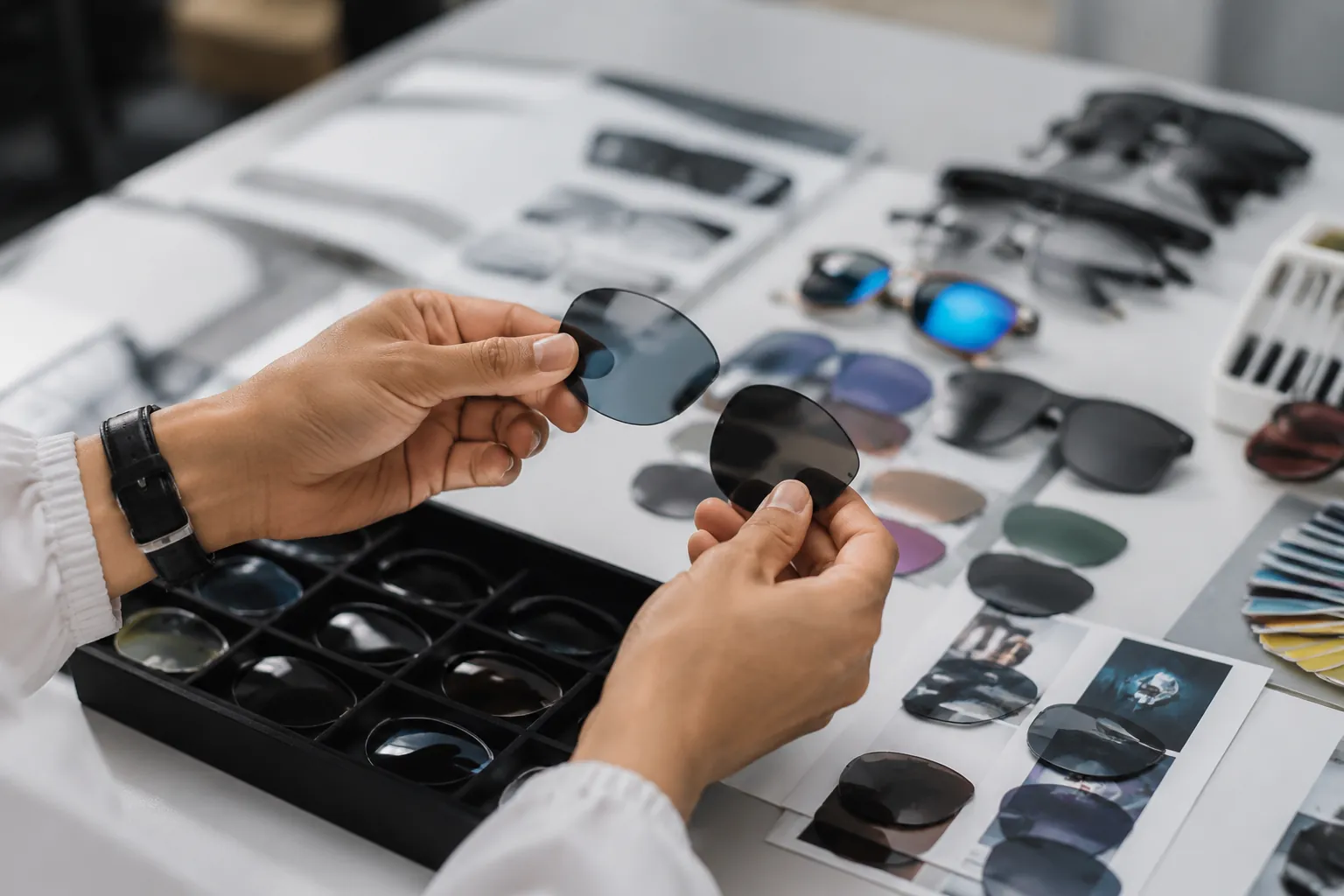
This guide is for brands, importers, distributors, and retailers buying polarized sunglasses in volume. The issue is not whether a spec sheet says "polarized." The issue is whether the lens performs as promised, stays consistent in production, and fits the target market without creating avoidable cost or compliance risk. If you source private label or retail programs, use this guide to define the lens, verify the process, and avoid claims you cannot support.
What polarized lenses actually do
A polarized lens is not just a tinted lens. It contains a polarizing film or laminate that cuts horizontally reflected light. That is the glare from water, roads, snow, glass, chrome, and car surfaces. Tint lowers brightness. Polarization lowers reflected glare. Different jobs.
For sourcing, the real question is not whether one sample darkens an LCD screen. The question is whether the finished lens keeps that glare reduction across the full viewing area, including the edge after cutting and fitting. Bad film orientation, weak lamination control, or stress from post-processing can create haze, banding, uneven zones, or distortion. A center sample will not always show that.
Start with the use case. Fishing and driving programs need strong glare suppression and stable color perception. Sport programs need optical clarity, impact behavior, and a secure fit in wrap frames. Fashion collections care more about appearance, lens color, and coating options. If the use case is vague, the factory will default to a standard build. That may miss the channel.
For B2B buyers, the lens spec should name the substrate, tint range, polarization orientation, base curve, coating stack, cosmetic standard, and the allowed difference between approved sample and bulk production. That is what turns "polarized" into a usable requirement.
Test glare performance, not the claim
Do not accept "polarized" as a yes-or-no answer without asking how it is verified. Ask what the factory checks, at which stage it checks it, and what happens when a lens fails. A credible supplier can explain the method, the acceptance criteria, and the reject path. Clearly.
At minimum, request a repeatable analyzer test or a practical LCD blackout check, plus visual inspection for uniformity and optical defects. In a controlled test, the lens should show a strong blackout when rotated about 90 degrees relative to the screen or analyzer. One hand-picked sample proves very little about lot stability.
Use a simple buyer checklist:
- Confirm the polarizing axis is consistent across left and right lenses and across the lot.
- Inspect under bright white light for haze, edge banding, and heat ripple.
- Check the lens against an LCD screen or analyzer and confirm the blackout is strong and repeatable at the expected rotation angle.
- Compare left and right lenses for color, brightness, and mirror reflection consistency.
- Ask for written sample approval criteria and bulk re-approval rules.
Most defects come from three process points: film sourcing, lamination temperature, and post-lamination cutting. Too much heat can warp TAC and weaken adhesion. Aggressive cutting can cause edge stress or micro-chipping. Controlled cutting keeps tolerances tight enough that the lens seats without force. The exact tolerance depends on frame design and tooling, so define it in the product spec. Do not guess.
Factories with in-house lens tinting, CNC milling, and QC usually control these variables better than traders who buy finished lenses from multiple sources. That matters. A weak batch can look fine in photos and fail later under heat, shipping, or customer handling.
What drives polarized lens cost
Price is a stack of choices, not one number. Material, coating, cosmetic standard, order size, packaging, and approval requirements all affect unit cost. Buyers often ask for the cheapest polarized lens. The better question is which cost drivers can be simplified without hurting the channel experience.
| Order level | Typical buying position | Cost behavior | Process reality |
|---|---|---|---|
| 50 pairs/design | Sampling or small test run | Highest unit cost because setup, QC, and packaging overhead are spread across very few pairs | Useful for approval, but not ideal for frequent spec changes |
| 300 pairs/design | First real market test | Unit cost starts to normalize as material buying and setup waste improve | Enough volume to test sell-through and return risk |
| 1,000 pairs/design | Program launch quantity | Better pricing on lens material, coatings, and print or packaging setup | Small spec changes begin to add cost |
| 5,000+ pairs/design | Scaled replenishment | Lower unit cost is typically possible when the spec is stable and the process is repeatable | QC, carton planning, and defect control matter more because mistakes scale fast |
Material choice is one of the biggest technical cost levers. TAC is often the value option because it is light, widely used, and suitable for many mass-market sunglasses. PC usually costs more, but it offers stronger impact resistance and is often preferred for sport or active lifestyle programs. Glass delivers strong optical clarity and scratch resistance, but it is heavier and is generally better suited to premium or optical-focused collections.
Coatings can add cost quickly. A basic polarized TAC lens will usually cost less than a lens with mirror coating, gradient tint, anti-scratch treatment, anti-reflective treatment, and custom color matching. Cosmetic standards also matter. If you require tighter color matching between left and right lenses, lower haze, or stricter rejection of edge defects, the unit price rises because the factory has to inspect more carefully and accept less scrap.
Lead time affects cost too. A supplier that can quote samples in 7 to 10 days and bulk production in 25 to 35 days is usually working from a structured process, but only if the spec is stable. Late changes to tint, logo placement, coating, or packaging create rework risk. In practice, the cheapest program is often the one that locks the spec early and avoids redesigning midstream.
Compare the main polarized lens options
Buyers should compare more than "polarized or not." Substrate, processing tolerance, impact behavior, and finish all affect the final product. The matrix below is a fast way to compare common options.
| Lens option | Strengths | Weak points | Best fit |
|---|---|---|---|
| TAC polarized | Lightweight, cost-efficient, strong glare reduction for the price | More sensitive to heat and rough handling than some alternatives | Value retail, promo programs, private label mass market |
| PC polarized | High impact resistance, suitable for active use and tougher environments | Needs tighter scratch-control discipline and careful coating selection | Sport, outdoor, ANSI-oriented programs |
| Glass polarized | Strong optical clarity and scratch resistance | Heavier and usually higher cost; less flexible in some fashion frames | Premium eyewear and optical-focused collections |
| Tint + mirror polarized | Strong shelf appeal and a high-visibility sunwear look | More process steps and a higher rejection risk if coating control is weak | Fashion-forward retail and seasonal drops |
There is no universal winner. TAC often fits price-sensitive channels because it balances cost and comfort. PC is the better option when impact performance and active use matter. Glass makes sense when optical feel and premium perception are part of the brand promise. The right lens is not the one the factory already has in stock. It is the one that matches the customer, the frame, and the selling price.
For wrapped frames, ask about base curve compatibility. A lens that works in a flatter fashion frame may not seat correctly in a deeper wrap sport frame without stress. That stress can show up later as edge lift, coating cracks, or early delamination. Lens choice and frame geometry should be specified together.
What a factory should control in production
Polarized lens quality is mostly process control. A serious factory should be able to explain raw material intake, film orientation, lamination temperature, cutting, edge finishing, decoration, and final inspection. If the conversation stays vague or focuses only on output volume, be cautious.
Good production control means the lens is not just made, but made repeatably. If the supplier also injects frames in-house, cuts acetate in-house, or runs CNC milling and lens fitting internally, the lens-to-frame interface can be checked earlier and more accurately. That reduces edge stress and improves fit. It also helps with decoration methods, because pad printing, laser engraving, or hot stamping near the lens zone should not interfere with coatings or the optical window.
A practical production checklist looks like this:
- Lock the lens material, tint target, and coating stack before tooling is opened.
- Confirm the wrap angle and base curve match the frame geometry before mass cutting.
- Hold lens cut tolerance within the approved frame fit range defined for the product.
- Verify the polarization axis after cutting, not only on the raw sheet.
- Inspect under both direct and diffused light for haze, banding, surface marks, and color drift.
Decoration also needs discipline. Pad printing is common for logos and can work well if the print zone is outside the optical path. Laser engraving can be cleaner for premium branding, but it must not overheat coated surfaces. Metal foil decoration and hot stamping can lift if the substrate surface is not prepared correctly. For retail programs, choose the decoration method for durability first and appearance second. A logo that rubs off quickly is a return risk, not a brand asset.
If the supplier cannot name its top defect categories and explain the cause of each one, it probably does not track them closely enough. Good factories know whether they are seeing haze, axis error, coating contamination, edge chipping, or stress whitening, because each problem needs a different fix.
Compliance is not optional paperwork
For overseas B2B buyers, compliance should match the destination market, the product claims, and the risk level of the channel. Do not ask for random certificates. Ask for the right documents, and confirm that they belong to the exact product family you are buying, not to a similar item from another line.
For LumiShades, the relevant certifications and compliance references are CE EN ISO 12312-1, FDA registration, ANSI Z80.3, AS/NZS 1067, REACH, ISO 9001, and BSCI. Use only those references in this article.
- CE EN ISO 12312-1 for EU sunglasses compliance.
- ANSI Z80.3 for U.S. sunglass performance requirements where applicable.
- AS/NZS 1067 for Australia and New Zealand.
- REACH for chemical compliance and restricted substances control.
- FDA registration as part of U.S. regulatory readiness.
- ISO 9001 for quality system structure, not product performance by itself.
- BSCI for supply chain social compliance expectations.
Remember the difference between factory certification and product suitability. A strong audit file does not make a weak lens compliant. A good lens still needs the right paperwork for the target market. If you sell into multiple regions, keep market-specific documentation organized by SKU and version, because a coating change can affect a compliance file even when the frame looks identical.
How to compare quotes without getting fooled
Two quotes can look different and still cost the same in real life. One supplier may include lens cloths, hard cases, or carton inserts while another leaves them out. One may quote a lower lens price but assume lower rejection standards or broader cosmetic tolerance. If you do not normalize the quote line by line, you may compare the wrong number.
Compare the same variables every time: lens material, polarization type, tint level, coating stack, frame compatibility, logo method, packaging, sampling fee, bulk lead time, and defect policy. If one supplier includes a hard case and another uses a soft pouch, the unit price alone is not useful. If one supplier promises a tighter finish standard, they may be pricing in more scrap and slower inspection.
Ask what happens if the approved sample and mass production differ slightly. A disciplined supplier will define an acceptable variance range and a re-approval step. A weak supplier will say "same as sample" and leave the tolerance vague. That is where disputes start, especially when the order is for 1,000 pairs or more and the issue appears only after packing.
The easiest savings usually come from spec simplification. Standardize lens colors where possible. Limit the coating stack to the features your channel can actually sell. Reuse lens shapes across multiple frame colors when the geometry allows it. Those choices reduce tooling changes, cut waste, and changeover time. In private label programs, that often matters more than trying to shave a few cents from the smallest order.
A buyer's decision rule for polarized programs
If you need a fast decision rule, use this: buy the lens that passes your target market's compliance, holds polarization under real use, fits the frame without stress, and still leaves margin after packaging and freight. Not the prettiest quote. Not the longest certificate list. The one that can survive sales, returns, and replenishment.
Use the sample order to test three things only: visual comfort, cosmetic consistency, and assembly fit. Then use the bulk order to prove repeatability. A good sample can hide weak process control if the bulk order is not checked carefully. That is why a staged approval plan matters: sample approval, pre-production confirmation, and bulk QC.
For a supplier such as LumiShades, a 50-pair MOQ, 7 to 10 day samples, and 25 to 35 day bulk timeline can work for this process, as long as the spec is stable and the approval steps are clear.
One blunt rule holds up well in polarized sourcing: if the supplier cannot explain the lens process in plain language, do not assume it controls the process. The factories worth pricing seriously can explain where the film comes from, how the axis is checked, how defects are classified, and why one coating stack costs more than another. That level of specificity usually predicts fewer surprises later.
The right polarized program is not just good enough to sell. It is stable enough to repeat, clear enough to defend, and simple enough to price accurately from the start.
Have a custom sunglasses project in mind?
Send us your styles, target market and quantities and we will return a detailed quote with MOQ, lead time and a sample plan.
Get a QuoteWhy source this from Wenzhou with LumiShades
Wenzhou in Zhejiang Province is widely regarded as China’s eyewear manufacturing capital, producing a large share of the world’s sunglasses. That concentration matters to buyers: a deep local supply chain for acetate sheet, hinges, lens blanks, plating and packaging means shorter component lead times, easier color and material matching, and a workforce with decades of eyewear-specific skill. LumiShades has manufactured in this ecosystem since 2009, and our vertical integration — in-house injection molding, acetate cutting, CNC milling, lens tinting, decoration and quality control — means no part of your order is quietly subcontracted to a workshop you cannot audit.
For international buyers, that vertical control translates into accountability. When a single factory owns every step, defects are traced and fixed at source rather than bounced between vendors, and your specifications survive intact from first sample to bulk. For procurement review, buyers can request process records, approved samples, quality checkpoints and project-specific compliance files before placing a bulk order. Required testing and documentation are confirmed against the destination market and product specification rather than assumed from a generic certificate list. Explore our manufacturing capabilities and quality control process to see how this works in practice.
Frequently asked questions
How can I tell if a polarized lens is actually polarized? Use a polarizing analyzer or rotate the lens in front of an LCD screen. The image should darken strongly at the expected angle, usually close to a 90-degree rotation relative to the screen or analyzer. For sourcing, also ask whether the supplier checks finished cut lenses or only raw sheets, and request the acceptance criteria in writing.
What lens material is best for a value private label program? TAC is often the most practical value choice because it balances weight, glare reduction, and cost. If the channel is sport, outdoor, or impact-sensitive, PC may be the better fit even if the unit cost is higher. Choose based on the use case, not just the lowest quote.
What MOQ should I expect for polarized sunglasses? MOQ varies by supplier, construction, and customization level. For a private label program, a small first run is often used for approval and market testing, then larger quantities are used once the spec is stable. If a supplier offers 50 pairs per design, treat that as a sampling or test quantity rather than a signal of low unit cost at scale.
Which certifications matter for polarized sunglasses exports? Match the documents to the destination market and the exact SKU. The relevant references here are CE EN ISO 12312-1, ANSI Z80.3, AS/NZS 1067, REACH, FDA registration, ISO 9001, and BSCI. Ask the supplier to show current documents tied to the product you plan to buy, not a similar style from another line.
What is a realistic lead time for custom polarized orders? A realistic planning range is often 7 to 10 days for samples and 25 to 35 days for bulk production when the spec is approved and stable. Lead time can extend if the order needs new tooling, complex coatings, or late logo or packaging revisions. Confirm the timeline in writing before you place the order.
What causes polarization defects in mass production? Common causes are poor film alignment, excess heat during lamination, cutting stress, coating contamination, and weak final inspection. Most failures are process problems, not just material problems. That is why you should ask how the factory checks axis alignment after cutting and how it handles rejected pieces.
Ready to start?
Explore our wayfarer sunglasses or request a quote — our sales team replies within 12 hours.
Request a Quote