
How to Source Photochromic Sunglasses
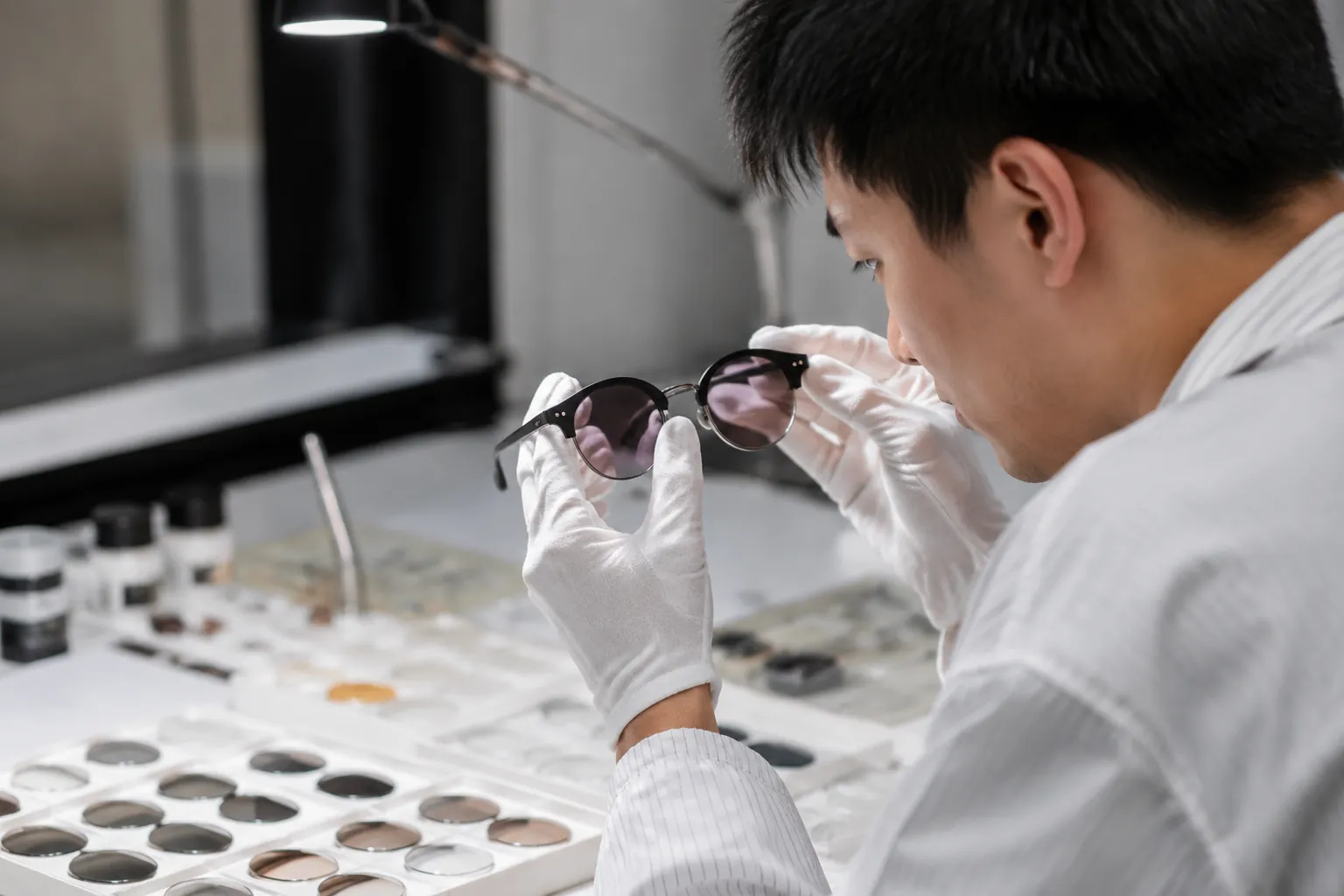
This guide is for brands, importers, distributors, and retail buyers sourcing photochromic sunglasses for a private label line. It explains where adaptive lenses make sense, what to put in a factory brief, how to compare quotes, and which controls protect bulk quality. Replace vague requests such as "UV400 photochromic lens" with measurable requirements for lens material, VLT, activation and fade testing, coatings, decoration, packaging, MOQ, inspection, and compliance.
Start with the use case
Photochromic sunglasses darken when exposed to ultraviolet radiation and fade back toward a lighter state when UV exposure drops. Simple idea. Complicated sourcing.
Performance changes with lens material, photochromic chemistry, base tint, lens thickness, coatings, ambient temperature, UV intensity, and whether the wearer is behind glass. Many vehicle windshields block a large share of UV, so standard photochromic lenses may darken only slightly inside a car.
Define the user before asking for a quote. A cyclist moving between open road and tree cover may need a lens that shifts from a lighter filter to a darker outdoor filter. A travel customer may want one pair for airports, streets, and sightseeing. A beach-fashion customer may be better served by a fixed Category 3 sunglass lens that is darker, cheaper, and easier to explain.
For B2B programs, photochromic lenses usually fit three routes: outdoor sports, travel lifestyle, and optical-style all-day sunglasses. They are weaker choices for very low-cost promotions, heavy mirror fashion lines, or products sold mainly for in-car darkening unless the lens is tested for that claim. Do not hide the limits. Put them in sales training, product pages, and packaging copy.
A useful factory brief should state the target retail price, user scenario, destination market, frame material, lens category target, expected order quantity, decoration method, packaging level, and required test reports. Small trial quantities can help validate demand. Unit economics change fast at higher volume. Do not add polarized photochromic lenses, mirror coating, custom packaging, and lens logo printing unless each feature supports the retail price and can be controlled in production.
Choose the right photochromic lens route
Do not compare two quotes as if all "photochromic" lenses are the same. They are not. The same frame can be quoted with PC, TAC, nylon, or a photochromic coating on a base lens. Each route has different cost, optics, impact behavior, coating risk, and inspection needs.
A professional quote should identify the full lens construction, not just the sales name.
| Lens route | Typical VLT target | Best use | Key sourcing risk |
|---|---|---|---|
| Photochromic PC lens | Commonly specified around 45-65% VLT in the light state and 12-25% VLT in the dark state, subject to formula and test conditions | Sports, injection frames, youth and active lifestyle ranges | Surface hardness and coating adhesion must be controlled; low-grade PC can scratch easily |
| Photochromic TAC polarized lens | Often specified around 35-55% VLT in the light state and 10-20% VLT in the dark state, depending on construction | Fishing, water sports, and glare-heavy outdoor use where polarization is part of the product promise | Layer structure can delaminate if lamination, cutting, edge sealing, or heat control is poor |
| Photochromic nylon lens | Commonly specified around 40-60% VLT in the light state and 10-22% VLT in the dark state | Higher-end cycling, running, and outdoor performance eyewear | Higher material cost; may be over-specified for basic fashion programs |
| Photochromic coating on standard base lens | Varies widely; must be verified by batch under agreed test conditions | Cost-sensitive lifestyle collections with controlled performance claims | Abrasion resistance, chemical resistance, and color consistency depend heavily on the coating process |
PC is often a practical starting point for private label sunglasses. It is light, impact-resistant, and compatible with many injection frames. TAC makes sense when polarization is central to the product claim, but test the full lens stack after cutting and assembly, not only as a flat raw sheet. Nylon is better suited to higher retail prices, wrap frames, and performance programs where optical clarity and toughness matter.
Ask the factory to state lens material, base color, activated color, VLT range in both states, UV protection level, polarization efficiency if relevant, coating package, lens curve, center thickness, edge thickness, and applicable standard. A quote that says only "photochromic UV400 lens" is incomplete.
Lock specs before sampling
A sample request should be a technical target, not a mood board. Photochromic lenses are easy to approve badly because lighting, UV intensity, temperature, and phone cameras can change how dark or how neutral the lens appears. Write the measurable requirements first. Then ask the factory to sample against them.
- Visible light transmission: define both states. Example: light state 45-60% VLT and dark state 12-20% VLT after defined UV exposure. Link the range to the sunglass filter category required in the destination market.
- Activation and fade time: specify test conditions, such as UV exposure for 5 or 10 minutes at 23°C, then record VLT immediately and after 5, 10, and 15 minutes indoors. Many photochromic lenses darken more in cooler weather and fade more slowly at lower temperatures.
- Lens geometry: confirm base curve, center thickness, edge thickness, and frame fit. For many sunglass programs, lens thickness tolerance is commonly controlled around ±0.10 mm to ±0.15 mm, but the final tolerance should be agreed based on lens material, frame groove, and assembly method.
- Color: grey is more neutral; brown can improve contrast but changes color perception; green can suit lifestyle collections but requires careful left-right matching.
- UV protection: require the UV protection level needed for the destination market and finished product standard, such as CE EN ISO 12312-1, ANSI Z80.3, or AS/NZS 1067.
- Polarization: if required, confirm axis alignment, polarization efficiency, screen behavior, and whether mounting in a curved frame creates visual distortion.
- Coatings: define hard coat, mirror, hydrophobic, oleophobic, or anti-reflective coating. Each coating can add cost, process risk, and inspection requirements.
- Frame compatibility: check lens groove depth, screw stress, rim pressure, heat exposure during assembly, and whether rework could damage the coating or lens edge.
Tolerances protect repeatability. Temple logo position is often controlled within about ±0.5 mm to ±1.0 mm, depending on decoration method. Agree the tolerance before production. Judge left-right lens color against an approved master under the same lighting and UV exposure. Check frame front width, temple length, hinge opening, nose fit, and lens retention during in-process QC, not only at final packing.
Where possible, use a manufacturer that can manage lens sourcing, cutting, frame production, assembly, and QC under one documented process. Adaptive lenses do not like rework. Repeated handling can create coating scratches, left-right shade mismatch, stress marks near the lens edge, or contamination during packing.
Test before bulk approval
Do not approve photochromic sunglasses from one outdoor photo. Use a repeatable test protocol that the factory, buyer, and third-party inspector can follow. It does not need to be academic. It does need to be consistent.
- Inspect frame color, surface finish, lens color, and logo placement against the approved master sample.
- Measure VLT in the light state before UV activation and in the dark state after defined UV exposure.
- Check left and right lens matching indoors, after activation, and during fade-back.
- Record activation and fade behavior at a stated temperature, ideally in a controlled range such as 20-25°C.
- Confirm UV protection and lens filter category marking for the destination market.
- Check lens retention by moderately flexing the frame and opening and closing temples through repeated cycles according to the agreed inspection plan.
- Inspect coating adhesion, abrasion resistance, cleaning resistance, and mirror color consistency if coatings are specified.
- Run final appearance checks after packaging because tight pouches, paper inserts, or plastic sleeves can mark soft coatings.
Compliance should apply to the finished product, not only the raw lens sheet. For Europe, sunglasses are commonly assessed to CE EN ISO 12312-1. For the United States, buyers commonly request ANSI Z80.3, and FDA registration may be relevant for suppliers placing eyewear into the US market. For Australia and New Zealand, request AS/NZS 1067. REACH is important for restricted substances in frame materials, coatings, inks, nose pads, and packaging contact points.
Ask which current documents are available for the exact product type, material, and production route. Relevant documents may include CE EN ISO 12312-1, ANSI Z80.3, AS/NZS 1067, REACH, FDA registration, ISO 9001, and BSCI, depending on the market and retailer. If a retailer needs extra chemical tests, lab reports, social audits, or carton-label rules, raise that before sampling. Waiting until the week before shipment can hold the order, especially if lens categories, warning text, or packaging labels must be corrected.
Understand MOQ, cost, and lead time
The lens is usually a major cost driver in photochromic sunglasses. Not the only one. Tooling, frame material, coating yield, decoration, packaging, inspection level, and compliance documents all affect the final price.
A plain PC adaptive lens in an existing injection frame is one program. Polarized photochromic TAC with mirror coating, custom acetate frame, metal logo plate, retail box, pouch, barcode label, and third-party test report is another. Treat them differently.
| Order level | Best use | Price behavior | Operational detail to control |
|---|---|---|---|
| 50 pairs per design | Market test, influencer kit, sales meeting, or retailer presentation | Highest unit cost because setup, decoration, sampling, and QC are spread across few units | Use existing frame molds, standard lenses, and standard packaging where possible |
| 300 pairs per design | First commercial drop or regional launch | Better purchasing efficiency for lenses, logos, pouches, cartons, and line setup | Freeze barcode, warning text, country-of-origin marking, and logo artwork before production |
| 1000 pairs per design | Retail replenishment or distributor order | More stable scheduling and lower material waste when specifications are fixed | Apply AQL-style final inspection and retain approved master samples |
| 5000+ pairs per design | Volume private label program | Best pricing potential on stable standard specifications, subject to lens construction, packaging, and inspection requirements | Lock change-control rules for lens batch, coating, logo, packaging, and compliance documents |
Sample lead time is often 7 to 10 days when frame molds, lens materials, and logo processes are already available. Confirm it for the exact specification. Add time for custom acetate colors, new injection molds, special mirror coatings, third-party lab testing, or custom retail packaging. Bulk production should be scheduled only after sample approval, deposit, final artwork, packaging files, and compliance requirements are confirmed. Put the final lead time on the purchase order and production schedule.
Higher MOQ can improve price through material purchasing, reduced setup loss, faster line balancing, lower decoration waste, and more efficient inspection. But over-ordering an unproven adaptive lens is risky. Test small. Reorder after claims and returns are understood. Scale only after the product page, sales script, packaging, and QC standard are stable.
Control decoration and packaging
Branding is not just cosmetic. Decoration affects durability, cost, lead time, and rejection rate. With photochromic sunglasses, keep the lens story clean. A large lens logo can block vision, conflict with markings, or wear differently from the coating around it.
Common decoration options include pad printing, laser engraving, hot stamping, metal logo plates, and molded-in details. Pad printing is flexible for temple logos and low to mid MOQ runs, but ink adhesion must be checked on rubberized or coated surfaces. Laser engraving is durable on suitable metal or acetate parts, but contrast varies by material color. Metal logo plates look premium but need accurate recess design and adhesive control. Agree position tolerance before bulk. Lens printing is possible, but it should be small, outside the central vision area, and tested for coating compatibility.
Packaging changes the sourcing plan. A microfiber pouch and cleaning cloth work well for sports and travel programs. A rigid retail box improves shelf presentation but increases freight volume and carton crush requirements. Barcode labels, warning cards, multilingual instructions, country-of-origin marks, recycling symbols, and compliance markings should be finalized before bulk starts. Late packaging changes often delay shipment even when the sunglasses are finished.
Mirror coatings need extra caution. They can make the photochromic transition harder to show online, and consumers may not realize the lens is changing. Mirrors also make scratches, color drift, and left-right variation easier to see. If the sales story is adaptive performance, consider a light mirror or no mirror for the first order unless the mirror finish is essential to the design.
Buyer rule: if a feature cannot be explained in one product-page bullet or shown in a short retail demo, question whether it belongs in the first production run.
Approve and protect the golden sample
Before bulk production, approve a physical golden sample and record what it represents. Do not approve adaptive lenses from chat photos alone. Phone cameras, screen brightness, weather, UV intensity, and time of day can all mislead you.
- Frame material, color, surface finish, and dimensions approved.
- Lens material, base tint, activated tint, VLT target, and filter category recorded.
- Left and right lens matching accepted before and after UV activation.
- Activation and fade behavior checked under agreed conditions.
- Logo method, logo size, logo location, and acceptable tolerance confirmed.
- Hinge tension, temple opening, screw security, nose fit, and lens retention checked.
- Packaging, pouch, cloth, barcode, warning text, carton marks, and compliance markings approved.
- One golden sample retained by the buyer and one by the factory for production comparison.
For larger orders, request pre-production samples or production-line photos after the factory has matched the approved master. During-production inspection is useful when the order has multiple colors, coatings, or packaging versions. Final inspection should cover appearance, dimensions, lens retention, logo placement, packaging count, barcode scan, carton marking, and any agreed VLT or UV verification.
Scale makes written approvals more important, not less. Late lens changes, packaging revisions, or compliance label corrections can disrupt a good schedule. Freeze the golden sample. Treat every later change as a controlled revision with documented cost, lead-time, and compliance impact.
Use a narrow first-order plan
For a first private label photochromic program, keep the range tight. One proven frame, two frame colors, and one lens technology are easier to test than six mixed SKUs with different coatings. Add complexity after customer feedback, not before.
- Define the user and use case: cycling, running, travel, fishing, outdoor retail, or lifestyle fashion.
- Select a frame construction. Injection frames are efficient for sporty volume; acetate needs more cutting, polishing, and fitting control.
- Choose one lens route and write measurable VLT, UV, filter category, color, coating, activation, and fade targets.
- Request samples with the intended logo method and packaging close to the final retail version.
- Test samples in real use conditions, including shade, direct sun, indoor fade-back, and behind a windshield if customers may ask about driving use.
- Approve a golden sample and confirm the required compliance documents for the destination market.
- Place the first order at a quantity that matches demand confidence, retailer commitments, and budget.
- Review sell-through, returns, customer questions, lens complaints, and inspection results before scaling to a larger program.
The lowest-risk first order is not always the cheapest specification. It is the specification customers understand, sales staff can explain, and QC can repeat. For photochromic sunglasses, that usually means realistic darkening claims, controlled lens geometry, limited coatings, practical decoration, and a clear golden sample. Get those right first. Then scale.
Have a custom sunglasses project in mind?
Send us your styles, target market and quantities and we will return a detailed quote with MOQ, lead time and a sample plan.
Get a QuoteWhy source this from Wenzhou with LumiShades
Wenzhou in Zhejiang Province is widely regarded as China’s eyewear manufacturing capital, producing a large share of the world’s sunglasses. That concentration matters to buyers: a deep local supply chain for acetate sheet, hinges, lens blanks, plating and packaging means shorter component lead times, easier color and material matching, and a workforce with decades of eyewear-specific skill. LumiShades has manufactured in this ecosystem since 2009, and our vertical integration — in-house injection molding, acetate cutting, CNC milling, lens tinting, decoration and quality control — means no part of your order is quietly subcontracted to a workshop you cannot audit.
For international buyers, that vertical control translates into accountability. When a single factory owns every step, defects are traced and fixed at source rather than bounced between vendors, and your specifications survive intact from first sample to bulk. We back this with 15+ years of experience, shipments to 60+ countries, more than 5 million pairs produced per year and a 98.5% on-time delivery rate. Our certifications — CE EN ISO 12312-1, FDA registration, ANSI Z80.3, AS/NZS 1067, REACH, ISO 9001 and BSCI audit — mean the compliance documentation your market requires already exists. Explore our manufacturing capabilities and quality control process to see how this works in practice.
Frequently asked questions
Can photochromic sunglasses become very dark inside a car? Usually not with standard UV-activated photochromic lenses. Most modern windshields block a large share of UV, so the lens may not receive enough UV to reach its outdoor dark state. If buyers expect strong in-car darkening, ask for a specific driving-use test and do not make that claim unless the finished product is validated for it.
What VLT range should I request for private label photochromic sunglasses? Specify both states. Many sunglass programs request a light state around 45-65% VLT and a dark state around 12-25% VLT, but the right range depends on lens material, use case, filter category, and destination standard. Include UV exposure time, test temperature, and measurement points in the sample brief so suppliers quote against the same target.
What is the normal lead time for private label photochromic sunglasses? If existing frame molds, lens materials, and decoration methods are available, samples are often quoted around 7 to 10 days. The supplier must confirm this for the exact specification. Bulk lead time should be confirmed after sample approval, deposit, final artwork, packaging files, and compliance requirements are complete. Add time for new molds, custom acetate, special mirrors, third-party testing, or retail packaging development.
What MOQ should I use for a first photochromic order? Use the smallest quantity that can produce reliable feedback. A small test order can work for sales presentations, influencer kits, or retailer validation. A mid-size first drop is better when packaging, barcodes, and retail commitments are already confirmed. Move to larger orders only after VLT behavior, customer claims, returns, and QC standards are proven.
Which certifications or compliance documents should I request for the EU, US, and Australia? For the EU, request finished-product documentation aligned with CE EN ISO 12312-1. For the US, buyers commonly request ANSI Z80.3, and FDA registration may be relevant for suppliers entering the US eyewear channel. For Australia and New Zealand, request AS/NZS 1067. REACH may apply to restricted substances in frames, coatings, inks, nose pads, and packaging contact points. Make sure documents match the finished product, not only the raw lens sheet.
Is polarized photochromic worth the extra cost? It can be worth it for fishing, boating, water sports, snow, and other glare-heavy outdoor use where polarization is a clear selling point. For basic fashion sunglasses, many customers may not value it enough to justify the higher cost and added QC risk. If you choose polarized photochromic lenses, verify polarization axis, lamination quality, lens distortion after mounting, and delamination risk after cutting and assembly.
What decoration method is safest for photochromic sunglasses? A temple logo by pad printing, laser engraving, hot stamping, or a small metal plate is usually safer than a large lens logo. The best method depends on frame material and surface finish. Before bulk production, test adhesion, abrasion resistance, logo position tolerance, and cleaning resistance. Keep lens logos small, outside the main field of vision, and compatible with the lens coating.
What should be recorded on the golden sample approval? Record frame material, color, surface finish, dimensions, logo method, logo size, logo position, lens material, base tint, activated tint, VLT targets, UV protection requirement, filter category, coating package, packaging, barcode, warning text, country-of-origin marking, carton marks, and required compliance documents. Keep one approved sample with the buyer and one with the factory. Treat any later change as a controlled revision.
Ready to start?
Explore our rimless sunglasses or request a quote — our sales team replies within 12 hours.
Request a Quote