
Photochromic Sunglasses: Wholesale Buyer Guide
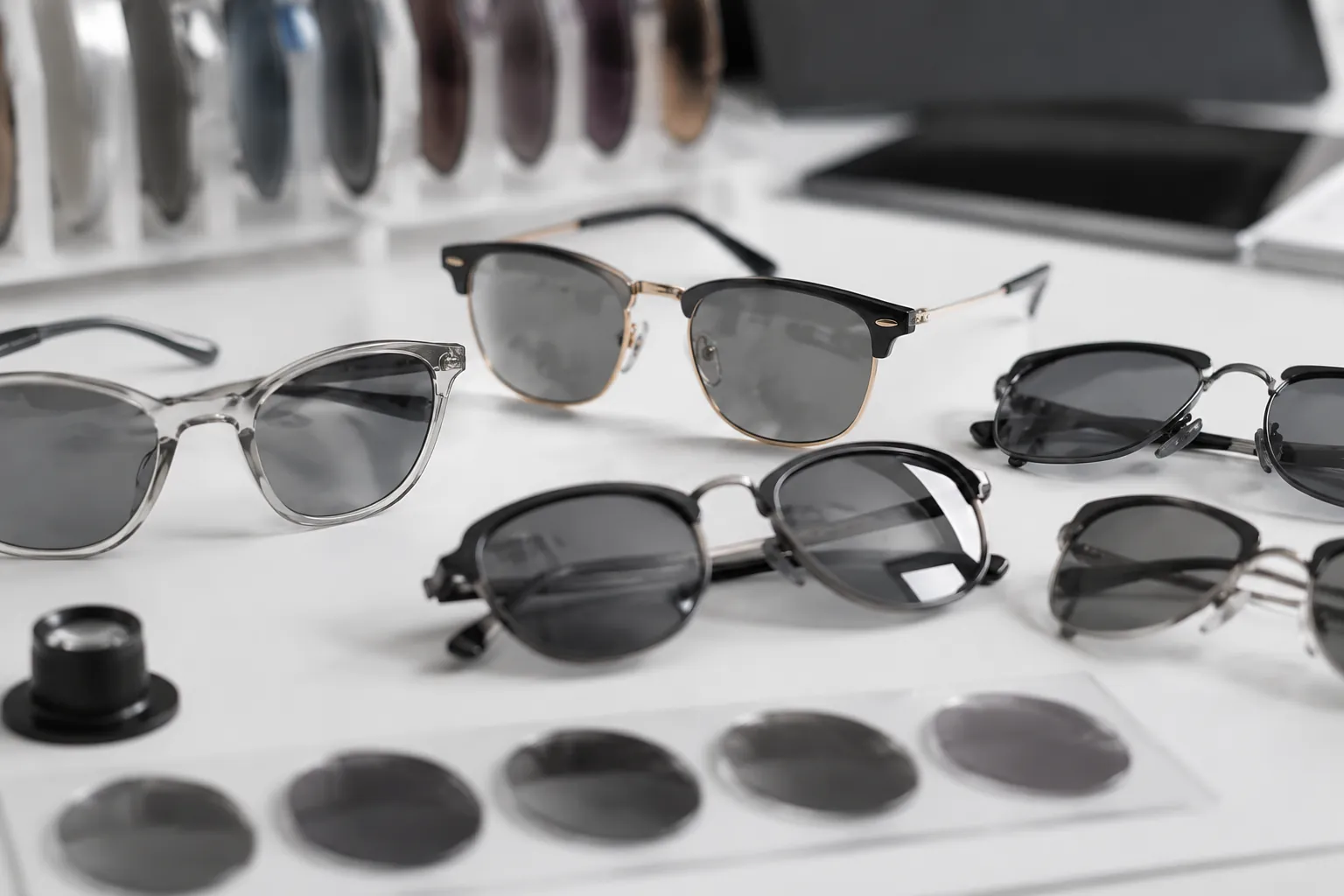
Photochromic sunglasses are not a fit for every channel. They are also not a low-risk add-on. For brands, importers, distributors, and retailers, the real question is simple: does the lens behavior fit the sell-through pattern, price point, and use case of a specific product line? This guide shows where photochromic lenses make commercial sense, where they do not, and what they do to unit cost, lead time, compliance, and approval risk. If you buy in volume, the details matter.
What photochromic lenses do
Photochromic lenses darken in ultraviolet light and return toward a lighter state when UV drops. That is the basic function. The commercial result depends on the lens material, the dye system or coating, the lens thickness, and the frame design around the lens. A thicker lens can behave differently from a thinner one. Rimless and semi-rimless builds can raise finishing and handling risk.
For wholesale buyers, the key question is not whether the chemistry exists. It is whether the lens performs the same across the exact SKU family you plan to sell. Check three things with the supplier: how dark the lens gets, how fast it changes, and how stable that behavior is from sample to bulk production.
Most photochromic systems are designed to reach a useful outdoor tint, not a fully opaque sunglass look. Indoors, many lenses keep some tint instead of going fully clear. That residual tint can change with formulation, temperature, and lens construction. So review real samples and test reports. Do not rely on product names alone.
Material choice also affects behavior and processing. Polycarbonate is common in sunglass programs because it is light and impact resistant. Other lens materials and coating stacks can work too, but the supplier should confirm that the final build has been tested as one configuration. In-house lens handling matters. Edge finishing, coating adhesion, and assembly quality can all affect haze, uneven activation, or early wear.
Where the product fits
The best channels for photochromic sunglasses are the ones that value convenience and can explain the benefit at point of sale. That includes commuter collections, travel eyewear, everyday retail, optical channels with a value tier, and private-label programs that want one style to cover indoor and outdoor use. In those settings, the functional story can justify the added cost if the buyer can say it simply.
The product fits less well in channels that sell mainly on visual impact or the lowest landed cost. If the customer wants a very dark fashion sunglass, a lens that starts lighter indoors can feel off-brand. If the program is price-first and inventory turns fast, the extra unit cost may not come back. Promotion-led programs also tend to struggle unless the message is clear and the order volume is large enough to absorb setup work.
- Good fit: commuter, travel, everyday wear, value optical retail, cross-season private label.
- Possible fit: club stores, marketplaces, workwear add-ons, practical promo lines.
- Poor fit: fashion-led sunglass walls, hard discount programs, trend drops built on low landed cost.
A useful internal test is blunt: does the channel reward function, or does it reward a look? Photochromic usually wins on function. If the buyer cannot explain the transition benefit in one sentence, the product probably belongs elsewhere.
Merchandising matters too. Neutral frame colors such as black, tortoise, smoke, navy, or crystal gray usually make the lens behavior easier to present. Loud translucent colors, heavy printing, or strong mirror effects can compete with the lens story. If the product depends on quick visual approval, sample it in the lighting conditions shoppers will actually see. Not just under lab light.
Cost and margin reality
Photochromic lenses add cost in more than one place. The lens itself usually costs more than a standard tinted lens. QA can also take longer because the buyer is checking not only appearance but response behavior. Packaging and copy may need adjustment so customers understand how the lens works. If they do not, returns and complaints can rise.
For a factory program, MOQ and volume tiers matter. A practical starting point for a custom order is 50 pairs per design. Pricing often becomes more efficient at 300 pairs, then 1000 pairs, and again at 5000+ pairs because setup and material costs spread more evenly. The exact quote depends on lens type, coating stack, frame material, decoration, and compliance scope. A supplier may quote one standard photochromic build at a lower price and a custom or premium build at a higher one, so ask for itemized pricing. Do not accept a single blanket rate.
| Option | Typical buyer use | Unit cost pressure | Lead time impact | Commercial risk |
|---|---|---|---|---|
| Standard tinted sunglass lens | Fashion, promo, basic retail | Lowest | Lowest | Low |
| Photochromic lens, standard spec | Everyday retail, commuter, travel | Moderate | Moderate | Medium |
| Photochromic lens with premium coating or custom appearance | Higher-margin private label, optical retail | Higher | Higher | Medium to high |
| Photochromic lens plus specialty decoration or complex frame build | Branded launch, premium collection | Highest | Highest | High |
Measure margin as more than gross sell price minus landed cost. Include return rate, retailer complaints, replacement risk, and dead stock. A product that is technically profitable but poorly explained can become unprofitable fast after returns. Ask for the price at each volume tier, plus separate pricing for any custom lens color, anti-scratch coating, hydrophobic coating, mirror finish, or logo work.
Lead time and sampling
Photochromic approval is visual and functional, so a spec sheet is not enough. Buyers need to see the shift under real light, confirm shade depth, check return speed indoors, and verify that the frame finish works with the lens appearance. A gray photochromic lens in a black acetate frame can feel very different from the same lens in a crystal frame or a patterned injection shell. Same lens. Different sell.
For custom programs, sample timing is often 7-10 days and bulk production is commonly 25-35 days once the specification is final. Those timelines work only if the lens spec is locked early. If the buyer changes tint target, coating, or frame color after sample approval, the process may need another approval round. That can mean remaking the lens batch, checking decoration alignment again, and repeating optical QC.
The schedule risk usually comes from three places. First, lens availability: uncommon photochromic formulas or special coatings may take longer to source. Second, color matching: the frame must look good in both indoor and outdoor states, not just one. Third, final QC: the batch can be held if darkening response, clarity, or surface finish does not match the approved sample.
To manage that risk, build a clear approval sequence. Start with a color and performance sample, then verify the same build under daylight or UV, then approve packaging copy, then release production. If the order is tied to a launch date, add buffer. Protect at least one extra week beyond the stated bulk lead time if the lens system is new to the program or the decoration is nonstandard.
Factories with in-house production can reduce handoff delays because molding, cutting, coating, decoration, and final inspection stay in one workflow. That does not remove risk. It just makes control easier.
Performance tradeoffs to test
Photochromic lenses are useful, but they are not universal. They react to UV, so performance can look different behind car glass, indoors near a window, or in low-UV conditions. That is not a defect. It is how the product works. The buying mistake is assuming one sample will behave the same in every setting.
Before you place a purchase order, test the exact SKU for activation speed, fade-back speed, indoor residual tint, and color neutrality. Also confirm whether the final lens is acceptable in the climate you sell into. Some formulations respond differently in warmer or cooler conditions. If you sell across regions, test the same SKU in the environments where it will actually be worn.
- Activation speed: how fast the lens darkens in sunlight.
- Fade-back speed: how quickly it clears after moving indoors.
- Residual tint: whether the lens stays too dark for indoor use.
- Color neutrality: whether the lens shifts toward gray, brown, or another tone you can sell.
- Frame and lens match: whether mirror, print, or acetate color conflicts with the photochromic look.
- Wear environment: whether the lens still performs as expected in cars, shade, and mixed light.
Short version: if the lens feels too slow, too light, or too tinted indoors, the buyer will hear about it. Consumers do not care how hard the chemistry was to source. They care whether the eyewear feels convenient, comfortable, and worth the premium. That is why a field test with real staff or a small pilot run is often better than reviewing samples only on a desk.
Compliance and documents
Do not buy photochromic sunglasses on a verbal claim. Ask for the compliance package you would require on any wholesale sunglass program, then verify the lens specification against the intended market. Photochromic behavior can vary with lens color, thickness, coating, and construction, so paperwork from a different build is not enough.
Keep the certification list focused on the documents that matter for the target market. For this program, the relevant references are CE EN ISO 12312-1, ANSI Z80.3, AS/NZS 1067, REACH, FDA registration, ISO 9001, and BSCI. The right mix depends on destination and channel. A buyer in the EU will usually focus on CE EN ISO 12312-1 and REACH. A buyer in the US will typically ask for FDA registration and ANSI Z80.3.
Ask for the actual report set tied to the SKU you plan to buy. If the lens is clear-to-gray with a specific thickness and coating, the report should reflect that configuration. If the frame material changes from acetate to injection, or if the product is rebranded under a different style code, confirm whether the existing documents still apply.
| Market or channel | What to confirm | Why it matters |
|---|---|---|
| EU retail | CE EN ISO 12312-1, REACH | Product safety and substance compliance |
| US retail or import | FDA registration, ANSI Z80.3 | Retail acceptance and safety claims |
| Australia / New Zealand | AS/NZS 1067 | Local eyewear standard expectations |
| General supplier audit | ISO 9001, BSCI | Process control and social compliance review |
Also ask what the factory can provide with the shipment: test reports, carton labels, style codes, barcode data, packing list, and country-of-origin documentation. A clean commercial file reduces customs delays and helps retailers load the product into their own systems without back-and-forth.
How to brief the factory
A good brief saves time. A vague one burns it. If you want a usable photochromic quote, send the factory the target market, target retail price, expected annual volume, frame material, preferred lens tone, target shade range, and any compliance requirements that apply. The more precise the brief, the more useful the first quote will be.
Include the following in the first round so the supplier can quote the right process, not just the right shape:
- Frame material: injection, acetate, or mixed build.
- Lens type: photochromic clear-to-gray, clear-to-brown, or another approved option.
- Lens performance target: preferred darkness, fade-back speed, and indoor residual tint.
- Decoration: laser engraving, pad printing, foil stamp, metal logo plate, or no decoration.
- Market: EU, US, Australia / New Zealand, or mixed.
- Volume ladder: 50, 300, 1000, 5000+ pairs.
- Timeline: sample date, PO release date, and ship window.
It also helps to specify the finish tolerance you can accept. If the frame uses printed branding, say whether slight registration drift is acceptable. If the lens is coated, ask for cosmetic criteria such as haze limits, speck tolerance, or edge polish expectations. In eyewear, these details matter because the lens is visible, the frame is touched, and buyers notice inconsistencies quickly.
If you buy from a factory with in-house injection molding, acetate cutting, CNC milling, coating, decoration, and QC, you reduce the chance that one subcontractor blames another for a defect. That does not remove the need for sample approval. It simply reduces avoidable handoff errors and gives the buyer a clearer accountability chain.
The best quote request is not long for the sake of length. It is specific enough that the supplier can tell whether the program fits their line, their equipment, and their compliance scope before anyone spends a round on revisions.
Buyer checklist
Use photochromic lenses when the product is supposed to solve a real use case. Skip them when the only goal is to add complexity to a low-price fashion line. The product should improve the shopper's life in a way the channel can explain and monetize.
- Choose photochromic if your channel sells daily-use eyewear and can explain the transition benefit.
- Choose standard tint if you need the darkest possible sunglass look at the lowest cost.
- Choose photochromic if you can support a slightly longer approval cycle and a clearer product story.
- Avoid photochromic if your channel has high return sensitivity and weak product education.
- Request samples first if frame color, lens tone, or branded decoration is part of the sales pitch.
For wholesale buyers, the right lens is the one that turns into sell-through, not just a line on a spec sheet. The strongest programs usually have a simple use case, a documented compliance package, a realistic margin model, and enough lead time to approve the visual result before launch.
Treat photochromic as a merchandising feature, not just a material upgrade. If the buyer, the sales team, and the retailer all understand why the product exists, it can perform well. If they do not, the extra complexity shows up in pricing pressure, returns, and slow inventory movement.
Have a custom sunglasses project in mind?
Send us your styles, target market and quantities and we will return a detailed quote with MOQ, lead time and a sample plan.
Get a QuoteWhy source this from Wenzhou with LumiShades
Wenzhou in Zhejiang Province is widely regarded as China’s eyewear manufacturing capital, producing a large share of the world’s sunglasses. That concentration matters to buyers: a deep local supply chain for acetate sheet, hinges, lens blanks, plating and packaging means shorter component lead times, easier color and material matching, and a workforce with decades of eyewear-specific skill. LumiShades has manufactured in this ecosystem since 2009, and our vertical integration — in-house injection molding, acetate cutting, CNC milling, lens tinting, decoration and quality control — means no part of your order is quietly subcontracted to a workshop you cannot audit.
For international buyers, that vertical control translates into accountability. When a single factory owns every step, defects are traced and fixed at source rather than bounced between vendors, and your specifications survive intact from first sample to bulk. For procurement review, buyers can request process records, approved samples, quality checkpoints and project-specific compliance files before placing a bulk order. Required testing and documentation are confirmed against the destination market and product specification rather than assumed from a generic certificate list. Explore our manufacturing capabilities and quality control process to see how this works in practice.
Frequently asked questions
What MOQ should I expect for photochromic sunglasses? A practical starting point for a custom program is 50 pairs per design. Pricing usually gets more efficient at 300 pairs, then 1000 pairs, and again at 5000+ pairs because setup and material costs spread more evenly at each tier. Ask the supplier to confirm whether the MOQ changes by lens type, frame material, or decoration method.
Do photochromic lenses add much to lead time? Usually yes, because the lens spec has to be approved as part of the full build. Sample timing is often 7-10 days and bulk production is commonly 25-35 days once the specification is locked. If you change lens tone, coating, or frame color after approval, expect extra time for a new sample check or partial rework.
Are photochromic sunglasses approved for the US and EU by default? No. You still need the right compliance package for the target market. For the EU, ask for CE EN ISO 12312-1 and REACH. For the US, ask for FDA registration and ANSI Z80.3. Always verify that the documents match the exact SKU, not just a similar style.
Can photochromic lenses be used in car-driving products? Use caution. Photochromic lenses rely on UV, so performance can be limited behind windshields. If the product is being sold for driving, test the exact lens in a vehicle before you make that claim. Do not assume a standard outdoor sample will behave the same in the car.
What should I ask the factory for before placing an order? Ask for the target-market compliance documents, a final-spec sample, documented response behavior under UV, frame-and-lens matching photos, the exact price at your volume tier, and the decoration method used on the frame. If possible, also request a packing spec, style code list, and carton label format so your internal team can approve the commercial file before production.
Ready to start?
Explore our rimless sunglasses or request a quote — our sales team replies within 12 hours.
Request a Quote