
Photochromic Sunglasses: Where They Sell
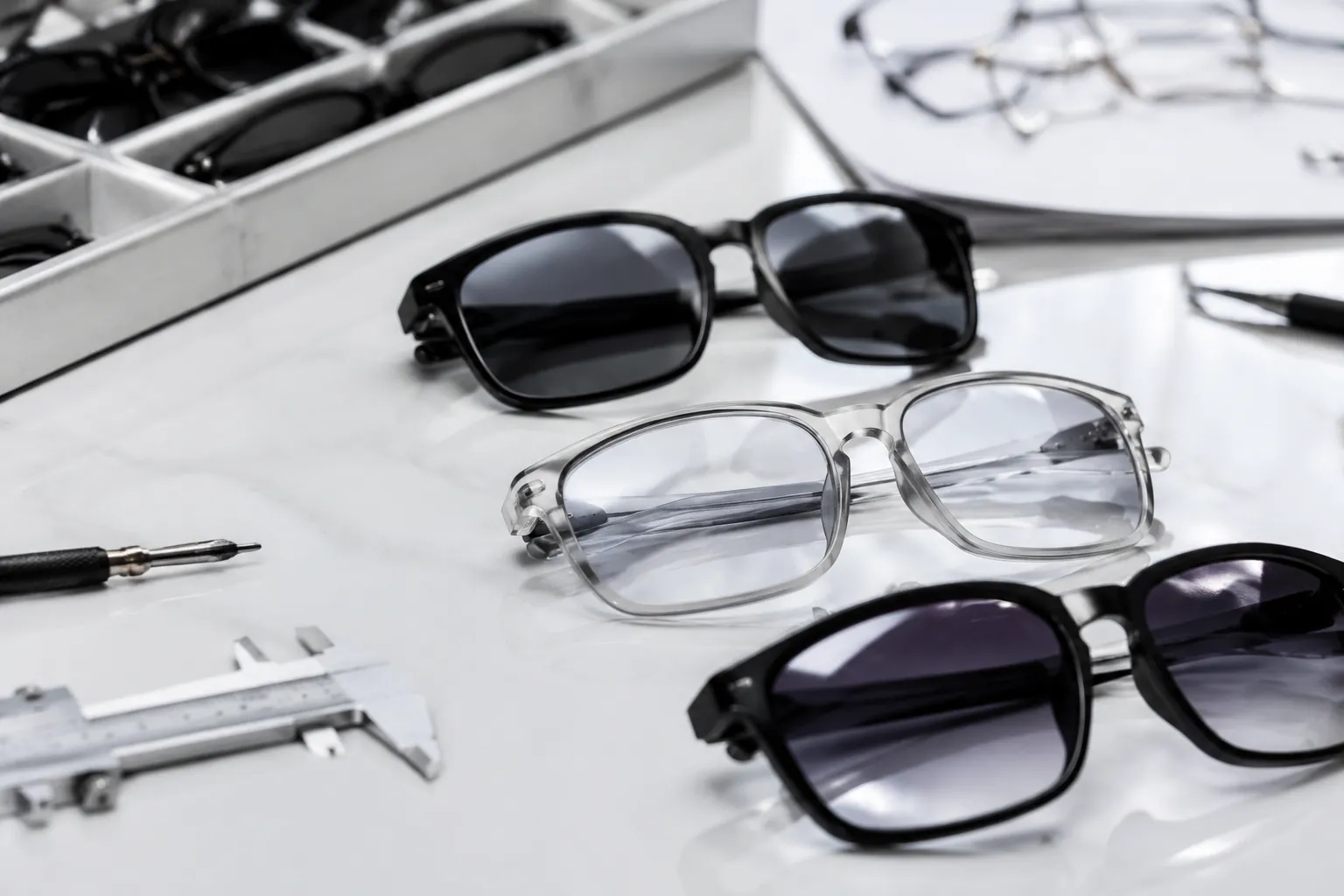
This guide is for brands, importers, distributors, and retailers deciding whether photochromic lenses belong in their sunglasses line. It stays practical: where they sell, where they fall short, what buyers should specify, and what to confirm before placing a bulk order. It is written from a custom-eyewear production perspective and avoids claims that cannot be checked in production or testing.
The commercial test: mixed light or not?
Photochromic lenses make sense when the wearer moves through mixed light during the day: shade, parking lots, sidewalks, trails, open sun, and short stops where changing glasses is annoying. That is the use case. If the customer wants one pair for a beach day and expects it to stay dark all the time, a standard tinted or polarized lens is usually easier to sell and cheaper to make.
For B2B buyers, the first question is not technical. It is channel fit. Light-adaptive lenses are easier to sell where the benefit is obvious at a glance: cycling, running, fishing, golf, travel retail, outdoor workwear, optical shops, and performance-led lifestyle brands. They are harder to move in fast-fashion channels where shoppers compare shape, lens darkness, and price first.
Margin matters too. Photochromic lenses add cost at the lens level and usually need more careful sample approval and QC because the buyer must check both the faded and activated states. On a commodity sunglass program, a standard lens may be the lower-cost choice at volume. If the retail price cannot absorb the extra lens cost and approval effort, do not force the feature into the line.
Timing matters as well. A SKU that needs explanation, staff training, and tighter sample sign-off is not a good fit for a short trend cycle. Start narrow. One user case. One frame family. One lens chemistry. One clear selling story.
Where photochromic lenses usually sell through
Photochromic sunglasses do not perform equally across every channel. They work best where one pair doing two jobs is an easy story: reduce glare outdoors and stay comfortable when the wearer moves into shade or indoor environments. The real question is whether the channel can explain that benefit without a long demo.
| Channel | Why it can work | Buyer caution |
|---|---|---|
| Outdoor sport brands | Riders, runners, and hikers move through clouds, tree cover, tunnels, and open sun in one trip. | Ask for activation and fade-back samples in the actual lens color, not only grey. |
| Optical and specialty eyewear shops | Staff can explain why the lens is lighter indoors and darker outside, and compare it against a regular sunglass lens. | Provide a demo card or UV-light demonstration so the team does not overpromise performance. |
| Travel and airport retail | Travelers may want one pair for terminals, city walking, and transit changes. | Activation behind car glass or terminal glass may be limited because UV is reduced or blocked. |
| Workwear and safety-adjacent distributors | Workers switch between warehouse shade and outdoor yards, so constant lens swapping is inconvenient. | Do not imply safety certification unless the product has been tested and certified for that use. |
| Fashion-focused retailers | Can work as a premium story if the frame is strong and the shelf messaging is simple. | Weak if shoppers expect a dark lens immediately when they see the product on shelf. |
In most cases, the strongest launch starts with two frame shapes at most and two lens colors at most. Too many SKUs dilute sell-through and make QC harder before the buyer even knows whether customers understand the feature. A tight range also gives cleaner feedback. If the grey lens sells but the brown lens stalls, that is useful. If eight variants move at different speeds, the lesson gets muddy.
Lens behavior buyers should check before approval
Photochromic lenses respond mainly to ultraviolet light. Outdoors, UV exposure triggers the lens to darken; when UV drops, the lens fades back. Simple idea. Not simple in practice. Different chemistries respond differently, and the same lens can behave differently depending on temperature, base curve, frame wrap, and the amount of UV reaching the lens.
Temperature is one of the most misunderstood variables. In colder conditions, many photochromic lenses darken more deeply and recover more slowly. In hotter conditions, they may not reach the same dark state. That does not automatically mean the lens is defective. It is normal material behavior. Buyers should test samples in the season and region where the product will actually be sold.
Car use needs separate review. Standard automotive glass blocks much of the UV that activates many photochromic lenses, so the lens may stay only lightly tinted inside a vehicle. If the marketing promise includes driving comfort, test the exact lens in a real car, not only under a UV lamp. Customers notice fast when a driving claim fails.
Color choice matters too. Grey is usually the safest commercial option because it preserves color perception and is easier to approve across multiple markets. Brown can improve contrast and feel warmer on the face, but color variation may be more visible from batch to batch. Fashion colors are possible, but they need tighter sample approval because the lens must look acceptable in both the faded and activated states.
- Ask for two states: faded indoor appearance and activated outdoor appearance.
- Check fade-back: customers notice if the lens stays too dark indoors.
- Confirm UV protection: clear-looking lenses still need verified UV blocking.
- Test with the final frame: curvature, base curve, and lens thickness change the look.
- Review under real light: store LEDs, daylight, and direct sun can make the same lens look different.
Do not rely on one hand sample. Use a loose lens sample, a mounted sample in the final frame, and a simple activation comparison photo or card. That gives a far better read on appearance and customer acceptance.
Spec decisions that affect cost and lead time
Most buyer problems start with vague specs. Saying "photochromic sunglasses, black frame, grey lens" is not enough for production. A factory needs a clear bill of materials and an approval target that defines what must not change. At minimum, specify frame material, lens material, lens color in faded and activated states, base curve, lens thickness, UV requirement, decoration method, packaging, and compliance market.
Lens material is a key cost and performance decision. PC is common for sport and kids' styles because it is light and impact resistant. TAC is common in polarized sunglasses, but photochromic options should be checked carefully because the treatment or layer behavior may differ by supplier. Nylon is often used for higher-end sport shields and rimless styles because it balances toughness, optical clarity, and drilling performance. Acrylic is cheaper, but it is usually a weaker fit for higher-performance or durability claims.
For practical approval, ask for measurable targets instead of vague descriptions. A production-ready spec should define allowable lens thickness tolerance, color tolerance, and curvature control. If the lens is meant for a high-wrap frame, the approved sample should show that the lens seats without stress whitening, edge lift, or warped appearance. Even a small base-curve mismatch can create visible distortion or fit problems.
Decoration also affects lead time. Laser engraving on temples is usually faster and more stable than custom metal logo plates. Pad printing is efficient, but it needs ink adhesion testing on the final frame finish, especially if the frame has a coated surface or high-gloss texture. If you add a new mold, a new lens chemistry, a custom hinge, a custom logo plate, and custom packaging in the same first order, the schedule will slip. Change one major variable at a time.
At LumiShades, in-house injection molding, acetate cutting, CNC milling, lens tinting, decoration, and QC reduce handoffs and help control quality. Even so, photochromic lenses still need real sampling. Typical samples take 7-10 days when materials are in stock. Bulk production is usually 25-35 days after approval, but uncommon colors, new molds, or a new lens source can extend that timeline.
For a buyer, the most useful production question is simple: what is fixed, and what is still moving? If the answer changes after every sample round, the spec is not ready.
Cost and MOQ logic for a first order
LumiShades supports MOQ from 50 pairs per design, which is useful for pilot runs. That said, a low-MOQ test should not be overloaded with custom variables. Use an existing frame, standard hinge, standard packaging, and one lens option. The goal is to validate the lens story and the customer response, not to prove a full custom program on the first order.
Cost usually improves at 300, 1000, and 5000+ pairs because material purchasing, line setup, lens cutting, decoration, and QC are spread across more units. In simple terms, low MOQ pays a setup penalty, while higher volume spreads that fixed cost. Photochromic lenses generally cost more than basic tinted lenses because the lens blank or treatment is more complex and inspection takes longer. If a factory quotes a photochromic SKU at the same price as a standard lens with no explanation, ask what is being omitted.
For first-order planning, think in stages. A 50-100 pair pilot is for proof of concept. A 300+ pair order is for market validation. A 1000+ pair run is for repeatability and supply discipline. A 5000+ pair program is where packaging, replenishment, and landed cost control matter as much as the product itself.
| Order stage | Practical quantity | Best spec choice | What to learn |
|---|---|---|---|
| Pilot | 50-100 pairs/design | Existing frame, one photochromic grey lens, simple logo | Customer understanding, returns, visual acceptance |
| Market test | 300+ pairs/design | Two frame colors or two lens colors, same construction | Which SKU sells without heavy staff push |
| Retail rollout | 1000+ pairs/design | Locked lens spec, approved packaging, fixed QC criteria | Repeatability and landed margin |
| Distributor program | 5000+ pairs/design | Stable BOM, carton plan, replenishment forecast | Unit cost control and delivery reliability |
Do not judge the program only by ex-factory price. Add packaging, freight, duties, local testing if required, retail staff training, and possible returns from misunderstood activation claims. A slightly higher factory price can be cheaper overall if it reduces complaints and rework.
Compliance questions by destination market
For sunglasses, compliance is not decoration. Buyers should confirm the required standard before approving the purchase order, because the right report for one market may be useless in another. The certifications and systems commonly relevant to eyewear programs include CE EN ISO 12312-1, ANSI Z80.3, AS/NZS 1067, REACH, FDA registration, ISO 9001, and BSCI. The required documents depend on where the sunglasses are sold and what claims are printed on the packaging.
For the EU, CE EN ISO 12312-1 is central for sunglasses, and REACH matters for restricted substances in materials and coatings. For the United States, buyers commonly ask about FDA registration and ANSI Z80.3 for non-prescription sunglasses. For Australia and New Zealand, AS/NZS 1067 applies. A report issued for one lens color or one sample build does not automatically cover every lens tint or frame version in the line.
Photochromic products need extra attention because the visible tint changes. Buyers should verify the final lens category and UV performance in the intended state of use. If a lens is marketed as protective when activated outdoors, the supporting test should reflect that exact lens construction, not a different sample with a different coating. Packaging claims also need to match the certificate, especially if the retail copy mentions driving, glare reduction, or full UV blocking.
- State the destination countries on the RFQ, not just "global market."
- Ask whether the tested lens category matches the lens you are ordering.
- Check that UV protection is verified for the final lens, not a different sample.
- Confirm markings, packaging text, and user information before printing cartons.
- Keep the approved sample, test report reference, and production batch records together.
- Confirm whether your market requires warnings, lens category markings, or country-specific labeling.
The safest rule is to align commercial claims, test reports, and carton text before production starts. If any one of those three is out of sync, a good product can still become a sales problem.
Factory questions that expose real capability
A serious factory should be able to answer process questions without hiding behind sales phrases. If the supplier cannot explain how lenses are sourced, cut, tinted or coated, mounted, and inspected, the buyer is taking avoidable risk. Short answers are fine. Vague answers are not. For photochromic programs, process control matters more than a polished catalog page.
- What is the lens material and photochromic method? Ask whether it is PC, TAC, nylon, or another substrate, and whether the effect is built into the material or applied as a treatment.
- What are the faded and activated transmission targets? You need target values or approved physical samples for both states.
- How do you test activation? Ask about UV exposure method, timing, temperature conditions, and the visual comparison standard.
- What frame curve is compatible? High-wrap sport frames can stress lenses if the lens is not suited to the base curve.
- How is logo decoration controlled? Laser engraving, pad printing, and metal logo plates each need separate approval limits.
- What is the inspection plan? Include scratches, tint mismatch, loose hinges, frame warpage, logo position, and packaging errors.
- What is the acceptable tolerance for lens fit? Ask how much edge lift, stress mark, or warpage is allowed before rejection.
LumiShades can handle injection molding, acetate cutting, CNC milling, lens tinting, decoration, and QC in-house, which helps control these points. But the buyer still needs written specs, sample sign-off, and a defined AQL. Factory capability does not replace a clear purchase specification.
One practical QC check is to compare three samples side by side: the approved golden sample, a production pre-shipment sample, and one random carton sample after packaging. That catches issues such as lens color shift, temple print drift, or frame distortion before the shipment goes out.
A practical launch plan
The safest launch is intentionally simple. Start with one proven frame and one photochromic lens. Approve the product outdoors, indoors, and under store lighting. Then order a controlled pilot before scaling. The goal is to find out whether the market likes the benefit before adding more variables.
A workable process is: RFQ with target market and compliance standard, material confirmation, sample order, activation review, fit and hinge review, packaging copy check, pilot order, sell-through review, then bulk order. Samples usually take 7-10 days. Bulk production is normally 25-35 days after final approval. If the order includes new molds, uncommon lens colors, or complex decoration, add buffer time rather than assuming the fastest timeline.
For launch discipline, define the approval points in advance. Decide what the lens should look like after indoor fade-back, how dark it should appear outdoors, whether the frame should remain clean after decoration, and which defects trigger rework. If the team knows the acceptance bar before production starts, the factory can hit it more reliably.
For volume planning, use 50 pairs per design to test, 300 pairs to validate a channel, 1000 pairs for a serious retail run, and 5000+ pairs when the design is proven and cost reduction matters. Photochromic lenses can improve sell-through, but only where the daily use case matches the lens behavior. Sell the use case, not the chemistry. If the customer cannot understand the benefit in ten seconds, the SKU needs better packaging, better staff notes, or a simpler lens offer.
In practice, the best launch often keeps the first order visually simple and commercially focused: one frame color, one lens color, one compliance target, and one clear retail claim. That is not conservative. It is how a technical product becomes an easy product to sell.
Have a custom sunglasses project in mind?
Send us your styles, target market and quantities and we will return a detailed quote with MOQ, lead time and a sample plan.
Get a QuoteWhy source this from Wenzhou with LumiShades
Wenzhou in Zhejiang Province is widely regarded as China’s eyewear manufacturing capital, producing a large share of the world’s sunglasses. That concentration matters to buyers: a deep local supply chain for acetate sheet, hinges, lens blanks, plating and packaging means shorter component lead times, easier color and material matching, and a workforce with decades of eyewear-specific skill. LumiShades has manufactured in this ecosystem since 2009, and our vertical integration — in-house injection molding, acetate cutting, CNC milling, lens tinting, decoration and quality control — means no part of your order is quietly subcontracted to a workshop you cannot audit.
For international buyers, that vertical control translates into accountability. When a single factory owns every step, defects are traced and fixed at source rather than bounced between vendors, and your specifications survive intact from first sample to bulk. For procurement review, buyers can request process records, approved samples, quality checkpoints and project-specific compliance files before placing a bulk order. Required testing and documentation are confirmed against the destination market and product specification rather than assumed from a generic certificate list. Explore our manufacturing capabilities and quality control process to see how this works in practice.
Frequently asked questions
Do photochromic sunglasses darken inside a car? Often only a little. Standard automotive glass blocks much of the UV that activates many photochromic lenses. If driving comfort is part of the claim, test the exact lens in a real vehicle and do not rely on a UV-lamp demo alone.
What is a sensible MOQ for testing photochromic sunglasses? Start with 50-100 pairs per design using an existing frame and one lens color. That lets you check fit, appearance, customer understanding, and returns before committing to a larger run.
Which lens color is safest for a first order? Grey is usually the safest first choice because it is neutral in color perception and easier to compare in faded and activated states. Brown can work well for contrast, but it deserves tighter sample approval.
What compliance documents should an overseas buyer ask for? Ask for the documents that match the destination market: CE EN ISO 12312-1 and REACH for the EU, FDA registration and ANSI Z80.3 for the US, and AS/NZS 1067 for Australia and New Zealand. Make sure the report covers the exact lens and frame build you are ordering.
How long do samples and bulk orders usually take? A typical sample lead time is 7-10 days when materials are available, and bulk production is usually 25-35 days after final approval. New molds, uncommon lens colors, or additional decoration can add time.
Are photochromic lenses worth the higher unit cost? They are worth it when the customer moves through changing light and can understand the benefit quickly, such as in sport, travel, optical, and outdoor workwear channels. They are harder to justify in low-price fashion channels where shoppers mainly compare frame style and price.
Ready to start?
Explore our cat-eye sunglasses or request a quote — our sales team replies within 12 hours.
Request a Quote