
Photochromic Sunglasses B2B Buying Guide
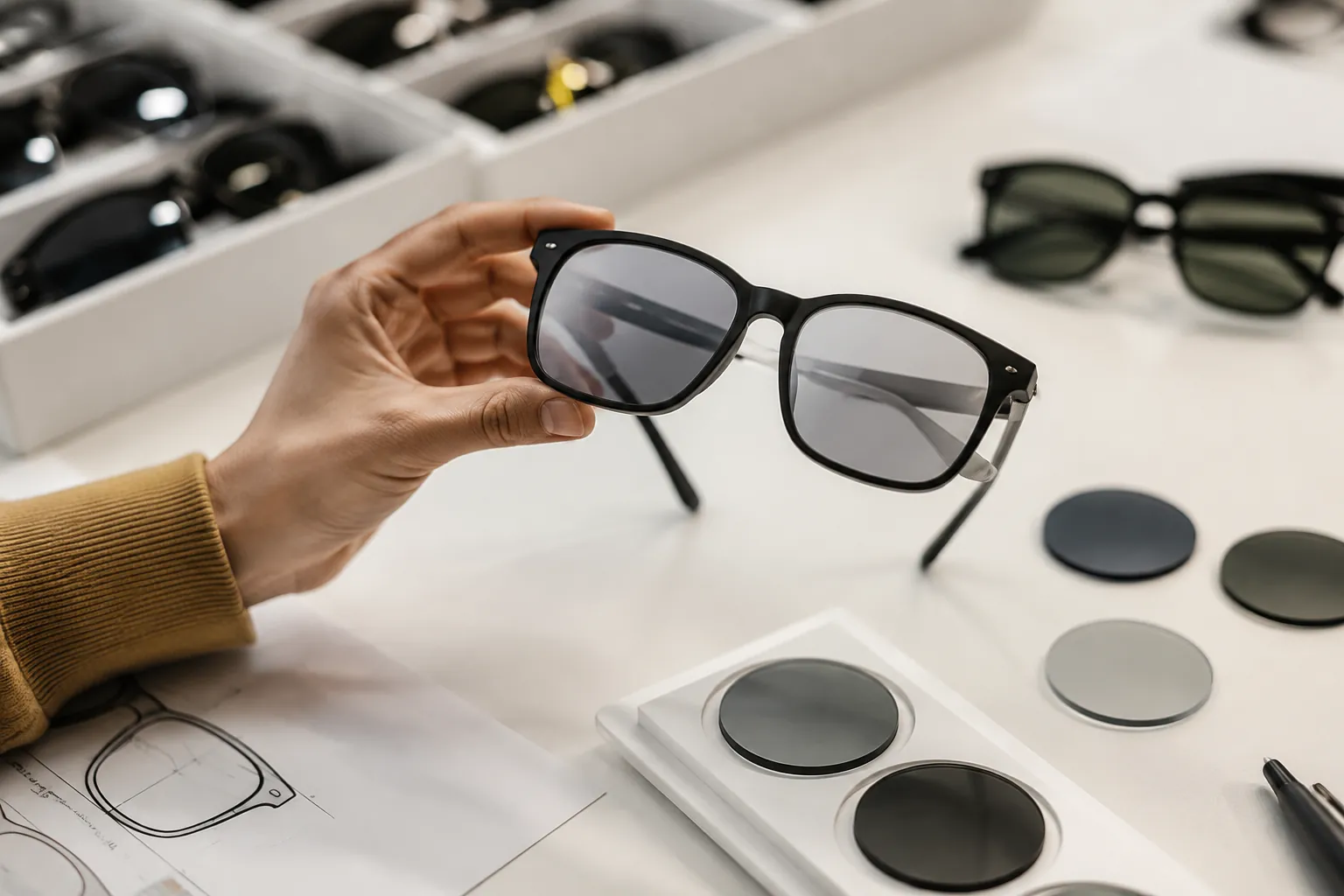
This guide is for eyewear brands, importers, distributors, optical retailers, and private-label buyers evaluating photochromic sunglasses for wholesale programs. It focuses on sourcing decisions: where adaptive lenses make sense, where they create risk, how they affect cost and lead time, and how to specify them clearly enough to protect margin. The lens behavior and compliance points below are written for factory buying, not consumer marketing.
Does the lens solve a channel problem?
Photochromic sunglasses are not automatically better sunglasses. They are useful when changing light creates a real selling point: commuting, trail use, cycling, fishing, travel, or everyday eyewear for customers who move between indoor and outdoor spaces. In wholesale, the feature should reduce SKU complexity, raise perceived value, or solve a specific use case.
The mistake is treating photochromic lenses as a universal upgrade. They add lens cost. They also demand tighter QC and clearer retail education. If the customer expects the lens to go very dark in every situation, returns follow.
A good B2B decision starts with channel fit. Outdoor sport brands, optical retailers, cycling stores, fishing brands, hiking brands, and travel retailers usually understand the benefit. Fast-fashion programs can use photochromic lenses, but only when the retail story is simple and the price structure can carry the cost.
Blunt rule: if the hangtag cannot explain the benefit in one sentence, the feature may not pay for itself.
A workable one-sentence claim is: adapts from a lighter tint to a darker tint in outdoor UV exposure for changing light conditions. Avoid claims such as instant darkening, universal driving performance, or replacing every sunglass category unless the exact lens has been tested and documented for that use.
Best-fit use cases by buyer type and price
Photochromic lenses make the most sense where the wearer moves through shade, sun, cloud, and variable terrain. They are weaker for pure beach sunglasses, where customers usually want a fixed dark lens, mirror color, and stronger glare control from polarization.
| Buyer channel | Good fit? | Typical positioning | Recommended use case | Margin risk |
|---|---|---|---|---|
| Outdoor sport brands | High | Mid to premium | Trail, cycling, running, hiking, fishing | Lower if the lens spec matches the activity |
| Optical retailers | High | Mid to premium | Daily convenience lens, travel, light outdoor use | Medium because customers ask technical questions |
| Fashion sunglasses brands | Medium | Entry to mid | Premium capsule, limited colorways, tech story | Medium to high if the base price is already tight |
| Promo distributors | Low | Entry | Premium corporate gift only, not mass giveaway | High because the added cost is hard to recover |
| Kids eyewear programs | Medium | Entry to mid | Outdoor school, sports, UV protection story | Medium; frame durability matters more than the lens story |
Price point matters. A basic fashion sunglass with a tight cost structure may not absorb a photochromic lens. A sport frame with wrap coverage, anti-slip details, and clear UV protection messaging has a better chance because the customer sees why the feature belongs there.
What photochromic lenses do, and what they do not
Photochromic lenses contain light-reactive compounds that darken under ultraviolet exposure and fade back when UV exposure drops. Performance depends on chemistry, lens base material, coating stack, lens thickness, UV intensity, and temperature. The exact behavior should be confirmed with supplier data and sample testing under the intended use conditions.
For B2B specifications, ask the factory for measured visible light transmission, or VLT, in the clear state and in the activated state under the relevant test method for the target market. Do not buy on language alone. A marketing sheet that says "darker" or "faster" is not enough to judge the lens.
A photochromic lens is not the same as a polarized lens. Polarization reduces reflected glare from water, roads, snow, and glass. Photochromic behavior changes light transmission. A lens can be photochromic, polarized, both, or neither, but each added function increases cost and process control requirements.
- Good claim: adapts from lighter tint to darker tint in outdoor UV exposure.
- Risky claim: turns black instantly in all sunlight conditions.
- Good claim: suitable for changing outdoor light.
- Risky claim: perfect for driving unless the exact lens has been tested for that use.
- Good claim: provides UV protection when the lens passes the relevant market requirement.
Car windshields reduce the UV that reaches the lens, so many photochromic lenses darken less inside vehicles. If driving is part of the product story, test the exact lens behind glass and keep packaging language conservative.
Spec decisions that change cost and returns
The factory needs more than the word photochromic. A serious purchase order should define the lens base, the required function, the target market, the decoration method, the packaging, and the quality documents. Vague specs create sample loops, approval delays, and margin surprises.
Common lens bases include PC, TAC, nylon, and CR-39. PC is common for sport and impact-oriented styles because it is tough and light, but it needs reliable hard coating to resist scratches. TAC is widely used for polarized sunglasses and cost-sensitive programs. Nylon is useful for higher-end shields and sport lenses because it has good optical performance and flexibility. CR-39 offers good optical clarity for flatter, optical-style frames, but it is less impact resistant than PC.
| Lens base | Typical use | Strength | Watch point |
|---|---|---|---|
| PC | Sport frames, kids frames, impact-conscious programs | Lightweight, strong, suitable for wrap designs | Needs a reliable hard coat; distortion should be checked on high-curvature shapes |
| TAC | Polarized fashion and value sunglasses | Cost-effective, widely available | Less suitable for some shield shapes and aggressive curves |
| Nylon | Premium sport, shield, cycling, fishing | Flexible, stable, good optical performance | Higher cost and tighter sourcing coordination |
| CR-39 | Optical-style sunglasses, flatter lenses | Good clarity, familiar optical material | Lower impact resistance than PC and less ideal for sport claims |
Before bulk approval, agree on what counts as acceptable. Include left-right color match, cosmetic defect criteria, logo placement tolerance, frame symmetry, and how the approved master sample will be used during inspection. Write exact tolerances into the spec or control plan. Do not leave them for later.
Compliance, testing, and documentation
Compliance should be mapped before artwork, labels, manuals, and cartons are approved. For sunglasses, the relevant requirements depend on destination market and product claims. Common references include CE EN ISO 12312-1 for the EU, ANSI Z80.3 for non-prescription sunglasses in the US, AS/NZS 1067 for Australia and New Zealand, and REACH for restricted substances. FDA registration is an administrative requirement in some US supply chains, but it is not a performance certification and should not be presented as one.
Management systems matter too. ISO 9001 can support process control and documentation consistency. BSCI is relevant when a buyer needs a social compliance audit framework. Neither one replaces product testing.
For a multi-market order, ask the supplier to quote the test and document plan by destination before the artwork is finalized. The same physical product may need different label language, warnings, importer information, or carton text. That affects packaging lead time and approval timing as much as lens production.
- Define the destination market first: EU, US, Australia/New Zealand, or mixed shipment.
- Confirm the lens category and the required light-transmission target under the applicable standard.
- Confirm the UV requirement through the relevant test report.
- Decide whether polarization is required and, if yes, test glare reduction and visual clarity.
- Approve real samples under outdoor sunlight, not only under indoor factory lighting.
- Keep one signed master sample for QC comparison during bulk inspection.
The practical point is simple: specify the destination market before the factory quotes testing, paperwork, labels, and lead time.
Cost and MOQ logic
Photochromic lenses raise unit cost because the lens blank or treatment is more expensive, QC takes longer, and scrap risk is higher when tint consistency or coating appearance fails. The frame cost may not change much, but the lens bill, inspection time, and sampling discipline do.
For buyers, the key question is not only the minimum order quantity. It is whether the added lens feature can be supported by the channel, the price ladder, and the content plan. A photochromic lens is easier to sell when the product story already includes sport use, commuting, travel, or mixed-light convenience. It is harder to recover in a price-sensitive promo program.
| Order stage | Best use | Cost behavior | Buyer advice |
|---|---|---|---|
| Pilot order | Retail test, influencer drop, sales sample set | Highest unit cost; setup and sourcing spread is weakest | Use one frame and one or two lens colors only |
| Small launch | Initial wholesale rollout | Better material buying; decoration still affects cost strongly | Freeze packaging and logo method before sample approval |
| Reorder level | Distributor or brand repeat program | More stable pricing and QC rhythm | Consider dedicated lens lots and formal inspection criteria |
| Large program | National retail or large importer program | Best cost spread; lens sourcing can be planned in batches | Negotiate inspection plan, reserve material, and freeze claims early |
Do not judge the lens only by FOB cost. If the sales team cannot explain the feature, the extra cost becomes dead weight. If the channel can sell the benefit, photochromic lenses can support a higher wholesale price and may reduce the need for multiple fixed-tint SKUs.
Sampling, decoration, and lead time control
Custom photochromic sunglasses need more disciplined sampling than standard tinted lenses. Sample timing depends on frame tooling, lens availability, decoration method, and whether third-party testing is required. Do not confirm a launch calendar until those items are checked.
The sample review should include outdoor exposure checks. Put one approved sample next to one fresh sample and compare activation behavior, color uniformity, fade-back behavior, optical distortion, and frame fit. Use the same lighting conditions where possible. Factory lighting can hide issues that appear outdoors.
Decoration also affects process risk. Pad printing is common for temple logos and can be cost-effective, but ink adhesion should be checked after handling and packaging friction. Laser engraving is durable on metal parts and some coated surfaces but may be subtle on dark materials. Metal logo plates look premium but add assembly steps and tolerance checks. Lens logos must be handled carefully because poor placement or ink choice can interfere with the visual field or coating appearance.
- Check lens edge fit in the frame groove; poor seating can create stress marks or popping.
- Inspect tint uniformity across both lenses after full activation.
- Confirm logo position after laser engraving, pad printing, metal plate application, or lens printing.
- Test hinge function after lens assembly, not before.
- Check nose pad and temple tip comfort on sport frames with wrap curvature.
- Approve packaging inserts with accurate claims, warnings, barcode, and compliance wording.
Factories with in-house molding, machining, lens processing, decoration, and QC can shorten feedback loops because frame and lens adjustments are not passed through multiple suppliers. That helps, but it does not replace a signed master sample.
Failure modes and a purchase-order checklist
Most photochromic program failures are not dramatic. They are small mistakes repeated across hundreds or thousands of pairs.
Wrong expectation: the buyer sells the lens as instant dark sunglasses. Customers notice the delay and complain. Fix it with accurate hangtag copy.
Wrong channel: a low-price promo order adds photochromic lenses, then the distributor cannot defend the price. The feature is real, but the channel does not pay for it.
Wrong lens category: the activated lens is too light for the intended sun exposure, or too dark for the activity. This must be checked against the target standard and use case.
Wrong decoration stack: mirror coating, lens logo, frame logo, and photochromic behavior are combined without enough sample testing. More layers mean more chances for cosmetic rejects.
Wrong compliance assumption: the buyer thinks one certificate covers every market. It does not. EU, US, and Australia/New Zealand requirements should be mapped before bulk labels and manuals are printed.
Use this checklist before sending a purchase order:
- Target buyer: sport, optical, fashion, travel, kids, promo, or retail private label.
- Target market: EU, US, Australia/New Zealand, or mixed shipment.
- Frame material: injection plastic, acetate, metal, or mixed construction.
- Lens base: PC, TAC, nylon, CR-39, or approved alternative.
- Lens function: photochromic only, polarized only, or photochromic plus polarized.
- Activation target: clear-state transmission, activated-state transmission, color range, and fade-back expectation.
- Decoration: laser engraving, pad printing, metal logo plates, temple print, or lens logo.
- Packaging: pouch, case, carton layout, barcode, instruction card, compliance wording.
- QC method: master sample, inspection standard, lens visual checks, hinge checks, packaging checks.
For first-time photochromic buyers, start with one proven frame and one lens color. Add more SKUs after reorder data. Complexity looks good in a catalog. It often looks worse on an inspection table.
Have a custom sunglasses project in mind?
Send us your styles, target market and quantities and we will return a detailed quote with MOQ, lead time and a sample plan.
Get a QuoteWhy source this from Wenzhou with LumiShades
Wenzhou in Zhejiang Province is widely regarded as China’s eyewear manufacturing capital, producing a large share of the world’s sunglasses. That concentration matters to buyers: a deep local supply chain for acetate sheet, hinges, lens blanks, plating and packaging means shorter component lead times, easier color and material matching, and a workforce with decades of eyewear-specific skill. LumiShades has manufactured in this ecosystem since 2009, and our vertical integration — in-house injection molding, acetate cutting, CNC milling, lens tinting, decoration and quality control — means no part of your order is quietly subcontracted to a workshop you cannot audit.
For international buyers, that vertical control translates into accountability. When a single factory owns every step, defects are traced and fixed at source rather than bounced between vendors, and your specifications survive intact from first sample to bulk. For procurement review, buyers can request process records, approved samples, quality checkpoints and project-specific compliance files before placing a bulk order. Required testing and documentation are confirmed against the destination market and product specification rather than assumed from a generic certificate list. Explore our manufacturing capabilities and quality control process to see how this works in practice.
Frequently asked questions
What MOQ should we use to test photochromic sunglasses? Start with the smallest production lot your supplier can make without changing the approved frame or lens spec. For a meaningful test, do not rely on samples alone: order enough units to cover sales samples, store or rep use, field feedback, and a small buffer for defects or replacements. If you want to validate wholesale demand, ask for one frame and one lens spec first rather than multiple variations.
Can photochromic sunglasses also be polarized? Yes. Photochromic and polarized functions can be combined, but the project needs tighter control over lens sourcing, optical quality, and sample approval. Ask the supplier for the exact lens construction, the measured light-transmission data, and sample pairs tested in the final frame. Do not approve the combination from a spec sheet alone.
How long do custom photochromic samples and bulk orders take? Timing depends on whether the frame tooling already exists, whether the lens base is stocked, whether decoration is simple or complex, and whether third-party testing is required. Ask the factory for two dates: a sample-approval date and a bulk-ready date. Then confirm which items are on the critical path, such as lens sourcing, packaging, or compliance documents.
Which certifications matter for importing sunglasses? Use the standard required by the destination market. Common references are CE EN ISO 12312-1 for the EU, ANSI Z80.3 for the US, AS/NZS 1067 for Australia/New Zealand, and REACH for chemical restrictions. FDA registration may be relevant in some US supply chains, but it is not a product-performance certificate. Also ask whether the factory has ISO 9001 or BSCI coverage if your sourcing policy requires quality-system or social-audit documentation.
Are photochromic lenses good for driving sunglasses? Be cautious. Many photochromic lenses darken less behind windshields because glass blocks part of the UV that activates the lens. If driving is a key use case, request a sample test behind glass or in a vehicle and only use wording that matches the test result. If you cannot test it, avoid making a driving-specific claim.
What is the biggest sourcing risk with photochromic sunglasses? Overpromising lens behavior. Buyers should verify the clear-state and activated-state transmission, the color appearance, the fade-back behavior, and the behind-glass performance on real samples before bulk approval. The second biggest risk is using the feature in a channel that cannot support the price.
Ready to start?
Explore our wayfarer sunglasses or request a quote — our sales team replies within 12 hours.
Request a Quote