
Private Label Photochromic Sunglasses: Buy or Skip?
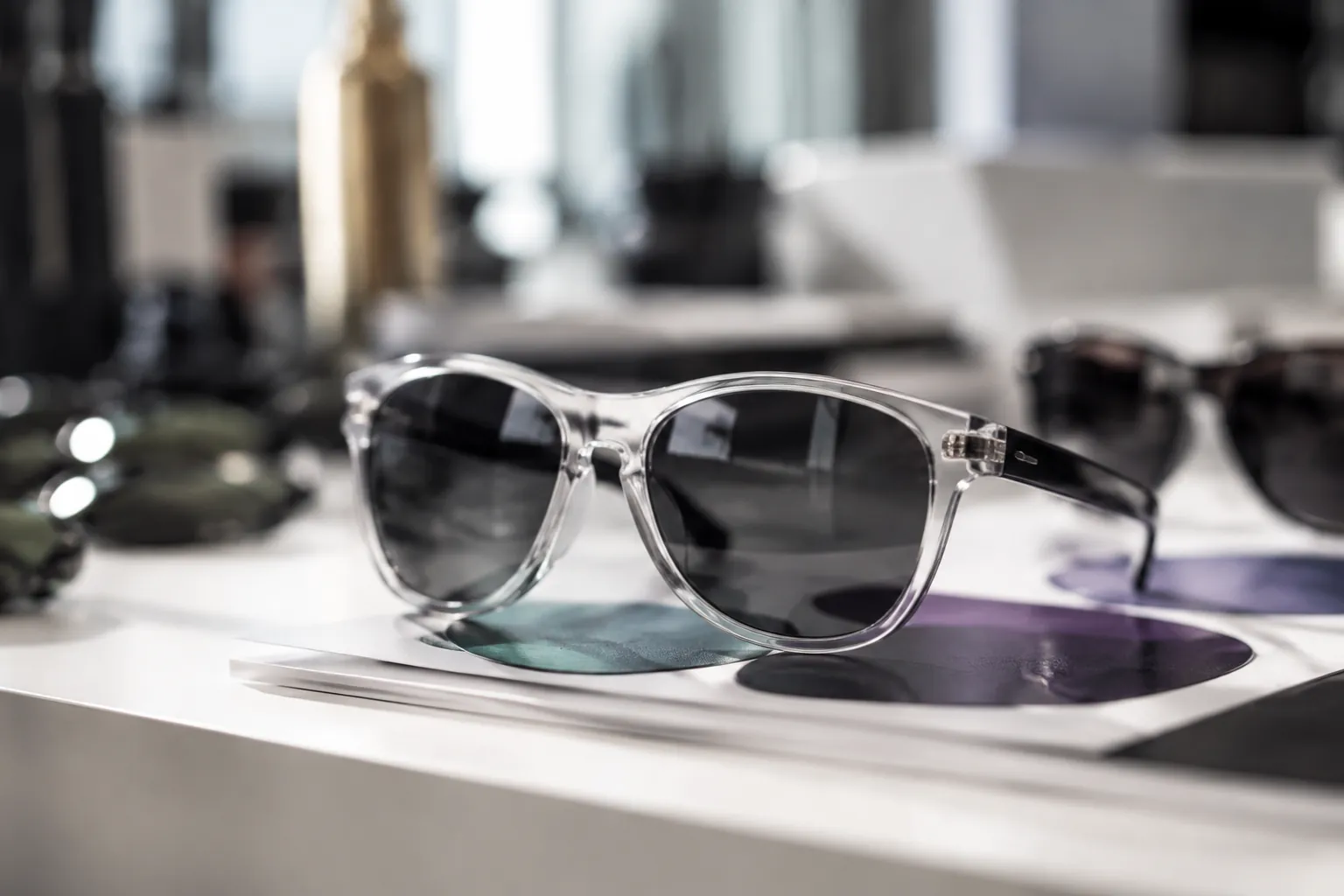
This guide is for brand owners, importers, distributors, and retailers deciding whether photochromic sunglasses belong in their assortment. It does not try to teach lens chemistry for its own sake. The point is simpler: judge channel fit, margin logic, lead-time impact, QC burden, and the failure points that show up during sampling and pre-production. Compared with a standard tinted sunglass, a photochromic style usually needs tighter performance definitions, stricter sample approval, and more careful customer-facing claims. It can work well under private label. But only if the use case is clear and the specification is controlled.
Start with the sales question, not the chemistry
Photochromic lenses darken under UV exposure and return toward a lighter state when UV drops. That part is simple. The buying decision is not. Start with the commercial question: does the end use justify the added cost, customer education, and tighter production control?
In private label, photochromic sunglasses usually fit best where the wearer moves through changing light during the same activity. Think cycling, trail running, golf, hiking, commuting, and travel. In those channels, one pair that adapts across early morning light, shade, cloud cover, and stronger sun can support a higher retail position and reduce the need for multiple pairs.
They are less convincing in appearance-led retail. A shopper trying on sunglasses indoors often expects to see the final lens look right away. Photochromic lenses may appear nearly clear or only lightly tinted indoors because activation depends mainly on UV, not visible brightness alone. That creates a shelf problem.
For a buyer, the first screen is simple:
- Good fit: function-first channels, technical sport, commuter, travel, utility outdoor.
- Conditional fit: resort, lifestyle outdoor, hybrid sport-fashion capsules.
- Poor fit: fashion wall display, gift and promo channels, fast-turn retail where staff cannot explain the product.
If your sell-in story depends on utility, photochromic is worth testing. If it depends on a fixed lens look, predictable shelf color, and instant customer understanding, standard tinted, polarized, mirrored, or gradient lenses are usually easier to merchandise.
Where photochromic works well, and where it disappoints
| Channel | Commercial fit | Main advantage | Main problem |
|---|---|---|---|
| Sport outdoor | Strong | Useful across changing light during a single activity | Activation speed, peak darkness, and lens retention in wrapped frames must be verified |
| Travel retail | Good | One pair can cover walking, transit, and mixed weather | Customer needs clear explanation that car windshields can reduce UV activation |
| Daily commuter | Good | Convenience in variable outdoor conditions | Performance perception varies by season, temperature, latitude, and exposure time |
| Fashion boutique | Weak to mixed | Novelty factor | Indoor lens appearance may not match expectation of a fixed sunglass look |
| Beach and resort | Mixed | Adaptability between shade and sun | Some users still expect a consistently dark category-3 look |
Sport is still the clearest fit. The user accepts a technical performance story if the product performs as claimed. Travel is often next because versatility matters and luggage space is limited. Daily commuter programs can also work, especially with lightweight sport-casual frames.
The weak point is fashion-led retail. If the lens looks lightly tinted under store lighting, conversion can drop unless packaging, point-of-sale copy, or trained staff explain what the lens does outdoors. In a small specialty setting, that may be manageable. In high-volume retail, it is harder.
Driving needs separate caution. Many windshields filter much of the UV needed for activation, so darkening inside a vehicle may be limited. If your copy says "ideal for driving" and the lens changes only slightly in use, complaints and returns will follow. Test inside an actual vehicle before making any driving-related claim. Keep the wording conservative.
The technical limits behind most buyer complaints
Most failed programs do not fail because a supplier cannot make a photochromic lens. They fail because the buyer did not define performance tightly enough at the start. That is the real issue.
- Activation and fade-back speed. A quick outdoor glance is not a valid approval method. Use controlled UV exposure under a repeatable light source, then observe darkening and recovery against a timer. Record the exact test condition used for approval. Performance varies with chemistry, temperature, and exposure conditions. Cooler temperatures often produce a darker apparent state; higher temperatures can reduce peak darkness.
- Final darkness range. A lens that shifts from light to moderate tint may satisfy a cyclist but disappoint a customer expecting a deep sunglass look. Define target visible light transmission ranges, or at minimum define approved light-state and dark-state appearance against a retained reference sample.
- Color consistency and left-right match. Grey-to-grey or brown-to-brown matching must be checked closely. Cosmetic standards should state how left-right matching will be judged, at what viewing distance, and under what lighting condition. If the standard is vague, disputes come later.
- Coating stack interaction. Hard coat, mirror coating, hydrophobic top coat, and other surface treatments can change final appearance. A sample that looks right in development can shift in bulk if process controls are loose.
At factory level, control starts with lens material selection, photochromic treatment method, coating sequence, curing conditions, and storage. It ends with repeatable performance checks, cosmetic inspection, and records linked to the exact SKU. For a buyer, the key point is blunt: "photochromic grey" is not a complete specification.
Compare photochromic with the real alternative, not with everything
Do not compare photochromic with "all sunglasses." Compare it with the lens option you would actually launch in the same channel.
| Lens option | Typical FOB position | Buyer appeal | Development risk | Best use |
|---|---|---|---|---|
| Standard tinted sun lens | Lowest | Easy to understand, stable shelf look | Low | Fashion, promo, broad retail |
| Polarized lens | Usually above standard tinted | Clear functional story, easy to explain | Low to mid | Driving, fishing, general outdoor |
| Mirrored coated lens | Usually above standard tinted | Strong visual impact | Mid | Sport, youth, trend retail |
| Photochromic lens | Usually above standard tinted | Convenience in changing light | Higher | Sport, commuter, travel |
For many private-label programs, the real question is not whether photochromic is interesting. It is whether photochromic adds enough sell-through or price support to justify the extra approval work and claim risk. In many channels, polarized is easier to explain fast. Mirror is easier to sell visually. Photochromic fits a narrower space.
Use a simple commercial screen:
- Landed cost increase: compare against the standard lens you would actually source for that SKU.
- Retail step-up: test whether your market accepts a higher ticket or whether the upgrade only compresses margin.
- Sell-through risk: estimate returns, customer confusion, and slower conversion caused by lighter indoor appearance.
- Reorder probability: if likely repeat volume is low, the extra development effort may not be worth it.
A product can be technically sound and still be commercially wrong for the channel.
What to lock on the spec sheet before sampling
Weak specifications create expensive sample rounds. Photochromic projects need more than frame shape and logo placement.
- Lens material: define the material required for the use case and frame geometry.
- Base curve: such as base 4, base 6, or base 8. Wrapped sport styles need tighter lens forming and retention control than flatter frames.
- Light-state and dark-state expectation: define target appearance or visible light transmission range, not just "photochromic grey."
- Color tolerance: define how left-right matching and batch consistency will be judged.
- UV activation test method: specify the exposure condition used for sample approval and bulk QC.
- Coatings: hard coat, mirror, hydrophobic or oleophobic top coat, and backside treatments if required.
- Lens dimension tolerance: especially for shields and wrapped frames, where cut accuracy and edge profile affect assembly stress.
- Decoration method: specify the approved branding method and placement.
- Packaging copy: define exact performance language early so sales claims do not outrun actual lens behavior.
Also define the approval workflow in writing. At minimum, keep one approved counter sample, one approved lens reference if possible, the exact test method used for approval, and the final wording approved for packaging and product-page claims. That paperwork prevents arguments once bulk starts.
MOQ may allow a pilot, but do not confuse pilot quantity with efficient production economics. Early runs are for market validation, not for judging mature cost structure.
Lead time, pricing logic, and where projects slip
Photochromic programs usually need more approval discipline than standard sun lenses. If the frame platform already exists and the lens specification is clear, sampling can move fairly quickly. If the project includes a new mold, a mirror layer over a photochromic base, or several rounds of lens correction, development time will stretch.
Bulk timing depends on one thing above all: whether approvals are frozen before production starts. In practice, delays often come from decision slippage, not factory capacity. The common failure points are predictable:
- Sample approved by indoor appearance only, without outdoor or controlled UV checks.
- Lens target described loosely as "dark grey" or "smoke," leaving too much room for interpretation.
- Packaging or product-page copy promising strong darkening in driving use without validation.
- Bulk started before written sign-off on lens performance, color, and cosmetic standard.
Pricing also needs realistic framing. Photochromic usually sits above a standard tinted lens because the lens system and approval burden are more complex. Exact cost depends on frame material, lens construction, coatings, branding method, packaging, order size, and tolerance level. Ignore generic market numbers. Ask for a quote against a locked specification and compare it with the standard lens option you would otherwise buy.
A sensible process is:
- Use a pilot run for market testing or sales sample seeding.
- Use a limited first production run to validate sell-through, complaint rate, and claim clarity.
- Move to larger volume only when reorder confidence is supported by actual field results.
If the category is new for your brand, pilot first. If the channel fit is already proven, move faster. But only after the approval criteria are documented.
Compliance and claims: no shortcuts
Photochromic sunglasses still have to meet the same market-entry requirements as other sunglasses. Depending on destination market and exact product type, buyers may need alignment with CE EN ISO 12312-1, ANSI Z80.3, AS/NZS 1067, REACH, and FDA registration where relevant. Supplier-level systems such as ISO 9001 and BSCI may also matter for importer qualification and retailer onboarding.
The bigger commercial risk is often not the existence of a certificate. It is the gap between the approved sample, the bulk lot, and the sales claim. A product can pass a test and still create problems if the packaging implies stronger real-world performance than the product delivers consistently.
Buyers should ask for:
- Test records tied to the exact lens and frame configuration being purchased
- Clear reference to the destination-market standard being used
- Evidence that packaging and product claims match approved performance
- Production records or controls showing that the bulk lens structure matches the approved sample
Good sourcing is not only passing a lab test. It is making sure the approved sample, bulk production, and product claim all describe the same item.
This matters more with photochromic than with ordinary tinted lenses because the end user judges behavior over time, not just appearance at first glance.
A practical buying framework: green light, yellow light, red light
Before spending development budget, use a simple go/no-go screen.
- Green light: your channel sells sport, commuter, or travel eyewear; the utility story is easy to explain; your team can approve through controlled UV testing; packaging can explain the benefit in one sentence.
- Yellow light: you like the concept but your customer buys on appearance first; the retail step-up is not yet proven; your team has not defined dark-state expectation or driving-claim language clearly.
- Red light: the main use case is driving; staff cannot explain why the lens looks lighter indoors; the brand wants the look of a deep fixed tint plus the convenience claim of photochromic without validating whether both expectations can be met.
For many buyers, the best approach is not to launch photochromic across the full collection. Test one or two proven frame platforms in a channel where utility is obvious. Keep the frame low risk. Keep decoration simple. Validate the lens first.
Then decide with data. Reorders, complaints, and returns will tell you more than early enthusiasm. Done well, photochromic can add functional value and support a stronger retail story. Done casually, it creates sample churn, claim problems, and avoidable delisting risk.
Have a custom sunglasses project in mind?
Send us your styles, target market and quantities and we will return a detailed quote with MOQ, lead time and a sample plan.
Get a QuoteWhy source this from Wenzhou with LumiShades
Wenzhou in Zhejiang Province is widely regarded as China’s eyewear manufacturing capital, producing a large share of the world’s sunglasses. That concentration matters to buyers: a deep local supply chain for acetate sheet, hinges, lens blanks, plating and packaging means shorter component lead times, easier color and material matching, and a workforce with decades of eyewear-specific skill. LumiShades has manufactured in this ecosystem since 2009, and our vertical integration — in-house injection molding, acetate cutting, CNC milling, lens tinting, decoration and quality control — means no part of your order is quietly subcontracted to a workshop you cannot audit.
For international buyers, that vertical control translates into accountability. When a single factory owns every step, defects are traced and fixed at source rather than bounced between vendors, and your specifications survive intact from first sample to bulk. We back this with 15+ years of experience, shipments to 60+ countries, more than 5 million pairs produced per year and a 98.5% on-time delivery rate. Our certifications — CE EN ISO 12312-1, FDA registration, ANSI Z80.3, AS/NZS 1067, REACH, ISO 9001 and BSCI audit — mean the compliance documentation your market requires already exists. Explore our manufacturing capabilities and quality control process to see how this works in practice.
Frequently asked questions
Do photochromic sunglasses make sense for fashion retail? Usually only as a limited test, not as a default range extension. They perform best where function is easy to explain, such as sport, commuting, or travel. In fashion-led retail, the main issue is that the shopper cannot see the final outdoor tint on the shelf. If you test the category in fashion, keep the SKU count low, add clear point-of-sale language explaining outdoor activation, and train staff to explain that UV exposure—not indoor brightness alone—drives the lens change.
Can I start with a small MOQ before scaling? Yes, and that is often the right approach for a first program. Use a small pilot to test sell-through, return reasons, and claim clarity before committing to a broader launch. But evaluate margin separately from the pilot run: small-quantity pricing is usually not a reliable indicator of long-run economics. Before scaling, review three points from the pilot: whether customers understood the product, whether outdoor performance matched claims, and whether the reorder case is strong enough to justify the added complexity.
How should I approve samples for a photochromic program? Do not approve by indoor appearance alone. Set a written approval protocol before sampling closes. At minimum, define: 1) the UV exposure condition or other repeatable activation method, 2) the approved light-state appearance, 3) the approved dark-state appearance or VLT range, 4) the acceptable left-right color match, 5) the fade-back observation method, and 6) the exact wording allowed for packaging and product-page claims. Keep an approved counter sample and record the test condition used at approval so the same method can be applied during pre-production and bulk QC.
Are photochromic lenses good for driving sunglasses? Only with caution. Many vehicle windshields reduce the UV needed for activation, so the lens may darken less inside the car than it does outdoors. If driving is the main use case, test the exact lens in a real vehicle under the conditions relevant to your market before making any claim. Review the result with your compliance and product teams, and avoid broad wording such as "ideal for driving" unless you have validated it against the actual configuration being sold.
What compliance documents should I ask for? Ask for documents tied to the exact frame-and-lens configuration and the market where the product will be sold, not a generic certificate pack. Common references include CE EN ISO 12312-1, ANSI Z80.3, AS/NZS 1067, REACH, and FDA registration where relevant, plus ISO 9001 and BSCI at supplier level. Also ask for the supporting test report or record, the date, the product identification used on the test, and confirmation that the approved bulk construction matches the tested sample. This helps prevent a common sourcing mistake: relying on documents that apply to a different lens, frame, or market than the one actually being purchased.
Ready to start?
Explore our cat-eye sunglasses or request a quote — our sales team replies within 12 hours.
Request a Quote