
Photochromic Sunglasses Sourcing Guide
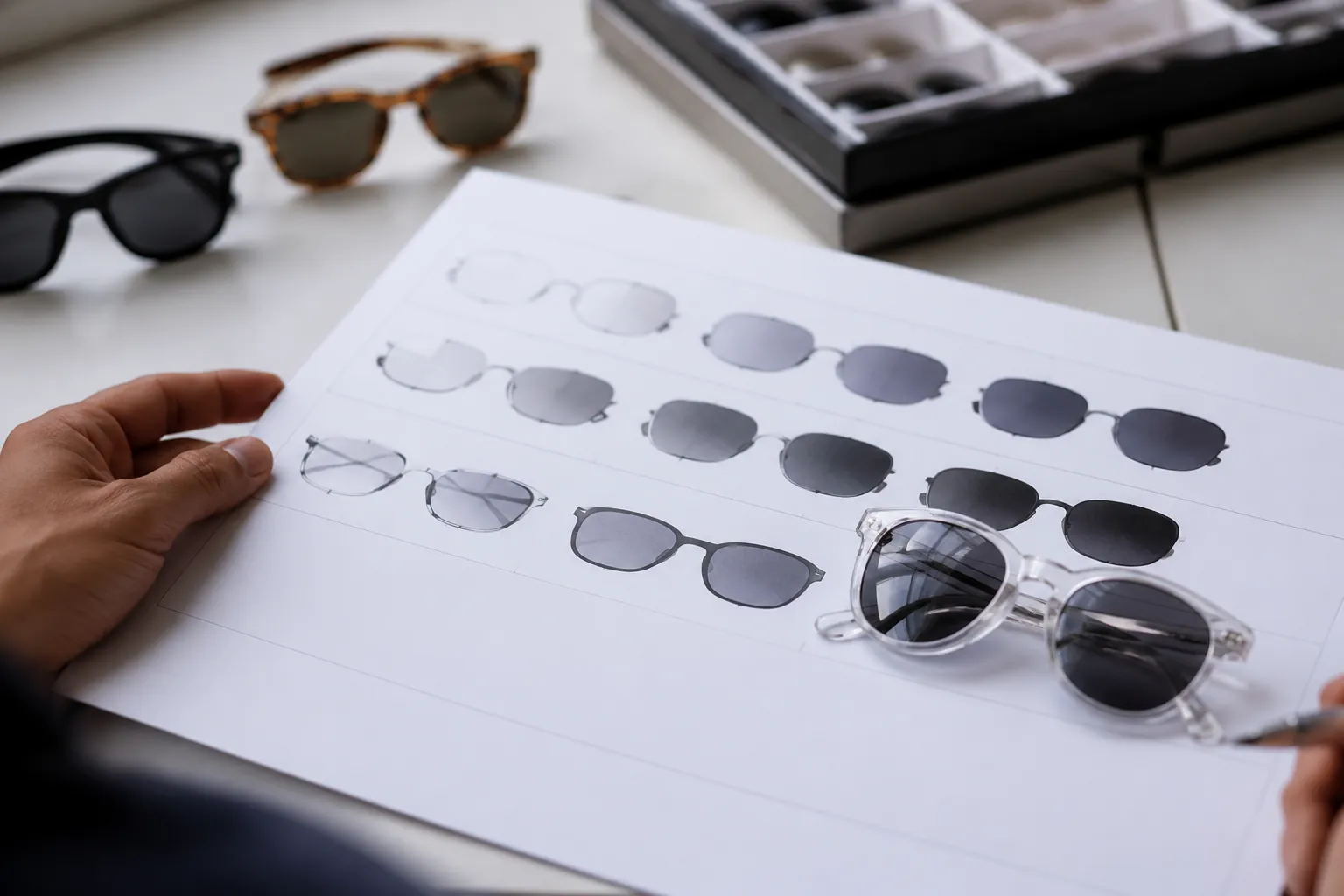
This guide is for brand owners, importers, distributors, and retail buyers deciding whether photochromic sunglasses fit a private label range. It covers where light-adaptive lenses make commercial sense, where they disappoint, how to specify measurable lens performance, and what to verify before bulk production. The aim is simple: clearer claims, tighter samples, stronger inspections, and fewer problems with lenses, frames, decoration, packaging, and compliance.
Start With the Use Case
Photochromic sunglasses are not an automatic upgrade. They work best when the wearer moves between changing light conditions and wants one pair for more than one setting. Strong use cases include cycling, golf, hiking, fishing, running, campus retail, resort shops, travel retail, outdoor lifestyle lines, and optical-adjacent fashion brands.
Some categories are weaker. Very low-price beach racks, decorative fashion sunglasses, and promotional programs often favor the darkest lens at the lowest price. In those programs, photochromic lenses can add cost without adding a clear reason to buy.
The commercial question is not, "Is photochromic interesting?" It is sharper than that: "Will the end customer understand the higher price?" A grey lens that shifts from Category 1 to Category 3 is not the same product as a lightly shifting brown lens that stays in Category 2. Define the use case before choosing the frame material, lens color, packaging copy, compliance standard, and retail price.
For private label brands, the safest first launch is usually a tight capsule: one or two proven frame shapes, one grey lens direction, one optional brown lens direction, and a claim based on measured luminous transmittance. LumiShades can support custom sunglasses from 50 pairs per design, but photochromic projects are easier to control at higher quantities. Lens purchasing, tint matching, QC setup, packaging inserts, and inspection time all become more practical when the batch is large enough.
Specify the Lens in Measurable Terms
A photochromic lens reacts mainly to ultraviolet exposure unless it uses chemistry designed for other activation conditions. Outdoors, it darkens. Indoors, it fades back. Heat matters. Colder conditions often allow stronger darkening, while high temperatures can reduce the final darkness.
Car use needs care. Many automotive windshields block enough UV to weaken activation. Do not position standard UV-activated photochromic sunglasses as driving sunglasses unless the lens construction and test data support that claim.
Replace vague language like "turns dark fast" with measurable purchasing language. A useful specification should include:
- Starting luminous transmittance: state the target percentage range before activation and identify the intended lens category.
- Activated luminous transmittance: state the target percentage range after UV activation and confirm whether the lens should meet Category 2 or Category 3 under the relevant sunglass standard.
- Activation time: define the UV source, exposure distance, temperature, and measurement interval instead of relying on a visual estimate.
- Fade-back time: define the indoor condition and acceptable time to return near the lighter state; slower fade-back is normal and should be explained in packaging copy.
- UV protection: specify UV400 or 100% UVA/UVB protection and verify it with calibrated test equipment.
- Color tolerance: approve grey, brown, or green against a signed golden sample because photochromic dyes and coatings can shift between lens batches.
For QC, ask the factory to record luminous transmittance before activation and after UV activation using the same method each time. The golden sample should include both visual approval and measured data. Photochromic behavior can change with lens supplier, lens material, coating stack, thickness, base curve, and frame coverage.
Match the Lens to the Frame Platform
The lens and frame must work as one product. A wrap sport frame with rubber temple tips can carry a stronger technical story. A flat fashion frame may need a softer adaptive tint because heavy activation can look too performance-driven.
Small construction details matter. Lens thickness, base curve, groove depth, and frame tension all affect fit. A frame that works with a standard tinted lens may need adjustment when the lens has a different thickness, coating stack, or polarization layer.
| Product Type | Recommended Lens Direction | Best Frame Platform | Buyer Watchpoint |
|---|---|---|---|
| Outdoor lifestyle | Grey Category 1 to 3, UV400 | TR90, PC, or injection frame | Check fade-back speed for shops, cafés, and indoor transitions |
| Cycling or running | Clear or light grey to Category 2 or 3 | Wrap PC shield or TR90 sport frame | Confirm impact requirements, optical distortion, ventilation, and temple grip |
| Travel retail | Brown or grey moderate shift | Acetate or mixed-material fashion frame | Packaging must explain UV activation limits behind glass |
| Kids or school programs | Light grey adaptive lens with UV400 | Flexible TPE, TR90, or PC | Use conservative claims, stronger hinge checks, and safer packaging |
LumiShades production covers injection molding, acetate cutting, CNC milling, lens tinting, laser engraving, pad printing, and metal logo plate decoration. These processes help when small engineering changes are needed after lens selection: a deeper lens groove, revised base curve, thicker lens edge, different nose pad, softer temple pressure, or adjusted screw length. Minor changes on paper can decide whether the finished sunglasses feel stable or cheap.
Control Material, Fit, and Decoration Risk
Material choice affects cost, feel, tolerance, and repair risk. PC frames are light and economical, but they can feel less premium and may show stress marks if lens insertion is too tight. TR90 is flexible and suits sport-lifestyle sunglasses, but batch color still needs control. Acetate gives a stronger fashion look and better polish, but it needs more processing time and can deform under heat if storage or assembly is poor.
For photochromic sunglasses, frame tolerance should protect the lens. Ask for lens fitting that is firm without excessive stress. Key control points include lens groove depth, rim gap, temple alignment, hinge opening angle, screw torque, bridge symmetry, and overall front curve.
Do not rely on a generic tolerance sheet for every design. A high-wrap frame or tight lens groove may need its own limits based on material, lens thickness, base curve, and the applicable standard.
Decoration also needs limits. Pad printing is cost-efficient for logos on temples, but it needs rub testing and can fail on oily, flexible, or highly textured surfaces. Laser engraving is cleaner and more durable on suitable metal or coated parts, but it may look subtle on dark frames. Metal logo plates can look premium, yet they add handwork, pull-test requirements, corrosion checks, and alignment risk. Heat transfer and foil effects can work for packaging. They are not a substitute for durable product marking if the retailer expects long-term branding on the frame.
Understand MOQ and Cost Drivers
Photochromic sunglasses usually cost more than standard tinted sunglasses. The lens blank, coating, or dye system carries a premium. The frame may be the same, but procurement, testing, and inspection are not.
At LumiShades, custom sunglasses can start from MOQ 50 pairs per design, with better project economics at higher quantities. Do not benchmark photochromic lenses against the cheapest promotional tinted-lens SKU. The lens specification, test requirements, and rejection risk are different.
The main cost drivers are lens chemistry, lens material, base curve, polarization, mirror or hard coating, frame material, mold use, logo method, case or pouch type, testing level, and inspection plan. Polarized photochromic lenses are possible in some constructions, but they narrow supplier options and increase cost. If the target retail price cannot support the full feature set, remove one feature. A clean non-polarized grey adaptive lens may sell better than an overloaded lens package that pushes the price too high.
A practical launch can be a small controlled order for retailer feedback or a larger colorway run when demand is clearer. For 50 to 100 pairs, expect fewer lens options, higher unit cost, limited custom packaging, and less leverage on color development. At higher quantities, it becomes more realistic to discuss dedicated lens stock, tighter color control, packaging automation, and more stable production scheduling. Price the project against a written specification, not a loose phrase like "photochromic lens."
Approve Samples Before Bulk Production
Sample approval for photochromic sunglasses must cover more than appearance. LumiShades typically targets 7 to 10 days for samples when the project uses an existing frame, available lens blank, and standard decoration. New molds, unusual base curves, special lens colors, polarized adaptive lenses, or custom packaging can add several weeks.
Separate a quick salesman sample from a true pre-production sample. They are not the same approval point.
- Confirm target market and compliance standard: CE EN ISO 12312-1, ANSI Z80.3, AS/NZS 1067, REACH, FDA registration, or other market requirements as applicable.
- Select frame platform: injection, TR90, PC, acetate, metal, or mixed material, with target weight and fit requirements.
- Choose lens direction: grey, brown, green, clear-to-grey, polarized, non-polarized, mirror-coated, or hard-coated.
- Make the first sample: check fit, lens seating, hinge tension, temple pressure, nose comfort, decoration position, and lens activation.
- Measure technical points: UV protection, luminous transmittance, lens category, lens thickness, base curve, optical power, prism, and visible defects.
- Approve packaging copy: explain activation, fade-back, cleaning, storage, UV exposure, lens category, and limits behind car glass.
- Approve golden sample: store one signed sample with the buyer and one at the factory, both labeled with date, version, material, and lens data.
Do not approve photochromic behavior by video only. A phone camera can exaggerate or hide lens color because of exposure and white balance. Ask for the physical sample. Test it in real light. Compare it with the written specification before authorizing bulk materials.
Ask Hard QC and Compliance Questions
Photochromic sunglasses still need to meet sunglass rules. Adaptive tint does not excuse poor UV protection, optical distortion, weak hinges, loose screws, sharp edges, or decoration failure.
Relevant compliance references may include CE EN ISO 12312-1, ANSI Z80.3, AS/NZS 1067, REACH, FDA registration, ISO 9001, and BSCI. The right list depends on the selling market, product category, supplier status, and claim language.
Key QC checks should include UV transmittance, luminous transmittance in unactivated and activated states, lens category marking, optical power, prism imbalance, robustness or impact testing where required, restricted substance checks for metal and coated parts, hinge cycle checks, screw torque, frame symmetry, temple alignment, logo adhesion, and packaging accuracy. For decoration, pad printing and coating should pass rub testing. Metal logo plates should be checked for pull strength, corrosion resistance, glue overflow, and alignment.
Ask for the inspection plan before paying the deposit. A useful plan defines AQL level, defect classification, sample size, test equipment, light source, activation method, and acceptance limits. Classify wrong lens category, failed UV protection, cracked frame, loose lens, missing logo, incorrect compliance marking, and unapproved packaging claims as major or critical defects. If the supplier only says "QC passed," ask for the measurement record, inspection photos, and test method.
Buyer note: Approve both appearance and measured transmission. A lens can look acceptable on a desk and still fail the category claim after UV activation.
Plan Lead Time and First Launch Scope
Bulk production at LumiShades is generally 25 to 35 days after sample approval and deposit when materials are confirmed and packaging artwork is ready. Photochromic jobs can take longer if the lens blank is not stocked, the order mixes too many frame colors at low quantities, the buyer changes the activation target after sample approval, or packaging copy needs compliance review.
In Wenzhou eyewear production, bottlenecks often appear at lens preparation, decoration, and final inspection. Not only frame molding.
The normal production flow is material incoming inspection, frame molding or acetate processing, CNC or finishing work, lens cutting and edging, tint or coating verification, assembly, logo decoration, cleaning, final inspection, packing, and carton marking. Buyers reduce risk by locking artwork early, limiting lens colors, confirming barcode and carton labels before packing, and avoiding last-minute claim changes such as "instant darkening" or "perfect for driving." Measured language protects the brand, the retailer, and the factory.
A strong first launch does not need ten SKUs. Start with one sport-lifestyle frame and one fashion frame, both using grey photochromic lenses. Add brown only if the brand already sells brown lenses well. Keep frame colors stable: black, tortoise, matte dark grey, transparent smoke, or navy. These colors pair well with adaptive lenses and reduce visible color mismatch. If the product sells, scale with fewer material changes, more predictable production windows, and a clearer lens purchasing plan.
Have a custom sunglasses project in mind?
Send us your styles, target market and quantities and we will return a detailed quote with MOQ, lead time and a sample plan.
Get a QuoteWhy source this from Wenzhou with LumiShades
Wenzhou in Zhejiang Province is widely regarded as China’s eyewear manufacturing capital, producing a large share of the world’s sunglasses. That concentration matters to buyers: a deep local supply chain for acetate sheet, hinges, lens blanks, plating and packaging means shorter component lead times, easier color and material matching, and a workforce with decades of eyewear-specific skill. LumiShades has manufactured in this ecosystem since 2009, and our vertical integration — in-house injection molding, acetate cutting, CNC milling, lens tinting, decoration and quality control — means no part of your order is quietly subcontracted to a workshop you cannot audit.
For international buyers, that vertical control translates into accountability. When a single factory owns every step, defects are traced and fixed at source rather than bounced between vendors, and your specifications survive intact from first sample to bulk. For procurement review, buyers can request process records, approved samples, quality checkpoints and project-specific compliance files before placing a bulk order. Required testing and documentation are confirmed against the destination market and product specification rather than assumed from a generic certificate list. Explore our manufacturing capabilities and quality control process to see how this works in practice.
Frequently asked questions
Are photochromic sunglasses suitable for driving? Do not make a driving claim by default. Many photochromic lenses react mainly to UV, and car windshields can reduce UV exposure enough to limit activation. If driving use is important, ask the supplier for test data behind representative automotive glass, confirm activated and unactivated luminous transmittance, and check whether the lens category and market standard allow the claim.
What MOQ should I plan for a private label photochromic launch? LumiShades can start from 50 pairs per design, but buyers should expect fewer lens choices, higher unit cost, and limited custom packaging at that level. For a more practical launch, plan enough quantity to support lens procurement, color control, packaging inserts, and QC setup. Ask for quotations at several quantity breaks using the same written lens and frame specification.
Can photochromic lenses also be polarized? Often yes, but it depends on the lens construction and supplier availability. Polarized photochromic lenses add cost, can increase lead time, and may limit color or base-curve options. Approve them through physical samples and verify luminous transmittance, UV protection, polarization efficiency, color uniformity, optical distortion, lens fit, and final lead time before placing bulk orders.
Which compliance standards matter for overseas buyers? Match the requirement to the selling market and product claim. Common references include CE EN ISO 12312-1 for Europe, ANSI Z80.3 for the United States, AS/NZS 1067 for Australia and New Zealand, plus REACH and FDA registration considerations where applicable. Confirm the current requirement with your importer, retailer, or compliance lab before printing packaging or compliance marks.
How long do samples and bulk production take? Samples are typically 7 to 10 days when using available frames, available lens blanks, and standard decoration. New molds, special lens colors, unusual base curves, polarized adaptive lenses, or custom packaging can add several weeks. Bulk production is usually 25 to 35 days after sample approval, deposit, confirmed materials, and approved packaging artwork, but the final schedule should be written into the purchase order.
What should be recorded on the approved golden sample? Record the frame material, lens supplier direction, lens color, unactivated and activated luminous transmittance, lens category, UV protection result, logo method, hinge type, packaging version, approval date, and buyer approval reference. Keep one signed sample with the buyer and one at the factory. Require bulk inspection to compare production against both the sample and the written specification.
Ready to start?
Explore our cat-eye sunglasses or request a quote — our sales team replies within 12 hours.
Request a Quote