
Photochromic Sunglasses for Private Label Buyers
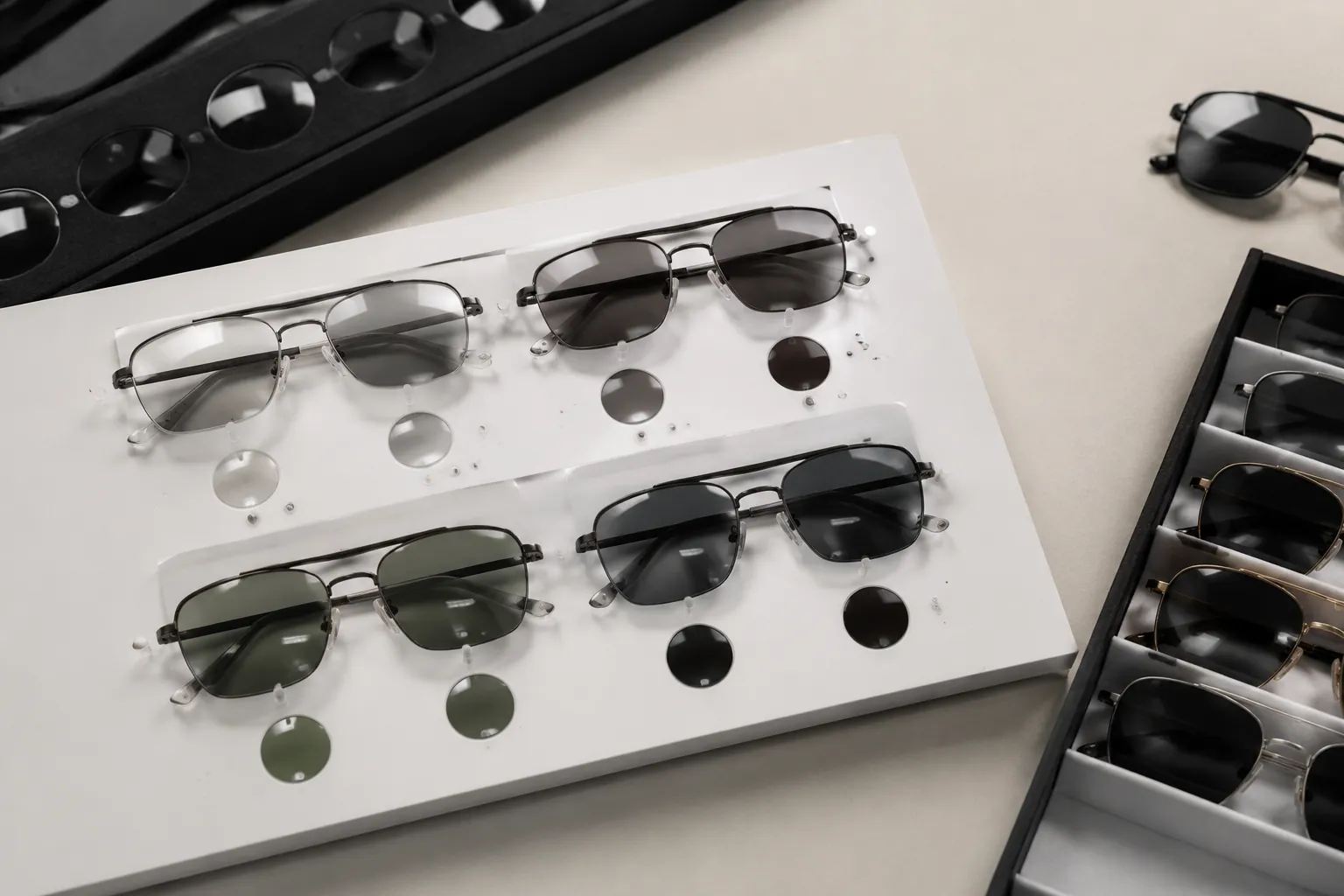
This guide is for brand owners, importers, distributors, and retail buyers deciding whether photochromic sunglasses belong in a private label line. It explains what photochromic lenses can and cannot do, which specifications to confirm before sampling, and which QC, labeling, and compliance checks prevent avoidable complaints. It also gives practical OEM planning points for MOQ, sampling, lead time, decoration, packaging, and launch control.
Use photochromic only when the buyer problem is clear
Photochromic sunglasses are a functional product, not a default upgrade. They fit customers who move through changing outdoor light and want one pair that can handle more of the day. If the only sales line is "the lens changes color," the product sits awkwardly between fashion sunglasses and performance eyewear.
The best private label use cases are outdoor lifestyle ranges, travel accessories, fishing and hiking assortments, cycling-commute collections, campus stores, resort retail, optical-adjacent chains, and premium promotional eyewear. The weakest use case is low-cost fashion, where the buyer mainly wants frame shape, lens color, and logo visibility. In that segment, a fixed smoke, brown, mirror, or gradient lens is usually cheaper and easier to explain.
Use a simple test before adding the SKU: can the product page, box, or sales rep explain the benefit in one sentence? Strong wording is "one pair for changing outdoor light during a full day outside." Weak wording is "technical lens for a premium look." The first gives a reason to buy. The second creates doubt.
- Good fit: outdoor retailers, commuter programs, fishing, hiking, travel, campus, resort, and sport-lifestyle collections.
- Possible fit: premium promotional eyewear where a functional lens supports a higher gift value.
- Poor fit: very low-price fashion lines, one-day giveaways, or assortments built around bright lens colors.
- Recommended launch size: 2-4 SKUs first, not a full 12-color lens program.
What the lens does, and what buyers miss
A photochromic lens darkens under ultraviolet light and fades as UV drops. It reacts to UV, not just visible brightness. That is why many photochromic lenses darken outdoors but change less inside a car. Most windshields block much of the UV. Side windows vary by vehicle, glass type, and tint film.
Temperature matters too. In colder conditions, many photochromic lenses darken more and fade more slowly. In hot conditions, they may not reach the same dark state. That is normal. It still needs to be stated plainly so the market does not expect the wrong result.
For OEM sunglasses, common lens bases include PC and TAC. PC is often chosen for sport and impact-oriented styles because it is light and more impact resistant than many low-cost plastics. TAC is widely used for polarized lenses and can give good optical comfort at a competitive cost. Buyers may also request nylon or other specialty materials for higher-end projects, but those usually raise price and testing demands.
Typical performance discussions include light-state transmission, dark-state transmission, UV400 protection, fade-back time, lens category, color shift, and left-right matching. Do not approve a sample by looking at it indoors. Expose it to controlled UV or steady sunlight, check both lenses together, then watch the fade-back indoors over several minutes using the same method for every sample.
Blunt point: photochromic does not mean instant change, unlimited fashion colors, or full darkening behind every windshield. It means controlled light adaptation within a defined tint range.
Freeze the specs before sampling starts
The sample stage is where many photochromic projects either get controlled or get messy. Do not start with only a frame photo and a target price. Give the factory a lens behavior target, base material, frame construction, logo method, packaging requirement, and destination-market compliance target. If the brief is thin, the sample may look fine and still fail retail labeling, testing, or repeat production.
For a proper OEM brief, confirm the following before the first sample is cut, molded, tinted, or assembled:
- Lens base material: PC for impact-oriented sport styles, TAC for polarized options, or another approved material if your channel needs it.
- Light-state color: nearly clear, light grey, light brown, amber, or another agreed starting tint. Define whether the product should already look like sunglasses before activation.
- Dark-state target: grey 2, grey 3, brown 2, brown 3, or another target aligned with sunglass category and market claims.
- Transmission target: define approximate visible light transmission ranges where possible instead of using only words such as "medium dark."
- UV protection: UV400 or an equivalent UV claim should be verified by applicable testing, not assumed from lens color.
- Frame material: injection plastic, TR-type material, acetate, metal combination, or stainless/PC hybrid construction.
- Decoration: temple pad print, laser engraving, hot stamping, metal logo plate, inlaid logo, lens mark, or custom hinge hardware.
- Packing: pouch, microfiber cloth, printed box, barcode, hang tag, warning text, user instruction, carton mark, and importer information.
If LumiShades is the OEM partner, confirm which processes are handled in-house and which are subcontracted for the exact project. That affects schedule, color correction, decoration changes, and repeat-order consistency. Small corrections such as temple logo position, lens darkness, hinge tension, nose fit, or pack layout should be resolved at sample stage, not after mass production starts.
Approve a golden sample before bulk production. Include the frame, both lenses, logo execution, packaging, printed warnings, barcode, carton mark, and any compliance wording for the destination market.
Compare lens options by selling job
Photochromic lenses should be selected by selling purpose, not by novelty. A 12-SKU sunglasses range may only need one or two photochromic SKUs. The rest may work better with standard tint, polarized, mirrored, or gradient lenses because those options are cheaper, faster to approve, and easier for consumers to understand.
| Lens option | Best private label use | Main limitation | Typical OEM note |
|---|---|---|---|
| Standard tinted lens | Fashion, beach, promotional, entry retail | No light adaptation | Lowest complexity; easiest color matching and fastest approval |
| Polarized lens | Fishing, driving, boating, outdoor retail | Can affect screen visibility; costs more than basic tint | Strong functional claim if polarization and UV protection are tested |
| Gradient lens | Fashion retail, travel, urban styles | Less useful for harsh overhead glare | Good for appearance-led collections and fashion ranges |
| Photochromic lens | Changing outdoor light, commuters, sport-lifestyle | Darkening depends on UV level and temperature | Needs clear consumer education and tighter batch QC |
| Photochromic polarized lens | Higher-end outdoor programs | Higher cost and longer sampling control | Best for fewer SKUs with stronger retail margin |
If your channel is a distributor catalog, keep the description conservative. Say the lenses darken in UV and fade when UV drops. Do not promise instant change. Do not promise full performance behind all windshields. Do not imply the lens works for every driving or night-use situation unless the claim is backed by the standard and test report. Clear expectations reduce returns.
Plan MOQ, pricing, and lead time with the full spec
Photochromic programs often fail because the buyer tests too many frame colors and lens combinations at once. Start narrow. For LumiShades projects, confirm the current MOQ in writing for the exact design, lens, decoration, and packaging combination before issuing a purchase order. MOQ can change when the buyer requests a new mold, special lens color, custom hardware, retail packaging, third-party testing, or split shipments.
Price depends on frame material, lens material, lens function, photochromic performance target, polarization, frame mold status, logo method, packaging, inspection requirements, and order quantity. Larger orders usually reduce unit cost because material prep, setup, decoration, packing, and QC get spread across more pairs. Still, the lowest unit price is not the safest first-run goal if the lens claim, packaging wording, or retail acceptance has not been proven.
Sampling time should be confirmed after the frame, lens target, logo file, and packing direction are fixed. Bulk timing should be confirmed after golden sample approval, deposit, material availability check, and any required compliance testing. Add time for special lens color development, custom metal trims, new mold work, third-party lab testing, complex retail boxes, or repeated artwork changes.
| Order stage | Practical quantity | What to check | Risk if skipped |
|---|---|---|---|
| Concept sample | 1-3 styles | Light/dark state, frame fit, logo position, packaging direction | Bulk order based on an unproven claim |
| Pilot order | 50-300 pairs per design, if supported by the supplier | Retail feedback, return reasons, real outdoor performance | Too many SKUs before market proof |
| Distributor launch | 1000+ pairs mixed by style, depending on channel needs | Barcode, carton labels, compliance files, packing consistency | Customs, warehouse, or channel delays |
| Volume repeat | 5000+ pairs or repeat lot | Batch shade consistency, inspection records, material reservation | Visible shade variation between lots |
Do not chase the lowest unit price on the first run if the lens claim is still untested in your channel. A smaller pilot with correct wording can save a full shipment of slow-moving stock.
Build the decoration and pack as part of the product
Photochromic sunglasses are often sold above basic fashion sunglasses, so decoration and packaging need to support the claim. A cheap pouch and vague hang tag can make the product feel flimsy. A clear insert card that explains UV activation, fade-back, cleaning, and driving limits makes the same product feel more credible.
Common decoration methods include pad printing for economical temple logos, laser engraving for subtle logos on metal or suitable plastic areas, hot stamping for acetate-style temples, metal logo plates for premium frames, and lens marks when the design and compliance rules allow them. For most private label buyers, temple pad print or laser engraving is the fastest route. Metal logo plates and custom hinge details can look stronger, but they need more sampling control and often add time.
Packaging should be approved as part of the product, not after production starts. At minimum, define pouch or case type, microfiber cloth size, barcode position, warning text, lens category statement, UV protection claim, importer details, user instructions, and carton labels. If the product goes to retail chains, check whether they require individual polybags, hang holes, anti-scratch film, EAN/UPC barcodes, carton dimensions, or pre-shipment inspection documents.
A practical tolerance approach is to approve logo placement within a small visible range, such as ±1 mm for temple print on standard styles where the surface allows it, and to define acceptable color difference by approved sample rather than by verbal description. For lenses, approve the visual standard under the same UV exposure, temperature range, timing, and viewing condition used for the golden sample.
QC the lens behavior, not just the frame
Standard sunglasses QC covers frame alignment, hinge function, lens scratches, logo placement, color matching, packing, and basic durability checks. Photochromic sunglasses need all of that plus behavior checks. The lens must change consistently across the batch, and the left and right lenses in one pair must match in the same state.
A practical factory QC flow includes incoming lens inspection, frame component inspection, UV exposure comparison, fade-back observation, assembly inspection, decoration durability review, and final packed-goods inspection. For a new lens combination, buyers should request a pre-production sample before releasing full bulk production. If using AQL inspection, define the inspection level, defect classification, sample size, and acceptance criteria before production starts.
- Pair matching: left and right lenses should not show an obvious darkness difference after the same UV exposure time.
- Surface condition: no coating streaks, pinholes, edge chips, deep scratches, or visible waves in the main viewing area.
- Optical comfort: no unacceptable distortion after mounting, especially in wrapped sport frames.
- Frame alignment: temples should sit evenly, with no twist that changes wearing angle.
- Hinge tension: temples should open and close smoothly without looseness, binding, or uneven resistance.
- Decoration durability: pad print, laser mark, or logo plate should survive normal handling and packing friction.
- Packing accuracy: model number, lens claim, barcode, warning text, importer information, and destination-market labels must match the approved file.
Delivery performance depends on approved samples, clean artwork, material availability, inspection standards, and fast buyer decisions. If acceptable variation is not defined before production, disputes usually appear after cartons are packed.
Handle compliance, labeling, and launch in order
Photochromic sunglasses still have to meet the sunglass rules for the market where they are sold. Relevant compliance references may include CE EN ISO 12312-1 for the EU, ANSI Z80.3 for the United States, AS/NZS 1067 for Australia and New Zealand, REACH for EU restricted substances, FDA registration context for the U.S., ISO 9001 for quality management, and BSCI for social compliance. Ask which documents apply to the exact frame, lens, coating, color, and packaging configuration being ordered, not only to the factory in general.
For the EU, CE EN ISO 12312-1 is commonly relevant for sunglasses, including filter and optical requirements. For the United States, buyers often request ANSI Z80.3 alignment and FDA registration context. For Australia and New Zealand, AS/NZS 1067 matters. REACH is relevant for restricted substances in materials, coatings, inks, and packaging components for EU supply chains.
Labeling should be plain and defensible. State UV protection, lens category where applicable, use limits, cleaning instructions, and manufacturer or importer information required by your channel. If the lens is not suitable for night driving, say so. If darkening depends on UV exposure, say that too. Do not copy compliance wording from a different model unless the same standard, lens category, and test basis apply.
The safest launch plan is a controlled capsule: one proven lifestyle frame, one sport-lifestyle frame if your channel supports it, and one or two lens behavior targets. Test real outdoor performance, revise packaging wording, approve the golden sample, place a pilot order, inspect carefully, then scale. Photochromic sunglasses make sense when they give the buyer a clear reason to pay more and the team can explain the limits honestly.
Buyer rule: approve compliance wording before mass packing starts. Changing an insert card after 20 cartons are packed is annoying. Changing it after 200 cartons are packed is expensive.
Have a custom sunglasses project in mind?
Send us your styles, target market and quantities and we will return a detailed quote with MOQ, lead time and a sample plan.
Get a QuoteWhy source this from Wenzhou with LumiShades
Wenzhou in Zhejiang Province is widely regarded as China’s eyewear manufacturing capital, producing a large share of the world’s sunglasses. That concentration matters to buyers: a deep local supply chain for acetate sheet, hinges, lens blanks, plating and packaging means shorter component lead times, easier color and material matching, and a workforce with decades of eyewear-specific skill. LumiShades has manufactured in this ecosystem since 2009, and our vertical integration — in-house injection molding, acetate cutting, CNC milling, lens tinting, decoration and quality control — means no part of your order is quietly subcontracted to a workshop you cannot audit.
For international buyers, that vertical control translates into accountability. When a single factory owns every step, defects are traced and fixed at source rather than bounced between vendors, and your specifications survive intact from first sample to bulk. We back this with 15+ years of experience, shipments to 60+ countries, more than 5 million pairs produced per year and a 98.5% on-time delivery rate. Our certifications — CE EN ISO 12312-1, FDA registration, ANSI Z80.3, AS/NZS 1067, REACH, ISO 9001 and BSCI audit — mean the compliance documentation your market requires already exists. Explore our manufacturing capabilities and quality control process to see how this works in practice.
Frequently asked questions
What MOQ should I plan for if I want to test photochromic sunglasses? Ask the supplier to confirm MOQ in writing for your exact frame, lens, logo, and packaging combination. For a market test, many buyers start with a small pilot such as 50-300 pairs per design if the supplier supports it, then scale after checking sell-through, return reasons, lens acceptance, and packaging wording.
How fast can photochromic sunglasses be sampled and produced? Confirm timing after the technical brief is complete. Sampling cannot be estimated reliably until the frame, lens material, light-state and dark-state target, logo file, and packaging direction are fixed. Bulk timing should be confirmed after golden sample approval, deposit, material availability check, and any required compliance testing. Special lens colors, new molds, metal trims, retail boxes, or repeated artwork changes can extend the schedule.
Do photochromic lenses darken inside a car? Often they darken less inside a vehicle because many windshields block much of the UV that activates photochromic chemistry. Side-window performance varies by vehicle glass and tint film. Do not market photochromic sunglasses as guaranteed to reach full dark state behind all windshields unless you have test evidence for that exact claim.
Which compliance documents should I ask for? Ask for documents that match your destination market and exact product configuration. Common references include CE EN ISO 12312-1 for EU sunglasses, ANSI Z80.3 for the U.S., AS/NZS 1067 for Australia/New Zealand, REACH for EU restricted substances, FDA registration context for the U.S., ISO 9001 for quality management, and BSCI for social compliance. Request model-specific test reports or declarations where applicable, not only general factory certificates.
Can I combine photochromic and polarized lenses? Yes. A photochromic polarized lens can work well for higher-price outdoor programs where both glare reduction and light adaptation are part of the selling proposition. It usually costs more, may require longer sampling, and needs tighter approval for polarization, activation level, color consistency, optical comfort, and labeling claims.
What should I check before approving the golden sample? Check the light-state and dark-state lens appearance, visible light transmission target if provided, left-right lens matching after equal UV exposure, UV protection claim, frame fit, optical comfort, hinge tension, logo placement, decoration durability, packaging wording, barcode, carton mark, importer details, and destination-market warnings. Keep the approved sample as the reference for production and inspection.
Ready to start?
Explore our cat-eye sunglasses or request a quote — our sales team replies within 12 hours.
Request a Quote