
Photochromic Lenses for Sunglasses: How They Work and When to Spec Them
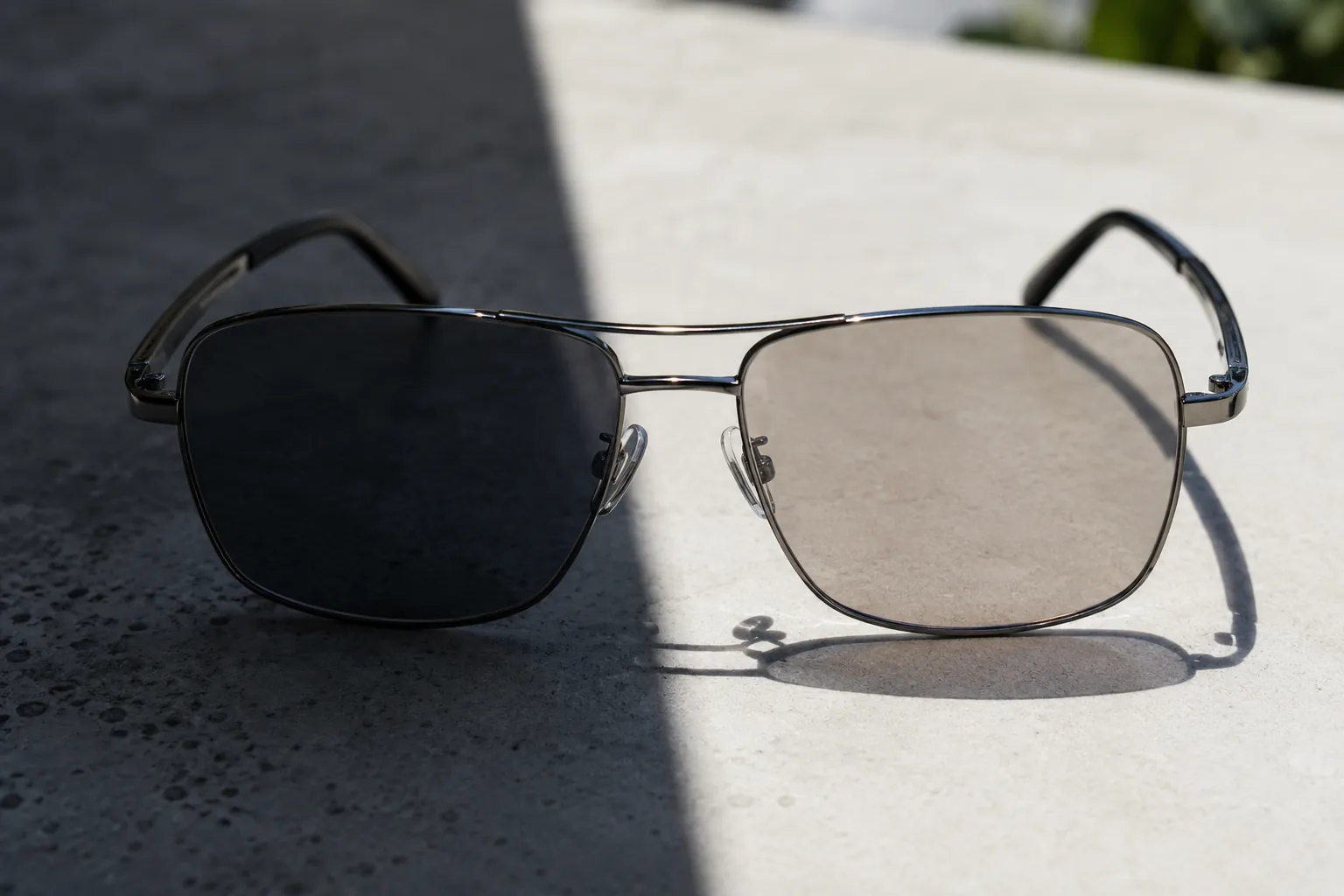
Photochromic — or "transition" — lenses darken in sunlight and clear indoors, giving wearers one pair that adapts to changing light. For brands, they're a premium, tech-forward feature with strong appeal in certain markets. This guide explains how they work, where they sell, and the trade-offs buyers must understand before spec'ing them.
How photochromic lenses work
Photochromic lenses contain molecules (often based on naphthopyrans) that change structure when exposed to UV light, becoming darker, then revert when UV drops. The reaction is triggered by UV, which has two important consequences buyers must grasp: lenses darken outdoors where UV is present, and they may not darken fully inside a car, where the windscreen blocks much of the UV.
The activation behaviour you must communicate
| Condition | Behaviour | Buyer note |
|---|---|---|
| Bright sun, cool temp | Darkens fully & fast | Best case |
| Bright sun, hot temp | Darkens less | Heat slows the reaction |
| Inside a car | Limited darkening | Windscreen blocks UV |
| Indoors | Clears | May take 1–5 min |
| Overcast | Partial darkening | UV still present |
The number-one photochromic complaint is "they don't darken in my car." That's physics, not a defect — set the expectation in your marketing.
Temperature dependence
Photochromics darken less in hot weather and more in cold. For sunglasses sold in hot climates, this matters: a lens that goes very dark in winter may only reach a moderate tint in midsummer heat. Set buyer expectations and choose formulations rated for the target climate.
Where photochromic sells best
- Outdoor sport: cycling, running, hiking — light changes constantly.
- Everyday all-rounders: one pair for variable conditions.
- Markets with changeable weather: high perceived value.
They pair naturally with sport wrap frames for an active-lifestyle range.
Cost, durability and lead time
Photochromic technology is more expensive than a standard tint and pushes a pair toward the top of its price tier. Durability is a real consideration — the photochromic response can fade over years of UV exposure (the molecules tire), so quality formulations and a protective hardcoat matter. Specialty lens batches can extend lead time slightly versus stock tints.
How to spec photochromic lenses
- Base material: PC or TAC; photochromic dye is integrated or coated.
- Clear and dark states: light transmission at each extreme (e.g. ~70% clear to ~15% dark).
- Activation/fade speed: seconds to darken, minutes to clear.
- Climate rating: formulation suited to target temperatures.
- UV400 + hardcoat: protection and longevity.
- Polarized? Combinable but adds cost — confirm feasibility.
Exploring photochromic sunglasses?
LumiShades produces photochromic lenses tuned for activation speed and climate, with UV400 and hardcoat. Request a sample to test the transition yourself.
Get a sampleHonest marketing wins
Because photochromic behaviour depends on UV and temperature, transparent marketing prevents returns. State that lenses darken in sunlight, may not fully darken in cars, and respond to temperature. Buyers who understand the technology love it; surprised buyers return it.
Summary
Photochromic lenses are a genuine premium feature for outdoor and all-rounder ranges — adaptive, tech-forward and high-margin. Understand the UV and temperature dependence, spec clear/dark states and climate suitability, and communicate the behaviour honestly. Done right, they're a standout addition to a collection.