
PC vs TAC Polarized Lenses in Bulk Sunglasses
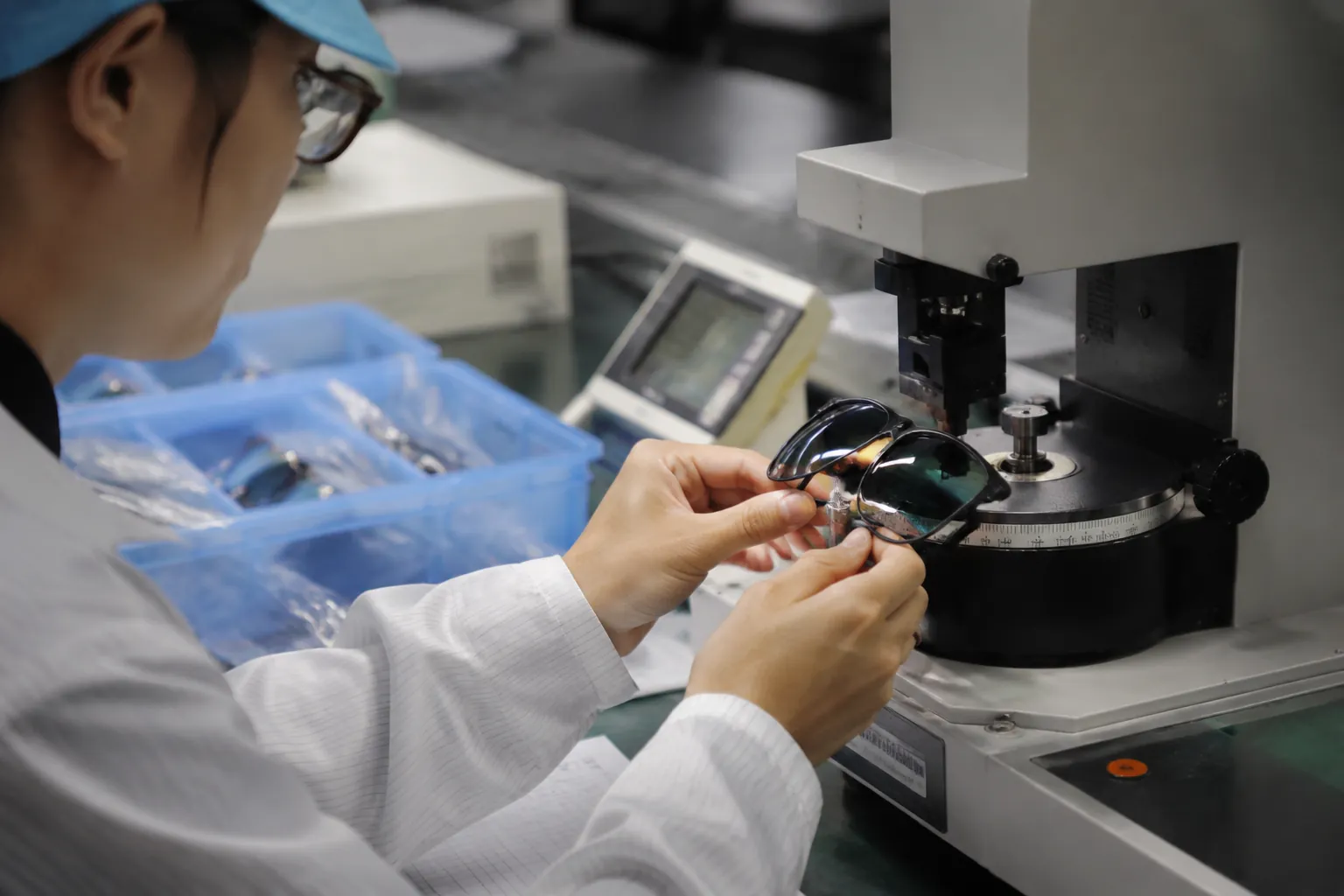
This guide is for brand owners, importers, distributors, and retail buyers sourcing sunglasses in volume. It compares PC and TAC polarized lenses from a buying and risk-control standpoint: unit cost, optical performance, assembly tolerance, compliance exposure, and return risk by channel. Keep the goal simple. A lower quoted lens cost can become the more expensive choice if it leads to distortion complaints, scratch-related returns, cracked lenses, or repacking after arrival. In most bulk programs, the right call comes from matching lens behavior to the sales channel, handling conditions, and inspection standard before mass production starts.
Start with the failure mode, not the material name
Many buyers start with the wrong question: is PC or TAC better? The better question is this: which failure hurts your channel most, and which one can your business absorb?
PC polarized lenses are often chosen for low weight and impact resistance. TAC polarized lenses are often chosen for cleaner perceived optics and a more premium look-through experience. Neither is automatically better. Each brings a different risk profile. That matters more than the material label on a quote.
In claims and inspection reviews, PC issues often show up as optical distortion, surface scratching when hard-coat performance is weak, haze, rainbow effect at certain viewing angles, or uneven mirror and coating appearance when process control slips. TAC issues more often show up as edge chipping, stress cracking during frame insertion, lamination defects, or delamination after rough handling, heat exposure, or poor storage.
Those risks do not land the same way in every channel.
- Discount retail and promotional programs usually care most about cost control and resistance to visible breakage in transit and handling.
- Fashion brands and boutique retail are more exposed to complaints about clarity, visual comfort, cosmetic cleanliness, and perceived quality at first try-on.
- Sports, outdoor, and youth channels often put more weight on impact resistance and low weight.
- Marketplace sellers are highly exposed to scratch and appearance complaints because returns are easy and product photos spread fast.
Use a simple sourcing rule. Define the complaint you can least afford. If breakage is the main risk, PC usually deserves stronger consideration. If poor visual quality is the bigger commercial risk, TAC may be the safer choice.
What PC and TAC mean in production
PC means polycarbonate lens substrate. In sunglasses production, the lens is usually injection molded from thermoplastic resin, then tinted or mirrored, hard-coated, and polarized if required. It is light. It is tough. That is why it shows up so often in active styles, youth sunglasses, and price-sensitive private label programs.
TAC usually refers to a triacetate-based laminated polarized lens construction. Instead of one solid injected substrate, TAC is built from layered sheets with a polarized film in the middle. The material is laminated, then formed, cut, edged, coated, and assembled into the frame. In many commercial programs, this construction gives better perceived optical definition than basic PC polarized lenses. It also creates more sensitivity in lamination, edging, and insertion.
That difference changes what the factory has to control. A PC program depends heavily on mold accuracy, injection stability, thickness consistency, and coating adhesion. A TAC program depends more on lamination uniformity, forming temperature, edge finishing, and stress-free insertion into the eyewire.
Do not accept a simple material label. Ask for the actual lens build specification: thickness, base curve, polarization requirement, visible light transmission target, mirror type, hard-coat system, and assembly method. Two lenses described with the same shorthand label can behave very differently if the build and controls differ.
Production integration matters too. If frame manufacturing, CNC groove control, lens edging, logo application, and final QC sit inside one system, fit and handling issues are easier to catch early. If lens supply, frame assembly, and decoration are split across multiple vendors, root-cause analysis gets harder once claims appear after shipment.
Head-to-head: cost, optics, durability, and claim risk
| Factor | PC Polarized | TAC Polarized | Buyer Impact |
|---|---|---|---|
| Typical cost position | Usually lower in many volume programs | Usually higher because of laminated construction and tighter handling requirements | PC is often easier to use for opening-price targets; TAC needs enough retail margin to support the upgrade |
| Optical clarity | Can be acceptable to good, but depends heavily on mold quality and coating control | Often delivers cleaner perceived sharpness and lower apparent distortion | TAC is often better suited to premium retail and try-on-driven channels |
| Impact resistance | Generally stronger and more forgiving in rough handling | Usually less impact-resistant than PC and more sensitive to assembly stress | PC is commonly preferred for sport, youth, outdoor, and transit-heavy channels |
| Scratch resistance | Depends on hard-coat quality; poor coating performance can lead to fast returns | Also depends on coating quality; premium optics do not prevent scratch complaints | Sample approval should include coating review, not just color and appearance |
| Assembly tolerance | Usually more forgiving during edging and insertion | Requires tighter groove control to reduce edge damage and stress cracking | TAC needs better fit discipline and operator control |
| Typical claim pattern | Distortion, scratching, haze, mirror inconsistency | Cracking, edge chips, lamination defects, stress marks | Choose based on the likely abuse level and customer expectation in the channel |
For bulk orders, never judge lens price on its own. A cheaper ex-factory lens can lose its advantage fast if it drives replacements, customer service load, repacking, or account friction. Compare total risk, not just the quote line.
Commercial breakpoints matter as well. At lower volumes, a lens upgrade can move unit cost sharply. At higher volumes, lens choice still matters, but decoration, packaging, and rework risk can weigh just as heavily in landed cost.
Channel fit: where each lens makes sense
PC polarized lenses usually fit programs that are cost-sensitive, active, or exposed to rough handling. TAC polarized lenses usually fit programs selling a more premium visual experience, especially where customers judge clarity right away.
PC is often the better commercial fit for:
- Seasonal chain-store programs where opening retail price is critical
- Sport-inspired or wrap styles that benefit from stronger impact resistance
- Youth, outdoor, beach, and promotional programs with higher breakage risk
- Large distributor orders where small unit-cost differences matter across the full order
TAC is often the better commercial fit for:
- Fashion brands positioned above basic private label product
- Boutique and specialty retail where customers compare lens clarity directly
- Travel, resort, and lifestyle collections where perceived quality supports conversion
- Acetate or metal frames where the lens experience is part of the premium story
Picture actual use. If the sunglasses are likely to end up in a glove box, beach tote, or promotional carton, PC often makes more sense. If the shopper will look through the lenses under store lighting and judge quality on first impression, TAC often becomes the safer commercial option.
How returns start on the factory floor
Most lens claims do not come from material choice alone. They usually start with weak control between lens production, frame machining, decoration, packing, and final inspection.
- Lens incoming or in-house prep: Check base curve consistency, thickness tolerance, polarization direction, tint uniformity, and hard-coat adhesion before assembly. If left and right lenses do not match under light, stop the issue here.
- Groove and eyewire control: TAC lenses are especially sensitive to overly tight grooves. Small fit errors can create edge stress that turns into a crack during shipment or wear. PC is more forgiving, but poor fit can still cause gaps, rattle, or cosmetic distortion.
- Edging and trimming: Poor CNC or trimming accuracy can chip TAC edges or create pressure points. On PC, rough edging may pass early inspection yet still cause poor seating or lens movement later.
- Decoration stage: Pad printing, laser marking, metal trim fitting, and other handling steps must be controlled so fixtures, tools, gloves, or heat do not scuff finished lenses.
- Packing check: Lens contact with pouches, insert cards, or inner cartons is a common hidden source of scratches. Pre-shipment inspection should include units pulled from packed cartons, not just from the assembly line.
Ask what the factory actually inspects. A serious final QC process should define distortion review, left-right color matching, scratch inspection under controlled light, hinge symmetry, opening and closing feel, and packed-carton review. A vague statement such as "100% visual check" is not enough without a written standard.
Compliance points to confirm before mass production
Compliance is not a generic line on a quotation. The real question is whether the exact finished style, with its specific tint, category, mirror, markings, and packaging, meets the destination-market requirement.
For sunglasses programs, buyers commonly ask for conformity to CE EN ISO 12312-1 for applicable markets, ANSI Z80.3 for the United States, and AS/NZS 1067 for Australia and New Zealand. Chemical compliance requests often include REACH. Some buyers also review supplier-level controls such as ISO 9001 or BSCI, and some importers ask whether the supplier maintains FDA registration. Useful documents, yes. But they do not replace finished-product verification for the exact style being ordered.
| Compliance Item | What Buyers Should Confirm | Why It Matters |
|---|---|---|
| Finished-product report | Report applies to the exact style or a clearly equivalent construction with the same relevant lens configuration | Raw-material or unrelated style reports do not prove finished-product conformity |
| Visible light transmission | Lens transmission and filter category remain compliant after tint, polarization, and mirror coating | Changes to tint or mirror can affect category and labeling requirements |
| Marking and warnings | Labeling, packaging, and carton marks meet destination-market requirements | Incorrect warnings or missing marks can create import and retail compliance risk |
| Chemical compliance | Applicable REACH or buyer-specific substance requirements are documented | Retailers and importers increasingly require chemical documentation in the PO file |
Lock the lens specification early. A late change from a standard smoke lens to a mirrored or gradient version can affect appearance approval, compliance review, and testing lead time at the same time.
Lead times, sampling, and where delays happen
Custom sunglass timelines vary by construction, lens treatment, order size, and supplier capacity. In practice, the most predictable programs lock the lens decision early and treat the pre-production sample as final.
| Stage | Typical Timing | Common Delay Cause | Best Buyer Action |
|---|---|---|---|
| Sample build | Often about 1-2 weeks, depending on complexity | Late logo files, repeated shape changes, unclear lens color target | Approve artwork, color references, and exact lens specification at project start |
| Material prep | Varies by stock status and custom treatments | Special TAC colors, custom mirror effects, non-stock hardware | Confirm what is stock, what is custom, and what needs additional replenishment time |
| Bulk production | Commonly several weeks after approval, depending on order size and process | Lens fit rework, coating issues, logo defects, frame-lens mismatch | Approve a sealed pre-production sample and a written QC standard before bulk starts |
| Final packing | Usually short, but still quality-sensitive | Barcode errors, mixed lens shades, pouch mismatch, carton mark issues | Send packing standard, barcode file, and carton marks before production closes |
TAC programs usually need stricter approval discipline because late changes to tint, mirror, or shape can force rework on laminated lenses. PC programs are somewhat more forgiving. But low-cost projects still go wrong when buyers approve samples without defining scratch expectations, color tolerance, or transit protection requirements.
For first orders, freeze five items in writing: lens material, color reference, polarization requirement, logo method, and packaging pack-out. That removes many avoidable delays.
A practical decision rule for first and repeat orders
If this is a first order in a new style, stay conservative. Choose the lens that fits the real sales channel, not the one that only improves the quotation.
Use this rule set when buying:
- Choose PC polarized if the target is aggressive price, active use, youth use, or heavy abuse in transit and handling.
- Choose TAC polarized if retail presentation, visual sharpness, and premium positioning are central to the sale.
- For a new customer, new frame shape, or untested lens color, run a pilot quantity first if the supplier allows it.
- Review repeat orders using actual complaint records, inspection data, and return reasons rather than assumptions.
- Write the inspection standard into the PO: lens category, polarization requirement, color match rule, scratch review method, assembly appearance standard, and packaging test expectation.
The cheapest lens is the one that survives the channel with the least downstream friction. Material choice matters. Process control, sample discipline, and clear QC language matter almost as much.
Good sourcing is predictable: exact specification, sealed sample, controlled production, and no surprises when cartons arrive.
Have a custom sunglasses project in mind?
Send us your styles, target market and quantities and we will return a detailed quote with MOQ, lead time and a sample plan.
Get a QuoteWhy source this from Wenzhou with LumiShades
Wenzhou in Zhejiang Province is widely regarded as China’s eyewear manufacturing capital, producing a large share of the world’s sunglasses. That concentration matters to buyers: a deep local supply chain for acetate sheet, hinges, lens blanks, plating and packaging means shorter component lead times, easier color and material matching, and a workforce with decades of eyewear-specific skill. LumiShades has manufactured in this ecosystem since 2009, and our vertical integration — in-house injection molding, acetate cutting, CNC milling, lens tinting, decoration and quality control — means no part of your order is quietly subcontracted to a workshop you cannot audit.
For international buyers, that vertical control translates into accountability. When a single factory owns every step, defects are traced and fixed at source rather than bounced between vendors, and your specifications survive intact from first sample to bulk. We back this with 15+ years of experience, shipments to 60+ countries, more than 5 million pairs produced per year and a 98.5% on-time delivery rate. Our certifications — CE EN ISO 12312-1, FDA registration, ANSI Z80.3, AS/NZS 1067, REACH, ISO 9001 and BSCI audit — mean the compliance documentation your market requires already exists. Explore our manufacturing capabilities and quality control process to see how this works in practice.
Frequently asked questions
Which lens is safer for budget retail: PC or TAC? In many budget retail programs, PC polarized is the safer starting point because it is often lower in cost and generally more impact-resistant than TAC. That does not make every PC lens acceptable. Before placing bulk, ask for the exact lens specification, confirm the hard-coat standard, inspect sample lenses under direct light for scratching and haze, and define a written distortion and appearance standard in the PO. If the retail channel is highly sensitive to look-through quality, test TAC as a comparison instead of assuming PC is good enough.
Which lens gets fewer consumer complaints about visual clarity? TAC polarized lenses often generate fewer complaints about perceived sharpness and visual cleanliness, especially in fashion and boutique channels where shoppers compare multiple pairs at the shelf. The right buying step is to compare sealed samples side by side under store-like lighting, check straight-line distortion, verify left-right lens consistency, and ask whether bulk production will use the same lens construction and coating system as the approved sample. Do not approve on lens color or mirror appearance alone.
Can TAC lenses crack during assembly? Yes. TAC lenses can crack or chip if the groove is too tight, the edge finish is rough, the lens shape is stressed during insertion, or handling is poor. To control that risk, ask the factory to confirm groove dimensions against the lens specification during pre-production, inspect edged lenses before insertion, and keep a signed pre-production sample that shows the approved fit. If the frame is a new shape or has a tight wrap, request an assembly trial before authorizing full bulk output.
Does polarized mean the sunglasses automatically meet CE or ANSI requirements? No. Polarization does not prove compliance on its own. The finished sunglasses still need to meet the applicable market standard, such as CE EN ISO 12312-1, ANSI Z80.3, or AS/NZS 1067, depending on where they will be sold. Buyers should request a finished-product test report for the exact style or a clearly equivalent construction, confirm visible light transmission and filter category after all lens treatments are applied, and verify that required markings and warnings match the destination market.
How should I sample a new lens option before placing bulk? Approve a true pre-production sample built with the exact frame, lens material, tint, polarization, coating, logo method, and packaging intended for production. Then create a written approval record covering visual distortion, left-right color match, scratch inspection under controlled light, lens fit in the frame, and packed-unit review for transit rubbing. If the supplier holds ISO 9001, BSCI, or FDA registration, treat that as background supplier information only. Judge the bulk order by the sealed sample, the finished-product compliance file, and the written QC standard tied to the PO.
Ready to start?
Explore our wayfarer sunglasses or request a quote — our sales team replies within 12 hours.
Request a Quote