
PC vs TAC vs Nylon: Choosing the Right Sunglass Lens
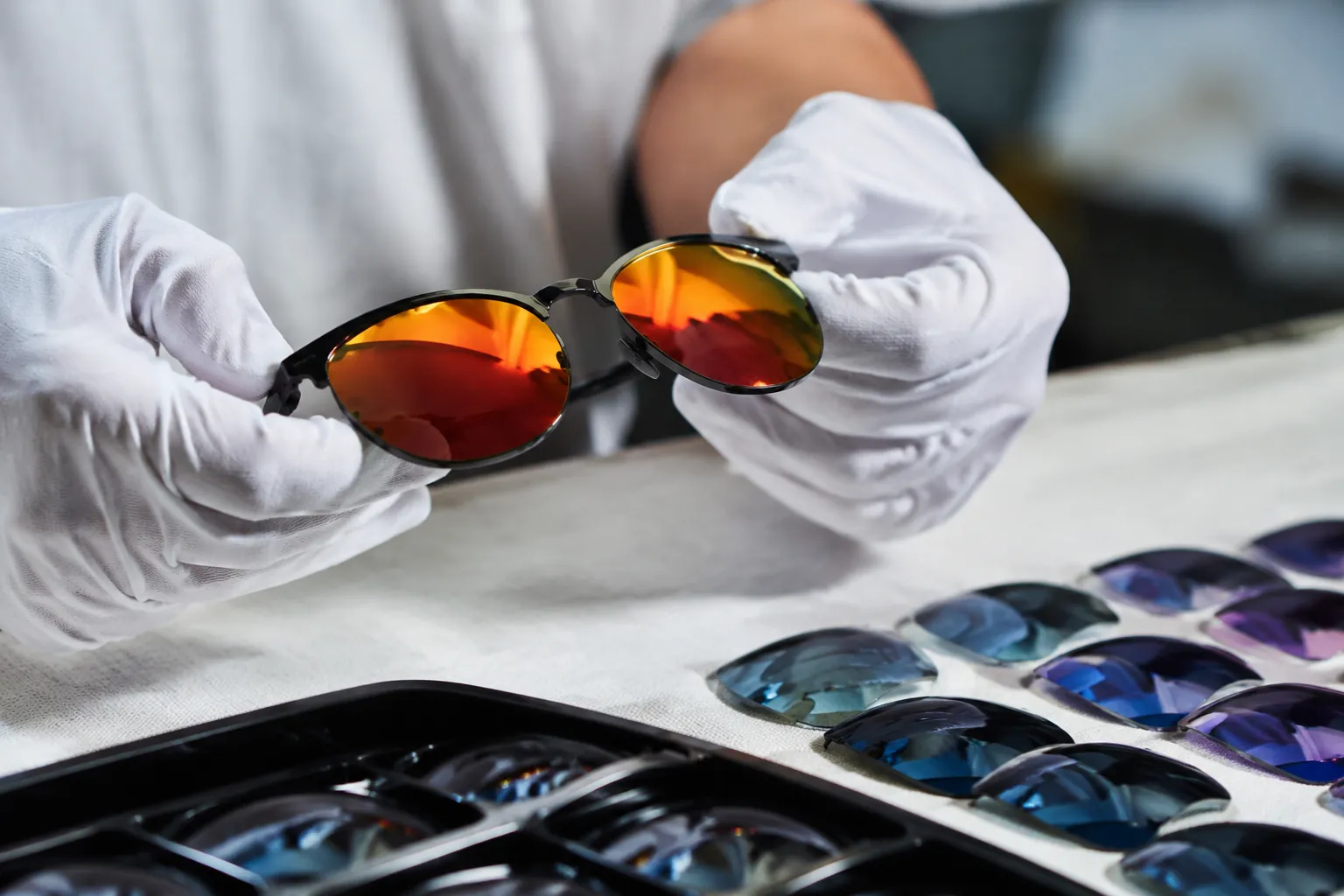
This guide is for brand owners, importers, distributors, and retail buyers sourcing sunglasses at volume. It compares PC, TAC, and nylon lenses using the factors that affect product fit, claim risk, unit economics, and production timing: optical performance, impact behavior, assembly tolerance, cost position, lead time, and compliance. If you are choosing between a promo run, a fashion polarized line, or a sport model, decide on lens material before samples are finalized. Do it early. That avoids rework in tint approval, lens cutting, packaging, and testing.
Start with channel, price, and actual use
A common sourcing mistake is asking for the "best" lens material before defining the sales channel, target price, and real use case. That is the wrong starting point. Lens selection is not a generic materials debate. It is a product-spec decision tied to retail position, expected handling, and compliance requirements.
A giveaway program, a boutique fashion capsule, and a sport-specialty model do not need the same lens. A low-cost order may prioritize impact resistance, easy processing, and stable supply. A fashion line may need polarization and stronger shelf appeal. A sport program may need better visual stability in wrapped frames and more demanding wear conditions.
- Promo, events, and tourist retail: PC is often the first material reviewed because it is lightweight, impact resistant, and widely used in cost-sensitive programs.
- Fashion private label: TAC is commonly reviewed when the line needs a polarized option at a commercially accessible price point.
- Sport and outdoor: nylon becomes more relevant when the frame has a higher wrap, the wearer is active, and optical stability under movement matters more.
- Kids and high-abuse channels: PC often remains the practical starting point because rough handling and repeated try-on can matter more than premium optics.
Order quantity changes the decision too. At low volume, setup charges, decoration, and packaging can outweigh small component differences. At higher volume, lens material has a clearer effect on cost structure, yield, and return risk. Review lens choice with channel fit. Not on its own.
Head-to-head: PC vs TAC vs nylon
The comparison below reflects common sourcing use cases, not sales language. Actual performance depends on resin quality, lens construction, coating, thickness, base curve, and assembly control.
| Lens material | Typical thickness range | Optical performance | Impact/stress behavior | Relative cost | Best-fit channels |
|---|---|---|---|---|---|
| PC | Commonly used in standard sunglass programs; thickness varies by frame and lens design | Generally suitable for mass-market sunglasses, especially flatter and mildly curved styles | High impact resistance; typically more forgiving in handling and assembly | Low | Promo, kids, entry private label, general retail |
| TAC | Laminated construction; thickness varies by supplier and polarization build | Can perform well in commercial polarized programs when lamination and finishing are well controlled | Moderate; can be more sensitive to edge stress, insertion force, and groove mismatch | Low to mid | Fashion polarized, gift retail, mid-range private label |
| Nylon | Often specified for sport-oriented lenses; thickness varies with curve and product brief | Typically strong in wrapped or technical shapes where visual stability is important | High toughness with good suitability for active-use frame designs | Mid to high | Sport, cycling, running, outdoor performance lines |
In simple terms, PC is usually chosen for toughness and cost control, TAC for an accessible polarized offer, and nylon for technical frame geometry or sport use. There is no universal winner. The right choice depends on the brief.
The wrong match usually shows up fast. A lower-spec laminated lens in a stressed wrap frame can raise distortion or edge-failure risk. A nylon lens in a basic fashion frame may add cost without adding enough value. A PC lens can be the right choice for a cost-sensitive program if the style, positioning, and compliance path support it.
Optical performance: process control decides the result
Buyers often try to rank optics by material alone. In production, that does not go far enough. Visual performance depends on thickness consistency, base curve, surface quality, tint uniformity, coating quality, and frame mounting stress. Material matters. Process control matters more.
PC is widely used because it is practical in volume production and offers dependable impact resistance. In flatter fashion shapes and many everyday sunglasses, it can meet the brief well. In larger shields or stronger curves, visual quality depends more on design control and lens consistency.
TAC should be treated as a lens construction, not just a label. Because it is laminated, buyers should review bond quality, edge finish, and post-assembly stress. If lamination or cutting is poor, issues can include haze, edge lifting, or inconsistent appearance between lenses. Tint approval alone is not enough.
Nylon is often selected for sport or technical styles because it can perform well in higher-wrap designs where distortion is easier for the wearer to notice. That matters in channels where users wear the product longer and expect stable vision.
Useful sample-stage checks include:
- Thickness consistency: confirm the lens build matches the approved specification and seats correctly in the frame.
- Edge finish: inspect for chips, rough edging, stress whitening, or visible defects after insertion.
- Polarization consistency: if using TAC, compare both lenses under the same conditions for uniform appearance.
- Frame stress: inspect the assembled sample after rest time, not only immediately after assembly.
If the line is aimed at sport specialty, optical, or premium outdoor channels, unit cost should not be the only decision point. Poor optics create returns. They also damage product position faster than a moderate increase in ex-factory cost.
Breakage risk, assembly tolerance, and return exposure
Impact resistance is not just a product feature. It affects assembly yield, replacement rates, and how well the product handles shipping and retail use. PC remains widely used because it is generally forgiving during assembly, packing, try-on, and end-user misuse.
TAC usually needs tighter process discipline. Because it is laminated, it can be less forgiving if the groove is too tight, the lens shape creates concentrated edge stress, or insertion is forced. A mismatch between lens edge and frame groove may not fail at once. That is why post-assembly inspection matters.
Nylon is often a stronger fit when the frame design itself creates more lens stress, especially in wrapped sport fronts. It is commonly considered when the product must handle repeated wear, movement, and tougher outdoor use.
A practical factory review process should include:
- Check lens seating after assembly and again after a rest period.
- Review handling and basic durability performance on approved samples.
- Inspect packaging fit if the goods will be packed tightly for shipment.
- Match lens material to the expected abuse level of the sales channel.
Many reported lens failures are actually fit or process failures. If groove tolerance is wrong, the front curve is too aggressive for the selected lens, or packaging compresses the frame front during transit, the material may get blamed for a problem created elsewhere.
MOQ, unit cost, and margin logic by order size
Low MOQ can help test a concept, but it can also distort cost analysis. At small volume, setup charges, custom decoration, packaging, and manual handling may affect unit cost more than the lens material itself. At that stage, the main question is often simple: is the concept worth validating?
As volume rises, the material decision becomes easier to judge because the cost effect is spread across a larger order and consistency matters more. Then buyers should look at the full commercial picture: target margin, return risk, visual standards, and whether the lens supports the intended retail story.
| Order size | Commercial reality | What matters most | Lens guidance |
|---|---|---|---|
| 50 pairs | Trial run, capsule, or concept test | Fast validation, presentation, clear approval flow | Choose the lens that best proves the concept and channel fit |
| 300 pairs | Small retailer launch or pilot line | Balanced unit cost and perceived value | PC or TAC often make the most practical starting options |
| 1,000 pairs | Established reorder or broader rollout | Margin control, QC consistency, reduced claim risk | Material choice should be fully aligned with retail brief and use case |
| 5,000+ pairs | Large promotion or scaled distribution | Yield, assembly stability, packaging efficiency, total landed cost | PC often leads on value; nylon usually needs a clear functional reason |
Decoration and packaging matter too. A basic logo process is usually easier to control than a complex one. Retail packaging may improve presentation, but it also adds cost, handling steps, and approval time. Review these variables together with lens material rather than treating the lens as the only cost driver.
Lead time, lens processing, and what shifts the schedule
Lead time depends less on the promised date and more on how stable the specification stays after sampling. The main schedule risks are usually late changes to lens material, tint, logo details, packaging, or compliance requirements.
PC is commonly used in commercial production and is often straightforward to process in volume. TAC usually needs closer control during cutting, edging, and insertion because the laminated structure is more sensitive to poor handling. Nylon can add complexity when the frame has a technical wrap or tighter optical expectations.
In a factory with stronger internal process control, buyers can usually manage lens-related troubleshooting faster. This matters when several steps interact, such as:
- Lens tinting: the approved color and category need to match the target market and sample standard.
- Lens cutting and edging: poor edge quality can increase insertion stress and cosmetic rejects.
- Logo decoration: approval timing can shift if branding details change late.
- QC checkpoints: in-process inspection helps catch lens-fit and finishing issues before final packing.
A practical production flow is clear: confirm frame drawing, lens material, tint, and compliance target; review the prototype; approve fit, color, logo, and packaging; then release production with in-process and final QC. Many delays start when buyers try to change lens construction after the sample standard is approved.
Compliance planning before bulk approval
Lens selection should be tied to destination-market compliance before bulk production starts. Do not assume that a dark tint or a polarized label automatically meets the required standard. Compliance applies to the finished product configuration, not just raw material declarations.
Common references in sunglasses sourcing include CE EN ISO 12312-1 for many international programs, ANSI Z80.3 for the US market, AS/NZS 1067 for Australia and New Zealand, and REACH for relevant chemical compliance obligations. Some suppliers also reference FDA registration in the US import context, but buyers still need to confirm how that documentation applies to the product category and sales route.
Operational controls such as ISO 9001 and social compliance programs such as BSCI may matter when evaluating factory systems, but they do not replace product compliance testing for sunglasses.
The key sourcing question is simple: which tests and documents apply to the finished lens-and-frame assembly, and which are only material-level declarations? That distinction matters if the buyer changes lens construction late in the project. A sample approved in one lens construction should not be assumed to cover a different construction without a fresh compliance review for the shipped configuration.
A safe pre-order checklist includes:
- Confirm destination market: US, EU, Australia/New Zealand, or a multi-market program.
- Lock lens construction: PC, TAC, or nylon before final compliance submission.
- Match tint and category: make sure the tested lens specification matches the approved production lens.
- Keep records by SKU: especially if one frame is sold with multiple lens options.
This protects the importer from finding out too late that the approved sample and the shipped goods are not technically the same product.
A practical material-selection framework for common programs
Most sourcing decisions can be narrowed quickly with three questions: what is the target price position, where will the sunglasses be sold, and how demanding is the expected use? The answers usually point to the right starting material.
| Program type | Best starting lens | Why it fits | Main caution |
|---|---|---|---|
| Low-cost promo or event order | PC | Good toughness, broad commercial use, and strong fit for cost-sensitive programs | Do not position it as a premium optical solution if the product brief does not support that claim |
| Fashion private label polarized line | TAC | Supports a polarized story with a commercially accessible cost structure | Control lamination quality, edge finish, and frame fit |
| Sport or outdoor performance model | Nylon | Well suited to active-use, curved designs where visual stability matters more | Higher cost needs to be justified by channel, function, and product positioning |
If the order is cost-driven and broad-market, start with PC. If the line needs polarization and stronger perceived value without moving fully into performance pricing, review TAC early. If the frame is technical and the user is active, evaluate nylon from the first sample stage rather than adding it later as a fix.
This approach shortens development, reduces specification changes, and lowers the risk of approving a lens that looks acceptable in a sample photo but does not hold up in assembly, shipping, or field use.
Have a custom sunglasses project in mind?
Send us your styles, target market and quantities and we will return a detailed quote with MOQ, lead time and a sample plan.
Get a QuoteWhy source this from Wenzhou with LumiShades
Wenzhou in Zhejiang Province is widely regarded as China’s eyewear manufacturing capital, producing a large share of the world’s sunglasses. That concentration matters to buyers: a deep local supply chain for acetate sheet, hinges, lens blanks, plating and packaging means shorter component lead times, easier color and material matching, and a workforce with decades of eyewear-specific skill. LumiShades has manufactured in this ecosystem since 2009, and our vertical integration — in-house injection molding, acetate cutting, CNC milling, lens tinting, decoration and quality control — means no part of your order is quietly subcontracted to a workshop you cannot audit.
For international buyers, that vertical control translates into accountability. When a single factory owns every step, defects are traced and fixed at source rather than bounced between vendors, and your specifications survive intact from first sample to bulk. We back this with 15+ years of experience, shipments to 60+ countries, more than 5 million pairs produced per year and a 98.5% on-time delivery rate. Our certifications — CE EN ISO 12312-1, FDA registration, ANSI Z80.3, AS/NZS 1067, REACH, ISO 9001 and BSCI audit — mean the compliance documentation your market requires already exists. Explore our manufacturing capabilities and quality control process to see how this works in practice.
Frequently asked questions
Which lens material is usually the best starting point for a private label fashion line? For many mid-range fashion programs, TAC is a practical starting point if the brief includes polarization and a stronger perceived-value story than basic PC. Ask the supplier to confirm the exact lens construction, then review assembled samples for lamination quality, edge finish, lens seating, and visual consistency before approving more than color. If the line is non-polarized and strongly cost-driven, PC may still be the better commercial fit.
Is PC too low-end for branded sunglasses? No. PC is widely used in branded commercial sunglasses because it is lightweight, impact resistant, and cost-efficient. The real question is whether it fits the product brief. Ask whether the style is flat or highly wrapped, what optical expectations the channel has, and which compliance standard the finished product must meet. If the brand promise depends on sport performance, higher-wrap optics, or a premium technical story, compare PC against nylon during sampling rather than judging PC by perception alone.
When should I pay more for nylon lenses? Nylon is usually worth reviewing when the frame has a higher wrap, the model is intended for sport or outdoor use, or the wearer is likely to notice distortion during long wear. To make the decision practical, request matched samples in the intended frame geometry, compare visual quality in use, and check whether channel margin can support the higher lens cost. If the product is mainly promotional or fashion-led, nylon may add cost without enough commercial return.
How early should compliance be discussed with the factory? Before final sample approval. Confirm the destination market first, then align the lens material, tint category, and final product configuration with the required compliance path, such as CE EN ISO 12312-1, ANSI Z80.3, AS/NZS 1067, and any relevant REACH documentation. Ask the supplier which documents apply to the finished sunglasses and which apply only to raw materials. If the lens material changes later, review compliance again for the shipped SKU rather than relying on the original sample paperwork.
Does polarized always mean TAC? No. Polarization describes a lens function, not automatically the base material. TAC is a common commercial route for polarized sunglasses, but buyers should confirm the exact construction shown on the quotation, sample record, and compliance file. A practical check is to ask the supplier to state the lens construction in writing, tie it to the SKU, and make sure the approved sample, test documents, and production order all refer to the same lens build.
Ready to start?
Explore our sport wrap sunglasses or request a quote — our sales team replies within 12 hours.
Request a Quote