
UV400 in Sunglasses Production: What Buyers Need to Verify
This guide is for brand owners, importers, distributors, and retail buyers who need UV400 claims that stand up in production, inspection, and market compliance—not just on a quotation. It explains what UV400 means at lens level, how factories achieve it in different materials, what laboratories actually verify, and how buyers should control sample approval, order specifications, and document matching before bulk production. The goal is simple: the approved sample, bulk goods, packaging claim, and compliance file should all refer to the same lens construction.
UV400 is a measured lens claim, not a tint effect
Many buyers still confuse UV400 with dark color, mirror finish, or polarized appearance. They are not the same thing. A dark lens can still fail ultraviolet requirements if the material or coating does not block radiation well enough. A lighter lens can pass if its spectral performance meets the claim.
In sourcing terms, UV400 means ultraviolet protection up to 400 nanometers. That generally covers the UVA and UVB range relevant to sunglass claims. You cannot confirm this by eye. It must be measured with proper test equipment.
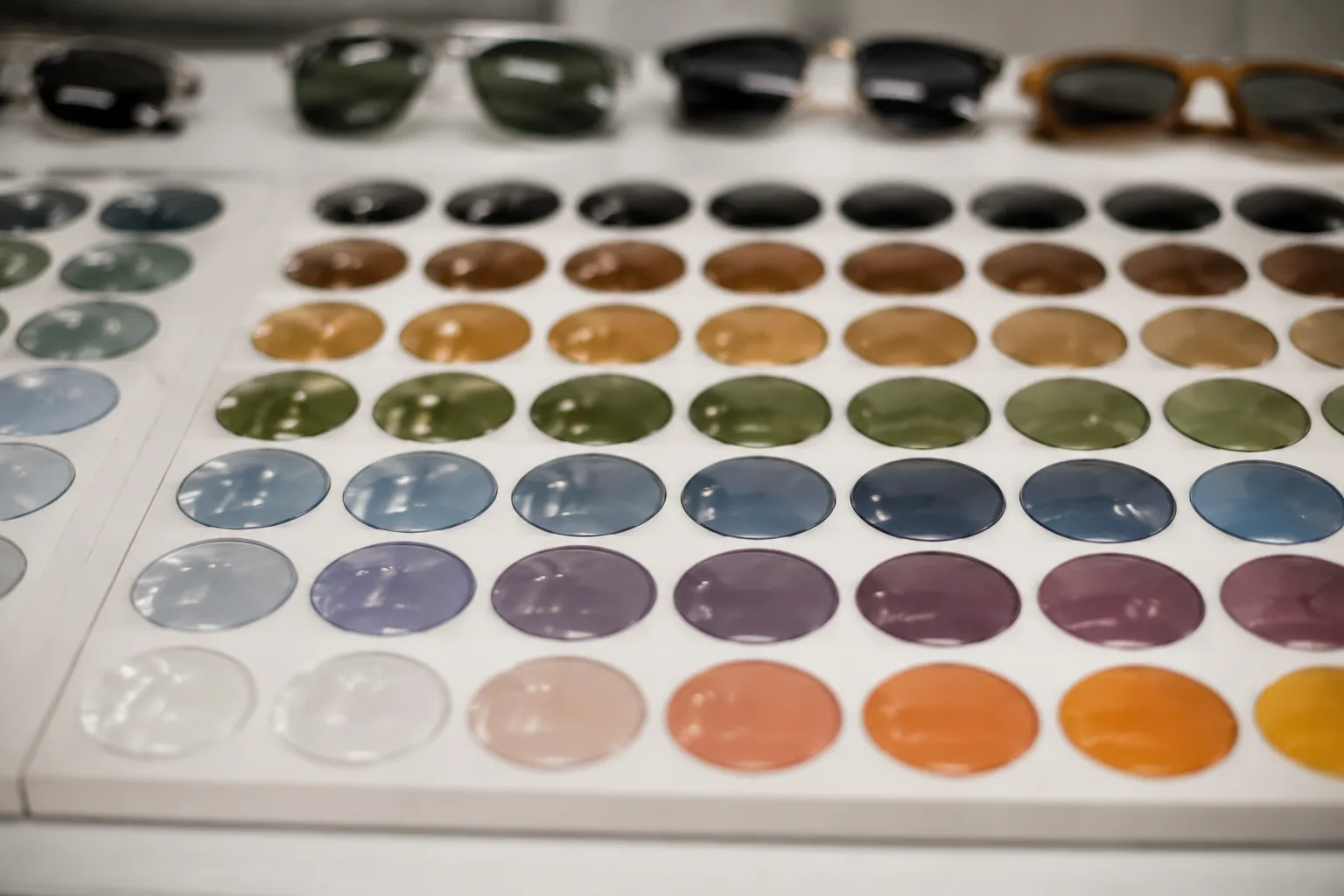
This matters on the factory side. Visible light transmission, lens category, base tint, gradient effect, mirror coating, flash coating, and polarization all change appearance and positioning. None of them, by themselves, proves UV400 performance. A mirrored blue lens and a plain grey lens may look completely different and still deliver similar UV blocking if the underlying lens construction is the same.
At production level, UV protection may come from the lens material itself, from a surface treatment, or from both. Polycarbonate lenses often rely heavily on the material formulation. Acrylic programs may depend more on material grade and process control. Nylon and TAC polarized constructions add more variables because performance depends on the full stack, not just the surface look.
Ask the direct question early: Is UV protection inherent in the lens material, added by coating, or dependent on the full laminate structure? If a supplier cannot answer clearly, ask for the lens specification sheet and matching test evidence before moving ahead.
How factories build UV performance into production lots
Reliable UV performance starts before tinting, coating, or decoration. It starts with a defined bill of materials, an approved material route, and controlled processing. The factory should know exactly which resin, lens blank, or laminate is approved for the SKU. Any change that could affect optical performance should be controlled. No guesswork.
A typical production route for private label sunglasses follows a sequence like this:
- Buyer confirms target market, lens category, material route, color, finish, polarization status, and claim language.
- Factory selects the exact resin, lens blank, or TAC laminate approved for that SKU.
- Trial lenses are produced and checked for color, basic appearance, and UV-related performance against the intended specification.
- If dye tinting is required, the process is controlled so visible light transmission stays within the target range for the intended category.
- If mirror, hard coat, anti-scratch, or other surface treatments are added, the final lens construction is checked again because those changes can affect the finished product specification.
- Pre-production samples are signed off against the final specification and intended claim.
- Bulk lots are checked during production and again during final quality control before packing.
In real production, problems often come from changes that look minor on paper: a new resin lot, a different lens supplier, a different tint process, or a substituted mirror treatment. Even if the frame stays the same, those changes can affect visible light transmission, consistency, and the relevance of existing test documents.
That is why serious buyers lock the lens construction in writing. A purchase order should specify material, color, finish, polarization status, target standard, and approved sample reference—not just "UV400 lens." On repeat orders, this reduces the risk that the factory matches the look of the sample but not the actual lens build.
Claiming UV400 is easy. Delivering the same UV performance across bulk production is harder. It takes material control, traceability, and confirmation that process changes do not break the approved specification.
Material routes: what changes in cost, consistency, and risk
Different lens materials can support a UV400 claim, but they do not behave the same way in production. Buyers should compare them by intended use, consistency, and document control—not just by sample appearance.
| Lens route | How UV blocking is achieved | Typical sourcing use | Main buyer risk |
|---|---|---|---|
| Injected PC sunglass lens | Often achieved through the material formulation, sometimes combined with additional surface treatments | Fashion sunglasses and many volume private label programs | Assuming every PC lens automatically meets the same UV claim without checking the actual material specification and test coverage |
| Acrylic lens | Depends more on material grade and processing route | Cost-sensitive programs and fashion-focused designs | Greater variation if the supplier changes material grade or process without revalidation |
| Nylon lens | Material formulation with possible added coatings or treatments | Sport-oriented and performance-positioned styles | Using a different material grade in bulk than in the approved sample |
| Polarized TAC lens assembly | Depends on the full laminate structure, including TAC layers, polarizing film, and adhesive system | Polarized collections and mid-range retail programs | Treating polarization itself as proof of UV400 without verifying the exact laminate construction |
For many private label programs, injected polycarbonate is a practical route because it is widely used and easier to scale when the material specification is controlled. Acrylic can work for some programs, but buyers should watch consistency and report matching closely. TAC polarized lenses add retail appeal, but the compliance file should match the exact laminate used in production, not a similar-looking substitute.
Simple rule: the more layers and treatments a lens has, the more tightly you need to control the match between the approved sample, the production bill of materials, and the test report.
What labs test, and what your compliance file must match
For overseas buyers, the issue is often bigger than whether a lens can pass a test. The real issue is whether the claim, report, product marking, packaging, and shipped goods all refer to the same sunglass configuration. This is where customs questions, retailer rejection, and post-shipment disputes usually start.
If you sell into multiple markets, the documentation may need to align with standards such as CE EN ISO 12312-1, ANSI Z80.3, or AS/NZS 1067, depending on the market and product category. These standards cover more than a basic UV statement. Depending on the standard and product, they may address spectral transmittance, luminous transmittance, lens category, optical requirements, and marking or labeling rules.
Buyers should verify that the report identifies a lens construction equivalent to the one being ordered. A report for a grey polycarbonate lens is not automatically valid for a mirrored polarized TAC version of the same frame style. Similar appearance is not enough. The documentation should cover the same material route and finished lens configuration.
- CE EN ISO 12312-1: commonly referenced for sunglasses placed on the EU market and should match the configuration actually sold.
- ANSI Z80.3: commonly referenced for non-prescription sunglasses sold in the US market and should align with the specific lens claim and product build.
- AS/NZS 1067: relevant for Australia and New Zealand programs and should match the product category and intended use.
- REACH: addresses chemical compliance and restricted substances, not UV performance by itself.
- FDA registration: is not the same as product performance compliance for sunglasses and does not by itself prove UV or optical performance.
The last two points are often misunderstood. REACH documents and FDA-related paperwork may still matter, but they do not replace sunglass lens performance testing. A complete compliance file should connect the exact SKU or lens family to the right standard, product marking, and claim wording used on labels, cartons, inserts, and listings.
Where buyers get burned: common UV400 failure modes
Most UV400 disputes do not come from unusual technical defects. They come from vague specifications, weak document control, or unapproved production changes. The same patterns show up again and again in private label programs.
- Sample passed, bulk changed. The approved sample used one lens source or material specification, but production used another without buyer approval.
- One report was applied too broadly. A report for one lens color or construction was reused for other colors, mirror versions, or polarized versions without confirming equivalent coverage.
- Polarized was treated as UV proof. Polarization reduces glare. It does not automatically prove UV400 performance.
- Compliance files were mixed up. Buyers accepted REACH or FDA-related paperwork as if it replaced product-specific sunglass performance evidence.
- Packaging claims outran the documents. The hangtag, carton, or online listing said UV400, but the supporting report referred to a different lens build or category.
The fix is not complicated. It does require discipline. Write the lens specification in full on the purchase order. Tie bulk production to a true pre-production sample, not just an early development sample. Ask the supplier to confirm in writing that the bulk lens construction will match the approved version. Then check that the test report, product marking, and packaging language all refer to that same configuration.
If multiple parties are involved, also confirm who controls lens sourcing, tinting, coating, and final inspection. More handoffs mean more risk. Traceability matters.
How MOQ, price, and lead time interact in custom programs
Buyers often want low MOQs, short lead times, and highly customized lens appearance at the same time. In practice, those demands pull against each other. The more the factory is asked to customize lens material, color, mirror treatment, polarization, and packaging, the more likely development time and unit cost will rise.
At lower volumes, factories may limit buyers to existing molds, standard lens materials, and proven color routes because that reduces setup risk. At higher volumes, suppliers may be more willing to support custom lens development, color matching, or packaging variation because the production run can absorb more tooling, sampling, and procurement complexity.
Lead time is affected less by the words "UV400" on a spec sheet than by the approval process behind the finished lens. Delays usually come from custom tint matching, mirror finish approval, polarized laminate confirmation, packaging review, and any need to update or verify compliance documents for the exact product build.
For faster launch programs, a practical approach is to start from an existing lens route that already has a clear material specification and matching compliance support. Then customize branding and pack-out around that stable optical configuration.
Branding methods such as laser engraving, pad printing, and metal logo plate application are usually managed separately from the UV claim because they are typically applied to non-optical areas. Even so, buyers should confirm that no decorative process changes the lens construction or creates a mismatch between the approved sample and the shipped goods.
The document pack and buying framework serious buyers should use
If you are sourcing for resale, do not rely on a generic statement that "all lenses are UV400." Ask for a document pack tied to the exact SKU, lens family, or construction being ordered. This is one of the most practical ways to reduce risk in customs clearance, retailer review, and marketplace compliance.
A sensible request list includes the following:
- Lens specification sheet listing material, color, finish, polarization status, and intended claim.
- Applicable test report matching the target market standard such as CE EN ISO 12312-1, ANSI Z80.3, or AS/NZS 1067.
- REACH or equivalent chemical compliance documents where required.
- Factory quality records such as ISO 9001 and social compliance documents such as BSCI if required by your sourcing policy.
- Written confirmation that the approved sample and the planned bulk lens construction are the same.
Ask one more direct question before deposit payment: Will the shipment marking, carton labels, and product claim language match the compliance file exactly? They should. If packaging says UV400 but the report references a different lens construction, the document chain is already inconsistent.
A practical buying framework is simple:
- Define the selling market first: EU, US, Australia/New Zealand, or multi-market.
- Choose the lens route based on budget and product use: PC, acrylic, nylon, or TAC polarized assembly.
- Lock the visual specification: color, mirror, gradient, lens category, and branding method.
- Match the compliance documents to that exact lens build.
- Approve a true pre-production sample.
- Require in-process and final QC checks on bulk lots.
That process is basic, but it works. UV400 is not a decorative extra. It is a measurable performance claim tied to material choice, process control, testing, and documentation. Buyers who manage it that way are in a much stronger position to avoid sample mismatch, retailer audit issues, and shipment document disputes.
Have a custom sunglasses project in mind?
Send us your styles, target market and quantities and we will return a detailed quote with MOQ, lead time and a sample plan.
Get a QuoteWhy source this from Wenzhou with LumiShades
Wenzhou in Zhejiang Province is widely regarded as China’s eyewear manufacturing capital, producing a large share of the world’s sunglasses. That concentration matters to buyers: a deep local supply chain for acetate sheet, hinges, lens blanks, plating and packaging means shorter component lead times, easier color and material matching, and a workforce with decades of eyewear-specific skill. LumiShades has manufactured in this ecosystem since 2009, and our vertical integration — in-house injection molding, acetate cutting, CNC milling, lens tinting, decoration and quality control — means no part of your order is quietly subcontracted to a workshop you cannot audit.
For international buyers, that vertical control translates into accountability. When a single factory owns every step, defects are traced and fixed at source rather than bounced between vendors, and your specifications survive intact from first sample to bulk. We back this with 15+ years of experience, shipments to 60+ countries, more than 5 million pairs produced per year and a 98.5% on-time delivery rate. Our certifications — CE EN ISO 12312-1, FDA registration, ANSI Z80.3, AS/NZS 1067, REACH, ISO 9001 and BSCI audit — mean the compliance documentation your market requires already exists. Explore our manufacturing capabilities and quality control process to see how this works in practice.
Frequently asked questions
Does a dark lens automatically mean UV400? No. Dark color affects visible light transmission, not guaranteed ultraviolet protection. To verify a UV400 claim, ask for a test report or technical evidence tied to the exact lens construction you are buying, and confirm that the report matches the color, material, and finished lens type on your order.
Can I use one UV400 test report for all lens colors in a collection? Only if the supplier or test laboratory confirms that the lens constructions are equivalent for compliance purposes. Different tints, mirror coatings, polarized laminates, materials, or surface treatments can change the finished lens specification. Ask the factory to identify which SKUs are covered by one report and which require separate confirmation.
Is FDA registration enough proof for selling sunglasses in the US? No. FDA registration is not the same as proving sunglass lens performance. For US programs, buyers should review product-specific evidence relevant to the product build and intended claims, such as documentation aligned with ANSI Z80.3 where applicable, and make sure the report matches the actual lens construction being sold.
What should I put on the purchase order besides 'UV400 lens'? Include the lens material, color, finish, mirror or gradient status, polarization status, target market, applicable standard, approved sample reference, and exact claim language planned for packaging or listings. Also require written confirmation that bulk production will use the same lens construction as the approved pre-production sample.
Will custom branding affect UV400 performance? Usually not when branding is applied to the frame or other non-optical areas through methods such as pad printing, laser engraving, or metal logo plate application. However, any decorative process that changes the lens itself—such as mirror treatment, coating changes, or a different laminate—should be reviewed against the approved specification and supporting compliance documents before bulk production.
Ready to start?
Explore our aviator sunglasses or request a quote — our sales team replies within 12 hours.
Request a Quote