
OEM vs ODM Sunglasses: Choose the Right Production Route
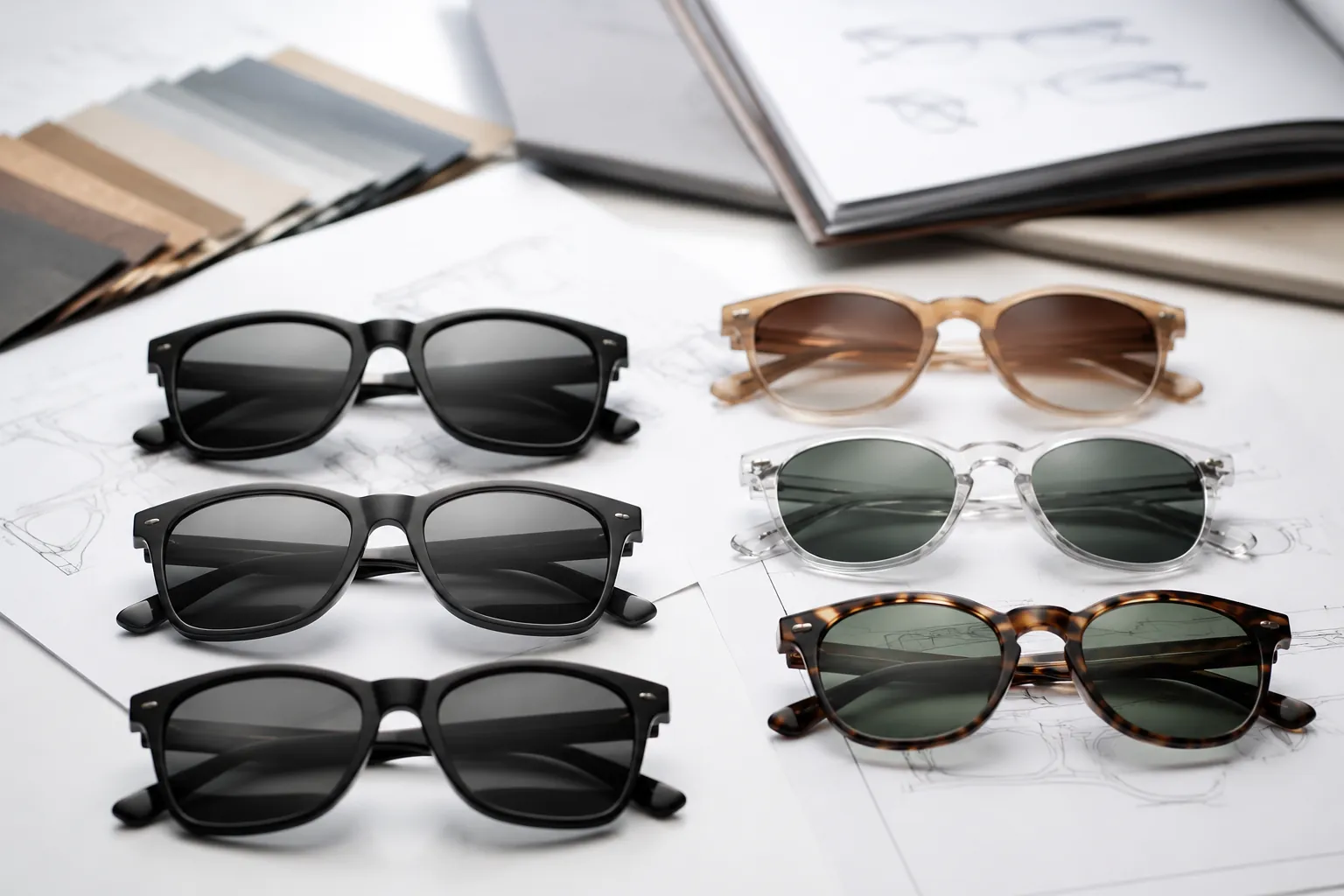
This guide is for brand owners, importers, distributors, promotional buyers, and retail teams choosing between private tooling and existing factory molds. Pick the wrong route and you can lose 6-12 weeks, tie up cash in tooling, or end up with a frame that looks too close to someone else's product. Use this as a practical filter before you ask LumiShades or any Wenzhou eyewear factory for a quote.
The real difference: OEM is your frame; ODM is a factory platform
Buyers often use OEM and ODM loosely. Factories do not. On the production floor, the difference is simple: who controls the frame geometry, who carries the development risk, and how much exclusivity you can claim.
OEM sunglasses usually mean the buyer owns the design direction and the factory produces to that requirement. This may involve a private injection mold, a custom acetate front, a special hinge seat, a unique temple profile, or a lens shape that is not in the factory library. OEM gives you more control over fit, silhouette, branding, and channel protection. It also adds tooling cost, development time, and more approval points.
ODM sunglasses use a factory's existing frame model, mold, or proven construction. You choose the model, frame color, lens tint, logo method, packaging, labeling, and sometimes small trim details. ODM is faster because the main engineering work is already tested: lens retention, temple closing, hinge alignment, shrinkage, and assembly flow.
ODM does not have to look cheap or generic. A ready mold with a strong translucent color, polarized lens, quiet temple logo, and good pouch can still feel retail-ready. The key question is blunt: must the silhouette be yours alone? If yes, look at OEM. If no, ODM often protects cash, lowers risk, and helps you meet the selling season.
Decision table: control, MOQ, speed, tooling, and unit cost
The table below shows typical planning logic for B2B eyewear orders. Exact pricing depends on material, lens category, coating, decoration, packaging, inspection level, and color split. The trade-offs stay fairly consistent.
| Factor | ODM ready mold | OEM modified design | OEM private tooling |
|---|---|---|---|
| Best fit | Fast launch, market test, promo program, resort order, retailer trial | Buyer likes an existing base but needs visible differentiation | Long-term product line, protected shape, signature brand style |
| Design control | Color, lens, logo, packaging, minor hardware choices | Temple decoration, trim, logo plate, small bridge or lens adjustments if tooling allows | Frame dimensions, lens groove, curvature, hinge seat, temple geometry, nose bridge, wall thickness |
| Typical MOQ logic | LumiShades can start from 50 pairs per design for selected ODM models | Usually 300-1,000+ pairs depending on changes and fixtures | Usually needs stronger volume commitment, often 3,000-10,000+ pairs over time to justify tooling |
| Sample lead time | 7-10 days for available models with basic customization | 10-20 days if fixtures, logos, or small structure checks are needed | 3-8 weeks for drawings, tooling, trial shots, corrections, and golden sample |
| Bulk lead time | 25-35 days after sample approval and deposit | 30-45 days if changes are stable | Longer first run; repeat orders may return to 30-45 days once tooling is proven |
| Unit cost behavior | Lowest at comparable specs because mold cost is already absorbed | Middle range due to setup, fixtures, and slower QC checks | Higher at low quantity; improves when annual volume is real |
| Exclusivity | Low unless restrictions are agreed in writing | Medium for modified visual details | Highest if tooling ownership, storage, use rights, and exclusivity terms are written clearly |
Use a simple rule. If the frame shape is not the main reason people buy the product, start with ODM. If the frame shape is the product, budget for OEM.
Private tooling: what buyers pay for besides the mold
Private tooling is not just cutting steel. It is the work of turning a drawing into a repeatable product that fits faces, holds lenses, passes inspection, and can be assembled thousands of times without a high reject rate.
Small errors get expensive fast. A 0.2-0.4 mm issue in lens groove depth can affect lens retention. A 1-2 degree change in temple angle can change how the frame sits on the face. Bridge width, pantoscopic angle, front curvature, and temple spread all affect comfort. Before bulk production, the factory should define tolerances for dimensions, color, logo position, hinge movement, lens fitting, and finish.
A proper OEM tooling process usually includes:
- Drawing or 3D file review. The factory checks lens base curve, bridge width, temple length, hinge position, wall thickness, and whether the proposed shape can be molded or cut reliably.
- Material planning. PC is economical and impact-resistant but can show stress marks if the design is poor. TR90 is lighter and more flexible but needs correct molding temperature and shrinkage allowance. Acetate is cut from sheet, tumbled, polished, and assembled with metal hinges, so its lead time and labor profile are different from injection.
- Tool design. Gate position, parting line, ejector marks, shrinkage, and polishing direction are set here. Bad choices show up on every pair.
- Trial shots or first cut samples. The factory checks warpage, surface quality, lens fitting, hinge alignment, temple closing, and opening-closing resistance.
- Correction loop. Steel-safe adjustments can fix minor problems, but not every defect can be corrected without remaking tooling parts.
- Golden sample approval. This physical sample becomes the reference for frame color, lens tint, logo, finish, assembly feel, packaging, and labeling.
LumiShades handles injection molding, acetate cutting, CNC milling, lens tinting, laser engraving, pad printing, metal logo plate application, assembly, and QC in-house. That shortens the feedback loop. If a lens does not fit, the issue does not have to pass through three vendors before someone finds the cause.
ODM customization: how to build a branded product without new tooling
ODM works best when the buyer treats the factory model as a platform, not a finished commodity. You may not own the shape, but you can still control the retail impression.
Common ODM choices include solid or transparent frame color, matte or gloss finish, rubberized coating, lens tint, gradient lens, mirror coating, polarized lens, UV400 lens, logo position, pouch, box, barcode label, hangtag, cleaning cloth, and retail insert card. Pick decoration based on material, durability, and the look you need.
- Laser engraving: clean and durable on many temples and lenses, but visibility depends on color and surface finish.
- Pad printing: useful for small logos and multi-color marks; needs ink adhesion testing, especially on coated surfaces.
- Metal logo plate: gives a premium look but adds component cost, assembly labor, and a possible snag point if poorly seated.
- Hot stamping or foil effects: useful for packaging and some temple details, but weak for high-rub areas.
- Lens logo printing: possible for fashion or promo use, but placement must not interfere with visual performance or market rules.
There are limits. Moving a hinge seat, changing bridge width, narrowing the lens groove, increasing frame wrap, or changing temple geometry can require tool modification or full private tooling. Buyers often ask for "just 2 mm less here." In eyewear, 2 mm is not always small. It can affect lens stability, face pressure, temple opening, and compliance measurements.
Color also needs discipline. A Pantone reference on paper will not look identical on translucent PC, acetate sheet, rubberized coating, and printed packaging. Approve physical color chips or sample parts, not screenshots. For lens tinting, review samples under daylight and indoor light. A brown gradient that looks good in an office may look too dark on a retail display.
MOQ and price logic: 50 pairs and 5,000 pairs are not the same business
LumiShades can support MOQ from 50 pairs per design on selected ODM models. That helps with market tests, influencer drops, resort shops, boutique retail, and event programs. But low MOQ does not mean best cost. Even a small order needs material preparation, lens cutting or tinting, logo fixture setup, packaging changeover, inspection, carton labeling, and packing.
Price usually improves at 300, 1,000, and 5,000+ pairs because fixed work spreads across more units and material buying becomes more efficient. On volume programs, pricing can move down to about $2.10 per pair depending on specifications. That is not a blanket price for every sunglass. Polarized lenses, category-specific lens requirements, mirror coating, thick acetate, metal trim, custom hinges, soft-touch coating, individual boxes, and multiple colorways can all raise cost.
Use this planning logic before asking for a quote:
- 50-299 pairs: good for validation, boutique retail, events, and design testing. Expect higher unit price, limited engineering changes, and fewer packaging options.
- 300-999 pairs: better for first commercial runs. More room to negotiate decoration, packaging, and lens upgrade costs.
- 1,000-4,999 pairs: practical for importers, distributors, and repeat retail programs. Color splitting must be controlled.
- 5,000+ pairs: meaningful cost improvement if specs are stable, packaging is not overcomplicated, and delivery can be scheduled efficiently.
Do not split one 1,000-pair order into ten colors of 100 pairs and expect the same price as one color. Every color adds setup, material control, QC comparison, packing complexity, and sometimes extra lens or coating work. If cost matters, cut color count before you cut quality.
Timeline planning: a fast sample is not a finished launch plan
For ODM projects using available molds, samples can usually be prepared in 7-10 days. Bulk production is commonly 25-35 days after sample approval, deposit, and final artwork. That is only the factory timeline. Buyers still need time for artwork approval, payment, compliance document review, pre-shipment inspection, freight booking, customs clearance, and inland delivery.
OEM private tooling stretches the first-order calendar. A buyer may spend 1-2 weeks finalizing drawings, then several weeks on tooling, first trial samples, corrections, surface finish checks, and golden sample approval. If the first tool trial shows lens popping, warped fronts, tight hinges, or poor temple closing, add correction time. Repeat orders are usually easier because the engineering risk has already been reduced.
A realistic buyer-side process looks like this:
- Send target market, order quantity, color split, material preference, lens category, packaging, logo files, target FOB price, and required ship date.
- Review factory model suggestions or confirm OEM drawings and 3D files.
- Approve quotation with Incoterms, MOQ, sample cost, tooling terms, packaging, logo method, and payment terms.
- Approve physical samples, not only photos or videos.
- Confirm compliance needs for the destination market before bulk production.
- Release production after deposit, final artwork, and written sample approval.
- Inspect against the approved golden sample, not against memory or catalog images.
The fastest projects are clear, not rushed. Vague tech packs slow sampling because the factory has to guess. Guesses become rework.
Compliance and inspection: the route changes, the obligations do not
Whether you choose OEM or ODM, sunglasses must be safe, correctly labeled, and suitable for the destination market. Compliance cannot be fixed at the end with a sticker.
LumiShades works with eyewear compliance requirements including CE EN ISO 12312-1, FDA registration, ANSI Z80.3, AS/NZS 1067, REACH, ISO 9001, and BSCI. Buyers need to match the actual product specification to the market. CE EN ISO 12312-1 applies to sunglasses for general use in many European programs. ANSI Z80.3 is relevant for non-prescription sunglasses in the United States. AS/NZS 1067 is used for Australia and New Zealand. REACH concerns restricted substances in materials, coatings, inks, and components. FDA registration is relevant in the U.S. eyewear import context.
Ask for test reports that match the actual product type, not only a factory certificate. A report for a black lens model does not automatically cover a new gradient lens, mirror coating, polarized lens, or different material mix. Lens category, visible light transmission, UV protection, optical quality, labeling, and warning text all matter.
Inspection should be practical. Typical checkpoints include frame color consistency, lens scratches, logo position, hinge smoothness, temple alignment, screw tightness, lens fitting, coating defects, packaging accuracy, barcode readability, and carton marks. For larger orders, define AQL levels and defect categories before production starts.
Buyer warning: If you change lens color, coating, material, or supplier after approval, treat compliance as a new check. The frame may be identical. Optical performance may not be.
Which route fits your buyer profile?
Different buyers need different routes. A fashion start-up testing three shapes should not act like a chain retailer with annual volume. A distributor serving multiple markets should not choose a frame only because it looks good in one catalog photo.
Choose ODM if you need fast samples, have limited budget, want to test demand, or can create brand value through color, lens, logo, and packaging. ODM also fits seasonal programs where missing the delivery window is worse than not owning the shape.
Choose OEM modified design if you like an existing base but need enough changes to reduce direct comparison. This can include a distinctive temple, adjusted trim, metal logo plate, custom lens tone, special coating, or retail-ready packaging set. It is the middle path: more differentiation, less tooling risk.
Choose OEM private tooling if you expect repeat orders, need a signature silhouette, sell through channels where copycat risk matters, or have technical requirements that ready molds cannot meet. Put tooling ownership, exclusivity, mold storage, mold maintenance, replacement responsibility, and use restrictions in the purchase agreement. Spoken promises are not enough.
Before requesting a quote, send a clean brief: target FOB price, quantity by color, target market, lens requirement, material preference, packaging, logo files, inspection standard, compliance requirement, and required ship date. With that information, LumiShades can recommend ODM, modified OEM, or private tooling. Without it, every quote is partly guesswork.
Have a custom sunglasses project in mind?
Send us your styles, target market and quantities and we will return a detailed quote with MOQ, lead time and a sample plan.
Get a QuoteWhy source this from Wenzhou with LumiShades
Wenzhou in Zhejiang Province is widely regarded as China’s eyewear manufacturing capital, producing a large share of the world’s sunglasses. That concentration matters to buyers: a deep local supply chain for acetate sheet, hinges, lens blanks, plating and packaging means shorter component lead times, easier color and material matching, and a workforce with decades of eyewear-specific skill. LumiShades has manufactured in this ecosystem since 2009, and our vertical integration — in-house injection molding, acetate cutting, CNC milling, lens tinting, decoration and quality control — means no part of your order is quietly subcontracted to a workshop you cannot audit.
For international buyers, that vertical control translates into accountability. When a single factory owns every step, defects are traced and fixed at source rather than bounced between vendors, and your specifications survive intact from first sample to bulk. We back this with 15+ years of experience, shipments to 60+ countries, more than 5 million pairs produced per year and a 98.5% on-time delivery rate. Our certifications — CE EN ISO 12312-1, FDA registration, ANSI Z80.3, AS/NZS 1067, REACH, ISO 9001 and BSCI audit — mean the compliance documentation your market requires already exists. Explore our manufacturing capabilities and quality control process to see how this works in practice.
Frequently asked questions
Can I start with ODM and later move to OEM private tooling? Yes. Many buyers test demand with a ready mold, then invest in private tooling after repeat sales are proven. Track sales by color, lens type, return reason, and channel so the OEM design is based on evidence, not taste alone.
Will a 50-pair MOQ get the same unit price as 5,000 pairs? No. Low MOQ carries more setup cost per unit. LumiShades pricing improves at 300, 1,000, and 5,000+ pairs, with volume pricing down to about $2.10 per pair depending on material, lens, decoration, packaging, and inspection requirements.
What should I approve before bulk production? Approve a physical golden sample covering frame color, lens tint, logo position, hinge feel, temple alignment, packaging, labeling, barcode, and fit. Photos help communication, but they do not replace a handled sample.
Do ODM sunglasses still need compliance testing? Yes. Ready molds do not remove compliance obligations. Check the correct standard for your market, such as CE EN ISO 12312-1, ANSI Z80.3, AS/NZS 1067, REACH, or FDA-related import requirements.
What changes usually force new tooling? Major changes to front shape, bridge width, lens groove, hinge seat, temple geometry, wall thickness, or frame wrap can require tool modification or private tooling. Color, logo, lens tint, and packaging usually do not.
How long should I plan for an ODM bulk order? For available models, plan 7-10 days for samples and 25-35 days for bulk production after approval. Add buyer-side time for artwork, payment, compliance review, inspection, freight booking, customs clearance, and inland delivery.
Ready to start?
Explore our wayfarer sunglasses or request a quote — our sales team replies within 12 hours.
Request a Quote