
Private Label Sunglasses MOQ Strategy for Retail Chains
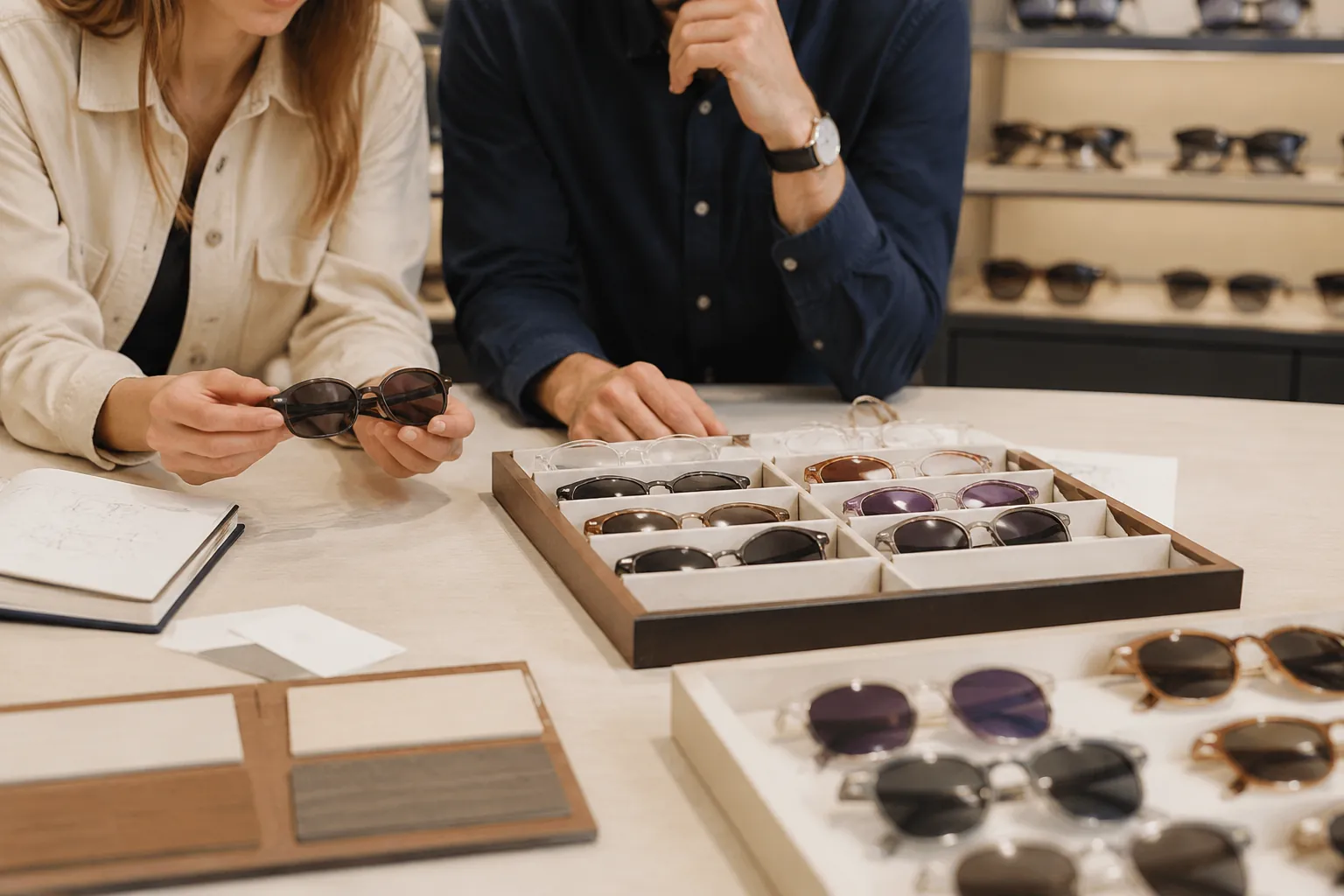
This guide is for regional retailers, importers, and small chain buyers planning a private label sunglasses line without locking cash into unproven stock. Start with a controlled test, such as 50 pairs per design or colorway where available. Keep the range tight. Measure sell-through. Then move proven items to 300, 1,000, or 5,000+ pair runs. The focus is practical buyer control: shelf capacity, SKU depth, existing molds versus new tooling, frame and lens materials, decoration, compliance files, QC checkpoints, and realistic lead-time planning.
Start With Shelf Capacity, Not Factory MOQ
The first ordering mistake is often simple: too many styles, too soon. A factory may offer dozens of shapes and colorways. That does not mean a small chain can sell or manage every SKU well.
Start with store math. If you operate 8 stores and each store has one rack holding 36 pairs, the first presentation is 288 pairs. Split that across 48 SKUs and each SKU averages only 6 pairs across the chain. That is too thin. You cannot read demand clearly, and replenishment becomes messy.
A better first buy is narrower and deeper. If the factory can support a 50-pair minimum per design or colorway, a retailer could launch 4 frame designs in 2 colorways each. That creates 8 SKUs and 400 total pairs. Each SKU has enough depth to show up in several stores, while the total order stays small enough to adjust after sales data comes in.
Treat color as inventory risk. Black, tortoise, brown, smoke, crystal, and matte dark finishes are usually easier to merchandise across broad retail channels. Bright mirror lenses and transparent fashion colors can work in beach, festival, ski, and tourist stores. But they should not dominate the opening buy unless you already have sales data for that customer.
Set the retail price band before sourcing. A $9.99 promotional sunglass, a $19.99 private label rack item, and a $39.99 acetate fashion frame should not carry the same construction, hinge, pouch, or inspection standard. MOQ planning only works when the specification matches the intended retail price and margin.
The MOQ Ladder: 50, 300, 1,000, and 5,000+ Pairs
MOQ is not just a factory rule. It is a risk-control and cost-control tool. At 50 pairs per design, the buyer is paying for flexibility and a small test. At 300 pairs, batching improves. At 1,000 pairs, component purchasing and production planning often become more efficient. At 5,000+ pairs, the factory can plan materials, packaging, inspection, and line time with more confidence. The buyer also carries much more inventory risk.
| Order level | Best use | Cost logic | Factory reality | Buyer decision |
|---|---|---|---|---|
| 50 pairs/design | Market test, new color, small seasonal capsule | Higher unit cost because setup, artwork handling, lens matching, and QC are spread across fewer pairs | Existing molds and standard components are usually preferred; custom mold cost is rarely justified | Use to learn sell-through, fit feedback, return reasons, and price acceptance |
| 300 pairs/design | First reorder after proof | Better batching for frame production, lens tinting, logo work, and packing | Color changes and decoration setup are more efficient than very small runs | Keep winners, remove weak colors, and adjust size and color ratios based on store data |
| 1,000 pairs/design | Core program across many stores | Improved purchasing leverage for lenses, hinges, pouches, cartons, printed materials, and labels | Production scheduling becomes more stable, but specifications must be locked earlier | Negotiate packaging format, logo method, inspection level, and reorder timing |
| 5,000+ pairs/design | Distributor volume, chain-wide promotion, annual basic SKU | Best chance for unit-cost improvement, subject to design, materials, lens type, packaging, compliance, and QC requirements | Forecast accuracy, carton planning, labels, and compliance documentation must be confirmed before production | Use only for proven repeat demand, not speculative fashion colors |
Do not jump from a small test to a large run just because the spreadsheet looks better. Sunglasses are seasonal, style-driven, and color-sensitive. A black square frame may become a reorder item. The same shape in clear pink may become markdown stock. Buy the evidence, not the hope.
Build a Tight SKU Architecture That Still Looks Complete
Fewer SKUs do not have to make a private label range look weak. The answer is controlled SKU architecture: enough choice for the shopper, not so much choice that every color is understocked.
Use a three-tier color plan. First, core colors such as black, tortoise, brown, smoke, and matte dark finishes. Second, controlled fashion colors such as crystal, champagne, translucent green, or navy. Third, local accents such as blue mirror, silver mirror, or gradient lenses for tourist or resort stores.
- Men's or unisex racks: black frame with gray lens, tortoise frame with brown lens, matte black sport frame with smoke lens.
- Women's fashion racks: black cat-eye, tortoise square, and one crystal or champagne option in a proven shape.
- Tourist stores: add one mirror lens option, but do not apply mirror lenses to every frame design unless sales history supports it.
- Optical-adjacent retailers: prioritize conservative lens colors, hinge feel, UV documentation, and clean fit over novelty colors.
- Promotional programs: use one or two shapes only, with simple branding and standardized packaging.
Color consolidation also helps production. In injection molding, changing frame color can require material-feed cleaning, color matching, and checks for shade drift between batches. In acetate, different sheet colors have different availability and cutting yield. Lens tinting adds another variable. Standard gray and brown lenses are usually easier to repeat than unusual gradients, flash mirrors, or very dark lenses.
Every variation must earn its space. Each added SKU creates more work: lens color matching, left-right lens consistency, logo positioning, assembly inspection, barcode control, carton labeling, and packing verification. A disciplined 6- to 10-SKU launch is usually easier to manage than a 20-SKU first order with no sell-through history.
Frame Materials, Molds, and Tolerances for First Runs
Material choice affects MOQ, price, lead time, quality perception, and compliance testing. For a first retail chain order, existing molds are usually the safest route. The buyer can often customize frame color, lens tint, temple logo, pouch, hang tag, barcode label, and carton label without paying for new tooling. New injection molds add development cost and approval time. Use them only after a shape has proved repeat demand or when a retailer needs a protected design.
| Material/process | Best use | MOQ impact | Technical watch-outs |
|---|---|---|---|
| Injection-molded PC/TR-style plastic | Affordable fashion, sport, and promotional sunglasses | Good for small tests when existing molds and standard components are used | Check parting lines, sink marks, color consistency, hinge seating, screw fit, and lens groove retention |
| Acetate cutting | Higher perceived value and thicker fashion frames | Better for fewer SKUs at a stronger retail price because material and finishing costs are higher | Sheet yield, polishing quality, temple adjustment, rivet or hinge setting, and front curvature are highly visible |
| Metal or combination frames | Aviators, rimless-look fashion, and higher price points | Often better after demand is known because components, plating, and fittings are more specific | Plating adhesion, solder points, screw torque, nose pad alignment, bridge symmetry, and lens shape tolerance matter |
| CNC or custom tooling adjustments | Refined custom bridge, temple, lens shape, or protected design detail | Best for proven SKUs moving toward larger repeat orders | Requires accurate drawings, fit samples, pre-production approval, and tighter change control |
Tolerance control matters. Temple opening angle, hinge tension, lens groove consistency, and front curvature decide whether the sunglass feels stable or cheap. Production checks should compare bulk goods against the approved sample, including lens seating, temple alignment, nose bridge symmetry, screw tightness, and whether the frame rocks on a flat surface.
Injection frames are not automatically cheap-looking. Poor finishing makes them cheap-looking. Inspect surface gloss, gate marks, hinge pin placement, and whether lenses move or pop out under light pressure. Acetate can support a higher retail ticket, but poor polishing, uneven temple adjustment, or warped fronts can damage the perceived value fast.
Lenses, UV Claims, and Decoration Methods
Shoppers judge private label sunglasses quickly. They notice lens appearance, logo execution, and packaging first. Do not overspend on decoration. Spend on consistency, accurate claims, and clean presentation.
For lenses, confirm the material, tint, visible light transmission category where applicable, UV performance, and whether the style is polarized or non-polarized. General retail sunglasses often use gray, smoke, brown, or green lenses because they are easy to merchandise and repeat. Polarized lenses can raise perceived value, but they add cost and must be labeled correctly. Store staff and customers should not confuse polarized and non-polarized SKUs.
Common decoration methods include laser engraving, pad printing, and metal logo plates. Each has a different role. Laser engraving can be clean and durable on suitable materials, but it may be subtle. Pad printing works for colored logos, but adhesion should be tested on the exact frame surface. Metal logo plates create a stronger branded look, but they add component handling, alignment checks, and glue or insertion-strength control.
- Laser engraving: best for understated logos on suitable temples; approve contrast on a physical sample.
- Pad printing: good for small logos and color branding; test rubbing, adhesion, and resistance to normal packing and handling.
- Metal logo plates: premium appearance; check left-right alignment, edge smoothness, and secure attachment.
- Lens sticker or removable mark: useful for UV400, polarized, or category communication; check for adhesive residue after removal.
- Packaging: standardize pouch, polybag, barcode, hang tag, warning text if required, country-of-origin label, and carton label before production starts.
Approve logo size on a physical temple sample. Always. A logo that looks balanced on a PDF may look too large on a narrow temple. Specify distance from hinge, vertical centerline, print color, finish, and acceptable placement variation. Late packaging changes can delay orders because barcode files, country-of-origin labels, warning text, retail hang tags, and carton marks affect receiving and compliance.
Compliance and QC for Regulated Products
Sunglasses are not generic accessories. They are consumer products with optical performance and chemical safety requirements that depend on the selling market. The specification sheet should state where the goods will be sold and which standards the importer requires. Do not rely on a loose "UV400" claim without test support tied to the relevant product, lens type, or production batch.
Common compliance references for non-prescription sunglasses include CE EN ISO 12312-1, ANSI Z80.3, AS/NZS 1067, REACH, FDA registration, ISO 9001, and BSCI. These documents do not mean the same thing. Some relate to product performance. Some cover restricted substances. Others relate to facility registration, management systems, or social compliance. Confirm which files are required by the importer of record, retailer, and selling country.
- EU: CE EN ISO 12312-1 is the key sunglass performance standard; REACH applies to restricted substances in frames, coatings, and components.
- United States: FDA registration and ANSI Z80.3 are commonly requested for non-prescription sunglasses, depending on importer and retailer requirements.
- Australia and New Zealand: AS/NZS 1067 applies to sunglass classification, labeling, and performance.
- Factory and social compliance files: ISO 9001 and BSCI may be requested by some buyers, but they do not replace product-level testing.
- Internal retail files: keep reports, artwork, labels, photos, specifications, and production batch references matched by SKU.
Define QC before bulk production. Typical checks include frame surface defects, lens scratches, lens color consistency, logo placement, hinge function, temple alignment, screw tightness, lens retention, pouch accuracy, barcode accuracy, carton labels, and assortment ratios. For retail chains, agree on an AQL inspection plan or a written final inspection checklist before the goods are packed.
Small MOQ orders still need discipline. A 50-pair test can become a larger reorder. If the first specification is loose, the larger reorder may repeat the same problem at greater financial and regulatory risk.
Sample, Bulk, and Seasonal Timing That Works
A realistic private label timeline has three clocks: sample approval, bulk production, and retail allocation. Typical sample timing for customized sunglasses is about 7 to 10 days when existing molds and available components are used. Bulk production is commonly planned at about 25 to 35 days after sample approval. Exact timing depends on order size, materials, decoration, packaging, compliance testing, and QC workload.
| Stage | Typical timing | Buyer action | Common delay |
|---|---|---|---|
| Spec confirmation | 1 to 3 days if information is complete | Confirm frame, lens, logo, packaging, barcode, country-of-origin marking, and required market standards | Missing label, warning text, barcode file, or compliance requirement |
| Pre-production sample | About 7 to 10 days for many existing-mold projects | Review the physical sample under store lighting and send written approval or clear revision notes | Changing lens color, logo size, frame color, or packaging after sampling |
| Bulk production | About 25 to 35 days after approval for many standard private label orders | Monitor schedule, artwork, material readiness, SKU ratios, and inspection plan | Late artwork, mixed assortment changes, component changes, or packaging revision |
| QC and shipment prep | Varies by order size and inspection method | Confirm inspection criteria, carton marks, packing list, shipping documents, and allocation ratios | Incorrect carton labels, unclear store allocation, or incomplete shipping documents |
Do not approve important orders from photos only. Check hinge tension, face fit, temple spread, lens darkness, logo placement, packaging, barcode readability, and hang tag position on a physical sample. Put the sample under store lighting. Some lenses look fine in factory light but too dark indoors, which can reduce rack conversion.
For seasonal retail, work backward from the in-store date. If sunglasses must be on racks by early May, sample approval in late April is usually too late. Freight, customs clearance, warehouse receiving, store distribution, and possible corrective action still need time. Many delays come from the buying process: late approvals, revised logos, unclear assortment ratios, and missing barcode files.
Reorder Rules: Scale Only the Winners
The first order should be built to create reorder data. Track sell-through by SKU, store type, region, and price point. Do not look only at total sales. A black square frame may sell across every store, while a transparent green version sells only in two tourist locations. Those need different reorder decisions.
Set rules before the first order ships. If a SKU sells through quickly across most stores with low returns, move it from a small test to 300 or 1,000 pairs. If it sells only in one region, reorder locally or keep it seasonal. If it needs markdowns to move, drop it. Do not reward weak SKUs with larger orders just because the unit price is lower.
- First test: use 50 pairs per design or colorway where available to prove shelf reaction and fit acceptance.
- First reorder: use about 300 pairs for SKUs with broad sell-through, acceptable margin, and low return rates.
- Core program: use about 1,000 pairs for shapes that repeat across seasons, regions, and store types.
- Large volume: use 5,000+ pairs only for proven promotions, distributor programs, or chain-wide basics with reliable demand.
Review return reasons before scaling. Look for loose hinges, lens popping, coating scratches, uncomfortable temple pressure, crooked frame fronts, missing labels, barcode errors, or complaints about lens darkness. Factory QC checks production against the approved specification. Retail return data shows how the product performs after real customer handling.
The best MOQ strategy is cautious at launch and firm after proof. Start narrow. Measure hard. Cut weak variants. Buy deeper only where sales data supports the risk.
Have a custom sunglasses project in mind?
Send us your styles, target market and quantities and we will return a detailed quote with MOQ, lead time and a sample plan.
Get a QuoteWhy source this from Wenzhou with LumiShades
Wenzhou in Zhejiang Province is widely regarded as China’s eyewear manufacturing capital, producing a large share of the world’s sunglasses. That concentration matters to buyers: a deep local supply chain for acetate sheet, hinges, lens blanks, plating and packaging means shorter component lead times, easier color and material matching, and a workforce with decades of eyewear-specific skill. LumiShades has manufactured in this ecosystem since 2009, and our vertical integration — in-house injection molding, acetate cutting, CNC milling, lens tinting, decoration and quality control — means no part of your order is quietly subcontracted to a workshop you cannot audit.
For international buyers, that vertical control translates into accountability. When a single factory owns every step, defects are traced and fixed at source rather than bounced between vendors, and your specifications survive intact from first sample to bulk. We back this with 15+ years of experience, shipments to 60+ countries, more than 5 million pairs produced per year and a 98.5% on-time delivery rate. Our certifications — CE EN ISO 12312-1, FDA registration, ANSI Z80.3, AS/NZS 1067, REACH, ISO 9001 and BSCI audit — mean the compliance documentation your market requires already exists. Explore our manufacturing capabilities and quality control process to see how this works in practice.
Frequently asked questions
Can a small retail chain really start with 50 pairs per design? Yes, if the supplier offers that MOQ and the project uses existing molds and practical customization. Treat 50 pairs as a market test, not a low-cost buy. Use it to confirm sell-through, fit feedback, lens preference, price acceptance, and return reasons before committing to larger quantities.
How many SKUs should we launch if we have 5 to 15 stores? A practical first range is usually 6 to 10 SKUs. For example, choose 3 to 5 frame designs and give each 1 or 2 colorways. That creates enough variety for the rack while keeping inventory deep enough to read sales by SKU. Avoid launching so many colors that each store receives only one or two pieces per SKU.
When should we move from 50 pairs to 300 or 1,000 pairs? Move to about 300 pairs when a SKU sells across multiple stores without heavy markdowns, has low returns, and fits the target margin. Move to about 1,000 pairs only when the style is a repeatable core item with proven demand across store types or seasons. Do not scale a colorway just because the same frame shape performed well in another color.
What compliance documents should we ask for before ordering? Ask based on the selling market. For the EU, request CE EN ISO 12312-1 support and REACH information. For the United States, ask about FDA registration and ANSI Z80.3 documentation. For Australia and New Zealand, ask for AS/NZS 1067 documentation. Also confirm whether your retailer requires ISO 9001 or BSCI factory files. Match reports, labels, product photos, and SKU descriptions to the actual product being ordered.
How long should we plan from sample request to bulk shipment? For many existing-mold private label projects, samples take about 7 to 10 days after the specification is clear. Bulk production is commonly planned at about 25 to 35 days after written sample approval. Add time for artwork confirmation, compliance review or testing if needed, final inspection, freight booking, customs clearance, warehouse receiving, and store distribution.
Should we create a new mold for our first private label sunglasses order? Usually no. Start with existing molds and customize lower-risk elements such as frame color, lens tint, temple logo, pouch, hang tag, barcode label, and carton label. Consider new tooling only when you have proven sales volume, a clear design reason, and enough reorder potential to justify the cost and development time.
What should be included in the purchase specification? List the frame model or mold reference, material, frame color, lens material, lens tint, UV or polarized claim, logo method, logo position, packaging, barcode, country-of-origin marking, carton assortment, target market, required compliance documents, approved sample reference, inspection checklist, and acceptable defect limits. A complete specification prevents disputes when the order scales.
What data should we collect after the first launch? Track sell-through by SKU, store, region, price point, and week. Record markdowns, returns, customer complaints, broken parts, fit issues, and replenishment requests. Separate frame-shape performance from colorway performance. Use that data to cut weak SKUs, reorder proven colors, and decide whether the next buy should be 300, 1,000, or larger.
Ready to start?
Explore our wayfarer sunglasses or request a quote — our sales team replies within 12 hours.
Request a Quote