
OEM vs ODM Sunglasses: MOQ, Tooling, Timeline
This guide is for overseas brands, importers, distributors, promotional buyers, and retailers choosing how much to customize a sunglasses program. It compares ready-made ODM, modified ODM, and full OEM using the factors that actually affect buying decisions: MOQ, tooling cost, sample time, frame tolerance, lens specification, compliance, decoration, packaging, and brand control. Use it to decide when an existing frame is enough, when modified ODM is the better route, and when a proprietary OEM mold is worth the spend.
The Short Rule: Speed, Control, or Ownership
Most sunglasses programs fit one of three paths. ODM uses an existing factory frame design and an existing production setup. Modified ODM keeps the base frame or mold but changes selected details such as frame color, lens tint, logo, temple print, hinge finish, pouch, case, barcode label, or retail box. OEM means the frame shape, dimensions, tooling, and often the lens profile are developed for your brand.
The right path usually becomes obvious once you compare quantity, launch date, budget, and risk. Need a festival drop, distributor sample range, corporate gift, marketplace test, or seasonal retail launch? ODM is usually the lowest-risk start. Already have customers and want a more distinct private-label range without mold investment? Modified ODM often fits best. If the frame geometry itself is part of the brand, choose OEM. Plan for tooling cost, sampling rounds, fit corrections, and engineering review. Do not skip them.
Practical rule: do not open a new mold for a 100-200 pair test unless the shape cannot be made from an existing frame and the business case is clear. For early validation, money is usually better spent on lenses, decoration quality, packaging, product photos, compliance checks, and inspection.
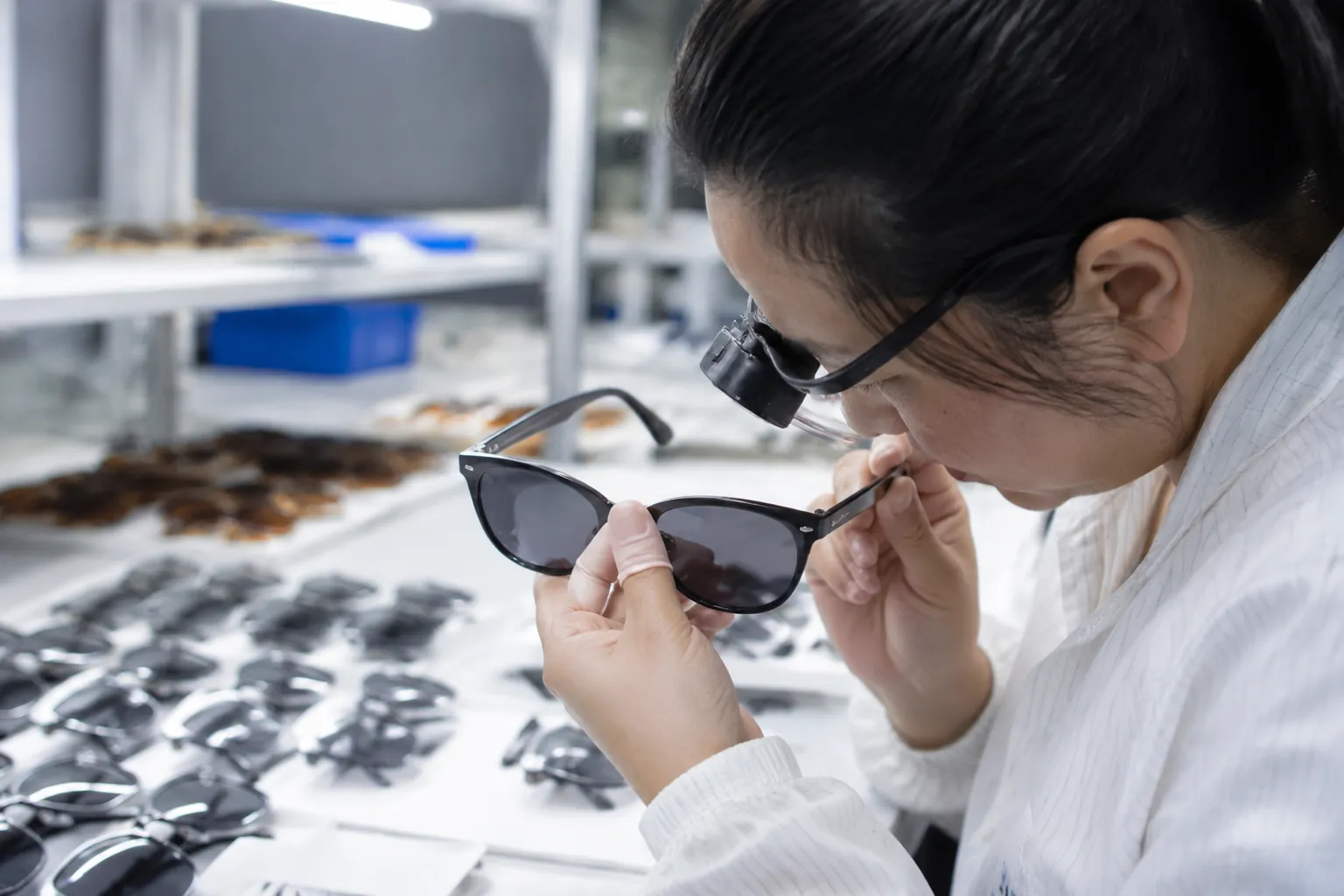
LumiShades supports ODM, modified ODM, and OEM sunglasses programs in Wenzhou. That includes frame production, lens tinting or fitting, decoration, assembly, packaging, and QC checks. The useful part is not just capacity. It is catching small issues early: logo position, hinge feel, lens seating, color match, package fit, and carton labeling before bulk shipment.
ODM, Modified ODM, and OEM Side by Side
The table below is a planning tool. Exact price and lead time depend on frame material, lens specification, hinge type, decoration method, packaging, inspection level, destination market, and order quantity. Use the figures as buying ranges. Confirm them in RFQ.
| Path | Best Use | MOQ and Price Logic | Sample Time | Bulk Lead Time | Brand Control |
|---|---|---|---|---|---|
| Ready-made ODM | Fast launch, promotional gifts, seasonal colors, distributor catalog, marketplace test | LumiShades MOQ starts from 50 pairs per design for selected ODM options. Unit price improves at higher volume because setup, material purchasing, decoration, inspection, and packing costs are spread across more units. | Typically 7-10 days when the frame, lens option, decoration method, and packaging are available. | Often 25-35 days after sample approval and deposit, subject to quantity, component availability, decoration workload, and inspection schedule. | Low to medium: color, lens option, logo, pouch, box, label, and basic packaging changes. |
| Modified ODM | Private-label retail range with controlled development cost | Usually more efficient from 300-1000 pairs per style when changes do not require new tooling. Exact MOQ depends on color, lens, decoration, and packaging suppliers. | Typically 7-15 days. Add time for custom lens tint, mirror coating, plating, physical color matching, or special packaging. | Often 25-40 days depending on decoration load, component confirmation, packaging approval, and QC requirements. | Medium: stronger color story, temple print, logo plate, special lens treatment, branded pouch, retail box, hang tag, and barcode control. |
| Full OEM | Proprietary frame shape, sport geometry, long-term collection, brand-owned visual language | Best justified when repeat orders are expected. Mold, engineering, sampling, and correction costs should be spread across meaningful volume, often 1000-5000+ pairs or multiple shipments depending on mold complexity. | Usually multiple sampling rounds. Each correction can add days or weeks depending on whether the change affects tooling, fit, lens seating, or decoration. | Longer than ODM because design review, tooling, mold trial, fit correction, lens confirmation, and final sample approval happen before bulk production. | High: own frame geometry, own fit, own visual language, and better control over product differentiation. |
Volume changes unit price because many costs happen before the first finished pair ships. Even a small run may need artwork review, color confirmation, lens cutting or sourcing, logo setup, packing instructions, inspection, and export handling. At 300 pairs, setup cost spreads better. At 1000 and 5000+ pairs, material purchasing, line planning, and QC handling usually become more efficient. If target price matters, define the exact material, lens category, decoration, packaging, compliance expectation, and Incoterm before comparing suppliers.
Cost Drivers Buyers Often Miss
Frame mold cost is only one part of OEM sunglasses development. Buyers also pay in time, sample revisions, inspection hours, engineering attention, and component control. A simple injected plastic frame is not comparable with a multi-part acetate frame using metal hinges, logo plates, gradient lenses, and rigid retail packaging.
- Frame material: PC and other injection materials suit many promotional, fashion, and volume programs. They are efficient for repeatable shapes, but the mold strongly controls the final geometry. Acetate has a richer retail feel and color depth, but cutting, tumbling, polishing, heat forming, and hinge insertion add labor and process variation.
- Lens specification: Solid tint is usually simpler than gradient tint. Mirror coating adds surface-control risk. Polarized lenses require correct axis alignment; inconsistent axis direction can affect performance and create customer complaints.
- Lens category: Lens category and visible light transmission must match the intended use and destination-market labeling rules. Changing tint, mirror coating, or lens supplier after testing may require re-checking compliance.
- Hinge choice: Standard hinges keep cost and complexity down. Spring hinges can improve comfort but add parts, movement checks, screw-retention checks, and potential repair issues.
- Decoration: Laser engraving is clean and durable for many logos. Pad printing is cost-effective for color marks but needs adhesion checks. Heat transfer can work for larger graphics. Metal logo plates look premium but require secure fixing and edge control.
- Packaging: A polybag or microfiber pouch is light and economical. A rigid case improves presentation but increases carton volume, freight cost, and risk of cosmetic damage if packing is weak.
A quotation that looks higher may include details another quotation ignored. Ask each supplier to state frame material, lens type, lens category, logo method, packaging, testing assumption, Incoterm, sample charges, mold charges, and whether packaging artwork or barcode application is included. If those lines are missing, the quote is not comparable yet.
Timeline Reality: Where the Days Actually Go
For ODM, the fast path is simple. Select an existing style, confirm frame material and color, choose the lens option, place logo artwork, review a sample, then approve bulk production. LumiShades typically samples selected ODM projects in 7-10 days when standard components and decoration methods are available. Bulk production is commonly quoted at 25-35 days after sample approval and deposit. Final timing still depends on order size, decoration workload, material availability, packaging approval, and inspection requirements.
OEM takes longer because the first sample is rarely the final product. A frame can look right in a rendering and still feel wrong on the face. Bridge width, pantoscopic angle, temple pressure, hinge stop, lens base curve, lens groove depth, and lens seating all affect fit and durability. Small things matter.
- Confirm target customer, frame size, reference market, material, lens category, destination market, and benchmark samples.
- Create or review a technical drawing or 3D file with lens width, bridge, temple length, front height, frame width, lens base curve, and temple opening angle.
- Review manufacturability, including wall thickness, screw boss position, hinge area strength, lens groove depth, injection gate location, logo placement, and decoration area.
- Open or adjust tooling, then run first mold trials or CNC samples depending on the material and construction.
- Check fit, symmetry, color, lens retention, hinge movement, logo position, coating quality, packaging fit, and required labeling.
- Correct tooling or process if needed. This step often extends OEM schedules.
- Approve a signed or sealed reference sample, lock the bill of materials, and start bulk production.
If a delivery date is fixed, count backward from warehouse arrival, not only the factory completion date. Add time for pre-shipment inspection, export documents, freight booking, international transit, customs clearance, and distribution to retail, distributor, or marketplace channels.
Tolerances, Fit, and Material Behavior
Sunglasses are small products. Small errors still show up. In injection frames, uncontrolled cooling can create front warping, temple twist, sink marks, or lens groove distortion. In acetate frames, polishing and heat forming can shift dimensions if the process is not controlled.
A buyer does not need to define every production tolerance alone, but critical areas must be agreed before bulk production. Around the lens groove, small dimensional differences can matter. Too loose, and the lens may move or pop out under flex. Too tight, and the lens can show stress marks, coating damage, or optical distortion. Temple alignment also matters. If one temple sits higher or opens differently, the frame can feel crooked even when the front looks fine on a table.
Material choice affects risk. PC and similar injection materials are efficient for bright colors, transparent frames, and volume programs. Flexible materials may suit sport and active styles when comfort and resilience matter. Acetate gives depth, layered color, and a heavier hand feel, but it requires more manual process control. Metal components add plating, soldering or fixing, screw, and nose-pad checks.
For OEM, ask the factory to confirm both dimensions and functional checks: lens retention, temple opening and closing smoothness, screw tightness, bridge comfort, frame balance, coating adhesion, logo adhesion, and heat resistance where relevant. A good-looking sample is not enough if the bulk run cannot hold the same fit and function.
Compliance Is a Product Requirement
Sunglasses compliance depends on destination market, product construction, lens category, labeling, and the exact frame-and-lens combination. Define the market before sample approval. Changing the lens tint, mirror coating, polarized lens source, lens category, or decorated component after testing may require a new review.
Common references include CE EN ISO 12312-1 for the European market, ANSI Z80.3 for the United States, AS/NZS 1067 for Australia and New Zealand, REACH for chemical restrictions where applicable, FDA registration where relevant to U.S. import requirements, and factory-level management or social compliance references such as ISO 9001 and BSCI. Check that any certificate, declaration, or test report matches the actual product, lens, material, and supplier being used.
| Market or Requirement | What Buyers Should Check | Common Mistake |
|---|---|---|
| European Union | CE EN ISO 12312-1, UV protection, lens category, labeling, traceability, and Declaration of Conformity. | Using CE artwork or claims without confirming the tested frame and lens combination. |
| United States | FDA registration where applicable for the supplier/import pathway and ANSI Z80.3 performance expectations for non-prescription sunglasses. | Assuming low-price fashion sunglasses need no documentation or product performance review. |
| Australia and New Zealand | AS/NZS 1067, correct lens category marking, warnings, and driving suitability statements where relevant. | Selling very dark or special-purpose lenses without checking category and use limitations. |
| Chemical control | REACH where applicable, especially coatings, paints, nose pads, soft-touch finishes, logo decoration, and packaging inks. | Testing only the base frame material and ignoring decorated, coated, or soft components. |
For polarized sunglasses, check axis consistency from piece to piece. For children's eyewear, be stricter on small parts, sharp edges, material declarations, and impact-related expectations. Review documentation before shipment, not after customs, a retailer, or a marketplace asks for it.
Decoration, Packaging, and RFQ Checklist
Many buyers assume brand value requires a custom mold. Often it does not. Good decoration and packaging can make an ODM frame look retail-ready without the cost and schedule of OEM tooling.
Common logo methods include laser engraving, pad printing, silk printing, heat transfer, metal logo plates, and embossed packaging. Laser engraving is durable and clean on many temples, but it may be subtle on dark or transparent materials. Pad printing gives color but needs adhesion checks, especially on coated or curved surfaces. Metal plates look premium but need controlled edge finishing and reliable fixing so they do not lift after heat, sweat, or flexing.
Packaging should match the sales channel. Promotional programs may only need a polybag, microfiber pouch, and barcode sticker. Retail programs often need a pouch, cleaning cloth, instruction card, hang tag, paper box, or rigid case. E-commerce programs should consider crush resistance, inner packing, carton strength, and barcode readability. A premium case is not helpful if it arrives dented or unscannable.
Before bulk production, approve a complete branded sample, not only the frame. Check logo scale, print position, color match, pouch stitching, barcode readability, box fit, carton mark, warnings, lens category marking, and any market-specific labeling. These details often decide whether a private-label program looks finished or rushed.
Use this decision framework before requesting quotations:
- Under 300 pairs per style: start with ODM unless there is a strong commercial reason for tooling. Use available frames, choose existing or easy-to-produce color and lens options, add a logo by laser engraving or pad printing, and keep packaging simple.
- 300-1000 pairs per style: modified ODM is often the best balance. Consider custom temple printing, a branded metal plate, selected lens tint, and retail packaging if those details support the sales channel.
- 1000-5000+ pairs with repeat orders: evaluate OEM if the shape will be reused. Mold cost and engineering effort make more sense when spread across multiple shipments or a long-term collection.
- Fit or geometry is the product claim: choose OEM earlier. Sport wrap frames, oversized fronts, unique bridges, performance fits, and proprietary silhouettes often need proper engineering.
- Brand difference is mostly color and packaging: do not pay for a new mold first. Put budget into better lenses, cleaner logo work, packaging, photography, compliance review, and QC.
Send one RFQ document with the development path, quantity per design, expected repeat volume, target FOB or landed price, frame material, lens type, lens category, destination market, logo method, packaging, Pantone or physical color references, barcode requirements, inspection level, and any special tests required before shipment. For selected ODM and modified ODM projects, LumiShades typically samples in 7-10 days when standard components and decoration methods are available, with bulk production often 25-35 days after approval. MOQ starts at 50 pairs per design for selected ODM programs. For OEM, send drawings, 3D files, or physical references early and expect engineering discussion before a final quotation.
Have a custom sunglasses project in mind?
Send us your styles, target market and quantities and we will return a detailed quote with MOQ, lead time and a sample plan.
Get a QuoteWhy source this from Wenzhou with LumiShades
Wenzhou in Zhejiang Province is widely regarded as China’s eyewear manufacturing capital, producing a large share of the world’s sunglasses. That concentration matters to buyers: a deep local supply chain for acetate sheet, hinges, lens blanks, plating and packaging means shorter component lead times, easier color and material matching, and a workforce with decades of eyewear-specific skill. LumiShades has manufactured in this ecosystem since 2009, and our vertical integration — in-house injection molding, acetate cutting, CNC milling, lens tinting, decoration and quality control — means no part of your order is quietly subcontracted to a workshop you cannot audit.
For international buyers, that vertical control translates into accountability. When a single factory owns every step, defects are traced and fixed at source rather than bounced between vendors, and your specifications survive intact from first sample to bulk. We back this with 15+ years of experience, shipments to 60+ countries, more than 5 million pairs produced per year and a 98.5% on-time delivery rate. Our certifications — CE EN ISO 12312-1, FDA registration, ANSI Z80.3, AS/NZS 1067, REACH, ISO 9001 and BSCI audit — mean the compliance documentation your market requires already exists. Explore our manufacturing capabilities and quality control process to see how this works in practice.
Frequently asked questions
Should I choose OEM sunglasses if I only need 100 pairs? Usually no. At 100 pairs, ODM or modified ODM is normally safer because tooling, engineering, sampling, and corrections can make the real unit cost very high. Choose OEM at this quantity only if the frame shape is commercially essential, legally protected, or tied to a confirmed larger program. If you are testing demand, use an existing frame, approve a branded sample, and spend budget on lens quality, logo execution, packaging, photography, and inspection.
Can I use an ODM frame and still make it look like my brand? Yes. A buyer can often build a credible private-label range by changing frame color, lens tint, logo method, temple decoration, pouch, case, hang tag, barcode label, instruction card, and retail box. Before bulk production, approve a complete branded sample and check logo position, color match, lens category marking, barcode readability, packaging fit, and carton marks. That gives stronger brand control without opening a new mold.
What is a realistic sample timeline for custom sunglasses? For selected existing ODM styles with available frame and lens options, standard samples are typically 7-10 days. Modified ODM may take 7-15 days or longer if it involves custom lens tint, mirror coating, plating, special decoration, physical color matching, or custom packaging. Full OEM should be planned in rounds: design review, tooling or CNC sample, fit correction, lens seating check, decoration approval, and final reference sample. Each tooling or fit correction can extend the schedule.
Which compliance documents should I ask for? Ask based on destination market and product specification. For the EU, request CE EN ISO 12312-1 support, UV protection information, lens category, labeling details, traceability, and Declaration of Conformity. For the US, review FDA registration where relevant and ANSI Z80.3 expectations. For Australia/New Zealand, check AS/NZS 1067, lens category marking, warnings, and driving suitability. For chemical control, request REACH information where applicable. Make sure documents match the actual frame, lens, decoration, and supplier, not just a similar style.
At what quantity does OEM start to make financial sense? OEM becomes easier to justify when the design will be repeated and the mold or engineering cost can be spread across meaningful volume, often 1000-5000+ pairs or multiple shipments depending on complexity. If it is a one-time small run, modified ODM is usually lower risk. Ask the supplier to separate mold cost, sample cost, unit price, packaging cost, testing cost, and lead time so you can calculate the true landed cost.
What details affect price the most besides quantity? The biggest price drivers are frame material, lens type, lens category, hinge choice, decoration method, packaging, compliance testing, inspection requirements, and Incoterm. Polarized lenses, mirror coatings, gradient tints, metal logo plates, acetate polishing, spring hinges, custom packaging, and rigid cases usually add cost. To compare quotes fairly, give each supplier the same specification and ask them to state what is included and excluded.
Ready to start?
Explore our rimless sunglasses or request a quote — our sales team replies within 12 hours.
Request a Quote