
TAC vs PC vs Nylon Polarized Lenses by Price Band
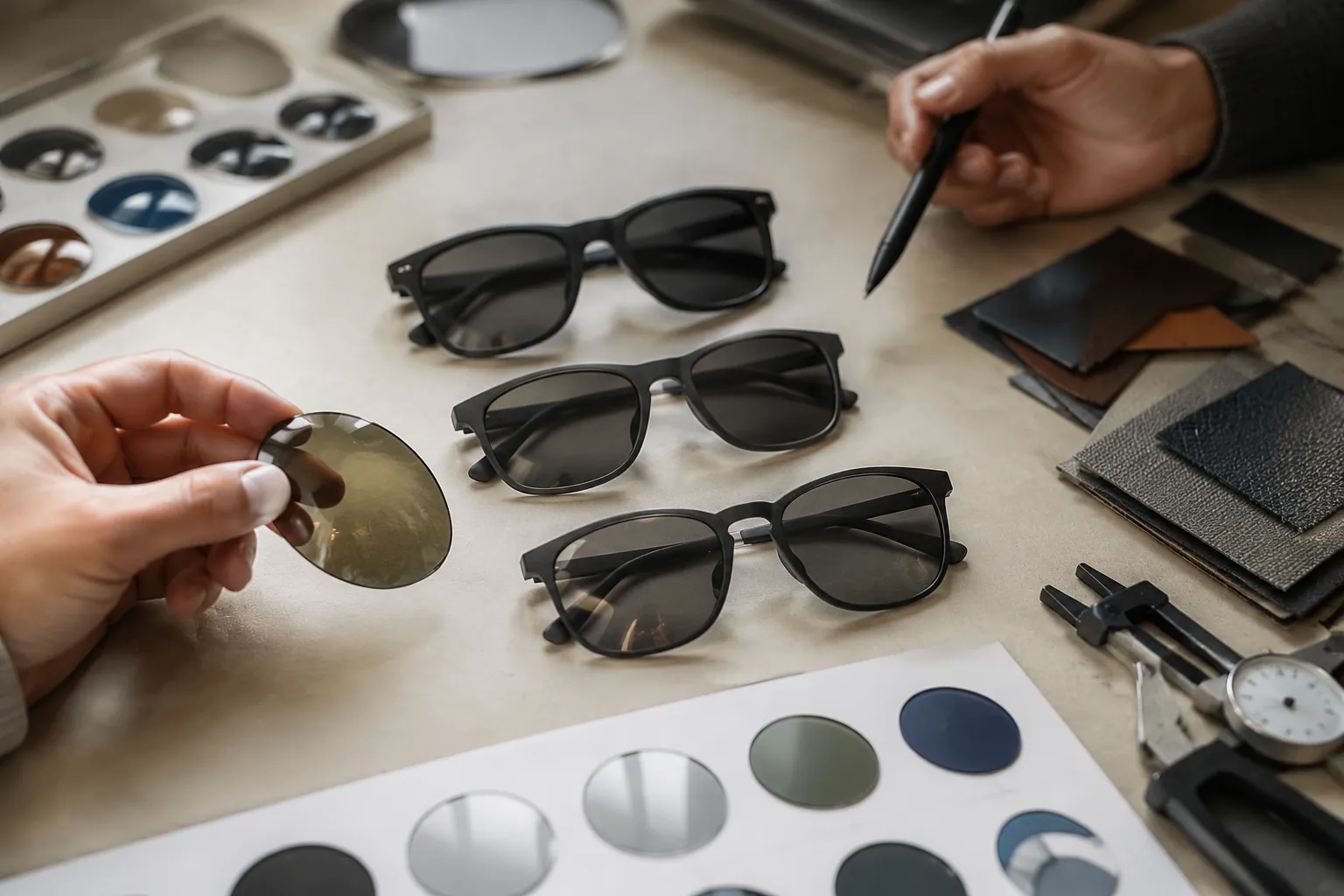
This guide is for brand owners, importers, distributors, and retail buyers sourcing custom polarized sunglasses at volume. The real decision is not whether to use a polarized lens. It is which polarized lens material fits the target price band, use case, product position, compliance path, and production setup. TAC, PC, and nylon can all work in polarized sunglasses, but they behave differently in optics, edging, coating performance, mounting tolerance, and durability. Choose only by unit cost and you can pay more later through sample revisions, failed testing, production yield loss, or returns tied to scratching, distortion, lamination issues, or inconsistent frame-to-lens fit.
Start with the retail position, not the lens spec
Many sourcing mistakes start in the wrong order. The buyer asks for a polarized lens first and defines the retail position later. That is backwards.
Lens material should follow the commercial brief. First set the retail slot, intended use, and acceptable quality risk. Then choose the lens build.
An entry-price fashion program has a very different cost structure and risk tolerance from a sport or outdoor program sold on clarity, comfort, and wrapped coverage. The same goes for claims. A buyer supplying promotions, chain retail, or low-ticket private label may accept a narrower performance window than a buyer building a premium performance story.
For sourcing, most custom polarized programs fall into three broad bands. Entry-level programs usually put cost control first and aim for acceptable appearance. Mid-market programs need cleaner cosmetics, more consistent lens matching, and fewer visible defects. Premium sport and outdoor programs usually demand better stability in wrapped frames, tighter optical control, and stronger resistance to handling and environmental stress.
- Entry retail: control ex-factory price first, then protect against visible or repeatable failures such as poor edge finish, color mismatch, and weak surface performance.
- Mid retail: balance optics, cosmetics, coating quality, and return risk.
- Performance retail: prioritize stable optics, wrapped-frame suitability, and long-term user satisfaction over the lowest initial lens quote.
As a rule, TAC enters the conversation first for cost-sensitive fashion sunwear. PC matters more when rough handling or impact resistance is the issue. Nylon becomes the stronger option when the product is built around sport, wrap geometry, lightweight wear, and a premium optical story.
Material differences that matter in production
TAC, PC, and nylon are not interchangeable just because all three can be polarized. They behave differently in lens construction, coating performance, edge finishing, mounting, and optical control.
TAC usually refers to a laminated polarized lens structure. Its commercial advantage is simple: it is widely used, broadly available, and often cost-effective for fashion and casual sunwear. The main production risks sit in lamination quality, edge finishing, and heat stability. If trimming, polishing, or bonding control is weak, buyers may see edge whitening, bubbling, separation, or warp after storage or transport stress.
PC, or polycarbonate, is often chosen for impact resistance and lower breakage risk in active or youth-oriented programs. That makes it relevant for kids' sunglasses, active casual styles, and some safety-focused assortments. The trade-off is control. Optical performance and surface durability depend heavily on processing quality. In wrapped shapes or weak production setups, PC can show stress patterns or more obvious distortion. Scratch performance also depends on hard-coat quality.
Nylon is common in higher-performance sunwear because it is light and generally better suited to wrapped sport geometries. It is often selected when the brief calls for a better balance of comfort, optics, and shape stability. The trade-off is cost and process sensitivity. Small problems in curvature, tint variation, or mounting control are easier to spot in premium products. They are also harder to excuse.
These differences show up fast on the factory floor. TAC needs disciplined edge handling and lamination control. PC needs strong coating control and careful management of optical stress. Nylon needs tighter consistency in curve, tint, and fit, especially in wrapped frames. Material matters. Process control matters just as much.
Quick comparison: where each lens material fits
| Lens material | Typical ex-factory fit | Main strengths | Main risks | Best use case |
|---|---|---|---|---|
| TAC | Entry to mid-price polarized programs | Competitive cost, good cosmetic appearance, commercially practical polarization | Lamination failure, edge peel, lower tolerance to heat and rough abuse than performance-focused materials | Fashion sunwear, casual lifestyle frames, price-sensitive private label |
| PC | Entry to mid-price active programs | Impact resistance, lower breakage risk, useful for youth and rough handling | Scratch performance depends on coating quality, distortion risk if processing is weak | Kids, promotional, active casual, safety-minded assortments |
| Nylon | Mid to premium performance programs | Lightweight feel, better suitability for wrapped frames, strong shape stability | Higher cost, tighter process control, higher rejection risk if tolerances drift | Sport, cycling, fishing, outdoor, performance-driven retail |
Read this table as a buying tool, not a ranking. TAC is not a poor choice if the brief is entry-price polarized fashion with a simple lens shape and a hard cost ceiling. PC is often the practical choice when breakage risk matters more than top-tier optics. Nylon usually makes sense when the end customer is likely to notice lens performance and when the retail position can absorb the extra material and process cost.
Frame geometry narrows the choice quickly. Flatter fashion frames are more forgiving across all three materials. Wrapped sport frames are not. As wrap increases, optical control, mounting tolerance, and shape retention become more important, and weak processing becomes easier to see.
Decision framework by price band and customer expectation
Use this as a sourcing shortcut.
- Entry-level polarized retail: start with TAC unless the product is meant for unusually rough use. Keep frame geometry simple and require sample checks for lamination quality, edge finish, basic scratch performance, and left-right cosmetic consistency.
- Affordable sport or rough-use casual: compare TAC and PC in the same frame where possible. If past returns come from dropped eyewear, cracked lenses, or rough handling, PC often gives a safer durability profile. If complaints tend to involve haze, visual discomfort, or lens mismatch, focus the comparison more heavily on optics and coating quality.
- Performance or premium outdoor retail: evaluate nylon early, especially if the design uses wrap or the product story depends on comfort, clarity, and premium perceived quality. In this segment, saving a small amount on lens cost is often less important than avoiding optical complaints or a weak performance impression.
Volume changes the math, but it should not override fit-for-use material selection. On larger orders, compare more than unit price. Review approval speed, yield risk, rejection exposure, and the cost of claims or rework. A cheaper lens can become the expensive option if it slows approvals, reduces production consistency, or drives avoidable returns.
In plain terms, TAC usually serves the cost-first discussion, PC serves the rough-handling discussion, and nylon serves the performance discussion. Trouble starts when one material is expected to do all three jobs equally well.
Failure modes buyers should check before approving samples
Experienced buyers cut risk at the sample stage. They check the failure points most likely to show up later in bulk production.
- TAC: inspect the edge under light for peel lines, bubbles, whitening, chips, or uneven lamination. Ask whether the sample has been checked after heat exposure or storage simulation, because weak bond lines often show up after temperature stress.
- PC: inspect the hard coat for surface durability, look for stress marks after edging or mounting, and compare left and right lens clarity side by side. If the frame has noticeable wrap, assess the lenses while worn as well as on the bench.
- Nylon: inspect lens curvature consistency, mounting fit, and color uniformity across more than one sample pair. In wrapped frames, compare left-right symmetry carefully because asymmetry becomes visible fast.
- All materials: verify polarization alignment, visible distortion, lens thickness consistency, UV performance documentation, and frame-lens fit after assembly.
Ask the supplier to define acceptance points in writing before bulk approval. Useful checkpoints include acceptable edge finish, left-right color consistency, visible scratch standard after normal handling, fit stability after assembly, and whether any rework is allowed after final lens mounting.
A golden sample helps only if it clearly represents the approved build. If the lens material, tint, coating, or frame fit changes later, treat that as a new validation step. Do not assume the first sample still applies.
Compliance is not optional, and lens choice affects testing risk
Polarized sunglasses must meet the rules of the destination market. The commercial point is simple: a product that passed with one lens construction does not automatically pass after a material, tint, coating, or frame-fit change.
Relevant standards and certifications commonly referenced in this category include CE EN ISO 12312-1, ANSI Z80.3, AS/NZS 1067, REACH, FDA registration, ISO 9001, and BSCI. Buyers should request documentation that matches the actual product configuration, not just a general factory profile. This matters when switching between TAC, PC, and nylon because material choice can affect transmittance, optical quality, impact-related behavior, and coating performance.
A TAC lens in one frame should not be treated as equivalent to a PC or nylon lens in the same frame. Differences in thickness, curvature, coating system, and mounting stress can affect test results and commercial reliability. If the program targets the EU, US, Australia, or New Zealand, build compliance review into the approval schedule from the start.
Decoration and packaging do not usually change core lens performance, but they can still affect lead time and approval flow. Stabilize the lens and frame specification first. Then finalize branding and packaging around an already approved build.
How MOQ, lead time, and decoration affect the lens decision
Lens choice does not sit on its own. It interacts with quantity, frame material, branding method, and production sequence.
In many OEM and private-label programs, sample development, bulk lead time, and minimum order quantity change how practical a lens option is. A straightforward TAC fashion style with standard tint and simple branding is usually easier to sample and scale than a wrapped nylon sport style with tighter curvature control and more demanding assembly tolerance. That does not make TAC better. It makes TAC the lower-risk option when the program is highly price-sensitive or time-sensitive.
Decoration method matters too because it affects approval order. Pad printing is common for cost-sensitive logo application. Laser engraving is often used when a cleaner or more permanent mark is preferred. Metal logo plates can raise perceived value but add extra component approval and assembly steps. Every added process makes it more important to lock the lens and frame specification early.
When comparing quotations, quote at realistic quantity breaks and against one stable build. A TAC lens quote at low volume is not directly comparable to a nylon lens quote at a different quantity, in a different wrapped frame, with different branding steps. Review material choice together with frame construction, quantity, approval complexity, and the final retail margin target.
If the order is small and the brand position is highly price-sensitive, TAC is often the simplest commercial starting point. If the product story depends on sport performance and wrapped optics, nylon is more likely to justify its higher cost.
A practical buying shortlist before you place the PO
Use this checklist before approving bulk production.
- Define the retail slot clearly: entry, mid, or performance.
- Match lens material to actual use: fashion, driving, rough casual use, kids, sport, or outdoor.
- Compare two builds when the choice is close: for example TAC versus PC in the same frame and tint.
- Review compliance against the real configuration: lens material, tint, coating, and frame assembly together.
- Confirm QC checkpoints in writing: polarization alignment, distortion standard, edge finish, scratch performance, color consistency, and fit after assembly.
- Quote at real quantity breaks: compare pricing only when quantity, frame build, lens build, and branding details are aligned.
- Lock decoration after lens and frame approval: pad print, laser engraving, or metal logo details should not delay core sample validation.
Short version: choose TAC for cost-disciplined fashion polarized lines, choose PC when impact resistance and rough handling are the main concern, and choose nylon for higher-positioned sport and outdoor lines where lightweight wear, wrapped-frame suitability, and cleaner optical performance help support the sale. Start with the customer, the retail price band, and the real use case. Then choose the lens material that fits the program instead of forcing the program to fit the cheapest lens option.
Have a custom sunglasses project in mind?
Send us your styles, target market and quantities and we will return a detailed quote with MOQ, lead time and a sample plan.
Get a QuoteWhy source this from Wenzhou with LumiShades
Wenzhou in Zhejiang Province is widely regarded as China’s eyewear manufacturing capital, producing a large share of the world’s sunglasses. That concentration matters to buyers: a deep local supply chain for acetate sheet, hinges, lens blanks, plating and packaging means shorter component lead times, easier color and material matching, and a workforce with decades of eyewear-specific skill. LumiShades has manufactured in this ecosystem since 2009, and our vertical integration — in-house injection molding, acetate cutting, CNC milling, lens tinting, decoration and quality control — means no part of your order is quietly subcontracted to a workshop you cannot audit.
For international buyers, that vertical control translates into accountability. When a single factory owns every step, defects are traced and fixed at source rather than bounced between vendors, and your specifications survive intact from first sample to bulk. We back this with 15+ years of experience, shipments to 60+ countries, more than 5 million pairs produced per year and a 98.5% on-time delivery rate. Our certifications — CE EN ISO 12312-1, FDA registration, ANSI Z80.3, AS/NZS 1067, REACH, ISO 9001 and BSCI audit — mean the compliance documentation your market requires already exists. Explore our manufacturing capabilities and quality control process to see how this works in practice.
Frequently asked questions
Is TAC always the cheapest polarized lens option? TAC is often one of the most cost-effective options in commercial polarized sunglasses, especially for entry and mid-price fashion programs, but buyers should verify the full lens build before treating it as the lowest-cost choice. Ask the supplier to confirm the lamination structure, edge-finishing method, scratch-resistance level, and whether the sample has been checked after heat exposure. When comparing quotes, use the same frame, tint, coating, and quantity so the TAC price is directly comparable to PC or nylon.
Should I choose PC over TAC for kids' sunglasses? PC is often the stronger starting point for kids' sunglasses because impact resistance and lower breakage risk usually matter more in rough handling. Before approving it, ask for evidence of hard-coat performance, compare left-right clarity in the actual frame, and inspect the lenses for stress marks after mounting. If the style has limited wrap and the program is highly cost-sensitive, TAC can still be considered, but the decision should be based on the expected abuse level and return risk rather than material price alone.
When does nylon justify the extra cost? Nylon usually becomes easier to justify when the product is positioned as sport or performance eyewear and the frame uses wrapped geometry where optical stability, lightweight comfort, and shape retention are commercially important. Buyers should compare nylon against TAC or PC in the same design and ask whether the premium is supported by lower distortion, better fit in wrap, or a stronger end-user experience. If the retail story does not depend on those benefits, the higher cost may be harder to defend.
Can I switch lens material after approving the sample? Yes, but treat it as a new approval stage. A material change can affect transmittance, optics, tint appearance, lens thickness, mounting stress, coating performance, and compliance outcome. The practical process is to request a revised sample in the final frame, confirm any updated documentation tied to that exact configuration, and re-check the same QC points used on the original approval before authorizing bulk production.
What should I ask a factory to test on polarized lenses before bulk production? Ask for checks on UV protection, visible distortion, polarization alignment, lens thickness consistency, left-right color consistency, edge quality, scratch resistance, and fit after assembly into the frame. Then add material-specific checks: lamination and heat-exposure review for TAC, coating durability and stress-mark inspection for PC, and curvature consistency plus mounting stability for nylon in wrapped frames. Also ask the factory to define the acceptance standard for each point in writing so the sample approval can be applied consistently during bulk QC.
Ready to start?
Explore our round sunglasses or request a quote — our sales team replies within 12 hours.
Request a Quote