
Matte vs Gloss Sunglass Frames by Sales Channel
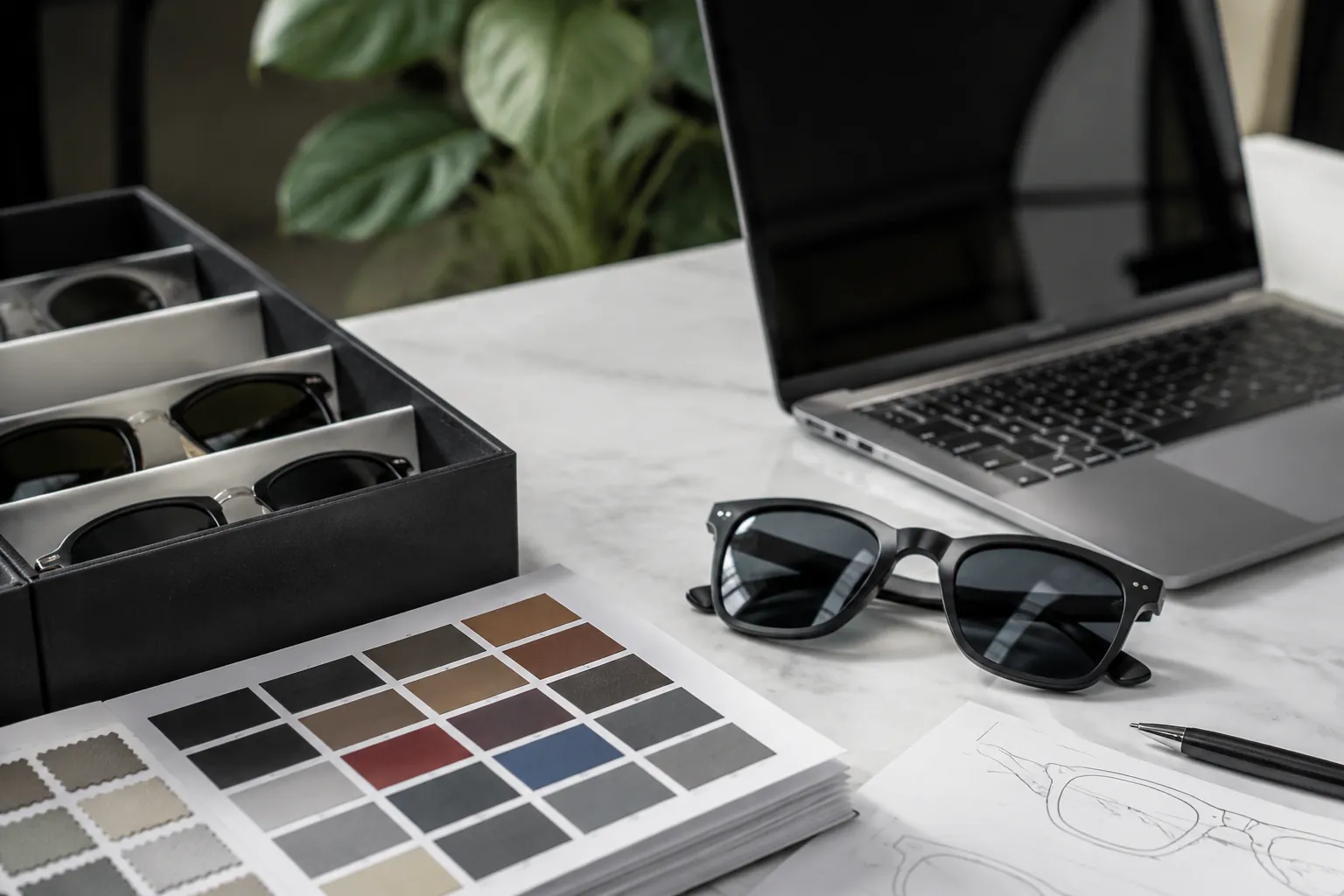
This guide helps brand owners, importers, distributors, and retail buyers choose between matte and gloss sunglass frames by sales channel. Finish affects more than looks. It changes fingerprint visibility, scratch perception, logo clarity, packing needs, and how closely repeat production matches an approved sample. For volume orders, the right choice depends less on taste and more on where the product will sell, how it will be handled, what branding method is required, and how clearly appearance standards are defined before production.
Start with the sales channel, not the sample room
Many buyers choose finish based on what looks best under showroom lights. That is a weak filter. Matte and gloss perform differently once sunglasses move through retail display, promotional distribution, and private-label replenishment.
In fashion retail, gloss often sells faster. It reflects more light, usually looks cleaner in product photography, and gives black, crystal smoke, clear, and tortoise effects more surface depth. That suits fashion-led assortments and broad-market presentation.
Matte fits a different job. It supports technical, sporty, tactical, and understated positioning. In outdoor retail, surf shops, streetwear capsules, and utility-focused private label, matte can signal function better than shine. It also tends to show fingerprints less clearly during try-ons and repeated handling.
For promotional programs, handling matters as much as style. A giveaway order may be packed, moved, sorted, distributed, and handled by event staff before the end user even touches it. In that setting, matte often stays looking cleaner because finger oils and light dust are less obvious. For repeat private-label programs, the best finish is usually the one the factory can reproduce consistently while still matching the brand's visual standard.
What changes after handling, shipping, and display
A frame finish gets tested long before the wearer steps outside. Frames are packed, moved in cartons, checked during QC, wiped, and tried on again and again. This is where matte and gloss start to separate.
| Factor | Matte Frame | Gloss Frame |
|---|---|---|
| Fingerprints | Usually lower visibility, especially on dark textured surfaces | Usually higher visibility on black and other dark colors |
| Hairline scratches | Often less reflective at first, but contact areas can become shinier over time | Usually easier to see under direct light as fine surface lines |
| Dust and lint | Moderate visibility depending on texture and color | Often more visible on dark high-shine surfaces |
| Shelf impact | Softer, lower-glare appearance | Brighter, stronger first-glance appearance |
| Store try-on aging | Can hide prints well, but friction points may polish up | Looks clean when new, but scratches show sooner under strong lighting |
Matte is not tougher by default. On injection frames, a matte texture can turn shinier at temple touch points, hinge zones, nose-contact areas, and corners where pieces rub during transport or repeated handling. Gloss frames do not create the same matte-to-shiny contrast, but they usually reveal micro-scratches faster under retail lighting.
For e-commerce, either finish can work if packing is controlled. Gloss usually benefits more from individual bagging, clean workstations, and stable carton separation. If the product will sit on open display and be tried on often, matte usually keeps a cleaner appearance over time.
How finish behaves by material and process
The same finish does not behave the same way on every material. This is a sourcing issue, not just a design choice.
On injection-molded frames, gloss depends heavily on mold polish, resin stability, process control, and cooling consistency. A well-polished mold can produce a smooth gloss with good repeatability if the material and molding conditions stay stable. Matte injection frames rely on texture built into the mold surface. Common issues include uneven grain, glossy patches, and drag marks caused by ejection or packing friction. If the texture is too light, the frame may read as semi-gloss. If it is too rough, it can hold dust and look flat.
On acetate, gloss often gives deeper color and a more polished retail look because the finish comes from sanding, tumbling, buffing, and hand polishing after shaping. That is one reason gloss remains common in fashion-driven acetate programs. Matte acetate is possible, but consistency can be harder to hold because the finish may need reduced polishing or extra surface treatment. Curved areas such as temple bends and bridge zones can show unevenness if finishing pressure or timing varies.
For low-MOQ development, process route matters. Injection is often the practical option when existing tooling or minor modifications keep development manageable. Acetate makes more sense when the brand needs stronger premium positioning, layered color, bevel detail, or a retail price that supports more labor. Ask the factory which route is being quoted. Then confirm that the approved finish comes from the actual production method, not a lookalike sample.
Branding compatibility: small logos fail first
Finish choice changes how branding reads at production scale. A logo that looks clean in artwork can become weak, blurry, or low-contrast on the real temple. Small marks fail first.
- Pad printing: Works on both finishes, but gloss often gives crisper edges on very small text because the surface is smoother. On matte, fine texture can soften edges. On black frames, white, silver, or other high-contrast inks are usually easier to read.
- Laser engraving: Better for subtle branding than for strong retail visibility. On matte surfaces, engraving often looks more integrated. On gloss, the engraved area may stand out more because the surrounding surface reflects more light.
- Metal logo plates: Usually fit polished acetate or gloss fashion frames better, where the shine level feels coordinated. On low-cost matte injection styles, the plate can look visually disconnected if the rest of the product is restrained.
- Molded or debossed branding: Often reads well on matte because less glare competes with shallow detail. This works well for sporty wraps and utility-led styles.
Test branding at production size. Do not approve vector art alone. A small temple logo may read clearly on a smooth gloss surface but lose definition on a fine matte texture. If pad printing is required, ask for an adhesion check on the final production surface because ink performance can differ between textured matte and polished gloss. For bulk orders, define acceptable logo position tolerance in writing for visible temple branding.
Retail, promo, and private-label buying guide
Most buyers do not need an abstract design debate. They need a quick recommendation tied to channel, branding, and complaint risk.
| Channel | Usually Better Finish | Why It Sells | Main Risk |
|---|---|---|---|
| Fashion retail chains | Gloss | Brighter shelf impact, familiar appearance, stronger photo readability | Fingerprints and scratch visibility during store handling |
| Sport and outdoor retail | Matte | Technical look, reduced visible glare on the frame, hides prints better | Contact areas can become polished with use |
| Promotional giveaways | Matte | Usually keeps a cleaner appearance through packing and mass distribution | Poor texture execution can look dull or inconsistent |
| Corporate branded merch | Depends on logo method | Matte suits subtle branding; gloss helps printed logos stand out | Wrong decoration method reduces legibility |
| Private-label fashion brands | Gloss | Broad market familiarity and cleaner color presentation | Higher appearance-complaint risk if packing control is weak |
| Private-label streetwear or tactical | Matte | Matches understated brand language and reduces flashy reflection | Texture consistency must be checked closely on repeat orders |
A simple rule helps. Gloss is often the safer commercial choice when the product must appeal quickly to a wide audience. Matte is often stronger when the program depends on technical styling, frequent handling, or quieter branding. The wrong finish may not ruin a sample, but it can raise returns, create repeat-order mismatch, or force repacking before shipment.
Cost, MOQ, lead time, and the real price of finish
In many programs, matte versus gloss is not a major direct cost driver by itself. The bigger issue is whether the finish creates more rejects, slower finishing, or stricter packing requirements.
At low MOQ, compare more than unit price. Compare process stability and packing assumptions too. If matte and gloss use the same mold, lens package, and assembly route, the quoted price may be close. The real cost difference often appears later through handling control, appearance standards, and reject risk.
- Sampling: If the finish is not decided, request both matte and gloss on the same frame color or the closest equivalent. That gives a cleaner comparison before bulk approval.
- Bulk production: Lead time usually depends more on material availability, branding steps, and factory capacity than on finish alone. Matte may need closer texture monitoring. Gloss may need stricter surface protection after finishing.
- Yield and rejects: Gloss can trigger more appearance complaints if scratch tolerance is not defined before production. Matte can create disputes if texture variation, rub marks, or acceptable sheen change are not written into the approval standard.
- Packing cost: Gloss often benefits more from disciplined bagging, cleaner inserts, and better carton separation. Those controls add cost, but they can prevent larger complaint costs later.
The cheapest finish on paper is not always the cheapest finish in practice. The better value is the one that survives your sales channel with fewer complaints, lower repacking risk, and more consistent reorders.
Compliance does not change with finish, but execution still matters
Finish alone does not determine whether sunglasses meet market requirements. Lens category, optical performance, material safety, labeling, and finished-product testing matter more. Still, finish matters commercially because a compliant product can become unacceptable if decoration, coating, or surface quality is poorly executed.
For export programs, confirm the standard required by the destination market, including CE EN ISO 12312-1, ANSI Z80.3, and AS/NZS 1067 where applicable. Chemical compliance requests should align with REACH. Some U.S. buyers also ask suppliers to confirm FDA registration where relevant to their sourcing process. Factory-management and social-compliance documents often requested during supplier review include ISO 9001 and BSCI.
Keep the checks practical. Make sure the chosen finish and decoration method do not create adhesion failure, color transfer, or cosmetic defects that force rework after testing or booking deadlines are fixed. If pad printing is included, request an adhesion check on the actual finished surface. If laser engraving is used on matte textures, verify that the mark stays legible after handling. If the project includes mirrored or flash lenses, confirm that the frame finish and lens appearance still match the intended retail position.
Buyer checklist before bulk approval
The best way to reduce disputes is to approve finish through a fixed process, not vague comments such as "make it feel more premium." Be specific.
- Check the sample under mixed lighting. Review it in office light, daylight, and store-style spot lighting because gloss depth and matte texture can shift across environments.
- Rub-test the contact points. Focus on temples, bridge edges, front corners, and hinge areas where friction marks often appear first during packing and try-on handling.
- Review logo size on the final surface. A logo that reads clearly on gloss may lose edge definition on matte texture, especially when the mark is small or uses thin strokes.
- Define the appearance standard before bulk. Put scratch tolerance, rub-mark acceptance, logo position, and texture variation into written approval criteria before mass production starts.
- Confirm lens and frame pairing. Matte black with a mirrored lens creates a different retail impression from gloss black with a smoke lens, even on the same frame shape.
- Approve the real finishing route. For larger orders, ask for a pre-production sample from the actual mold, color, texture, and branding route rather than relying only on an early prototype.
If the order uses custom color, acetate, low-gloss texture, laser branding, or highly visible temple logos, a pre-production sample is especially important. Many finish complaints are not design failures. They come from approving too little detail before bulk production starts.
Have a custom sunglasses project in mind?
Send us your styles, target market and quantities and we will return a detailed quote with MOQ, lead time and a sample plan.
Get a QuoteWhy source this from Wenzhou with LumiShades
Wenzhou in Zhejiang Province is widely regarded as China’s eyewear manufacturing capital, producing a large share of the world’s sunglasses. That concentration matters to buyers: a deep local supply chain for acetate sheet, hinges, lens blanks, plating and packaging means shorter component lead times, easier color and material matching, and a workforce with decades of eyewear-specific skill. LumiShades has manufactured in this ecosystem since 2009, and our vertical integration — in-house injection molding, acetate cutting, CNC milling, lens tinting, decoration and quality control — means no part of your order is quietly subcontracted to a workshop you cannot audit.
For international buyers, that vertical control translates into accountability. When a single factory owns every step, defects are traced and fixed at source rather than bounced between vendors, and your specifications survive intact from first sample to bulk. We back this with 15+ years of experience, shipments to 60+ countries, more than 5 million pairs produced per year and a 98.5% on-time delivery rate. Our certifications — CE EN ISO 12312-1, FDA registration, ANSI Z80.3, AS/NZS 1067, REACH, ISO 9001 and BSCI audit — mean the compliance documentation your market requires already exists. Explore our manufacturing capabilities and quality control process to see how this works in practice.
Frequently asked questions
Does matte always look more premium than gloss? No. Matte usually signals a technical, understated, or modern look, while gloss often gives stronger color depth and a more polished fashion presentation, especially on acetate, clear colors, and tortoise effects. Judge both finishes on the same frame shape, material, and color under retail lighting and in product photos. Finish alone does not decide perceived value.
Which finish is safer for a low-MOQ first order? If the goal is broad retail appeal, gloss is often the safer first option because it is familiar to more consumers and usually photographs well. If the brand direction is sporty, tactical, streetwear, or event-driven promo, matte may be the safer fit because it tends to hide handling marks better. For a first order, request both finish samples if budget allows, then choose based on channel, branding method, and packing plan rather than preference.
Will matte frames hide scratches better? Only partly. Matte usually hides fingerprints better, but repeated contact can polish certain areas and create shiny spots that stand out against the rest of the surface. Gloss does not show that same contrast shift as easily, but it usually reveals fine hairline scratches sooner under direct light. Ask the supplier to show likely wear points after handling, or run a simple rub test on the sample before approval.
Does finish choice affect lead time? Usually not by much on its own. Lead time is more often driven by material availability, branding steps, production scheduling, and packaging requirements. Matte may need closer texture control, while gloss may need more careful post-finish protection. To avoid delays, confirm early that your approved sample reflects the real production finish, branding method, and packing standard.
Which branding method works best on matte black frames? For high visibility, white or metallic pad printing is usually the most readable option on matte black, provided the logo is not too small and adhesion is tested on the finished surface. For a quieter brand look, laser engraving can work well if the mark stays legible after handling. Before bulk approval, ask for a sample with the final logo size and placement on the exact matte texture planned for production.
Ready to start?
Explore our round sunglasses or request a quote — our sales team replies within 12 hours.
Request a Quote