
Custom Sunglasses Logo Methods: What Actually Fits
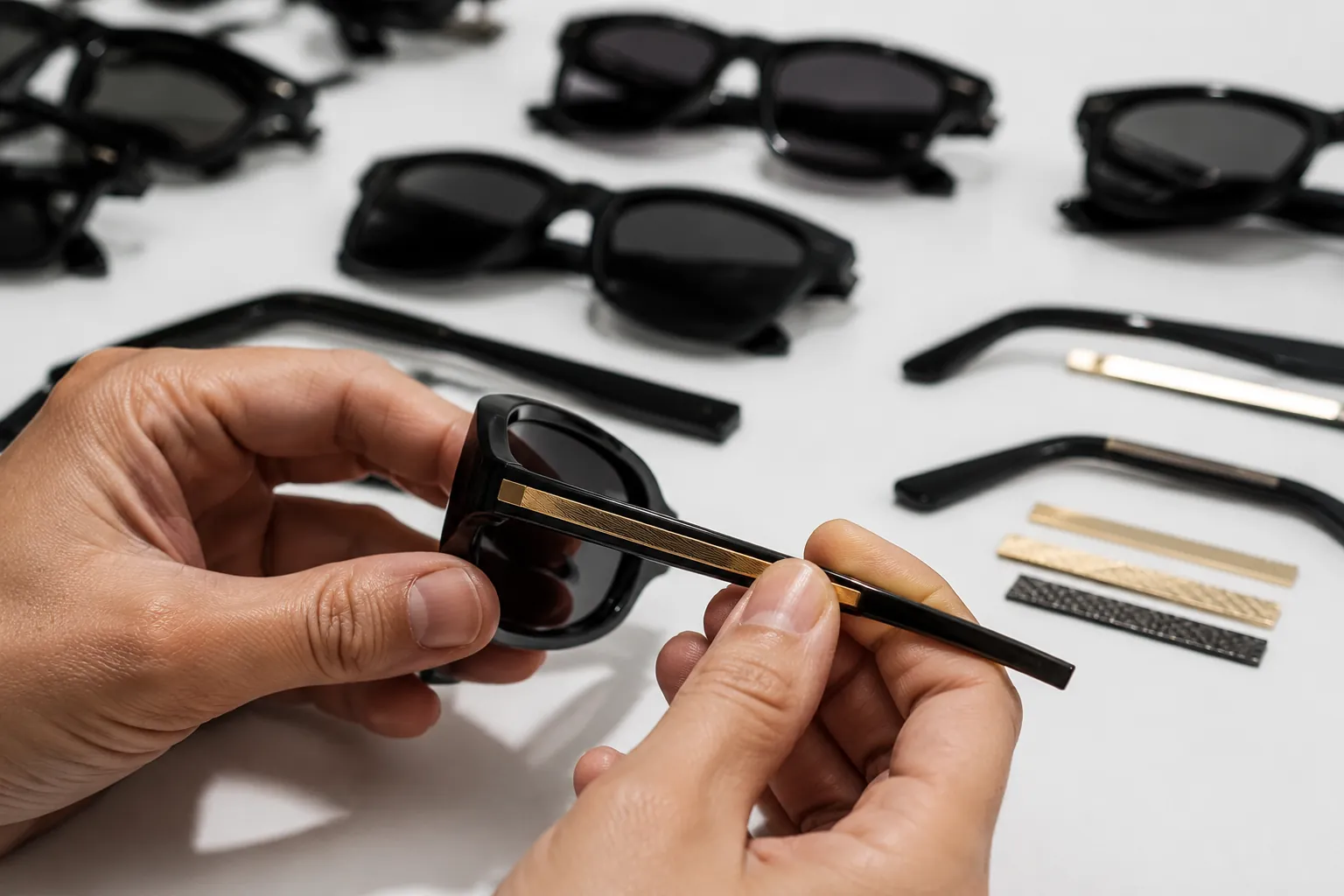
This guide is for brands, importers, distributors, and retailers buying custom sunglasses in volume. The main question is not which logo method looks best in a mockup. It is which method fits the frame material, logo position, durability target, price point, and production plan. Pad printing, laser marking, and metal logo plates solve different manufacturing problems. Pick the wrong one and the order gets slower, riskier, or more expensive than it needs to be.
Start with the buying decision, not the artwork
Most decoration mistakes start too early. A buyer approves a logo visual before defining how the product will be used, handled, cleaned, and sold. That is backwards. A seasonal giveaway does not need the same logo performance as a premium acetate frame meant for daily wear and repeated cleaning.
Use four filters first: frame construction, order volume, expected wear, and retail position.
- Frame construction: Injection PC, TR90, nylon, acetate, stainless steel, and mixed-material temples react differently to ink, heat, pressure, and machining. Low-surface-energy plastics can weaken print adhesion. Flexible temples can stress a printed film over time. Acetate can accept machining for hardware, but pocket depth and finish still need control.
- Order volume: At lower volumes, setup cost, sample speed, and process simplicity usually matter most. At higher volumes, added hardware, fixtures, and slower steps become easier to justify because the cost is spread across more units.
- Expected wear: A logo near the temple tip gets touched more often than one near the hinge. That can matter more than the decoration method itself.
- Retail positioning: A one-color print, a tonal laser mark, and a fitted metal plate signal different value levels. The method should match the intended price band and shelf presentation.
Decoration also changes the production route. A printed logo may only need surface prep, printing, curing, and inspection. A metal plate may require hardware production, finishing, incoming inspection, pocket machining, insertion, bonding, and added cosmetic checks. That is a different project. Buyers should judge the method as part of the full manufacturing flow, not as a stand-alone artwork step.
Head-to-head: cost, durability, and best use
| Method | Best frame types | MOQ logic | Durability in use | Typical added cost logic | Lead-time impact |
|---|---|---|---|---|---|
| Pad printing | Injection PC, TR90, coated plastics, some metals | Usually the most practical option for low-volume and multi-color programs | Moderate; depends heavily on surface preparation, ink system, curing, and placement | Usually the lowest setup and unit-cost option for simple branding | Low once artwork and print setup are approved |
| Laser marking | Metal temples, coated metal parts, selected acetate and rigid plastics after testing | Works well when the substrate is suitable and the logo does not require ink color | High on compatible surfaces; performance depends on how the mark is created and the required contrast | Mid-level cost driven by machine time, setup, and fixture control | Low to moderate; physical sample approval is often the key step |
| Metal logo plates | Acetate temples, thicker injection temples, premium mixed-material frames | More viable when order size and product positioning can absorb hardware and added labor | High if pocket fit, bonding, edge finish, and alignment are well controlled | Highest cost due to hardware production, finishing, insertion labor, and tighter QC requirements | Moderate to high because hardware must be produced, checked, and installed |
There is no default winner. Pad printing is usually the simplest route for low-MOQ branding. Laser marking avoids ink adhesion issues and is often the safest option for basic branding on metal temples. Metal logo plates create the strongest premium cue, but they add the most process steps and the most cosmetic risk.
Judge decoration cost against the base frame cost and the selling target. On an entry-level promotional frame, a metal plate can add too much cost and QC exposure. On a premium acetate frame, the same plate may be reasonable if it supports the intended retail position and margin.
Pad printing: low MOQ, color control, simple execution
Pad printing is still the most common logo method for sunglasses. The reasons are practical. It handles curved surfaces, supports spot colors, and keeps setup manageable. It is especially useful when the same frame is sold in several colorways and only the logo color changes.
The process still needs control. Artwork is prepared for a printing plate or cliche. Ink is chosen for the substrate and finish. The image transfers from the plate to a silicone pad and then onto the temple or other branding zone. Performance depends on surface cleanliness, ink compatibility, curing, and handling during production. Mold-release residue, oil, dust, anti-scratch coatings, or poor curing can all reduce adhesion.
- Best use: One-color or two-color logos on outer temples, inner temples, and selected lens-corner applications where design and performance allow.
- Best order profile: Low- to mid-volume programs where speed, color control, and lower added cost matter more than hardware appearance.
- Main risk: Wear, rub-off, or weak adhesion in high-contact areas or on difficult substrates.
- Buyer control point: Confirm the exact substrate, ink system, curing method, and durability standard before bulk approval.
Placement matters. A print near the temple tip sees more finger contact, skin oil, and cleaning friction than a print near the hinge. On flexible materials such as TR90, branding near a bend point can reduce long-term print stability. On coated plastics, the result depends on whether the coating and ink system are compatible.
The real question is simple: not whether pad printing is possible, but whether the chosen placement and substrate can hold the print to the required standard. Check that on a production-representative sample.
Laser marking: strong on metal, conditional on plastics
Laser marking gets oversimplified. In practice, the result depends on the substrate, any surface coating, the beam settings, and the size of the branding area. On coated stainless steel or alloy temples, laser marking can produce a clean, abrasion-resistant logo with good line definition. On some plastics, especially dark, glossy, or variable-density materials, the mark can look faint, uneven, or too subtle.
Pre-production review matters. Fine details that look sharp on screen may close up or lose clarity when reduced to a small temple logo. Thin strokes can break on textured or matte coatings. Curved branding zones can also reduce consistency because focal distance shifts across the surface.
Buyers should confirm three points before approval:
- What the laser is doing: removing a surface coating, changing the color of the substrate, or cutting into the base material.
- Expected contrast: dark coatings may reveal bright metal, while lighter or matte surfaces may only produce a tonal effect.
- Durability and legibility after handling: abrasion resistance may be strong, but the mark still needs to stay readable after cleaning and normal use.
Laser marking is usually strongest on metal temples and mixed-material frames with a defined metal branding zone. It can work on acetate, but the effect is often subtler than print or inset hardware. That makes it better for understated branding than for programs that need strong shelf visibility.
Do not approve laser by mockup alone. A physical sample is required because contrast, edge clarity, and visibility depend on the real material and finish.
Metal logo plates: premium look, tighter tolerances
Metal logo plates send the clearest premium signal because the branding reads as hardware, not surface decoration. But they are not a simple add-on. They create a second manufacturing stream that may include logo tooling, stamping or etching, plating or finishing, dimensional inspection, pocket machining, insertion, bonding, and cosmetic inspection.
On acetate temples, the cleanest result usually comes from a precisely machined pocket sized to the hardware. Tolerances matter. A loose pocket can let the plate shift, sit unevenly, or show adhesive. A tight pocket can cause stress marks, chipping, or visible pressure at the edges. Temple thickness matters too. There must be enough material to hold the plate securely without weakening the part.
Common control points include:
- Pocket depth: deep enough to seat the plate correctly, but not so deep that it weakens the temple wall or risks breakthrough.
- Alignment: left and right temples should match in position, angle, and distance from the hinge.
- Edge finish: plates should be free of sharp edges, burrs, or visible finish defects.
- Bonding method: adhesive-only fixing should be validated for heat and wear; mechanical features can improve retention but add complexity.
- Finish match: the plate finish should be checked against hinge tone and other visible metal details.
Typical failure modes are cosmetic mismatch, plate lift, adhesive squeeze-out, rotation, and inconsistent left-right positioning. Small defects still matter here. The branding is highly visible, so minor variation can stop shipment.
Metal plates make the most sense on premium acetate or thicker temples where the product price and brand position justify the added cost and process control. They are usually hard to justify on short-run promotional programs.
Match the method to frame construction
Frame material should narrow the options fast. Buyers who ignore substrate behavior usually lose time in sampling and pay for it later.
| Frame construction | Safer decoration choices | What to watch |
|---|---|---|
| Injection PC | Pad printing, some metal plates on thicker temples | Surface energy, coatings, and mold-release residue can affect print adhesion; test before approval |
| TR90 or similar flexible plastic | Pad printing with a tested ink system; selective laser only after trials | Flexing can stress printed areas; avoid placing logos near bend zones |
| Acetate | Metal logo plates, selective laser, pad print on suitable zones | High polish can affect print hold; pocket machining and finish control determine plate quality |
| Metal temple construction | Laser marking, pad print for colored logos | Coating type and finish affect both contrast and adhesion; gloss and matte surfaces behave differently |
For mixed-material frames, review the exact branding zone, not just the frame category. A metal core inside a plastic temple does not make the outer surface suitable for laser marking. A thick-looking temple may still lack enough usable wall thickness for a recessed metal plate. Approval should be based on the real section, finish, and decoration location.
A volume-based framework that holds up in production
If you need a practical rule set, use this:
- Low-volume programs: Start with pad printing unless the branding zone is metal and the logo works as a laser mark. At lower volumes, simple setup and lower added cost usually matter more than hardware presentation.
- Mid-volume programs: Choose based on product position and substrate suitability. For opening-price goods, print is usually the most stable commercial choice. For understated branding on metal, laser becomes more attractive. For premium acetate, metal plates are worth costing carefully.
- Higher-volume programs: Specialized decoration becomes easier to justify because tooling, fixture, and hardware costs are spread across more units. This is where custom hardware and tighter cosmetic standards may start to make sense.
Then test the choice against schedule, defect tolerance, and approval discipline. Printed and laser-marked programs are generally easier to sample and scale than hardware-based decoration. Once custom metal plates are added, the project usually needs extra approvals for hardware finish, dimensions, installation quality, and cosmetic consistency.
Also check acceptable variation. If the customer program cannot absorb visible logo shift, avoid methods that depend on difficult manual placement unless the factory can show stable jigs, work instructions, and in-line inspection. Decoration is a small part of the frame. It can still delay the whole lot.
What to approve before you release the PO
Many branding failures are really approval failures. Buyers approve an artwork file but not the decoration standard on the physical part. That is where scrap, delay, and disputes usually start.
- Approve exact placement: define distance from the hinge, top edge, or other fixed reference points, not just a visual mockup.
- Approve logo size on the real part: a logo that looks correct on screen can lose detail or look oversized on a curved temple.
- Approve appearance under normal lighting: this is especially important for laser marks on dark, matte, or translucent surfaces.
- Define durability checks: specify the rub, adhesion, or handling test required for the program and the pass criteria.
- Separate branding from compliance markings: required information must remain readable and correctly placed.
- Confirm left-right consistency: orientation, angle, and spacing should match across both temples.
- Request a golden sample or pre-production sample: this is especially important for metal plates and mixed-process frames.
For regulated markets, decoration should not interfere with compliance markings, traceability, or approved materials. Keep branding review separate from compliance review. Also verify that any added coating, adhesive, or metal component matches the approved specification and supporting documentation where required. Depending on the market and program, buyers may also review factory records such as ISO 9001, BSCI, FDA registration where relevant to importer requirements, and product-related compliance documents including CE EN ISO 12312-1, ANSI Z80.3, AS/NZS 1067, and REACH.
The rule is straightforward: do not approve decoration based on expectation. Approve it on a production-representative sample, a written placement standard, and a defined durability check that matches actual use.
Have a custom sunglasses project in mind?
Send us your styles, target market and quantities and we will return a detailed quote with MOQ, lead time and a sample plan.
Get a QuoteWhy source this from Wenzhou with LumiShades
Wenzhou in Zhejiang Province is widely regarded as China’s eyewear manufacturing capital, producing a large share of the world’s sunglasses. That concentration matters to buyers: a deep local supply chain for acetate sheet, hinges, lens blanks, plating and packaging means shorter component lead times, easier color and material matching, and a workforce with decades of eyewear-specific skill. LumiShades has manufactured in this ecosystem since 2009, and our vertical integration — in-house injection molding, acetate cutting, CNC milling, lens tinting, decoration and quality control — means no part of your order is quietly subcontracted to a workshop you cannot audit.
For international buyers, that vertical control translates into accountability. When a single factory owns every step, defects are traced and fixed at source rather than bounced between vendors, and your specifications survive intact from first sample to bulk. We back this with 15+ years of experience, shipments to 60+ countries, more than 5 million pairs produced per year and a 98.5% on-time delivery rate. Our certifications — CE EN ISO 12312-1, FDA registration, ANSI Z80.3, AS/NZS 1067, REACH, ISO 9001 and BSCI audit — mean the compliance documentation your market requires already exists. Explore our manufacturing capabilities and quality control process to see how this works in practice.
Frequently asked questions
Which branding method is cheapest for a 50-pair trial order? In most cases, pad printing is the lowest-cost starting point because it usually adds less hardware and less assembly complexity than metal logo plates. Laser marking can also be cost-effective if the branding area is already metal and the design does not need a specific ink color. The practical step is to quote the same frame both ways, confirm any sample charges, and ask which option needs the fewest custom components.
Will pad printing last on sunglasses used daily? It can, but only if the print is matched to the substrate and the wear conditions. Ask the supplier to confirm the temple material, ink system, and curing method, then approve the logo on a production-representative sample. Define a rub or adhesion check before bulk approval, and keep the logo away from high-contact bend or grip zones where possible. Daily-use programs should rely on a documented sample standard, not appearance alone.
Are metal logo plates worth it below 300 pairs? Sometimes, but only if the product is positioned as premium and the added hardware cost, longer approval cycle, and tighter QC requirements still make commercial sense. Before approving, ask for the added cost per pair, any hardware development charge, the installation method, and the defect standard for alignment and edge finish. If the program is price-sensitive or time-sensitive, pad printing is usually easier to control at that scale.
Can laser marking be used on acetate frames? Yes, but treat it as a trial-based decision, not a default assumption. The result varies by acetate color, polish level, density, and surface finish. Ask for a physical sample on the exact acetate color you plan to buy and check three points: contrast, edge clarity, and consistency across multiple pieces. If the mark is too subtle, switch to pad printing or use a metal logo plate if the frame construction allows it.
Does decoration affect compliance for sunglasses? It can if branding interferes with required markings, changes approved materials, or creates a mismatch between the product and its compliance records. Keep branding separate from mandatory product information and confirm that any added adhesive, coating, or metal part is included in the approved specification. For market access and buyer due diligence, review the relevant product and factory documents for the program, which may include CE EN ISO 12312-1, ANSI Z80.3, AS/NZS 1067, REACH, FDA registration where applicable, ISO 9001, and BSCI.
Ready to start?
Explore our wayfarer sunglasses or request a quote — our sales team replies within 12 hours.
Request a Quote