
Sunglasses Packaging by Retail Channel
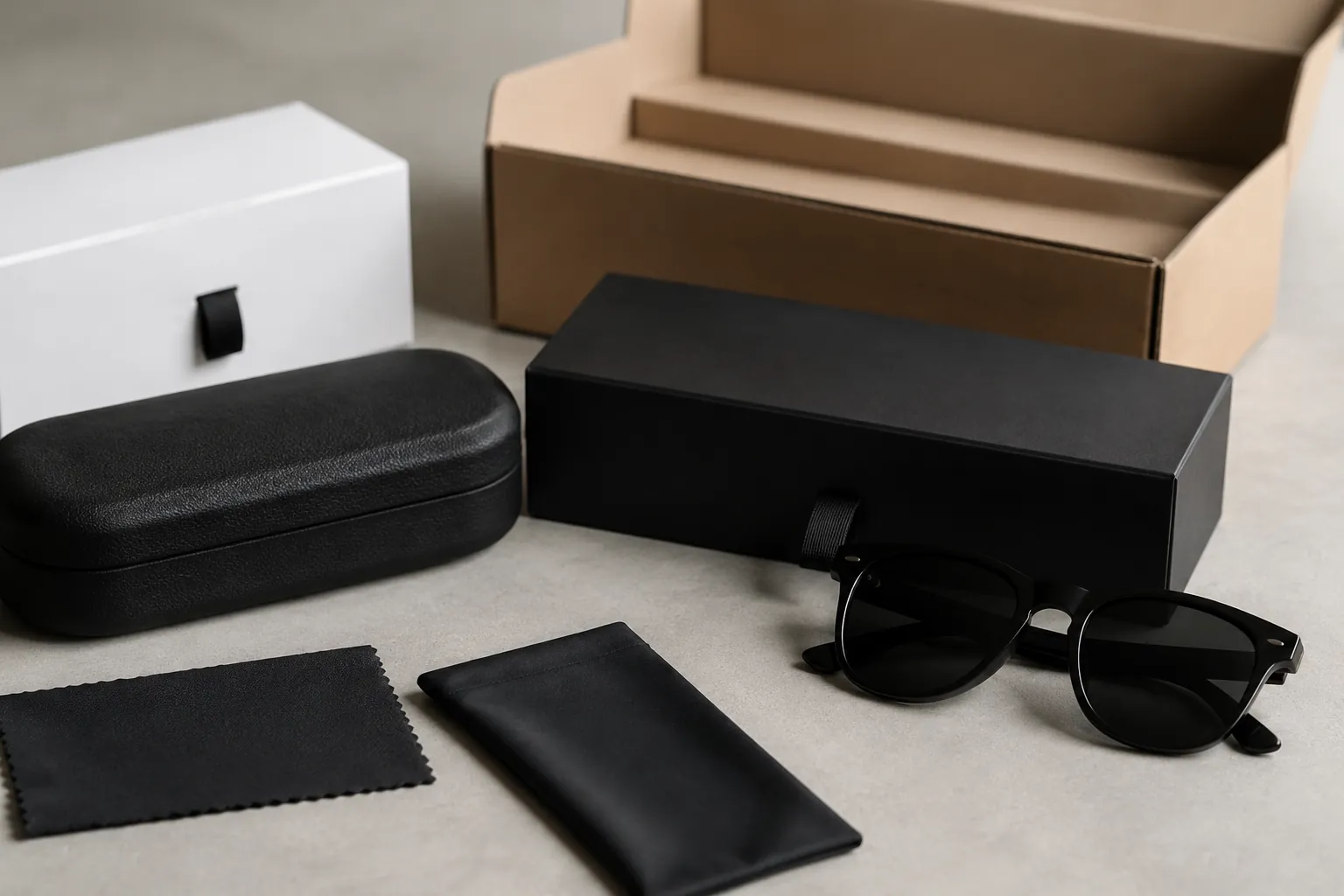
This guide is for buyers sourcing custom sunglasses for chain retail, boutiques, and online sales. Packaging that works in one channel can add cost or create failure points in another. The right structure, labeling, and pack-ins reduce repacking, barcode problems, avoidable damage, and artwork delays. The wrong setup creates copy revisions, scan failures, excess freight volume, or packaging that no longer matches the approved product specification. Start with the real product. For sunglasses, packaging decisions should be based on actual folded frame dimensions, decoration method, compliance files, and channel requirements, not a concept render alone.
Start with the channel, not the box
Many packaging problems begin the same way: a buyer approves a box concept before defining where and how the sunglasses will be sold. That is backwards. A unit pack for a big-box retailer has different requirements from a boutique gift box or an e-commerce ship-ready carton. The frame may be the same. The packaging should not be.
For big-box retail, the priorities are usually shelf or peg fit, barcode readability, and easy receiving at the retailer distribution center. For boutiques, the pack needs to present well in hand, hold print quality, and avoid weak details such as loose inserts, distorted trays, or crush-prone corners. For e-commerce, the job is simple: protect the sunglasses through parcel handling without shipping air.
Buyers should lock four points before approving packaging samples: sales channel, unit-pack structure, case-pack logic, and labeling content. Leave any of those open and approvals often slip while frame production keeps moving.
Packaging artwork should reflect the final approved product specification. If decoration, lens category, warning language, or market-specific labeling changes after artwork release, the outer pack and inserts may also need revision.
- Define the sales channel first.
- Approve packaging dimensions against the real folded frame.
- Lock barcode and compliance text before artwork release.
- Request at least one fully packed approval sample, not just a frame sample.
A channel-by-channel packaging decision table
Use this framework when briefing the factory. It links the packaging format to the way the product will be displayed, handled, and shipped.
| Channel | Recommended unit pack | Main labeling needs | Pack-in level | Cost and risk notes |
|---|---|---|---|---|
| Big-box retail | Hanging box, window box, or tray-in-carton sized for the retailer fixture and approved planogram | EAN or UPC barcode, country of origin, style and color code, importer or responsible-party details, market warnings, compliance references where required | Minimal: pouch, folded leaflet, anti-scratch bag only if needed | Keep cube tight. Barcode quiet zone and flat placement matter. Weak peg holes, poor assortment control, or inconsistent case packs can cause receiving issues. |
| Boutique | Rigid box or heavier folding carton with a branded insert matched to the frame size | Clean branding, discreet compliance label area, removable price sticker area if needed | Higher: pouch, cloth, story card, branded insert | Supports presentation, but buyers often overspecify board weight, finishing, and printed pieces that add cost without improving sell-through. |
| E-commerce | Compact folding carton inside a tested mailer or protective outer box with limited empty space | SKU label, barcode, return-friendly identification, FNSKU if required by the marketplace | Moderate: pouch and cloth are often sufficient | Watch dimensional weight and transit protection. Too much void space raises freight cost and can allow movement inside the pack. |
| Distributor mixed-channel stock | Neutral master carton with an adaptable unit-pack label zone and market-specific sticker workflow | Market-specific sticker logic, batch traceability, destination labeling rules | Flexible by destination customer | Useful for importers serving several markets, but sticker hierarchy and artwork control must be set early. |
The cheapest unit pack is not always the lowest total packaging cost. A carton that scuffs, crushes in transit, or uses a barcode panel that will not scan creates rework and claims later.
Packaging cost varies by structure, print method, finish, insert type, pack-in count, and order volume. Ask the supplier to quote at least two or three pack options side by side so you can compare material cost, assembly complexity, and shipping impact on the same frame program.
Big-box packaging: built for shelves, scans, and case handling
Big-box buyers usually care more about consistency than extras. The pack needs to arrive on time, scan cleanly, and fit the approved shelf or peg setup. That makes unit dimensions, barcode placement, hang-hole position, and case-pack discipline more important than decorative upgrades.
For pegged items, confirm the hang-hole position from the retailer specification, not a generic dieline. If the board grade is light for the pack weight, reinforce the peg area or revise the structure. For shelf packs, keep the footprint consistent and avoid front-panel bowing caused by oversized frames or poorly controlled inserts.
- Place the barcode on a flat surface, not over a fold, corner, emboss, or textured finish.
- Protect the quiet zone and keep dark artwork away from the scan area.
- Match style-color coding across the artwork file, unit label, inner-carton label, and master-carton marks.
- Keep inserts tight so the package does not look opened or tampered with after handling.
Packaging and enclosed documentation must match the destination market and the approved product specification. If the sunglasses are sold into markets where compliance with CE EN ISO 12312-1, ANSI Z80.3, or AS/NZS 1067 is part of the buyer requirement, check labeling and inserts against the tested configuration. Buyers should not change lens category, tint specification, or warning language after testing and assume the existing packaging is still correct.
At factory level, pre-shipment checks should include barcode readability, assortment accuracy, packaging condition, and shipper marking accuracy. This matters even more when one purchase order includes several colorways with similar packaging.
Boutique packaging: brand feel, materials, and finish control
Boutique packaging allows more brand expression, but it still needs production discipline. A rigid box can suit a premium program or gifting setup. It is a poor fit when the added volume and cost do not support the product position.
Good boutique packaging usually comes down to three things: a clean opening experience, coherent branding, and practical protection. That does not require exotic materials. Often, a well-made folding carton with a fitted paper insert or EVA tray, plus a microfiber pouch and cleaning cloth, performs better than a large rigid box with empty space.
Material behavior matters. Dark solid cartons can show scratches and edge whitening. Soft-touch lamination marks easily. Uncoated board gives a more natural look, but it can pick up dirt during handling. Foil stamping can sharpen brand presentation, but very fine artwork may not hold cleanly. Embossing works best when board thickness supports the intended depth without cracking the print surface.
Decoration choices should relate to the frame. If the sunglasses use a brushed metal logo plate, matching that tone in foil can help the packaging feel coherent. If the frame finish is restrained, overly glossy packaging can feel disconnected.
| Packaging element | Low-risk option | Higher-cost option | What to watch |
|---|---|---|---|
| Outer structure | Folding carton | Rigid setup box | Rigid boxes increase freight volume and often require higher order quantities to price efficiently. |
| Insert | Folded paper insert | EVA or flocked tray | EVA protects well but can add cost beyond what a mid-price program needs. |
| Finish | Matte varnish or aqueous coating | Soft-touch lamination plus foil | Soft-touch can scuff; foil registration needs control on small brand marks. |
| Brand piece | Single story card | Multi-piece booklet set | Extra printed pieces add assembly steps and increase kitting error risk. |
For boutique programs, the strongest packaging is often the version with fewer components, tighter sizing, and cleaner finish control.
E-commerce packaging: protect the frame without shipping air
E-commerce packaging has two jobs: protect the sunglasses in parcel transit and keep package volume under control. Buyers often focus on unboxing first and shipping performance later. That is a mistake.
A compact carton plus microfiber pouch is enough for many online programs. Some frame types need more support. Acetate frames, styles with exposed metal trim, sharp bevel details, or high-wrap constructions may need an insert or sleeve that prevents rubbing at the lens edge, temple tips, or logo hardware contact points.
- Measure the real folded frame width, front curve, temple stack height, and hinge protrusion.
- Choose the smallest inner carton that prevents lens-to-wall contact and does not compress the frame front.
- Add only enough insert support to stop movement during parcel handling.
- Test the packed unit inside the intended mailer or outer shipper, including corner and flat-drop checks.
- Verify final packed weight and outer dimensions before sign-off.
For marketplace orders, reserve a clean label panel for the required SKU or fulfillment label. Do not place core brand graphics where a warehouse label is likely to be applied. If the same stock may go to direct-to-consumer and marketplace channels, define one neutral label area early.
Ask for at least one fully packed shipping sample before release to bulk packing. If order volume or channel exposure is meaningful, basic transit testing is a practical step before launch.
What belongs on the pack and what belongs in the insert
Sunglasses packaging is not just a branding surface. It is also part of the product identification and compliance workflow. Exact requirements vary by destination market, importer setup, and retail channel, so buyers should separate outer-pack essentials from information that can sit in a leaflet.
Common outer-pack items include product name, style number, color code, barcode, country of origin, importer or responsible-party details, and any warnings or compliance references required for the target market. For sunglasses sold into the EU, CE EN ISO 12312-1 is commonly referenced when the product has been tested to that standard. For the US market, ANSI Z80.3 is the relevant performance standard. For Australia and New Zealand, AS/NZS 1067 is the applicable reference. REACH belongs in the material compliance file and supporting documentation, and should be referenced on-pack only where the customer or market specification requires it.
FDA registration may be part of a supplier qualification review for some US buyers, but it is not a substitute for product performance compliance or correct labeling. These are separate issues. Treat them separately in the sourcing file.
Use inserts for care instructions, lens category explanation, cleaning guidance, brand story content, and multilingual copy where carton space is limited. This keeps the outer pack legible and makes importer-specific language changes easier to control.
The cleanest workflow is to freeze legal text, barcode files, and importer details before final dieline approval. Missing barcode assets, unconfirmed origin wording, or late warning-copy changes are common reasons packaging approval falls behind production.
Supplier controls and pre-production checkpoints
Packaging performance depends on process control as much as design. Buyers should confirm who owns the dieline, artwork sign-off, barcode generation, label approval, and packed-sample release. Put that in writing before bulk packaging starts.
For supplier assessment, buyers may review operating controls such as ISO 9001 quality management and BSCI social compliance where relevant to their procurement process. These do not replace product testing or packaging approval, but they do help a buyer understand how the supplier manages repeatability, records, and factory controls.
Before releasing packaging for mass production, close these points:
- Sales channel confirmed: big-box, boutique, e-commerce, or mixed-channel.
- Unit-pack dimensions approved against the real folded frame, not a drawing only.
- Barcode type, size, orientation, and placement approved.
- Country of origin, importer details, and required market text finalized.
- Compliance references match the tested product specification.
- Pack-ins specified by material, size, print method, and fold method.
- Master-carton assortment and shipping marks confirmed.
- A packed approval sample signed before bulk packing starts.
If one sunglass program is being sold across multiple channels, keep the frame specification stable where possible and vary only the final packaging set. That reduces change risk and makes compliance control easier.
Cost, MOQ, lead time, and how to compare options
Packaging decisions affect unit economics, assembly complexity, and production timing. The exact impact depends on order quantity, structure, finishing, and how many components must be sourced and packed together.
| Packaging choice | Typical MOQ impact | Lead-time effect | Where buyers overspend |
|---|---|---|---|
| Stock pouch plus printed sticker carton | Usually the easiest option for lower-volume runs | Often the simplest approval path because fewer custom components are involved | Too many SKU-specific sticker versions on small runs |
| Custom printed folding carton with insert | Usually more efficient once volume is stable | Artwork and dieline approval become the main timing risk if decisions are late | Oversized carton dimensions and unnecessary insert complexity |
| Rigid gift box with custom insert | Usually suits higher-margin or more established programs | More supplier coordination and finish approvals can extend the schedule | Paying for extra weight, setup labor, and unused internal volume |
| Premium multi-pack-in set | Best suited to programs that can absorb more assembly cost | Highest coordination risk across pouch, cloth, leaflet, labels, and manual kitting | Late-stage rework when one component is delayed or out of spec |
Do not rely on generic cost ranges. Ask suppliers to quote each packaging option with the same frame, the same incoterm basis, and the same pack-in list. That makes the trade-offs visible. A larger box can increase freight exposure. A more complex insert can increase assembly time. Extra printed pieces can create version-control problems across markets.
A practical comparison set for sunglasses is usually:
- one low-cost option built around a compact folding carton,
- one mid-tier option with a cleaner insert and upgraded finish,
- one premium option only if the retail position supports it.
Review all three against protection, compliance space, assembly complexity, and freight volume before making the final decision.
Have a custom sunglasses project in mind?
Send us your styles, target market and quantities and we will return a detailed quote with MOQ, lead time and a sample plan.
Get a QuoteWhy source this from Wenzhou with LumiShades
Wenzhou in Zhejiang Province is widely regarded as China’s eyewear manufacturing capital, producing a large share of the world’s sunglasses. That concentration matters to buyers: a deep local supply chain for acetate sheet, hinges, lens blanks, plating and packaging means shorter component lead times, easier color and material matching, and a workforce with decades of eyewear-specific skill. LumiShades has manufactured in this ecosystem since 2009, and our vertical integration — in-house injection molding, acetate cutting, CNC milling, lens tinting, decoration and quality control — means no part of your order is quietly subcontracted to a workshop you cannot audit.
For international buyers, that vertical control translates into accountability. When a single factory owns every step, defects are traced and fixed at source rather than bounced between vendors, and your specifications survive intact from first sample to bulk. We back this with 15+ years of experience, shipments to 60+ countries, more than 5 million pairs produced per year and a 98.5% on-time delivery rate. Our certifications — CE EN ISO 12312-1, FDA registration, ANSI Z80.3, AS/NZS 1067, REACH, ISO 9001 and BSCI audit — mean the compliance documentation your market requires already exists. Explore our manufacturing capabilities and quality control process to see how this works in practice.
Frequently asked questions
Should I use the same packaging for retail stores and e-commerce? Usually no. Retail packaging is designed around shelf fit, barcode visibility, planogram requirements, and point-of-sale presentation. E-commerce packaging is designed around parcel handling, dimensional efficiency, and clean label application. If you want one pack for both channels, ask the supplier to validate three points before approval: first, that the barcode and required retail text remain visible after any marketplace label is applied; second, that the pack survives the intended parcel test method; third, that the final dimensions do not create avoidable freight cost. A single compromise pack can work, but it should be approved as a tested exception, not assumed by default.
At what order size does custom packaging start to make economic sense? Custom packaging can make sense even at low volume if the channel requires it, but the better question is what level of customization is justified. For small test orders, a stock pouch with a printed label or simple carton is usually easier to control. Once volume is repeatable, a custom folding carton with a fitted insert often becomes more practical because it improves fit, branding consistency, and packing efficiency. Rigid boxes and multi-component sets make the most sense when the retail price, gifting purpose, or brand position can absorb the extra material, freight, and assembly cost. Ask the supplier for side-by-side quotations at your actual order quantity and compare not only unit price, but also carton size, pack-out labor, and shipping cube.
What labeling details should I send the factory before packaging sampling starts? Send a complete packaging file, not partial notes. At minimum, include the barcode file in the required format, style number, color code, country-of-origin wording, importer or responsible-party details, destination market, language requirements, and any warning or compliance wording tied to the approved product specification. If you are selling through a marketplace, include FNSKU rules or label placement requirements at the same time. Also confirm whether any information must appear on the unit pack, insert, inner carton, and master carton separately. That prevents late artwork revisions caused by missing ownership details or incorrect market copy.
Can I change lens color after packaging artwork is approved? Yes, but treat it as a formal change request and recheck the documentation. A lens change can affect lens category, warning language, product description, and any compliance references tied to the tested configuration. Before proceeding, confirm with the supplier what changed in the lens specification, whether existing test documents still apply, and whether the outer pack, insert, or barcode-linked SKU description must be updated. Do not assume that a cosmetic lens-color change is packaging-neutral if product identification or compliance wording depends on that lens.
How do I reduce packaging cost without making the product look cheap? Start by reducing empty space, not visible quality. A well-fitted folding carton with stable print, accurate color, and clean assembly usually presents better than a larger box with loose inserts and unnecessary components. Review the insert first, then the box dimensions, then the number of printed pieces. Keep only the items the customer is likely to use, such as a pouch and cloth, unless the channel clearly needs more. Ask the supplier to show a packed sample of the simplified version next to the original concept so you can judge the effect on presentation, protection, and freight efficiency before approving the change.
Ready to start?
Explore our rimless sunglasses or request a quote — our sales team replies within 12 hours.
Request a Quote