
Kids' Sunglasses Wholesale Sourcing Guide
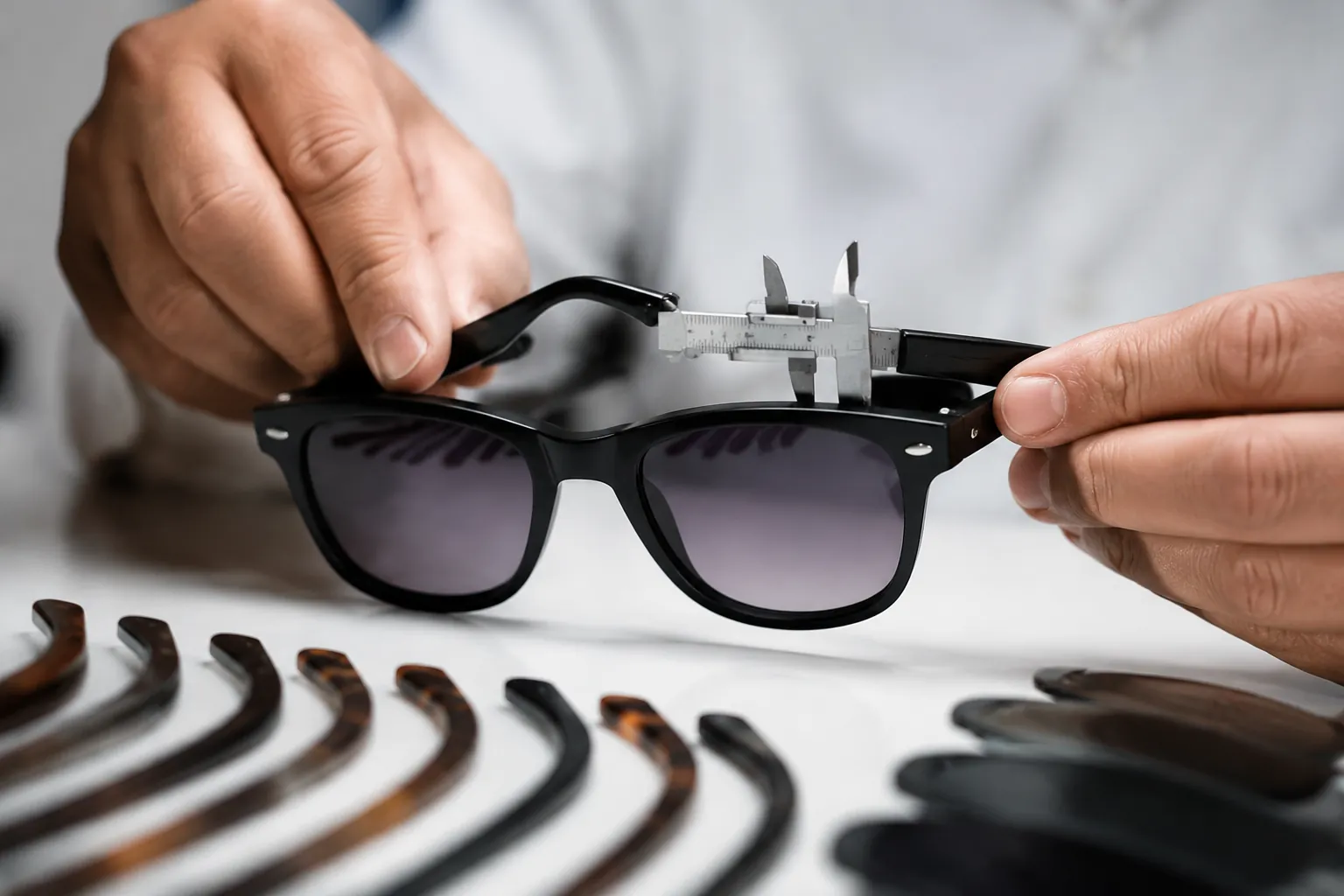
This guide is for brands, importers, distributors, and retail buyers sourcing kids' sunglasses at wholesale scale. Children's eyewear is not a smaller adult frame. Fit, UV claims, small parts, labeling, and market compliance need model-specific control. Use this guide to write a better RFQ, compare quotes, review samples, and prevent avoidable problems before production, inspection, and import.
Start With Age Band, Measurements, and Fit Tolerances
Many kids' sunglasses programs start badly: a buyer takes an adult bestseller and asks the factory to shrink it. That rarely works. The bridge may sit too low. Temples may run too long. Hinges can become weak after scaling. Children do not have smaller adult faces. Bridge height, head width, ear position, and temple-to-ear distance change fast as children grow.
Define the target age band before you discuss colors, logos, or packaging. Then lock the key dimensions. The ranges below are planning references only. Confirm final measurements against your target customer, physical samples, and the supplier's technical drawing. For custom molds, request drawings with critical dimensions and agreed tolerances. If a tolerance is not written into the drawing, purchase order, or quality agreement, it is not controlled.
| Age band | Typical front width | Temple length guide | Main sourcing risk | Recommended check |
|---|---|---|---|---|
| 2-4 years | Approx. 110-118 mm | Approx. 105-115 mm | Sliding nose fit, pressure behind ears, detachable parts | Use rounded geometry and test physical samples on an appropriate child head form or fit model before mold approval |
| 4-7 years | Approx. 116-124 mm | Approx. 112-122 mm | Temple too long; frame sits low during movement | Confirm bridge, front width, temple bend, and temple opening on physical samples |
| 7-10 years | Approx. 122-128 mm | Approx. 120-128 mm | Adult lens curve copied without comfort review | Check pantoscopic angle, lens edge finish, and temple opening force |
| 10-13 years | Approx. 126-132 mm | Approx. 125-135 mm | Frame pinches at temples or looks too childish for the channel | Review head width, hinge feel, styling direction, and retail positioning |
Ask the supplier to quote by size set, not only by design. One style may need two sizes if you want to cover younger and older children properly. LumiShades can start small runs from 50 pairs per design. Larger quantities usually improve unit economics because color setup, lens preparation, logo setup, packaging setup, and QC time are spread over more units.
Choose Frame Materials by Use, Age, and Market
Material choice affects safety, comfort, durability, cost, and compliance. Do not treat it as a color decision. A kids' frame should be light, smooth at skin-contact points, resistant to normal handling, stable in color, and suitable for the chemical rules of the destination market.
Weak material selection or poor processing creates predictable failures: cracked bridges, sharp broken temples, peeling coating, warped fronts, and restricted-substance risk. Avoid vague terms such as "kids safe material." State the material family, age band, color, finish, target weight if needed, and destination market.
Injection-molded plastics, including PC, are common because they can be light and impact resistant. Flexible TR-type materials are often used for active children because they tolerate twisting better than rigid structures, if the design supports that behavior. Acetate gives a premium fashion look and strong color depth, but it is heavier than many injection materials and needs careful polishing around the bridge, lens groove, and temple tips. Metal frames can work for older children, but they need tight control of solder joints, nose pads, screws, plating, and market-specific restricted-substance requirements.
- Toddlers: prioritize low-part-count designs, rounded edges, flexible temples, and low finished weight where the design allows.
- School-age children: specify hinge cycle checks, screw retention checks, and temple flexibility because children often twist frames when putting them on or taking them off.
- Acetate junior frames: request smooth polishing at the bridge, lens groove, temple tips, and any area that contacts the face.
- Printed or coated frames: require adhesion checks after curing, such as tape pull and dry/wet rub tests on the actual production material and finish.
- Metal components: control plating quality, burrs, nose pad security, screw retention, and applicable nickel or heavy-metal restrictions for the sales market.
LumiShades handles injection molding, acetate cutting, CNC milling, and decoration in-house. That matters when a sample needs bridge adjustment, thinner temples, revised logo placement, or weight reduction. Put those changes in writing. Photos are not enough.
Specify UV Protection, Lens Category, and Batch Checks
Kids' sunglasses are often sold as protective eyewear. The lens claim must be specific and testable. A dark lens is not the same as a UV-protective lens. Say exactly what protection you need and connect it to the standard for the sales market.
For most branded junior sunglasses, request UV400 or 100% UVA/UVB protection and verify it through appropriate product testing. Name the applicable standard in the RFQ: CE EN ISO 12312-1 for many European sunglasses requirements, ANSI Z80.3 for non-prescription sunglasses in the United States, and AS/NZS 1067 for Australia and New Zealand. LumiShades' stated compliance scope includes CE EN ISO 12312-1, ANSI Z80.3, AS/NZS 1067, FDA registration, REACH, ISO 9001, and BSCI. Product test reports should match the actual model, lens type, lens color, and frame or material configuration being supplied.
Lens category is based on visible light transmission. Darker is not automatically better for a child. Category 3 lenses are common for bright outdoor conditions. Lighter fashion lenses may fall into Category 1 or 2, depending on transmission. The label, instruction sheet, hangtag, online listing, and test report should all describe the same lens category and use limitation.
- Define lens material, commonly PC for kids because it is lightweight and impact resistant.
- Define UV claim, such as UV400 or 100% UVA/UVB, supported by test data for the relevant SKU.
- Define tint and coating: grey, smoke, brown, gradient, mirror, transparent fashion, or polarized if required.
- Define lens category and intended use condition.
- Approve the production lens color and coating, not only the first visual sample, because tint and mirror batches can vary.
For tinted lenses, request batch-level internal QC records or transmission readings where available. At minimum, bulk lenses should be compared with the approved master sample under controlled lighting and checked for UV protection with suitable equipment. Mirror coatings need extra abrasion and edge-quality control. Coating defects often appear at lens edges or high-contact areas during packing, transport, or retail handling.
Control Hinges, Small Parts, and Decoration
The highest-risk details in children's eyewear are often small. Screws back out. Decorative plates lift. Nose pads detach. Charms and accessories can create small-parts concerns, especially for younger age bands. Treat decoration and hinge selection as safety and durability decisions, not just branding choices.
LumiShades offers laser engraving, pad printing, and metal logo plates. Laser engraving is a low-added-part option for temple branding on many plastic and acetate frames, but contrast must be checked on light colors and curved surfaces. Pad printing works for colorful logos and character-style graphics. Its durability depends on material, surface treatment, curing time, ink system, and topcoat. Metal plates can look premium on older kids' fashion frames, but they need smooth edges, secure bonding or mechanical fixing, and pull-resistance checks.
| Detail | Best use | Control point | Typical failure |
|---|---|---|---|
| Laser logo | Low-added-part temple branding | Approve depth, position, contrast, and logo size on the curved temple | Logo too faint, uneven, or misaligned |
| Pad print | Bright retail artwork and color themes | Run tape pull and rub tests after full curing on production material | Ink scratches, smears, or flakes after handling |
| Metal plate | Older kids' fashion SKUs | Check edge smoothness, bonding, and pull resistance | Plate lifts at corners or creates a sharp edge |
| Screw hinge | Structured frames for older children | Check torque, hinge cycling, and screw retention | Screw backs out after repeated opening and closing |
| Flexible hinge or one-piece frame | Toddlers and active children | Check repeated bending, recovery, and surface stress marks | Temple warps, cracks, or loses shape after stress |
For very young children, fewer parts are usually better. Inspect packaging items too: pouch, hangtag, sticker, retail card, barcode label, and display pack. Avoid sharp tag pins, exposed staples, loose trim, and detachable accessories in toddler-positioned products. Packaging is part of the product. Treat it that way.
Map Compliance Before You Quote
A serious kids' sunglasses RFQ must name the destination markets. The supplier should not have to guess whether a shipment needs EU, US, Australian/New Zealand, or mixed-market documentation. If the same SKU will sell in multiple regions, align testing, labeling, warnings, and packaging artwork before mass production. Fixing a hangtag file is cheap. Relabeling finished goods is not.
For Europe, CE EN ISO 12312-1 is a key sunglasses standard, and REACH chemical restrictions can apply to plastics, inks, coatings, metal trim, and other materials. For the United States, ANSI Z80.3 is relevant to non-prescription sunglasses, and FDA registration is also relevant. For Australia and New Zealand, AS/NZS 1067 applies. Do not accept loose claims such as "export standard," "UV passed," or "children safe" without a named standard, report date, model reference, and scope.
Request documents that connect to the real product being purchased. A report for a different adult frame, different lens color, different lens category, or different frame material may not support your shipment, retailer onboarding, or marketplace compliance review. This matters even more when private-label packaging makes UV, outdoor, sport, fashion, or child-use claims.
- Product test report: should identify the model, lens type, lens category, frame or material details, applicable standard, report date, and issuing laboratory.
- Material declaration: useful for REACH review, retailer technical files, and internal restricted-substance screening.
- Factory documents: ISO 9001 and BSCI can support supplier approval, but they do not replace product-specific testing.
- Label approval: check CE mark use where applicable, lens category, warnings, importer or responsible-party details, barcode, age guidance, and country of origin.
Blunt rule: if the packaging says one thing and the report supports another, expect trouble. Customs, marketplace compliance teams, or retailer QA may reject the file. Align claims, reports, labels, retail packaging, and carton marks before goods leave the factory.
Understand MOQ, Pricing, and Lead Time
Kids' sunglasses often use more colors per design than adult programs. That helps retail displays, but it fragments production. A 600-pair order across 12 colors is not the same job as 600 pairs across two colors. Each color can require separate material preparation, color control, lens matching, logo setup, packaging segregation, and QC records.
LumiShades' MOQ starts at 50 pairs per design, which can support boutique tests, influencer drops, and new junior SKUs. Pricing usually improves at higher quantities because setup costs are spread across more units and material purchasing becomes more efficient. Exact pricing depends on frame material, lens specification, decoration method, packaging, documentation, inspection requirement, and order structure. A molded plastic frame with one laser logo and a basic pouch will not price like an acetate frame with mirror lenses, pad print artwork, retail card, barcode labels, and market-specific reports.
| Order level | Best use | Price behavior | Production advice |
|---|---|---|---|
| 50 pairs/design | Market test, boutique retail, photo launch | Highest unit cost because setup is spread over fewer units | Limit to 1-2 colors and one logo method |
| 300 pairs/design | Small wholesale launch | Better setup absorption than very small runs | Suitable for 2-4 colors if packaging is simple |
| 1000 pairs/design | Distributor or chain retail program | Stronger price efficiency and more stable production planning | Lock master samples, color standards, and carton plan before production |
| 5000+ pairs/design | Large seasonal buy | Best opportunity for volume pricing, subject to specification | Book material, lenses, packaging, testing, and inspection windows early |
Samples normally take 7-10 days after the design, color, logo file, and lens direction are confirmed. Bulk production is commonly planned at 25-35 days after sample approval and deposit, subject to order size, material availability, packaging complexity, testing, and factory schedule. Add time for sample shipping, fit review, artwork correction, compliance review, pre-shipment inspection, and freight. Buyers often remember production time and forget approval time. That is how a workable schedule becomes a late shipment.
Write a Practical RFQ for Kids' Sunglasses
A clean RFQ saves days of back-and-forth. It also stops suppliers from quoting the cheapest unclear version. For children's eyewear, include fit, safety, compliance, packaging, and inspection details at the first quote stage, not after price negotiation.
- Target age band: state 2-4, 4-7, 7-10, 10-13, or your own measured size range.
- Frame dimensions: request front width, lens width, bridge, temple length, temple opening, and finished weight target if important.
- Frame material: injection plastic, PC, TR-type flexible material, acetate, or metal, with color and finish.
- Lens specification: PC lens, UV400 or 100% UVA/UVB, tint, category, mirror or non-mirror, polarized or non-polarized.
- Compliance market: EU, US, Australia/New Zealand, or mixed markets; request only applicable documents and specify the standard by name.
- Decoration: laser engraving, pad print, metal plate, or no logo; provide vector logo files and placement drawings.
- Packaging: polybag, pouch, case, hangtag, retail card, barcode, warning label, carton marks, and inner-box quantity.
- Quantity plan: pairs per design, colors per design, reorder forecast if available, and required launch deadline.
- Inspection requirement: define major/minor defects, UV verification, hinge checks, scratches, burrs, logo position, and labeling accuracy.
For a first custom junior SKU, keep the program controlled: one frame size, two to four colors, one lens family, and one logo method. Expand after sales data and quality feedback come back. Too many launch variants make QC harder and can leave uneven stock across colors.
Lock QC Points Before Cartons Close
Kids' sunglasses need standard eyewear QC plus child-specific checks. Inspection should not stop at appearance. A shiny frame with poor UV protection, loose hinge screws, sharp burrs, insecure decoration, lens defects, or mismatched labeling should not pass as a minor issue.
LumiShades runs in-house QC, but buyers should still define acceptance points in writing. Check lens transmission and UV protection against the approved specification and applicable standard. Inspect frame symmetry, temple opening, screw tightness, burrs, sharp edges, lens seating, logo position, decoration adhesion, and packaging accuracy. For printed logos, run an adhesion check. For metal plates, check lifting edges and edge smoothness. For acetate, check polishing around the bridge, lens groove, and temple tips.
Factory-floor rule: do not approve bulk production from a beauty photo. Approve a physical master sample, then require production inspection against that sample and the written specification.
Useful QC controls include visual comparison to the approved color sample, logo position within the agreed artwork tolerance, no sharp edges at skin-contact points, lenses seated without gaps or rattle, and temple movement that is smooth but not loose. Hinges should be cycled during inspection, especially on frames for school-age children. If screws loosen during a short cycle check, rework the lot before packing.
Carton labeling also deserves attention. Importer information, SKU, color, lens category where required, barcode, country of origin, and age-related warnings must match the purchase order and retail packaging. Mixed cartons cause receiving errors. If a pre-shipment inspection finds repeated loose screws, incorrect hangtags, lens scratches, wrong barcodes, or mismatched lens categories, reserve time for correction and reinspection. That buffer is cheaper than emergency air freight after a missed retail window.
Have a custom sunglasses project in mind?
Send us your styles, target market and quantities and we will return a detailed quote with MOQ, lead time and a sample plan.
Get a QuoteWhy source this from Wenzhou with LumiShades
Wenzhou in Zhejiang Province is widely regarded as China’s eyewear manufacturing capital, producing a large share of the world’s sunglasses. That concentration matters to buyers: a deep local supply chain for acetate sheet, hinges, lens blanks, plating and packaging means shorter component lead times, easier color and material matching, and a workforce with decades of eyewear-specific skill. LumiShades has manufactured in this ecosystem since 2009, and our vertical integration — in-house injection molding, acetate cutting, CNC milling, lens tinting, decoration and quality control — means no part of your order is quietly subcontracted to a workshop you cannot audit.
For international buyers, that vertical control translates into accountability. When a single factory owns every step, defects are traced and fixed at source rather than bounced between vendors, and your specifications survive intact from first sample to bulk. We back this with 15+ years of experience, shipments to 60+ countries, more than 5 million pairs produced per year and a 98.5% on-time delivery rate. Our certifications — CE EN ISO 12312-1, FDA registration, ANSI Z80.3, AS/NZS 1067, REACH, ISO 9001 and BSCI audit — mean the compliance documentation your market requires already exists. Explore our manufacturing capabilities and quality control process to see how this works in practice.
Frequently asked questions
What is the safest starting MOQ for a new kids' sunglasses line? For a market test, 50 pairs per design can work if the specification is simple. Keep the first run to one size, one lens family, one logo method, and one or two colors. If you need better unit cost, more color options, or steadier production efficiency, plan around 300 pairs per design or more and confirm the exact MOQ by material, color, lens, and packaging.
Which lens standard should I request for kids' sunglasses sold in the US? For the US, request ANSI Z80.3 documentation for the actual non-prescription sunglasses SKU you are buying. Also confirm FDA registration status with the supplier. The report and packaging should match on UV claim, lens category, model reference, and lens type. Do not rely on a report for a different frame, different lens color, or adult model.
Can I use metal logo plates on children's sunglasses? Yes, but they are better suited to older kids' fashion frames than toddler products. Before approval, check that the plate has smooth edges, secure bonding or mechanical fixing, and acceptable pull resistance. For younger children, laser engraving or no added logo part is usually the lower-risk option because it avoids an extra detachable component.
How long should I allow from sample request to bulk shipment? Plan samples at about 7-10 days after the design, color, logo file, and lens direction are confirmed. Bulk production is commonly 25-35 days after sample approval and deposit, but this can change with order size, testing, packaging, and factory schedule. Add time for sample shipping, fit review, artwork corrections, compliance review, pre-shipment inspection, rework if needed, and freight.
What documents should I ask for if selling in Europe and Australia? For Europe, ask for CE EN ISO 12312-1 support and REACH-related material documentation. For Australia and New Zealand, ask for AS/NZS 1067 support. The report should identify the model, lens color, lens category, lens type, material or frame configuration, standard, report date, and issuing laboratory. Make sure your hangtag and packaging claims do not exceed what the reports support.
Are dark lenses better for children? Not automatically. UV protection is the key safety claim. Specify UV400 or 100% UVA/UVB, choose the correct lens category for intended use, and confirm the production lens matches the approved sample and test report. A darker tint without verified UV protection is not a reliable protective specification.
Ready to start?
Explore our sport wrap sunglasses or request a quote — our sales team replies within 12 hours.
Request a Quote