
Best Branding Placement for Custom Sunglasses
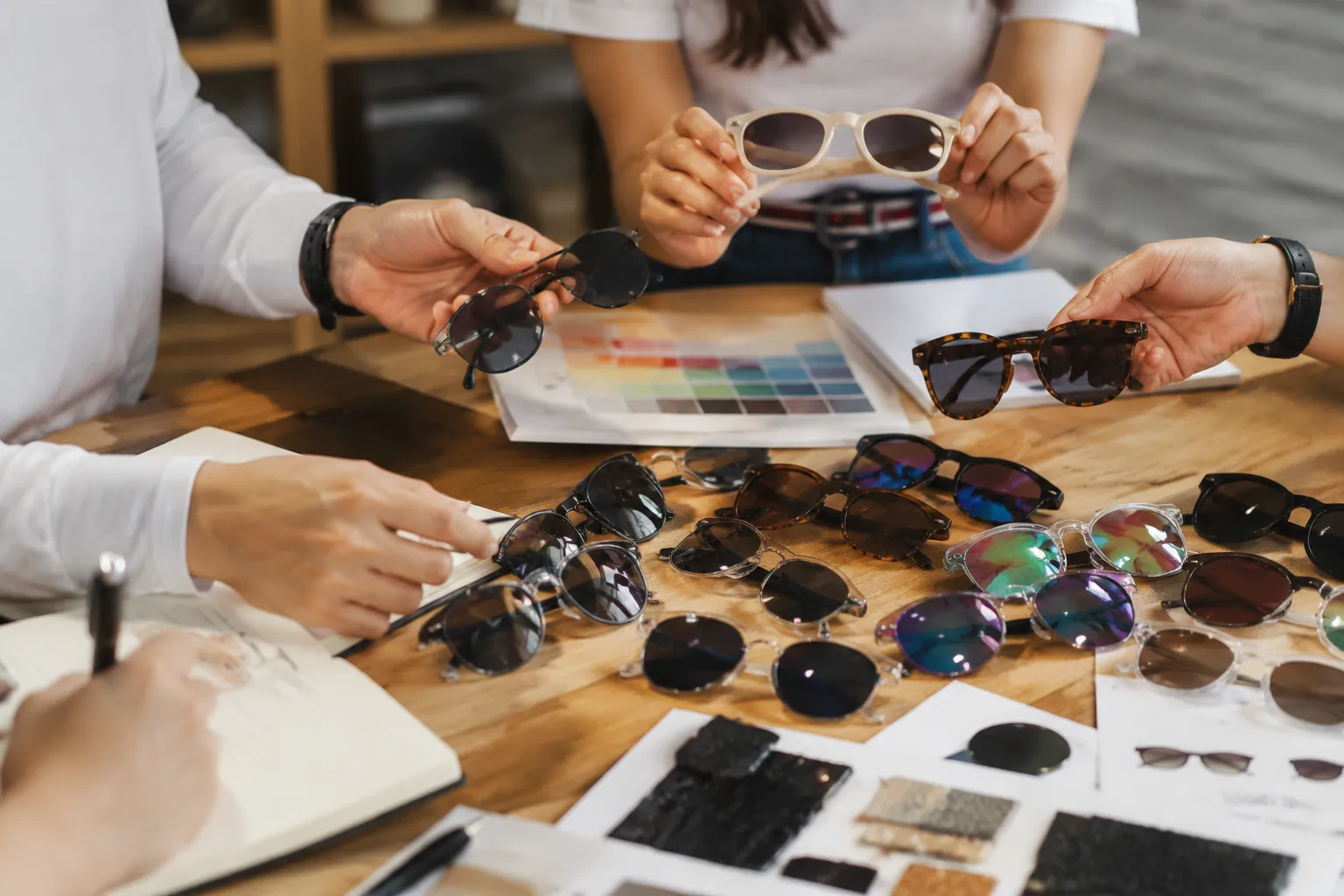
This guide is for brand owners, importers, distributors, and retail buyers sourcing custom sunglasses in volume. It compares three common branding positions—inside print, outer temple branding, and lens marking—using the factors that matter in purchasing: retail visibility, wear durability, unit cost, lead time, and compliance risk. If you are deciding where to spend a limited branding budget, this guide helps you choose placements that look right on the shelf and still hold up after normal use. It also shows when combining two branding methods is worth the extra cost, and when it is not.
Start with the buying job, not the logo
Buyers often start by asking where a logo will look best. That is not the first question.
Start with the sales channel, target price, and how long the product needs to keep its branded appearance under normal handling.
A sunglass line sold in a tourist shop, fashion chain, optical boutique, or online marketplace does not need the same branding logic. Shelf-facing products need clear recognition from a typical retail viewing distance. Reorder-driven programs need branding that still looks acceptable after folding, wiping, storage, and shipping.
There are three common branding zones on sunglasses:
- Inside print: logo, model code, compliance marks, or size information printed on the inner temple.
- Outer temple branding: visible logo on the outside of the arm, usually pad printed, laser marked, engraved, or applied as a metal logo plate.
- Lens marking: logo placed on one lens by laser, screen print, hot stamp, or another process suited to the lens material and coating system.
For most volume orders, the practical choice is simple. If budget is tight, keep legal and identification information inside the temple and spend branding money on the outer temple. If the line is meant to feel more premium, pair outer temple branding with a restrained lens mark. Lens-only branding rarely does enough at retail, especially when frames are displayed folded in trays.
Match decoration complexity to the channel. For a promotional or entry-fashion program, prioritize unit cost, legibility, and fast approval. For a premium private label line, prioritize placement symmetry, surface quality, and resistance to normal wear. The logo should support the commercial job of the frame. It should not dictate the spec by itself.
Head-to-head: visibility, durability, cost, and value
The table below reflects typical trade-offs on injection-molded, TR90, metal, and acetate sunglasses produced at factory scale. Actual pricing varies by logo size, print colors, curvature, fixture requirements, and packaging, but the pattern is consistent.
| Branding location | Retail visibility | Wear durability | Typical added cost | Approx. MOQ fit | Best use case |
|---|---|---|---|---|---|
| Inside temple print | Low | Medium | Lowest | 50-300 pairs | Private label entry lines, compliance marking, SKU control |
| Outer temple pad print | High | Medium | Low | 100-1000 pairs | Retail programs needing visible brand recognition |
| Outer temple laser engraving | High | High on suitable substrates | Low to medium | 300-3000 pairs | Technical, sporty, or minimalist branding |
| Metal logo plate on outer temple | High | High if fixed well | Medium to high | 300+ pairs | Mid-tier and premium fashion collections |
| Lens marking | Medium | High for laser, lower for surface print | Low to medium | 300-5000 pairs | Brand reinforcement, sport and fashion crossover lines |
Inside print is the cheapest place to put brand information because it often shares setup with mandatory or operational markings. Outer temple branding creates the strongest first impression in store. Lens marking adds brand recognition during wear and in product photography, but its retail effect depends on how the product is merchandised and whether the mark is visible on a folded frame.
Many buyers get the best return from a two-point approach: inner temple for legal and tracking information, outer temple for the main logo. That keeps the unit economical while giving the frame visible shelf identity. For premium programs, a small lens mark can add value if it is subtle, correctly placed, and technically stable.
Inside temple print: cheap, useful, and overlooked
Inside print does not sell the frame by itself, but it does important operational work. It is where buyers usually place the brand name, model code, color code, country of origin statement where required, lens category references where applicable, and approved artwork for traceability.
In production, inside printing is usually done after frame finishing and before final packing. The surface has to be clean, dry, and stable. On injection frames, residual mold release, dust, or uneven cooling can reduce print adhesion. On acetate, high-gloss polishing can also affect ink hold unless the print area is controlled properly. A print zone that looks smooth to the eye may still need surface preparation or tighter curing control to hold the ink film.
Ask for these details:
- Print tolerance: ask for left-right positioning within a defined production window, and agree the logo size tolerance for repeat orders.
- Line thickness: very fine strokes can break up on curved substrates, especially in small logos or fine-serif text.
- Ink system: solvent-based, UV-cured, or laser-etched marking each behave differently on TR90, acetate, and metal.
- Rub resistance: request dry-rub and wet-rub confirmation after full cure, not just an immediate visual check.
Inside print is also the most practical place to carry compliance information because it is hidden from the consumer unless the frame is handled. That said, the wording still has to match the approved product specification and destination market. If the artwork changes after testing, the marking may need to be reapproved.
The weakness is straightforward. Customers do not see it on the shelf unless they pick up the frame. If the retailer wants visible brand presence without adding packaging cost, inner temple print is not enough.
Outer temple branding: the clearest shelf signal
If a buyer asks for one visible logo position only, outer temple branding is usually the answer. It is the easiest branding area for a shopper to notice on a display, especially for folded frames presented side-on or at a slight angle. It also photographs well for e-commerce listings and social ads.
The method matters. Pad printing is common and cost-efficient for simple one-color or two-color logos. Laser engraving works well on certain coated metals and some frame materials when the visual effect fits the brand. Metal logo plates cost more, need extra assembly steps, and make more sense at higher volumes, especially if the same plate can be reused across several colorways.
Real factory constraints matter here:
- The logo area must be flat enough, or predictably curved enough, for consistent transfer.
- Artwork line weight cannot be too thin, or fine edges can break down during printing or after abrasion.
- For left and right temples, alignment should be checked against hinge position and temple taper so both sides look balanced.
- Adhesion and rub resistance should be checked after curing, not just immediately after print.
For lower-price programs, outer temple pad print usually gives the best cost-to-visibility result. On acetate or mixed-material frames positioned as more premium, a metal plate or engraved treatment can justify a higher retail price because the brand mark feels built into the frame rather than added on top. Plate thickness, mounting method, and temple curve all need to work together so the logo sits cleanly and does not interfere with assembly.
Common failure points are predictable. Too much ink can soften edge sharpness. Too little pressure can leave a weak transfer. Poor curing can cause fingerprinting in packing. And if the temple surface is too glossy, too soft, or too textured, the logo can look sharp on the sample and unstable in bulk production. Process control matters more than the mockup.
Lens marking: useful, but not the default
Lens branding has a different job. It is less about identifying the frame on a crowded shelf and more about reinforcing the brand while the product is worn. On sport styles and fashion aviators, a small lens logo can make the sunglasses feel more intentional. It can also help distinguish your product from low-effort private label copies.
Still, lens marking is not a default choice. Ask four direct questions: Will the logo interfere with the wearer's field of view? Does the lens material support the marking process cleanly? Will the mark survive cleaning and normal abrasion? Does the retail price support the extra operation?
At factory level, the answer depends on lens type and coating. Standard polycarbonate lenses used in many promotional and fashion sunglasses can take certain markings well, but process settings must avoid haze, burn, or distortion. A laser setting that is too aggressive can leave a visible whitening halo on dark tints or coating damage on mirrored films. Surface-applied lens logos may look fine at packing and then fail after repeated wiping with microfiber cloths or cleaning fluids. Laser marking often holds better, but the visual style is more limited and must be tested on the exact tint, base curve, and coating stack.
Some buyers use a very small lens logo, often placed in the upper corner of one lens, so the field of view stays clean while the frame still carries a branded look. Check the logo under retail lighting, daylight, and photography conditions because a mark that feels subtle in person can disappear in product images.
If the frames must comply with CE EN ISO 12312-1, ANSI Z80.3, or AS/NZS 1067 under the approved lens specification, make sure the branding method does not alter lens performance or create cosmetic rejection issues. Heat from marking, coating damage, or local opacity changes can become a quality problem even if the logo itself looks fine.
Durability depends on process control
Many branding complaints blamed on location are actually process failures. A poor outer temple print can fail faster than a well-made lens mark, and a badly prepared inner temple print can start lifting in the carton. The same is true for metal plates that are attached with the wrong adhesive or installed before the temple surface is properly cleaned.
Branding quality depends on coordination between material preparation, decoration, curing, assembly, and inspection. If those steps are split across too many subcontractors, defects are harder to catch and sample approval can become misleading.
A practical decoration control sequence looks like this:
- Confirm artwork size, line thickness, Pantone reference, and left-right placement window.
- Check substrate condition after polishing or molding for oil, dust, and surface consistency.
- Run pre-production samples and compare logo sharpness across colorways and materials.
- Cure or fix the decoration according to the material and ink system.
- Perform rub, tape, and appearance checks before final assembly and again before packing.
For volume orders, ask for approval samples made on actual production material, not just a photo or digital mockup. A 7 to 10 day sample cycle is common, and it is much cheaper than discovering logo wear problems after bulk production has started. For a new frame family, ask for at least one sample on a light colorway and one on a dark colorway, because logo contrast and surface behavior can differ materially.
Acceptable branding should remain legible after normal handling and a basic rub check. If the decoration is already weak during sample review, it will not improve in production.
Cost and lead time: where branding pays back
Branding choice should follow quantity. The economics improve at larger volumes because setup costs are spread over more units. That pricing logic affects which branding methods make sense.
On small runs, every extra setup hurts. A simple inner temple print and one-color outer temple print is usually the safest build. On larger runs, fixed setup costs are spread over more units, so laser marking, metal logo plates, or combined frame-and-lens branding become easier to justify.
Lead time also matters. Typical sample timing is 7 to 10 days. Bulk production commonly takes 25 to 35 days after sample approval and deposit, assuming artwork and packaging are locked. Branding can add delay when buyers keep revising logo position, logo color, or lens mark size after the sample stage. A logo plate may also add component lead time if the insert or mold is not already in stock.
| Order volume | Branding approach that usually fits | Cost logic | Lead-time risk |
|---|---|---|---|
| 50-299 pairs | Inside print plus simple outer print | Lowest setup burden | Low if artwork is final early |
| 300-999 pairs | Outer print, optional lens mark | Better spread of setup cost | Medium if multiple colorways need matching |
| 1000-4999 pairs | Outer branding plus lens mark or logo plate | Added decoration starts to look efficient | Medium, manageable with an approved sample |
| 5000+ pairs | Full branding system across frame, lens, and packaging | Best unit economics | Mostly driven by component planning, not print time |
For reference, many factory programs become more efficient once the artwork is locked by the start of sampling. If the buyer changes logo placement after the approved sample, a delay is likely even before rework or new fixtures are considered. If packaging also needs matching marks, add more time for carton art, bag print, or barcode revisions.
Short version: if you are testing a design, keep branding simple. If you are building a repeat program, put money where customers will notice it and where the process can hold quality consistently.
A practical decision framework for buyers
If you need a working rule, use this one.
- Choose inside temple print if the line is price-sensitive, operational clarity matters, and visible branding is not the main sales driver.
- Choose outer temple branding if you need immediate shelf recognition and only have budget for one visible brand location.
- Choose lens marking if the line sells partly on image during wear and the retail price can carry the extra process.
- Choose outer temple plus lens marking for mid-tier and premium programs where the frame needs both shelf presence and stronger branded identity after purchase.
- Choose metal logo plates when you want a more permanent, premium look and the order size can absorb the assembly cost.
Before placing the PO, ask for a final checklist covering decoration method, logo size, exact placement drawing, color reference, abrasion standard used internally, and confirmation that branding does not conflict with the approved compliance basis for the product. Also ask for the artwork file in vector format and a measurement drawing that shows the logo relative to hinge centerline, temple width, and the visible fold zone.
A useful buyer-side acceptance standard is simple: the logo should be centered within the agreed window, remain legible after a basic rub check, and match the approved sample on the real material. If the product has multiple colorways, approve at least one light and one dark version so contrast issues are not discovered late.
The best branding position is not universal. It depends on how the sunglasses will be displayed, worn, cleaned, reordered, and priced. That is the decision that holds up in retail.
Have a custom sunglasses project in mind?
Send us your styles, target market and quantities and we will return a detailed quote with MOQ, lead time and a sample plan.
Get a QuoteWhy source this from Wenzhou with LumiShades
Wenzhou in Zhejiang Province is widely regarded as China’s eyewear manufacturing capital, producing a large share of the world’s sunglasses. That concentration matters to buyers: a deep local supply chain for acetate sheet, hinges, lens blanks, plating and packaging means shorter component lead times, easier color and material matching, and a workforce with decades of eyewear-specific skill. LumiShades has manufactured in this ecosystem since 2009, and our vertical integration — in-house injection molding, acetate cutting, CNC milling, lens tinting, decoration and quality control — means no part of your order is quietly subcontracted to a workshop you cannot audit.
For international buyers, that vertical control translates into accountability. When a single factory owns every step, defects are traced and fixed at source rather than bounced between vendors, and your specifications survive intact from first sample to bulk. We back this with 15+ years of experience, shipments to 60+ countries, more than 5 million pairs produced per year and a 98.5% on-time delivery rate. Our certifications — CE EN ISO 12312-1, FDA registration, ANSI Z80.3, AS/NZS 1067, REACH, ISO 9001 and BSCI audit — mean the compliance documentation your market requires already exists. Explore our manufacturing capabilities and quality control process to see how this works in practice.
Frequently asked questions
If I can afford only one visible logo position, which one usually performs best? Outer temple branding usually gives the best retail return because shoppers can see it immediately on display. It is the strongest option for shelf recognition at a moderate added cost. If your frame is often shown folded, ask for a proof that shows the logo position from the actual retail viewing angle before approving the artwork.
Is lens branding more durable than outer temple printing? It can be, but only when the lens marking method is matched to the lens material and coating. Laser marking on a compatible lens often lasts better than a surface print, while surface-applied marks can wear faster if the buyer uses alcohol wipes or abrasive cleaning. Always test the exact lens build you plan to order.
Can inner temple print include compliance-related information? Yes, if the wording matches the approved product specification and the destination market requirements. Use the exact compliance text that was tested or approved for that model, and do not add standards references unless they are part of the verified build. If the market changes, recheck the marking before bulk production.
At what order size do metal logo plates start making sense? They usually become easier to justify from around 300 pairs upward, and more so at 1000 pairs or more, because the plate and assembly cost are spread across more units. They make the most sense when the brand wants a premium look and the same hardware can be reused across colorways. Ask for a physical sample, because temple thickness and curvature affect fit.
How should I approve branding before bulk production? Approve a physical sample made on the actual frame and lens materials, with final artwork, placement, and color reference. Check the sample under normal light, not only in photos. Confirm rub resistance, alignment, and legibility, then lock the file set before the PO so the factory is not forced to guess later.
Ready to start?
Explore our square sunglasses or request a quote — our sales team replies within 12 hours.
Request a Quote