
Best Logo Methods for Low-MOQ Custom Sunglasses
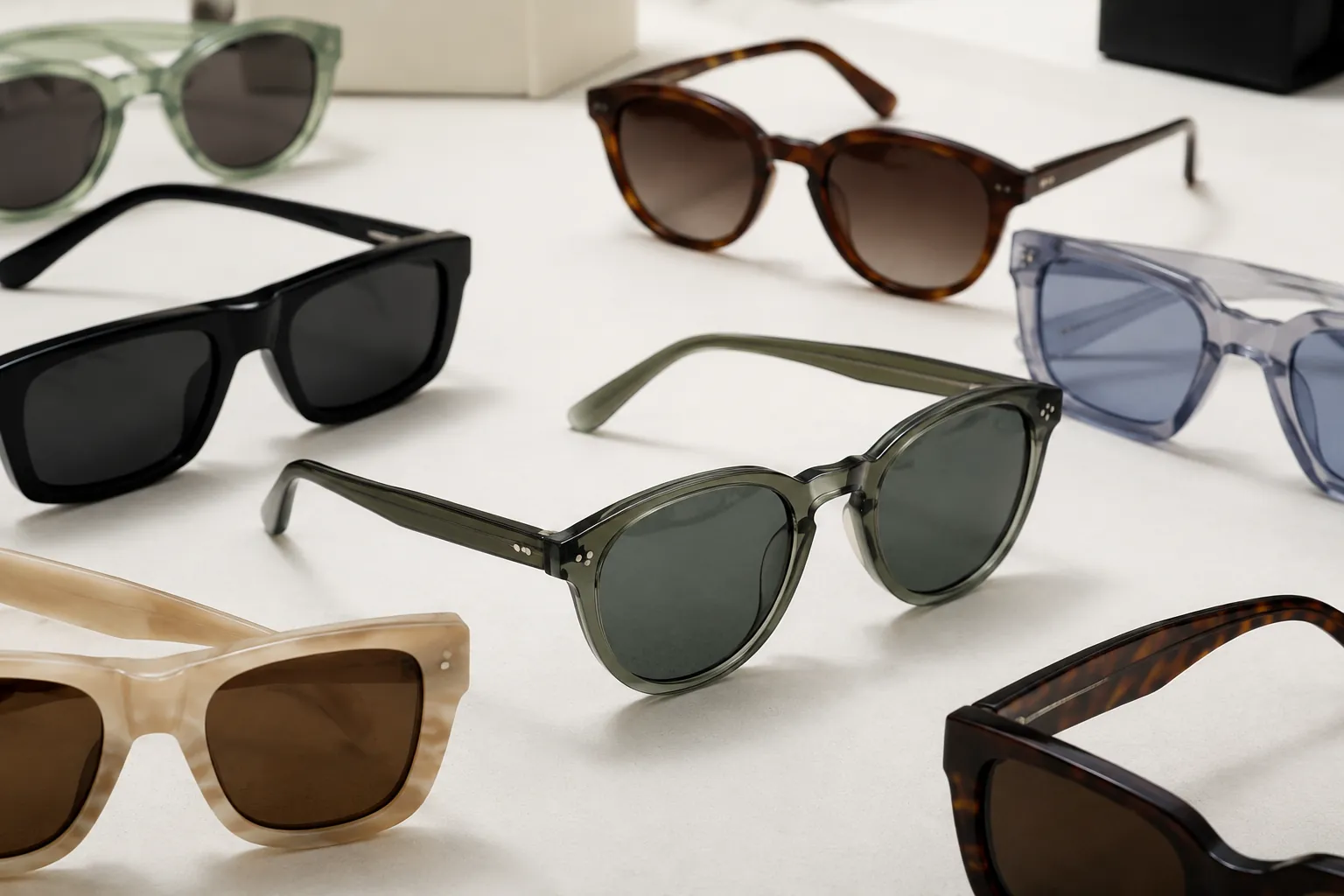
This guide is for buyers ordering branded sunglasses in short runs: promotional distributors, startup labels, importers, and retailers testing a style before scaling. In low-MOQ eyewear, logo decoration affects more than appearance. It changes setup cost, sample effort, production handling, and how well the branding survives packing and daily wear. Start with three decisions, in this order: frame material, target quantity, and brand position. Get those right first. The decoration method gets much easier to choose.
Start with the three decisions that control the outcome
Many buyers start with the artwork and ask, "Can you put this logo on the temple?" For low-volume sunglasses, that is usually the wrong first question. Choose decoration in this order: material first, quantity second, look third. Reverse that order and a logo that looks clean in a mockup can become expensive, fragile, or inconsistent in production.
- Material first. Injection-molded PC, TR90, acetate, and metal temples do not accept decoration the same way. Ink adhesion, engraving contrast, and hardware attachment all depend on the substrate and surface finish.
- Quantity second. On small orders, setup charges, fixtures, and sample work have a bigger effect per pair. A method with a low unit add-on can still be the wrong choice if the setup burden is high.
- Look third. A giveaway frame, a mid-range private-label style, and a premium acetate model should not default to the same branding treatment. The logo needs to match how the product will be sold.
At low MOQ, the gap between methods matters. A one-color pad print usually adds less process complexity than a custom metal plate. A plate may improve perceived value, but it also brings more variables: fit, recess quality, bonding, alignment, and cosmetic inspection.
A simple rule helps. If the program sells mainly on price, keep decoration simple. If the frame needs stronger retail presence, spend on branding the customer will actually see, usually on the outer temple.
What each decoration method does well at low MOQ
For small-run branded sunglasses, four methods matter most: pad printing, laser engraving, metal logo plates, and molded branding. Each solves a different problem. None is best in every case.
| Method | Best Materials | Typical Logo Size | Small-Run Cost Effect | Durability | Lead-Time Impact |
|---|---|---|---|---|---|
| Pad printing | PC, TR90, painted or coated temples, some acetate | Commonly used for small temple logos; exact size depends on temple geometry and artwork detail | Usually the lowest setup burden for 1-2 colors | Moderate; depends on ink system, curing, and surface preparation | Usually low; often the easiest method to sample |
| Laser engraving | Metal parts, coated surfaces, acetate with visible contrast, some painted plastics | Suitable for small logos and fine detail when the substrate gives clear contrast | Low to moderate | Usually high because the mark is engraved rather than printed | Usually low |
| Metal logo plate | Acetate temples, thicker injected temples | Small plate formats are common; actual size depends on temple thickness and recess design | Higher due to hardware, recess work, and assembly handling | Can be high if fit, bonding, and inspection are controlled | Moderate; more approval points than print or laser |
| Molded branding | Injected plastic only | Built into the mold or mold insert | Usually poor for small runs because tooling or insert cost dominates | High and permanent | Higher during development or revision |
Pad printing is the default for many promotional sunglasses because it is flexible and usually easy to set up. It works best for simple one-color or two-color logos on a reasonably flat temple area. Ask about the actual print zone. Curvature and texture can reduce edge sharpness and registration.
Laser engraving works well when the brand wants a quieter look or when print wear is a concern. It is especially useful on metal temples and on surfaces where engraving creates clear tonal contrast. That last point matters. If the mark does not stand out from the substrate, precision alone will not save it.
Metal logo plates are a common upgrade for premium temple branding, especially on acetate. They add depth, reflectivity, and a more finished look. They also add risk. Plate thickness, edge finish, recess depth, bonding method, and alignment all need control. On low MOQ, that extra work needs to be justified by the frame's retail position.
Molded branding is rarely the right answer for a pilot run. A logo formed into the injection mold is durable and integrated, but mold inserts or tool revisions usually do not make sense at low volume. This method fits stable programs with expected repeat orders.
Match the logo method to the frame material
Material behavior is where many sourcing mistakes start. A method that performs well on one substrate can fail on another.
- Injection-molded PC: Often a practical choice for pad printing. Adhesion depends on surface energy, mold-release control, and any top coating used. Ask for adhesion and rub-resistance checks after curing, not just a visual sample.
- TR90 and similar flexible materials: Printable, but repeated flexing can shorten print life. Keep the logo away from high-bend zones near the ear curve and hinge area where possible.
- Acetate: Often well suited to laser engraving and metal plates, especially on thicker temples. Pad printing is possible, but polished surfaces may need preparation to improve adhesion.
- Metal temples or metal inserts: Laser engraving is often the cleanest option. Pad print can also work on metal, but only with solid process control for adhesion and curing.
Geometry matters too. A temple sidewall that looks flat on screen may still have draft angle, taper, or curvature that cuts down the usable print or engraving area. Slim fashion temples may leave only a narrow decoration zone. A metal plate may require enough wall thickness to form a clean recess without weakening the side profile or hurting appearance.
Review artwork at actual size. Temple logos are small. Very fine reversed text, thin serifs, and delicate lines often lose clarity in both print and engraving. In many cases, the best production file is a simplified version of the master logo.
Low-MOQ cost logic: where buyers overspend first
At low volume, decoration cost has to be judged as part of the total order cost, not only as a per-pair add-on. The smaller the order, the more setup, handling, and reject risk matter. That is why the option that looks cheapest in a quotation can end up costing more if it triggers extra sample rounds or cosmetic failures.
In practice, buyers often compare methods across rough volume bands such as pilot runs, small retail tests, and repeat production. A simple pad print can stay efficient across several of those stages. A metal plate or molded feature usually needs a stronger business case.
| Order Size | Best Decoration Starting Point | Main Cost Risk | Best Buyer Strategy |
|---|---|---|---|
| 50-100 pairs | One-color pad print or basic laser | Setup cost and sample revisions | Keep artwork simple and limit colors |
| 100-300 pairs | Pad print, laser, selective plate use | Rejects on premium cosmetic finishes | Use upgraded decoration only where it adds clear retail value |
| 300-1,000 pairs | Pad print, laser, metal plate | QC consistency across larger batches | Define approval standards and tolerances before bulk production |
| 1,000+ pairs | All methods, including molded branding | Tooling or revision cost if design changes late | Use mold-based branding only after the frame and logo are stable |
Common low-MOQ overspending patterns are predictable:
- Choosing a metal plate too early. It may suit a premium concept, but on a very small run the added hardware, assembly, and inspection burden may not be worth it.
- Adding too many print colors. Each extra color adds another pass and tighter registration demands, especially on curved temples.
- Approving artwork without production adjustment. Simplifying small details often improves both appearance and consistency.
- Requesting molded branding for a trial order. Tool changes usually make sense only when the same frame is expected to repeat at scale.
If the program is a short campaign or giveaway, the frame is mainly a communication tool. If it is an initial retail line, spend where the customer will notice it. Usually that means the outer temple, not hidden or secondary details.
Lead time and sample approval: what actually slows projects
Decoration alone does not usually delay a project. Approval loops do. Sampling and production timing vary by factory, material, order size, and season, so ask for confirmed timelines on the specific program. Do not assume a standard number of days.
The slow points are usually the same:
- Artwork cleanup. Gradients, tiny reversed text, and very thin strokes often need to be rebuilt before printing or engraving.
- Placement confirmation. Left temple, right temple, both temples, inner-arm branding, and lens corner print should be confirmed clearly in writing and on the artwork file.
- Color matching. For pad print, provide a Pantone reference or another clearly approved standard. Instructions such as "gold" or "white" are too vague for repeat production.
- Surface compatibility checks. New paints, rubber finishes, and coated temples may require adhesion and rub checks before bulk production starts.
For placement, expect normal production tolerance, not perfect symmetry. Define the acceptable tolerance with the supplier during sampling, especially for visible outer-temple branding. Reflective hardware such as metal plates usually needs tighter cosmetic control than ink because small misalignment is easier to spot.
If speed matters, choose a lower-complexity method. One-color pad print is often the fastest route for sampling. Straightforward laser engraving can also move quickly when the material gives clear contrast. Metal plates are not always slow, but they add more approval points because the plate finish, thickness, fit, and attachment all need confirmation.
Ask for a pre-production sample made under real production conditions, not only a hand-finished mockup. That exposes problems early: weak print adhesion, low engraving contrast, recess misfit, or logo placement that looks different on the physical frame than it did in a rendering.
Durability and compliance are part of the branding decision
Branding should never interfere with eyewear performance. Buyers sometimes focus on logo appearance and forget the product still has to function and comply as sunglasses. For export programs, that usually means confirming the market requirements that apply, such as CE EN ISO 12312-1, ANSI Z80.3, AS/NZS 1067, REACH, and FDA registration where relevant. Management and supply-chain standards such as ISO 9001 and BSCI can indicate stronger factory systems, but they do not replace product-specific testing or market-specific documentation.
Decoration affects durability in ways that often show up only after packing and shipping. A printed logo that scuffs during bagging or carton movement is still a branding failure. So is a metal plate that lifts or shows adhesive problems after heat exposure, even if the frame itself remains sound.
Useful QC checkpoints include:
- Print adhesion testing after full curing rather than immediately after application.
- Rub resistance checks on outer-temple logos that will be handled repeatedly.
- Position consistency review across left and right temples and across multiple pairs.
- Visual inspection for skew, scratches, contamination, plate gaps, or adhesive squeeze-out.
- Lens branding review to confirm the mark does not interfere with vision or create avoidable complaints.
Lens decoration needs extra caution. Corner logos can work, but they should stay outside the wearer's useful field of view and should not distract from the sunglass's main job. Decorative branding is always secondary to UV protection, optical performance, and chemical compliance for the destination market.
A practical buyer framework by order type
If you are stuck between methods, decide by selling scenario. Not by preference alone.
| Buyer Type | Typical Quantity | Best Starting Method | Why It Usually Works |
|---|---|---|---|
| Promotional campaign buyer | 50-300 pairs | One-color pad print | Low setup burden, straightforward sampling, and clear logo visibility |
| Startup retail brand | 100-500 pairs | Pad print or laser, depending on material | Keeps the first run lean while testing customer response |
| Premium acetate capsule | 100-300 pairs | Metal logo plate or laser engraving | Adds perceived value when temple thickness and retail position support it |
| Repeat volume program | 1,000+ pairs | Molded branding or upgraded hardware | Development and tooling costs are easier to justify across larger repeat volume |
The shortest decision path is simple. For giveaways or price-sensitive campaigns, start with print. For understated branding, check engraving. For premium acetate, consider a plate only if the frame and price point support it. For stable repeat-volume programs, molded branding becomes commercially reasonable only after demand is proven and the frame design is unlikely to change.
That is the point of low MOQ. Test demand, quality expectations, and brand presentation without adding avoidable cost or production risk.
Checklist to send your factory before sampling
Most decoration problems start with incomplete instructions. A short, exact brief cuts sample loops and makes quotations easier to compare.
- Logo file: Send vector artwork and confirm that line thickness and spacing are suitable for small temple application.
- Method request: Specify pad print, laser engraving, or metal plate, or ask the factory to sample two methods on the same frame for comparison.
- Position: State left temple, right temple, both, inner temple, lens corner, or packaging only.
- Size: Give actual width and height in millimeters rather than vague instructions such as "small" or "same as before."
- Color or finish: Provide a Pantone reference for print, define the required contrast for laser, or specify metal finish such as shiny, matte, brushed, or gunmetal.
- Quantity: Confirm whether the order is a short pilot run or a repeat program, because that changes the most suitable method.
- Durability expectation: State whether the product is for resale, long-term brand use, or a short campaign giveaway.
- Compliance market: Confirm target-market requirements and documentation needs before sampling starts.
A supplier with in-house molding, acetate machining, decoration, and QC may be able to advise faster on what is practical at low MOQ, but the buyer still needs to provide a complete brief. Good sourcing is not complicated. It is precise. When the brief is clear, the factory can recommend the right branding method earlier, quote more accurately, and reduce avoidable approval cycles.
Have a custom sunglasses project in mind?
Send us your styles, target market and quantities and we will return a detailed quote with MOQ, lead time and a sample plan.
Get a QuoteWhy source this from Wenzhou with LumiShades
Wenzhou in Zhejiang Province is widely regarded as China’s eyewear manufacturing capital, producing a large share of the world’s sunglasses. That concentration matters to buyers: a deep local supply chain for acetate sheet, hinges, lens blanks, plating and packaging means shorter component lead times, easier color and material matching, and a workforce with decades of eyewear-specific skill. LumiShades has manufactured in this ecosystem since 2009, and our vertical integration — in-house injection molding, acetate cutting, CNC milling, lens tinting, decoration and quality control — means no part of your order is quietly subcontracted to a workshop you cannot audit.
For international buyers, that vertical control translates into accountability. When a single factory owns every step, defects are traced and fixed at source rather than bounced between vendors, and your specifications survive intact from first sample to bulk. We back this with 15+ years of experience, shipments to 60+ countries, more than 5 million pairs produced per year and a 98.5% on-time delivery rate. Our certifications — CE EN ISO 12312-1, FDA registration, ANSI Z80.3, AS/NZS 1067, REACH, ISO 9001 and BSCI audit — mean the compliance documentation your market requires already exists. Explore our manufacturing capabilities and quality control process to see how this works in practice.
Frequently asked questions
What is the safest logo method for a 50-pair promotional order? In most cases, start with one-color pad printing on the temple. It usually has the lowest setup burden and is the easiest method to sample quickly. Before approval, ask the supplier to confirm the print area, provide a production sample, and perform adhesion and rub-resistance checks after curing.
Are metal logo plates worth it below 300 pairs? They can be, but only when the frame is positioned as a premium retail item and the added cost is supported by the selling price and margin. Ask the supplier to quote the plate, recess work, attachment method, and any extra sampling cost separately. Then compare that against a laser-engraved or printed version on the same frame so you can judge whether the visual upgrade is commercially justified.
Can the same logo method work on both acetate and injected plastic? Sometimes, but performance can differ by material and surface finish. Pad printing may work on both, but adhesion and wear resistance should be checked on each substrate. Metal plates are generally more suitable for acetate or thicker injected temples, while molded branding applies only to injected frames. The practical step is to ask for material-specific samples rather than assuming the same result across all frame types.
Does logo decoration affect compliance? It can if the decoration interferes with the product's function or creates a durability issue. For example, lens branding should not obstruct vision, and any decoration should remain compatible with the product's required performance and chemical compliance. Confirm the destination-market requirements early, including standards such as CE EN ISO 12312-1, ANSI Z80.3, AS/NZS 1067, REACH, and FDA registration where relevant.
How can I shorten sample approval time? Send a complete technical brief at the start: vector artwork, exact logo size in millimeters, placement by side, color reference, decoration method, frame material, and target quantity. Ask the factory to mark the logo position on the sample approval sheet and to note any artwork simplification needed for production. Most delays come from unclear placement, vague color instructions, and artwork that is too fine for the actual temple size.
Ready to start?
Explore our aviator sunglasses or request a quote — our sales team replies within 12 hours.
Request a Quote