
Build a Sunglasses Line Around One Signature Detail
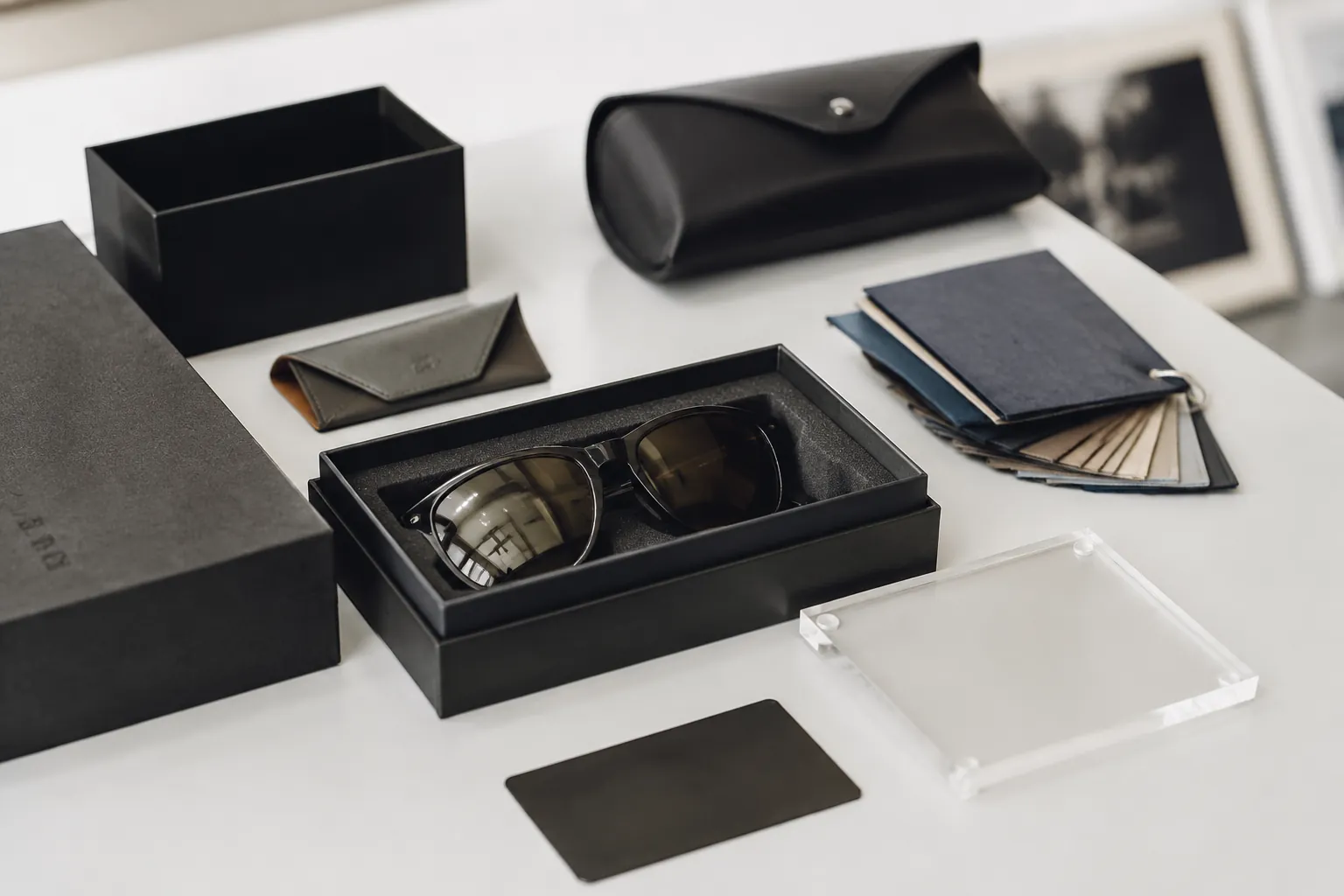
This guide is for brand owners, importers, distributors, and retailers building custom sunglasses lines at production scale. The goal is not to make every frame match. It is to build a line that feels recognizably yours across different shapes, materials, and price points. Pick one design marker carefully and engineer it for repeat use. Done well, it improves shelf recognition, makes sample reviews easier, and keeps MOQ, tooling, and compliance decisions easier to manage.
Start with a repeatable brand marker, not a hero frame
Many buyers start with one standout frame and try to stretch that look across the rest of the collection. In production, that often fails. A detail that works on one construction may not transfer cleanly to another. Build the range around one repeatable brand marker instead. That marker should work across injection-molded plastic, acetate, and mixed-material styles with metal parts.
The best marker is easy to spot at shelf distance and simple enough to reproduce without forcing every SKU into the same build. Practical examples include a custom temple tip profile, a small metal insert near the hinge, a repeated engraved icon on both temples, or one controlled lens color family used across core styles. Define placement and dimensions in the tech pack. Suppliers then can judge early whether the detail is realistic for each construction.
Weak choices are usually tied to one material or one finishing method. A carved line that looks crisp on a thick acetate temple may disappear on a slimmer molded temple after texture, paint, or polishing. A raised bridge ornament may suit one fashion frame, then create needless trouble on sport or wrap styles.
- Pick one primary marker that a buyer notices first at a glance.
- Add one secondary support detail such as logo position, a controlled metal finish, or one lens tint family.
- Test both across at least three constructions before locking the range architecture.
- Define measurable placement and finish requirements so sampling feedback can be turned into production action.
This is where process control matters. If development, molding, CNC work, decoration, and QC are coordinated, the same marker can be tested across materials under comparable conditions. That is far more reliable than approving a concept on screen and hoping it survives molding, milling, polishing, assembly, or decoration.
Use a decision framework before you sketch the range
A signature detail should pass four tests before the range expands: visibility, manufacturability, compliance safety, and cost repeatability. Miss one, and problems usually show up in sampling or bulk production. Sometimes both.
| Detail type | Best-fit materials | Typical setup logic | Main advantage | Main risk |
|---|---|---|---|---|
| Laser engraving | Acetate, coated metal, some painted molded plastics | No new mold required; artwork and fixture dependent | Clean, consistent branding when the surface is stable | Lower visibility on curved, textured, or highly polished surfaces |
| Pad print | Injection-molded frames, temple outsides, temple tips | Artwork-driven with relatively simple setup | Fast to sample and flexible for lower-volume programs | Durability depends on ink system, curing, and surface preparation |
| Metal logo plate | Acetate and thicker temples | Requires part sourcing and assembly control | Higher perceived value and strong visual identity | Flush fit, adhesive control, and tolerance stacking can create rejects |
| Acetate lamination stripe | Acetate only | Material-driven feature built into the sheet structure | Distinctive premium look | Does not transfer cleanly to molded plastic programs |
| Custom temple tip geometry | Molded plastics and acetate | Requires tooling adjustment or CNC programming | Can carry across multiple shapes without relying on decoration | Needs development discipline and left-right consistency control |
For a first collection, one structural detail plus one graphic detail is usually enough. For example, pair a distinctive temple tip geometry with a small engraved or printed icon near the hinge. The geometry builds recognition even when the logo is subtle. The decoration supports it at close range.
Ask direct questions early. Can the feature stay visually consistent across all planned materials? Will it survive pouch abrasion, cleaning, and routine handling? Does it depend on a process the supplier can repeat with control? If the answer is unclear, simplify before sampling. Not after three revisions.
Choose details that survive different materials and processes
Material choice decides whether a brand detail stays sharp, visible, and commercially practical. Buyers often approve artwork before checking how the substrate behaves during molding, CNC cutting, tumbling, polishing, painting, or laser marking. That is where trouble starts.
Injection-molded frames are efficient for volume and can hold stable geometry once tooling and process settings are under control. They work well for molded temple-end shapes, surface textures, pad print elements, and some inserted logo parts. But very fine cosmetic details may soften depending on texture, shrink behavior, and finishing sequence. A feature that looks clear in CAD may read poorly on the finished part.
Acetate supports richer edge finishing, visible lamination, stronger bevel definition, and cleaner CNC-carved details. It is often the better choice when the marker depends on a bevel break, layered color reveal, inset plate, or milled line. The trade-off is finishing sensitivity. If buffing and polishing are inconsistent, a carved feature can look uneven from pair to pair.
Metal accents can add value, but they also add assembly risk. If the pocket, adhesive volume, plating thickness, and part tolerance are not aligned, the plate may sit proud, tilt, or show gaps. Then it becomes a QC problem and a comfort problem.
Lens-led branding also needs discipline. A signature tint can tie a collection together, but the target shade should be approved against production references under consistent lighting. Skip that step and the same "brand color" can look different across SKUs, especially when lens bases or coatings vary.
Build the line in families, not one SKU at a time
The strongest private label sunglass ranges are built as families of related styles. The fronts can vary. The marker should not. It should appear in the same relative place and carry similar visual weight. That gives the line identity instead of leaving it as a random assortment.
- Set one anchor style. Use the frame where the marker reads most clearly and photographs best.
- Add one commercial style. Choose an easier fit with broader consumer coverage and lower return risk.
- Add one trend style. Let this SKU carry more fashion energy without changing the core brand marker.
- Repeat placement consistently. Keep the marker in the same relative zone, such as near the hinge or on the outer temple tip.
- Control colors tightly. Use a planned frame palette and a limited lens family instead of scattering unrelated color decisions across the range.
This approach also improves sourcing. If several styles share the same decoration logic, insert part, or geometry rule, the collection can look broader without multiplying development complexity. Many buyers lose efficiency by creating separate branding systems for low-volume SKUs that should have belonged to one family.
Restraint matters. One repeated marker is memorable. Too many repeated elements across the hinge, bridge, lens, and temple make the product look overworked and raise production risk at the same time.
Know the cost and lead-time effect of each branding method
Brand recognition is not free, but the real cost driver is often not what buyers expect. A decorative feature with no tooling charge can still become expensive if it adds manual assembly, extra handling, or more QC checkpoints. A structural feature may cost more to develop, then become easier to repeat on later orders.
Lead time depends on construction, process control, and how early the specification is frozen. Custom sunglasses projects usually move faster when artwork, lens color, logo placement, packaging, and decoration method are confirmed before sampling starts. Late changes to metal parts, plated finishes, or mirror color usually cause more delay than modest edits to the frame outline.
| Branding method | MOQ logic | Cost effect | Lead-time effect | Best use case |
|---|---|---|---|---|
| Pad print | Commonly used for lower-volume trial orders | Low added cost when setup is simple | Usually limited if artwork is approved early | Promotional lines and first-market tests |
| Laser engraving | Useful for small to mid-volume programs | Low to moderate depending on fixture and surface | Generally predictable once the surface is confirmed | Clean temple branding on acetate or coated parts |
| Metal logo plate | Better suited to programs that can absorb custom part cost | Moderate due to sourcing and assembly steps | Can extend if fit, finish, or plating changes are needed | Premium acetate collections |
| Custom molded geometry | Best when the style is planned for repeat production | Higher development input; lower dependence on secondary decoration later | Development-heavy at the front end | Longer-running branded families |
For short runs, printed or engraved markers are usually safer because they preserve flexibility. For follow-up programs, structural geometry often becomes more attractive because it is harder to copy and less dependent on decoration quality.
At pricing stage, ask the supplier to separate one-time development cost from recurring unit cost. That makes it easier to see whether a detail is only expensive at launch or stays expensive on every reorder.
Keep compliance in the design brief from day one
Compliance is not a final paperwork step. It belongs in the design brief from the start. The brand marker itself can affect whether the sunglass is commercially viable in its target market.
If the product is sold as sunglasses, lens performance, labeling, and material declarations need to match the destination market and product category. Common references include CE EN ISO 12312-1 for many programs sold into markets that require CE compliance, ANSI Z80.3 for the U.S. market, AS/NZS 1067 for Australia and New Zealand, and REACH where chemical substance controls apply. FDA registration should be described accurately. It is not a substitute for product compliance or testing.
- Check lens category early if your branding relies on dark tints, mirrors, or gradients.
- Review field-of-view impact if logos, shields, or side structures become oversized.
- Confirm material declarations if coatings, adhesives, inks, or plated parts are added.
- State the destination market in the tech pack so testing, labeling, and claims follow the correct standard from the start.
Design choices affect compliance more than many buyers expect. A mirrored decorative lens may need tighter control of lens performance. A plate inside the temple can become a comfort issue if thickness and edge finishing are poor. An oversized side element may create wearability or field-of-view concerns. Put the intended market, lens family, decoration process, and packaging claims into the initial brief. It reduces avoidable redesign later.
If supplier selection is still underway, ask practical questions early: whether the factory works under ISO 9001 quality management, whether social compliance is supported through BSCI where that matters to your sourcing policy, and how test reports and material declarations are handled for the markets you plan to enter.
Run a sample review like a production audit
A sample is not just a styling checkpoint. It is where you confirm whether the signature detail can hold placement, finish quality, symmetry, and repeatability under real manufacturing conditions. Treat it like an audit.
Review in sequence. First inspect the marker itself: is the engraved line centered, is the molded tip profile consistent left to right, does the plate sit flush, does the pad print register cleanly without spread or misalignment? Then move to assembly basics: hinge function, temple opening balance, lens seating, front symmetry, polish consistency, and color match under controlled viewing conditions.
For a branded collection, do not approve one style in isolation. Review related samples side by side and ask one direct question: do these frames clearly belong to the same brand without relying only on the printed logo? If the answer is no, the marker is either too weak or too inconsistent in scale and placement.
Comments should be measurable. Examples include: move the temple icon closer to the hinge by a defined distance; deepen the CNC line to improve visibility; reduce plate thickness so it sits flush; change the ink finish to improve contrast on a gloss surface. Vague comments such as "make branding stronger" are hard for a supplier to execute correctly.
The review checklist should also cover packaging claims, labeling content, and any compliance markings required for the intended market. That helps prevent a technically acceptable frame from moving forward with incomplete commercial documentation.
Plan first orders and reorders around repeatability
For a first order, discipline matters more than range width. Three connected styles are often enough to test whether the market notices and accepts the signature detail. Start with one marker, one logo treatment, a limited frame palette, and one lens color family. That keeps approval loops shorter and concentrates volume on the details that matter.
A practical structure is simple: one anchor style that shows the marker most clearly, one commercial style with broader fit, and one trend-led style that uses the same marker with controlled adaptation. If the opening order is modest, keep the branding method flexible. If repeat orders become stable, review whether a more structural feature makes sense on the next cycle.
That is also the point to review the economics. Ask which costs are one-time, which are recurring, and which depend on volume or process choice. A custom geometry feature or upgraded metal component may become more attractive when the program is clearly moving into repeat production. If demand is still uneven, lighter-touch decoration methods usually preserve more flexibility.
Do not redesign the whole line on reorder unless the first concept clearly failed. The purpose of a signature detail is repetition. Buyers remember what repeats. Retailers build recognition the same way.
Have a custom sunglasses project in mind?
Send us your styles, target market and quantities and we will return a detailed quote with MOQ, lead time and a sample plan.
Get a QuoteWhy source this from Wenzhou with LumiShades
Wenzhou in Zhejiang Province is widely regarded as China’s eyewear manufacturing capital, producing a large share of the world’s sunglasses. That concentration matters to buyers: a deep local supply chain for acetate sheet, hinges, lens blanks, plating and packaging means shorter component lead times, easier color and material matching, and a workforce with decades of eyewear-specific skill. LumiShades has manufactured in this ecosystem since 2009, and our vertical integration — in-house injection molding, acetate cutting, CNC milling, lens tinting, decoration and quality control — means no part of your order is quietly subcontracted to a workshop you cannot audit.
For international buyers, that vertical control translates into accountability. When a single factory owns every step, defects are traced and fixed at source rather than bounced between vendors, and your specifications survive intact from first sample to bulk. We back this with 15+ years of experience, shipments to 60+ countries, more than 5 million pairs produced per year and a 98.5% on-time delivery rate. Our certifications — CE EN ISO 12312-1, FDA registration, ANSI Z80.3, AS/NZS 1067, REACH, ISO 9001 and BSCI audit — mean the compliance documentation your market requires already exists. Explore our manufacturing capabilities and quality control process to see how this works in practice.
Frequently asked questions
What is the safest signature detail for a first private label sunglasses collection? A temple-based marker is usually the safest starting point because it can transfer across multiple shapes without changing the whole frame architecture. Good first options include a repeatable temple tip geometry, one fixed logo position, or a small engraved or printed icon on the outer temple. Ask your supplier to show the same detail on at least one acetate sample and one molded-plastic sample before you approve the range.
Can I use the same brand detail on both acetate and injection-molded frames? Yes, but only if the detail is chosen for cross-material compatibility from the start. Geometry, logo placement, and some print or engraving concepts can work across both materials. Acetate-specific ideas such as lamination stripes, deep bevel reveals, or certain inset constructions usually do not transfer cleanly to molded lines. In practice, list the detail, placement, and finish in your tech pack and ask the supplier to confirm feasibility by material before sampling begins.
How should I plan MOQ if I want one branded family across several styles? Build the first program as a small family rather than as unrelated SKUs. A practical approach is to choose three related styles that share the same brand marker, then ask the supplier to quote them with identical decoration logic and to separate any one-time setup cost from unit cost. That lets you judge whether the marker works at your opening volume and whether it becomes more efficient on repeat orders. Review MOQ by style together with tooling, decoration, and component charges instead of looking only at the per-pair price.
Will a signature lens color create compliance issues? It can if the color decision is made before checking the destination-market requirements. Dark tints, mirrors, and gradients should be reviewed against the applicable standard for the market you plan to enter, such as CE EN ISO 12312-1, ANSI Z80.3, or AS/NZS 1067. Define the target market in the brief, request lens performance confirmation before bulk production, and keep a retained approved lens reference for color and performance comparison.
What slows sampling most on branded sunglasses projects? The biggest delays usually come from late changes to logo placement, decorative hardware, lens color, plating finish, packaging claims, or compliance requirements that were not stated clearly at the start. The fastest path is to freeze the brand marker early, define measurable placement and finish requirements in the tech pack, and confirm which items need approval before sampling begins. Ask the supplier for a written pre-sample checklist covering artwork, lens specification, decoration method, packaging, and destination-market compliance points.
Ready to start?
Explore our rimless sunglasses or request a quote — our sales team replies within 12 hours.
Request a Quote