
Custom Sports Sunglasses: Buyer Guide for Teams
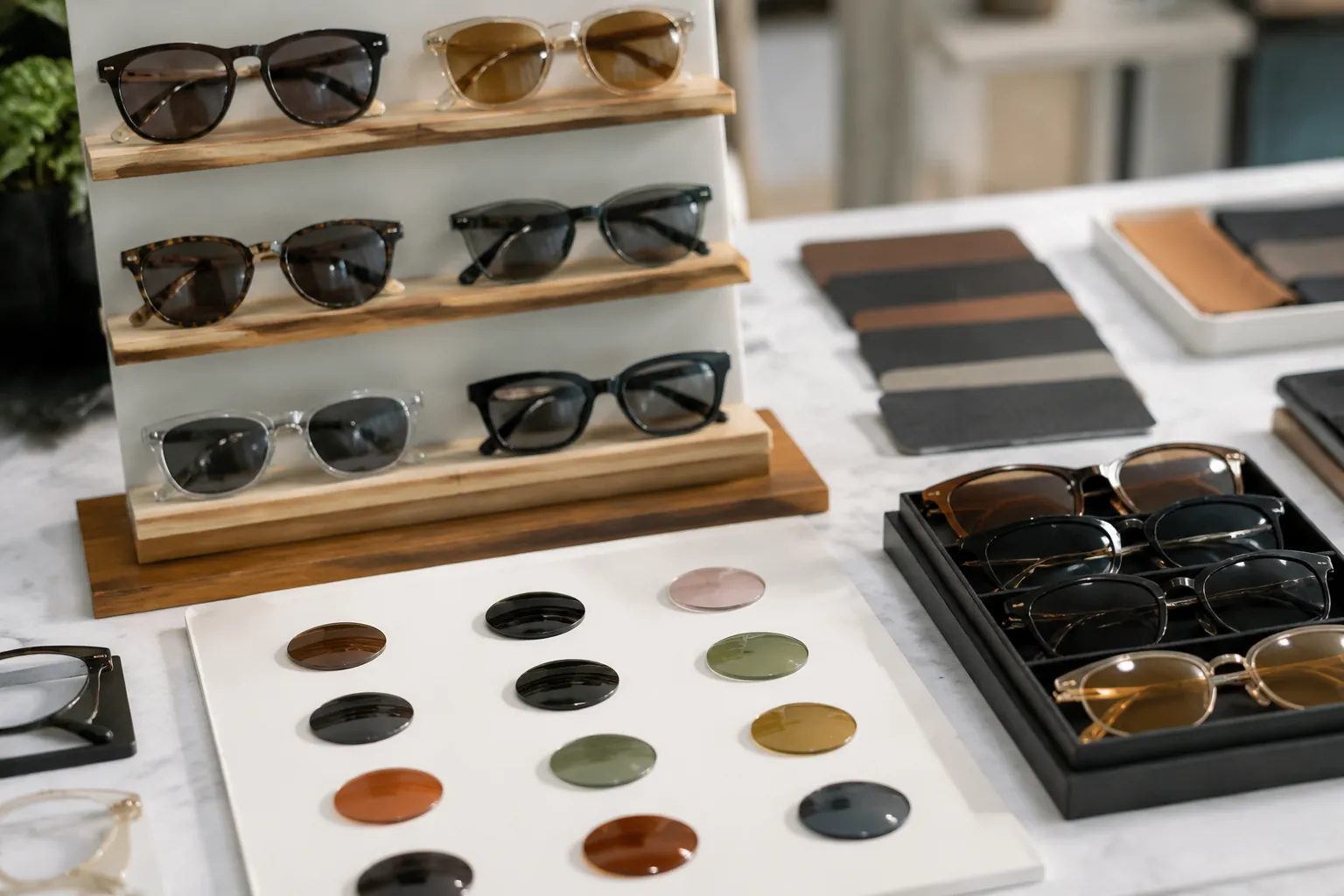
Buying sunglasses for a club, league, stadium shop, sponsor activation, or licensed sports program usually comes down to five variables: logo visibility, color accuracy, landed cost, lead time, and compliance. They are connected. A low ex-factory price stops looking cheap if the logo has no shelf impact, team colors drift on repeat orders, or the shipment lands after the event. This guide shows how experienced buyers build a custom sunglasses program that is easier to sample, approve, produce, and reorder. It is written for brands, importers, distributors, and retailers that need production guidance, not sales copy.
Start with the sales job, then build the SKU ladder
Before you discuss frame shape, define the product's job. Sunglasses sold at a stadium kiosk do not serve the same purpose as sunglasses sold in a premium club store or packed into a sponsor giveaway. If that role is vague, buyers tend to overbuild a low-price item or under-spec a style that needs to carry margin.
A disciplined sports program often starts with a three-level SKU ladder:
- Entry SKU: a simple, lower-risk style for impulse purchase, event-day traffic, or promotional distribution.
- Core retail SKU: a stronger everyday seller with better finish, more deliberate branding, and a retail position designed for steady in-season sales.
- Premium or seasonal SKU: a limited-run style with upgraded material, decoration, or lens treatment for special drops, playoffs, anniversaries, or collector-oriented releases.
Quantity planning should follow that ladder. Small runs help with line testing, stakeholder approval, and local sell-through checks. Mid-volume orders usually improve unit economics because setup and decoration costs are spread across more units. Higher-volume orders shift the focus to consistency, packaging flow, freight planning, and reorder control.
Ask these questions early:
- Is the product for a single event, a season, or an evergreen merchandise line?
- What is the target retail price band?
- Is the main value driver logo size, frame finish, lens appearance, or gift-ready packaging?
- How much inventory risk is acceptable if demand changes or team creative direction shifts?
Answer those first. Then choose the frame platform, decoration method, and order size. Artwork approval should come later.
Choose the frame platform for cost, branding, and repeat orders
For sports retail, frame material is not just a style choice. It affects unit cost, decoration durability, color control, and repeatability. The common routes are injection-molded plastic, acetate, and mixed-material builds.
| Platform | Best use | Decoration strengths | Lead-time/cost profile | Typical buyer trade-off |
|---|---|---|---|---|
| Injection molded | Stadium merch, event promos, entry retail | Pad printing, hot stamping on suitable builds, laser marking where material and finish allow | Generally the most cost-efficient for larger runs and repeat orders | Strong value and repeatability, but surface feel and visual depth are usually simpler than premium materials |
| Acetate | Premium club stores, fashion-led licensed lines | Laser engraving, inset metal logos, polished edge finishing | Higher material and processing cost; longer finishing cycle | Richer color and higher perceived value, but more expensive and slower to produce |
| Mixed material | Mid-tier retail, lifestyle/sports crossover | Metal logo plates, pad printing, engraved metal temples | Moderate to high cost; additional assembly steps | Higher perceived value, but more components create more QC points |
| Performance-style wrap frame | Cycling, running, outdoor fan activations | Temple printing, approved lens marks, rubber detail accents | Specification control can be stricter because fit and lens geometry matter more | Functional look, but logo area may be more limited than on lifestyle frames |
Injection-molded frames are often the practical choice for licensed sports retail. They pair lower unit cost with solid repeatability and efficient pack-out at volume. Acetate gives better visual depth and stronger shelf appeal, but it needs closer control of color approval and finishing consistency. Mixed-material frames can raise perceived value, especially with metal details, but every extra part adds a new QC checkpoint for alignment, fit, finish, and plating quality.
Check the supply chain too. If frame production, lens tinting, decoration, and final QC are split across multiple suppliers, schedule risk goes up. So does sample-to-bulk variation.
Treat logo visibility as a technical issue
A common failure in team sunglasses is not missing branding. It is weak branding. The logo may be there, but it disappears under store lighting, loses contrast on a glossy surface, or sits in a spot hidden by a cap brim or side angle.
In most retail programs, the outside temple is still the strongest branding position because it shows on shelf and on face. Usable print area varies by frame, so artwork often needs to be simplified to fit the surface. Small text, thin outlines, and multi-color gradients are risky on eyewear. Keep it blunt. If the logo cannot be read at a glance, it is not doing its job.
Decoration methods and where they work best:
- Pad printing: usually the most practical option for simple logos, solid colors, and cost-sensitive programs. It is efficient, but not ideal for very fine detail or luxury-level metallic effects.
- Laser engraving: useful for a quieter premium look on materials and finishes that provide enough contrast. It is durable, but typically less visible than printed ink.
- Metal logo plates: a strong premium cue with good durability when properly fixed, but they add cost, parts, and assembly control points.
- Lens corner marks: best used as a secondary brand cue rather than the primary recognition element.
For licensed programs, use one primary mark and one secondary cue. More than that can make the product look promotional instead of retail-ready. If the rights holder requires hierarchy, put the licensed mark in the dominant temple position. Add a smaller accent at the tip, inner temple, or lens corner only if the style guide allows it.
Request a strike-off or decorated sample on the final frame color and finish. Flat swatches lie. Real parts tell the truth.
Control color in three layers: frame, lens, and logo
Sports buyers often ask for an exact team color match. In production, that request needs to be split into three controls: frame color, lens appearance, and decoration color. They do not behave the same way, and they should not be approved as one variable.
Frame color should be tied to a retained physical standard whenever possible. Screen approval is weak because display settings, finish level, and lighting all change perception. Injection-molded color can usually be controlled well once a standard is fixed, but slight lot-to-lot variation can still happen. Acetate offers richer depth, yet sheet-based material may vary across lots and after polishing.
| Color element | What to control | Common risk | Best buyer action |
|---|---|---|---|
| Frame color | Physical master sample, finish level, approved reference | Shift between sample and bulk or between production lots | Approve and retain a physical standard for repeat orders |
| Lens tint | Tint depth, mirror tone, visible appearance | Different visual effect indoors versus outdoors | Review under daylight and indoor retail lighting |
| Logo color | Ink tone, metal finish, contrast against frame | Reduced readability on glossy, metallic, or dark surfaces | Request a logo strike-off on the final frame color |
| Rubber or accent parts | Color consistency and assembled appearance | Accent parts reading differently from the main frame | Approve the assembled sample, not loose components only |
For a licensed line, close enough may not pass the style guide. Build time into the schedule for a pre-production sample if color accuracy matters. Mirror lenses need extra care as well. Their appearance can shift sharply with lighting angle and environment. That is an optical characteristic, but buyers should review it before bulk approval.
Work backward from the event date
Sports retail runs on fixed dates. Miss the date and the product loses value fast. One common mistake is counting factory production days only and ignoring internal approvals, packaging decisions, freight booking, customs, and local delivery.
For any event-driven program, build the timeline backward from the in-store date. Include:
- Artwork cleanup and placement confirmation
- Sample production and review
- Pre-production approval if required
- Carton and packaging approval
- Freight booking and transit
- Customs clearance and final delivery
If the event date cannot move, cut variables. Fewer SKUs, fewer lens options, one packaging format, and one approved logo method usually mean fewer chances for rework, mixed cartons, or partial completion.
A sensible launch structure is:
- 1 entry SKU in the highest-volume colorway
- 1 retail SKU with upgraded finish
- 1 limited SKU only if approvals are already stable
That gives enough range for multiple channels without adding avoidable risk. Lock the artwork, BOM, packaging, and ship mode early. Every delay after that is harder to absorb.
Match compliance to the final BOM
Compliance is part of the product specification. It is not a separate paperwork exercise. If the frame material, lens, coating, plating, adhesive, or ink changes, the compliance file may need another review. Serious buyers ask for documents tied to the final bill of materials, not a generic certificate image or a broad supplier claim.
Common references in sunglasses sourcing include CE EN ISO 12312-1, ANSI Z80.3, AS/NZS 1067, REACH, FDA registration, ISO 9001, and BSCI. They do not mean the same thing:
- CE EN ISO 12312-1: a core reference for sunglasses sold into applicable European markets.
- ANSI Z80.3: a U.S. performance standard commonly referenced for non-prescription sunglasses.
- AS/NZS 1067: a standard relevant to applicable Australia and New Zealand markets.
- REACH: material-related chemical compliance requirements relevant to the EU supply chain.
- FDA registration: a U.S. regulatory registration point often requested in sourcing discussions, but buyers should confirm what is required for the exact product category and import route.
- ISO 9001: a quality management system certification, not a product compliance test.
- BSCI: a social compliance audit framework, not a product safety standard.
Decoration and hardware matter here too. Chemical and regulatory review may extend beyond the base frame resin to inks, coatings, adhesives, and metal finishes. A late change to a logo plate, coating, or plating supplier can create compliance questions and shipment delays at the same time.
For PO release, request:
- Material description for frame and lens
- Final decoration method and finish
- Market-specific test reports, declarations, or supporting documents linked to the final spec
- Confirmation that the approved sample and bulk order use the same BOM
This matters even more in licensed sports retail, where brand risk is high and post-shipment correction is rarely realistic.
Know what moves price and what does not
Pricing in custom sunglasses is shaped by more than order quantity. The main drivers are frame platform, lens specification, decoration complexity, packaging, tooling status, and how much manual handling the line needs. Volume helps. Stable specifications help more.
At low quantities, buyers are paying for setup, artwork handling, sampling, and short-run inefficiency. That level works for a proof run or launch test, not for the lowest possible unit cost. As volume rises, setup costs are spread more efficiently and production planning improves. Cost movement becomes more meaningful once the program is standardized: fewer colors, fewer decoration variations, and more consistent packaging.
A practical workflow that cuts rework looks like this:
- Send vector artwork with exact placement notes.
- Select the frame platform based on target retail price and channel.
- Define market compliance requirements before sampling.
- Approve a physical color standard for frame and lens appearance.
- Review the sample for logo contrast, hinge feel, surface finish, and pack-out.
- Lock packaging, carton count, and shipping marks before bulk.
- Release the PO only after the approved sample and compliance documentation match the intended BOM.
Simple process. Big payoff. In team merchandise, one or two repeatable SKUs often outperform a wide assortment with unstable specifications. The winners are usually the styles that arrive on time, read clearly under retail lighting, and can be reordered without unwanted variation.
Have a custom sunglasses project in mind?
Send us your styles, target market and quantities and we will return a detailed quote with MOQ, lead time and a sample plan.
Get a QuoteWhy source this from Wenzhou with LumiShades
Wenzhou in Zhejiang Province is widely regarded as China’s eyewear manufacturing capital, producing a large share of the world’s sunglasses. That concentration matters to buyers: a deep local supply chain for acetate sheet, hinges, lens blanks, plating and packaging means shorter component lead times, easier color and material matching, and a workforce with decades of eyewear-specific skill. LumiShades has manufactured in this ecosystem since 2009, and our vertical integration — in-house injection molding, acetate cutting, CNC milling, lens tinting, decoration and quality control — means no part of your order is quietly subcontracted to a workshop you cannot audit.
For international buyers, that vertical control translates into accountability. When a single factory owns every step, defects are traced and fixed at source rather than bounced between vendors, and your specifications survive intact from first sample to bulk. We back this with 15+ years of experience, shipments to 60+ countries, more than 5 million pairs produced per year and a 98.5% on-time delivery rate. Our certifications — CE EN ISO 12312-1, FDA registration, ANSI Z80.3, AS/NZS 1067, REACH, ISO 9001 and BSCI audit — mean the compliance documentation your market requires already exists. Explore our manufacturing capabilities and quality control process to see how this works in practice.
Frequently asked questions
What is the best logo method for team sunglasses? For most team programs, start with pad printing because it balances visibility, cost, and production efficiency. Choose laser engraving when the goal is a subtler premium look and the substrate provides enough contrast. Use metal logo plates when the retail price supports the added cost and assembly complexity. Ask the supplier to show the same logo on the same frame in the intended finish using competing methods. Then compare readability under store lighting, rub resistance, and consistency on curved surfaces.
How early should I place an order before an event? Work backward from the required in-store date and include every step, not just factory production. Your timeline should cover artwork approval, sample production, pre-production approval if needed, packaging confirmation, freight transit, customs clearance, and domestic delivery. Leave contingency time for revisions. If the event date is fixed, reduce avoidable variables by limiting SKU count, lens options, and packaging variations. Do not assume the factory clock starts the moment you request a quote. Internal approvals often cause the first delay.
Can team colors be matched exactly? They can often be matched closely, but approval should be based on a retained physical standard, not a screen image. Treat frame color, lens appearance, and logo color as separate approvals because they behave differently in production and under different lighting. Ask for a pre-production sample when color control is critical, and review it under both daylight and indoor retail lighting. For repeat orders, reference the original approved physical sample and confirm the finish level as well as the color, since gloss and matte can change how the same hue appears.
What order size makes sense for a launch test? The right test quantity depends on channel, budget, and how many variants you are introducing. Use a quantity large enough to measure sell-through, packaging performance, and customer response, but small enough to limit inventory risk if artwork, fit, or demand needs adjustment. Keep the test narrow: one or two styles, limited colorways, and a clear target channel. After the test, review sell-through rate, return issues, logo readability, and reorder interest before expanding the assortment or increasing volume.
Which compliance documents matter for overseas sports retail? Request documents based on the destination market and the final product specification. For applicable European programs, buyers commonly review CE EN ISO 12312-1 support and REACH-related material information. U.S. buyers may ask about ANSI Z80.3 alignment and FDA registration where relevant to the supplier and product route. Australia and New Zealand programs may require AS/NZS 1067 support. Also ask whether ISO 9001 and BSCI are current, while remembering that these are system or audit credentials rather than product safety tests. Most important, require that any test report, declaration, or compliance file be linked to the final BOM, including lens, coating, decoration, and metal components.
Ready to start?
Explore our square sunglasses or request a quote — our sales team replies within 12 hours.
Request a Quote