
Temple Logo Methods by Budget for Private-Label Eyewear
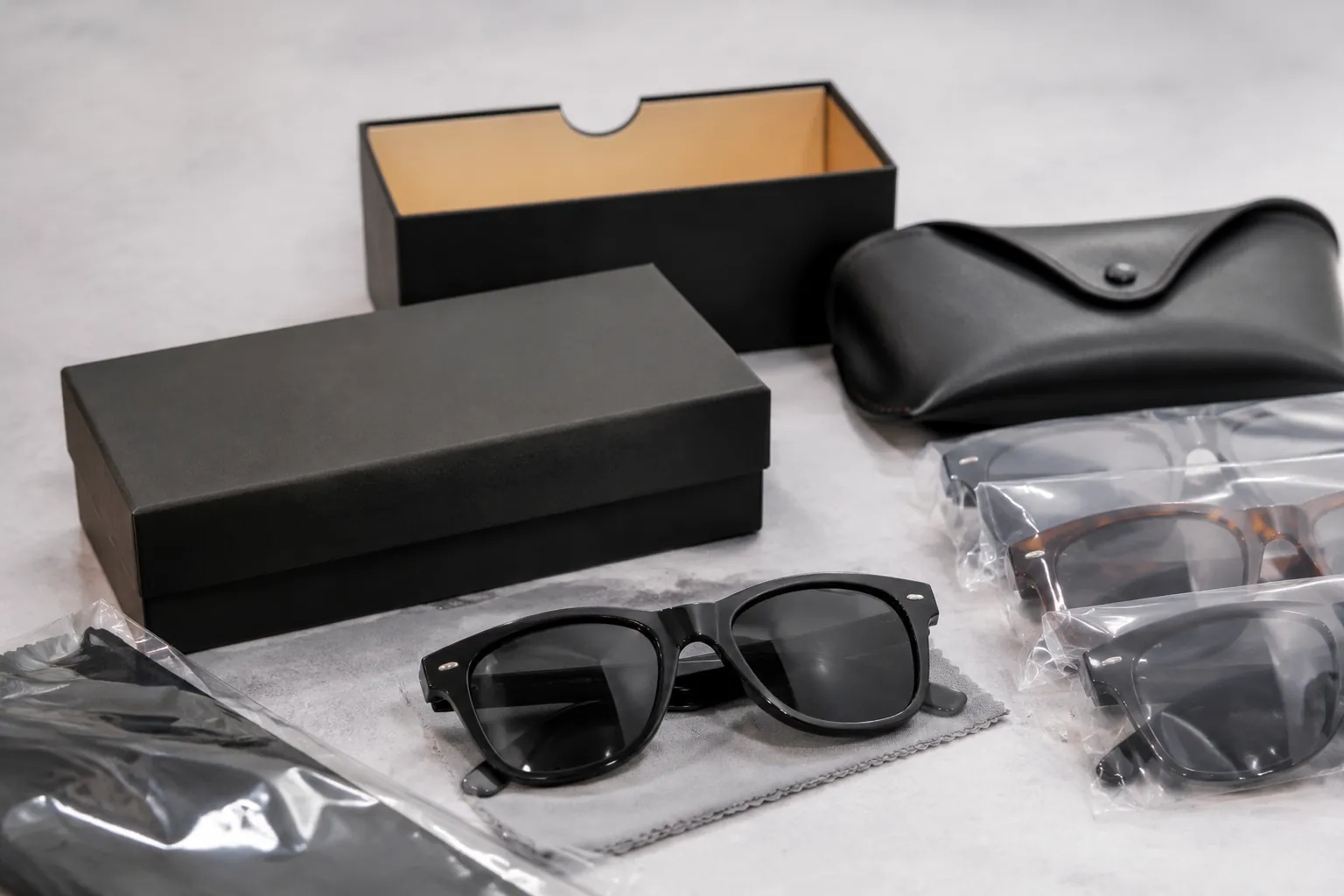
Temple branding can make private-label sunglasses look retail-ready. It can also add cost, slow approvals, and create obvious quality faults. The right question is not which logo treatment looks best by itself. It is which method fits the retail price, order volume, frame material, and production schedule. This guide compares common temple branding options—pad printing, laser engraving, metal logo plates, molded details, and CNC-machined branding zones—with practical notes on MOQ, setup, placement tolerance, lead-time impact, and common failure risks. Use it as a sourcing guide. It is built to help buyers match artwork decisions to methods a factory can repeat in samples and bulk production.
Start with retail position, not decoration preference
Choose temple branding from the outside in. Set the retail position first. Then choose the decoration method that supports it.
A logo treatment that suits a premium acetate frame can look excessive on a low-price promotional style. The reverse is also true. A basic one-color print may be fine for an entry program, but it can make a higher-value frame look underfinished.
A simple way to frame the decision is to work in three commercial bands:
- Entry tier: value retail, promotional programs, and fast market tests. Priorities are low setup cost, low rejection risk, and quick sample turnaround.
- Mid tier: private-label fashion, chain-store programs, and better gift or accessory lines. Placement control, finish consistency, and stronger side-view branding matter more.
- Upper tier: premium acetate, boutique collections, and higher-priced direct-to-consumer lines. Flush hardware, engraved detail, paint fill, and tighter appearance control may be worth the extra effort.
MOQ changes what makes commercial sense. A supplier may accept a low frame MOQ, but each branding method carries its own practical threshold once tooling, hardware, sampling time, and inspection are added. At small quantities, buyers usually stay with print or simple laser marking. Custom metal parts are hard to justify unit by unit. At higher volumes, hardware-based branding and dedicated fixtures are easier to absorb.
Keep the decision simple. Pick the method that adds visible value without adding avoidable process risk.
Head-to-head: which temple branding method fits which budget
| Method | Best fit | Typical setup impact | Visual effect | Main trade-off |
|---|---|---|---|---|
| Pad printing | Entry tier, promo, fast launches | Low; artwork preparation plus print plate | Clean on flat or lightly curved areas | Wear resistance depends on ink system, surface preparation, and placement |
| Laser engraving | Mid tier matte plastics, coated metal parts, selected acetate or injected components | Low to moderate; fixture and contrast test required | Precise, understated, permanent look | Contrast can be weak on some dark, glossy, or patterned substrates |
| Metal logo plate | Mid to upper tier acetate and thicker temples | Moderate; custom hardware, recess design, fitting review | Strong premium shelf impression | Needs sufficient temple thickness, accurate placement, and extra QC |
| Molded logo detail | High-volume injection styles | High initial tooling impact | Integrated, durable brand shape | Not flexible for low MOQ or frequent artwork changes |
| CNC engraved recess with paint fill | Upper tier acetate or mixed-material frames | Moderate to high; machining and finishing steps | Sharp depth and controlled premium look | More approval points and greater cosmetic-variation risk |
For most programs, the shortlist gets narrow fast:
- Low-volume programs: pad print or laser is usually the safest place to start.
- Mid-volume programs: small metal plates or recessed branding may become viable.
- Higher-volume programs: hardware-led branding and multi-step finishing can make sense if the retail tier supports the added cost and control.
Keep branding in proportion to the temple geometry. Bigger is not better. In many cases, a smaller mark with clean placement looks more expensive than a large logo applied with less control.
What actually makes temple branding look premium
The method matters. Execution matters more.
Most weak temple branding comes from the same issues: poor scale, weak spacing, low contrast, or inconsistent left-right placement. The visible side area of a sunglass temple is small, so even minor position errors show up quickly at retail.
Review temple branding against three basic controls:
- Distance from hinge: leave enough clearance from the hinge, rivet, or screw zone so the logo does not crowd a high-stress area or compete visually with hardware.
- Height relative to temple width: keep the logo comfortably inside the top and bottom edge margins. The exact margin depends on the temple profile, but artwork should not be approved before the usable zone is confirmed on the actual sample.
- Contrast and finish: high-contrast branding reads more clearly, while tonal or low-contrast branding can feel more refined if the substrate supports it.
Acetate usually allows the widest range of options because it can support recesses, flush metal parts, laser work, and fine polishing if there is enough thickness. Injection-molded plastics can also carry branding well, but the result depends more on surface curvature, wall thickness, and how the part was designed for molding. Too much curve can distort printed edges. Too little wall thickness can cause a recessed insert to show through or weaken the temple.
One rule holds across price tiers: restraint reads better. A smaller mark, placed well and finished cleanly, usually looks more premium than a larger one.
Material and process limits to check before artwork approval
Do not approve artwork before checking the frame material and temple construction against the proposed branding method. The same logo can behave very differently on injection-molded plastic, acetate, and metal. A method that works well on one substrate may have weak adhesion, poor contrast, or too much cosmetic variation on another.
| Material / process | Best branding options | Key production checks | Typical risk points |
|---|---|---|---|
| Injection-molded plastic | Pad print, molded-in logo, selective laser on compatible coated parts | Flat print area, draft angle, wall thickness, shrink behavior | Print distortion on curved surfaces, sink marks, weak contrast |
| Acetate | Metal plate, CNC recess, paint fill, laser, print | Temple thickness, polishing allowance, sheet pattern consistency | Pattern shift, overpolish around recess, uneven insert fit |
| Metal temple or metal trim part | Laser engraving, etched plate, printed fill | Coating type, alloy hardness, engraving contrast | Low visibility after laser, coating damage, edge burrs |
For custom metal plates, ask exactly how the part is fixed. Adhesive-only assembly can work, but only if recess geometry, surface preparation, adhesive choice, dosage, and cure process are controlled. In some builds, mechanical retention features such as pins, tabs, or locating geometry improve consistency. The right answer depends on the temple design and insert size.
Useful sample-review requests include:
- straight-on macro photos of both temples
- angled side-view photos in normal lighting
- inside-temple photos to check for show-through, sink, or distortion around inserts
- measured logo position from a defined hinge reference point
These checks catch common issues early: paint spread, laser halo, adhesive squeeze-out, plate corner lift, and left-right mismatch.
Cost and lead-time logic: where decoration changes the schedule
Temple decoration affects schedule as much as cost. Simple print and simple laser marking usually move faster through sampling and bulk production than custom hardware or multi-step finishing. Add custom metal parts, CNC recesses, paint fill, or extra curing steps, and the approval path gets longer. So does final inspection.
| Order stage | Pad print | Laser engraving | Metal logo plate |
|---|---|---|---|
| Artwork preparation | Fast; print file and plate | Fast; vector file and test marking | Slower; hardware drawing and finish approval |
| Sample complexity | Low | Low to moderate | Moderate to high |
| Revision risk | Color, size, position | Contrast, depth, burn level | Plate size, thickness, finish, recess fit, placement |
| Bulk labor impact | Low | Low | Higher due to fitting, curing, and inspection |
Think in terms of setup dilution. At low quantities, any custom hardware charge has a large unit impact. At moderate and higher quantities, the same charge is easier to spread. That still does not make the most complex method the right one. It just means the economics become easier to test against the target retail price and margin.
Late artwork changes also carry very different costs. A print revision may mean updated artwork and a new plate. A custom metal plate revision may require a new hardware drawing, another sample round, updated fixture settings, and fresh appearance approval. If the launch date is fixed, freeze temple branding early. Do not let decoration become the schedule bottleneck.
Compliance and durability: branding still has to perform
Temple branding is cosmetic, but it still has to perform as part of the product. Sunglasses supplied to different markets may need to align with requirements or customer requests tied to standards and systems such as CE EN ISO 12312-1, ANSI Z80.3, AS/NZS 1067, REACH, FDA registration, ISO 9001, and BSCI. For buyers, the practical point is simple: inks, coatings, plating, and adhesives must be controlled within the overall production and quality process. They are not just cosmetic extras.
Ask the supplier to confirm:
- ink and coating compatibility with the substrate
- adhesive suitability for the specific material combination, such as metal-to-acetate or metal-to-plastic
- restricted-substance control where REACH or customer chemical requirements apply
- appearance checks after assembly and cleaning, not only before
Durability checks should be basic and documented. For printed logos, ask what rub-resistance check is used and whether a protective topcoat is part of the process. For metal plates, ask when fit and bond quality are checked: right after assembly, after curing, and again after final cleaning. For engraved details with paint fill, confirm how edge cleanliness and paint-chip risk are reviewed.
For stronger programs, set a golden sample and a written appearance standard. Define acceptable variation in position, finish, and edge quality. Otherwise inspection becomes subjective fast.
A practical specification workflow buyers can use
Most temple-branding problems start upstream. The fix is a tighter spec sequence:
- Set the retail target and expected order volume. This determines whether the branding approach should stay print-led, move to laser, or justify hardware.
- Lock the frame material first. Acetate, injected plastic, and metal respond differently to each decoration method.
- Define the logo zone. Ask for the maximum usable branding area and required edge margins on the actual temple design.
- Shortlist only two or three methods. Too many options slow comparison and make costing less clear.
- Review a physical decorated sample. Do not approve branding from a rendering alone.
- Freeze the golden sample before bulk production. This is especially important for custom metal parts and multi-step finishing.
This workflow pushes risk earlier, where changes are cheaper. It also forces the branding decision to be checked against real temple geometry instead of artwork alone.
If a brand operates across several price tiers, build a branding ladder. For example, the entry tier may use a fixed-position one-color print; the mid tier may move to tonal laser or a small insert; the upper tier may use a flush-fit plate or another higher-control detail. That keeps brand language consistent while protecting margin at each level.
Common failure modes that make private-label eyewear look cheap
The same mistakes show up again and again in private-label eyewear:
- Oversized logos: they dominate the temple and reduce perceived refinement.
- Bad left-right alignment: visible mismatch makes the pair look poorly controlled.
- Weak contrast: the logo is hard to read, so the added cost does little retail work.
- Metal plates on thin temples: this can cause telegraphing, proud fit, or local weakness.
- Print too close to flex points: repeated opening and closing increases wear risk.
- Overcomplicated branding at low MOQ: cost and approval effort rise faster than perceived value.
The fix is usually simple. Match the method to the material. Match the material to the retail tier. Match the complexity to the order size.
A low-volume test order rarely benefits from forced custom hardware on a frame that was not designed for it. A higher-volume program with stronger retail ambitions may justify more investment, but only if the construction and QC plan can support it.
Good temple branding is quiet. It looks centered, durable, and intentional. Buyers notice that immediately. Consumers usually read it as better quality, even if they cannot explain why.
Have a custom sunglasses project in mind?
Send us your styles, target market and quantities and we will return a detailed quote with MOQ, lead time and a sample plan.
Get a QuoteWhy source this from Wenzhou with LumiShades
Wenzhou in Zhejiang Province is widely regarded as China’s eyewear manufacturing capital, producing a large share of the world’s sunglasses. That concentration matters to buyers: a deep local supply chain for acetate sheet, hinges, lens blanks, plating and packaging means shorter component lead times, easier color and material matching, and a workforce with decades of eyewear-specific skill. LumiShades has manufactured in this ecosystem since 2009, and our vertical integration — in-house injection molding, acetate cutting, CNC milling, lens tinting, decoration and quality control — means no part of your order is quietly subcontracted to a workshop you cannot audit.
For international buyers, that vertical control translates into accountability. When a single factory owns every step, defects are traced and fixed at source rather than bounced between vendors, and your specifications survive intact from first sample to bulk. We back this with 15+ years of experience, shipments to 60+ countries, more than 5 million pairs produced per year and a 98.5% on-time delivery rate. Our certifications — CE EN ISO 12312-1, FDA registration, ANSI Z80.3, AS/NZS 1067, REACH, ISO 9001 and BSCI audit — mean the compliance documentation your market requires already exists. Explore our manufacturing capabilities and quality control process to see how this works in practice.
Frequently asked questions
At what MOQ does a custom metal logo plate usually start making sense? There is no universal MOQ, but custom metal plates usually become more practical once order volume is high enough to spread hardware development, sampling, fitting review, and extra inspection across the run. Start by asking for two quotations on the same frame: one with print or laser, and one with the plate solution. Then compare not just unit price, but also sample cost, tooling or hardware cost, added lead time, and rejection risk. If the plate option adds visual value but creates fit or approval problems on a low-volume program, print or laser is usually the safer first-run choice.
Is pad printing too cheap-looking for retail sunglasses? No. Pad printing is common on retail eyewear and can look clean if the artwork is simple, the print area is stable, and the ink system matches the substrate. Evaluate it on a physical sample. Check four things: edge sharpness, opacity, position consistency between left and right temples, and rub resistance after final finishing. It tends to look weak when the logo is oversized, printed over heavy curvature, or specified with too little contrast against the base color.
What should I ask for in a sample review for temple branding? Ask for one physical decorated sample and a standard review pack: close-up photos of both temples, angled side-view photos in normal lighting, inside-temple photos where inserts are used, and a measured logo position from a fixed reference such as the hinge face. During review, check left-right symmetry, edge cleanliness, finish contrast, and whether the chosen method suits the material and temple thickness. If the branding uses a metal plate, also ask how it is retained, what adhesive is used if applicable, and when bond quality is checked during production.
Can acetate and injection-molded frames use the same branding method? Sometimes, but do not assume the result will be comparable. Acetate usually supports CNC recesses, flush inserts, paint fill, and finer edge finishing better because it often provides more body for machining and polishing. Injection-molded frames are often better suited to pad print, molded-in logos, or selected laser applications, depending on the resin, surface texture, and part geometry. If you want to compare methods across both materials, request the same logo treatment on both substrates and review the samples side by side before approving artwork.
Do branding choices affect compliance? Yes. Branding adds materials and processes such as inks, coatings, plating, and adhesives that need to be controlled within the overall product and supplier quality system. For buyer due diligence, ask which chemical and production controls apply to the decorated parts, especially where REACH or customer restricted-substance requirements apply. Also confirm that decoration is reviewed after assembly and cleaning, because a logo that passes visual inspection before final finishing can still fail through smearing, lifting, discoloration, or weak bond performance in packed goods.
Ready to start?
Explore our square sunglasses or request a quote — our sales team replies within 12 hours.
Request a Quote