
Control Brand Colors in One Sunglasses PO
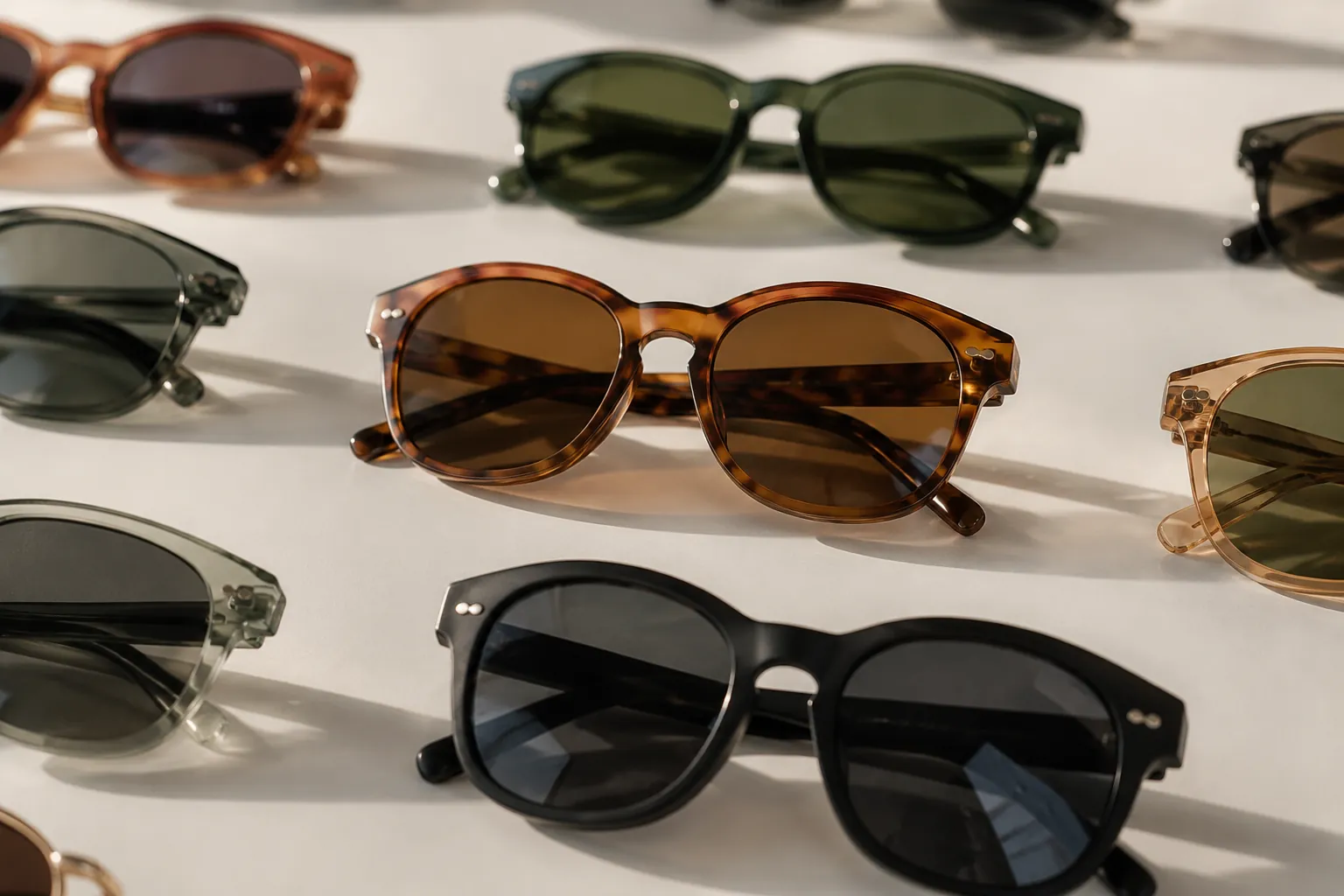
This guide is for brand owners, importers, distributors, and retailers placing one custom sunglasses PO with multiple branded parts. The core issue is simple: one brand color will not look the same on acetate, injected plastic, metal logos, printed marks, lenses, and paper packaging. That is normal. A buyer who sets color controls before sampling and bulk release can cut rework, approval delays, and disputes over mismatched goods. The framework below shows how to manage color across product and packaging in one order with a sunglasses manufacturer.
Start with one master color brief
Most color problems start early. A buyer sends a Pantone reference for the frame to one contact, a logo AI file to another, and packaging artwork to a third. Each team reads the brand color in its own way. The finished set drifts.
Use one master color brief for the full PO. Put every branded component in the same control document: frame front, temples, temple-tip print, metal logo plate, lens tint, pouch, box, barcode label, polybag sticker, and carton marks. Also rank visual priority by part. A retail box may need a tighter visual match than an injected frame, where resin flow, gloss, and wall thickness can shift how color reads.
A practical color brief should specify:
- Primary reference: Pantone code plus, where possible, an approved physical swatch or sealed sample
- Finish: gloss, matte, soft-touch, brushed metal, mirror polish, satin plating
- Material: acetate, TR90, PC, metal, TAC lens, PU pouch, paperboard, corrugated carton
- Decoration method: pad print, screen print, laser engraving, paint fill, enamel, hot foil
- Viewing rule: approval under one defined light source, such as daylight-equivalent lighting
- Acceptance distance: close product inspection versus outer-pack review at normal handling distance
For larger programs, add a tolerance note by component. Keep it plain. Packaging print should match the approved proof visually. An injected frame should match the sealed chip within normal production variation. A metal logo should match the approved filled sample, not a digital mockup. One document. One revision number. One approval chain.
Know where exact matching will fail
Different materials handle color differently. Pigment in injected resin does not behave like ink on a matte temple. Acetate has depth from sheet composition and polishing. Metal throws back ambient light. Paper color changes with stock whiteness, coating, and lamination. A Pantone reference helps, but it does not guarantee identical output across substrates.
A better target is controlled visual harmony, not literal sameness. Some parts can be controlled tightly. Others cannot.
| Component | Process | Realistic color control | Typical tolerance logic | Main risk |
|---|---|---|---|---|
| Injected TR90/PC frame | Masterbatch pigment in molding | Moderate to good | Approved molded chip or first-shot sample; minor lot variation reviewed against sealed sample | Resin batch variation, wall thickness, gloss affecting shade perception |
| Acetate frame | Sheet selection, CNC cutting, polishing | Good if physical sheet is approved | Approve the exact sheet sample or the approved sheet family before production | Sheet batch shift, edge translucency, polishing depth |
| Pad printed logo | Surface ink print | High on stable surfaces | Visual match on the real substrate; placement tolerance defined on the drawing or PO | Opacity loss on dark or textured surfaces, poor curing, abrasion failure |
| Metal logo plate | Plating, enamel, or paint fill | Moderate | Approve a physical sample only | Base metal tone, plating reflectance, enamel or fill thickness |
| Lens tint | Tinting or smoke/gradient process | Moderate | Visual approval plus transmission/category confirmation where required | Lens material, process consistency, compliance limits |
| Paper packaging | Spot color or CMYK print | High with approved proof | Proof-to-bulk visual match on the agreed stock and finish | Paper whiteness, lamination, print density variation |
This affects purchasing choices. A custom translucent frame may clash with a raw plated logo plate even if both looked acceptable on their own. Sometimes a paint-filled or enamel-filled logo gives a cleaner brand result than bare metal. That is the decision that matters.
Pick decoration methods for the result you need
Do not pick a branding method by habit. Pick it for the job. The real priority may be color accuracy, abrasion resistance, premium appearance, or simpler production.
| Method | Best use | Color match potential | Durability note | Cost / lead-time effect |
|---|---|---|---|---|
| Pad printing | Temple logos, inner markings, simple icons | High with matched ink on the actual substrate | Good if surface preparation and curing are controlled; rub testing should be defined | Low setup cost and relatively easy sample adjustment |
| Laser engraving | Subtle branding on acetate or metal | Low for true brand color | Stable because there is no added ink layer | Usually efficient, but decorative effect is limited |
| Metal logo plate | Premium outer branding | Moderate with paint fill; lower with raw plating only | Stable if fixing method and alignment are controlled | Often adds tooling, sampling, and approval steps |
| Foil / screen print on packaging | Retail box, pouch, case | High if stock and finish are fixed | Depends on substrate and scuff resistance | Packaging timing should be reviewed separately from frame production |
If a logo must hit a specific brand shade, printing is usually easier to control than metal. If metal branding is required, ask for physical comparisons: raw plated, enamel-filled, and paint-filled. Review those versions next to the frame and packaging. Artwork is not enough.
Build sampling around clear checkpoints
A sample round should test more than fit, lens shape, and hinge feel. It is also the cheapest stage to catch color mistakes before bulk materials are locked.
- Approve base material color first. For acetate, review the actual sheet sample or a cut swatch from the intended sheet family. For injection, review a molded chip or first-shot sample. Do not finalize logo color before the base color is fixed.
- Approve decoration on the real substrate. An ink drawdown on white paper will not show how a logo reads on a black matte temple or translucent frame.
- Approve lenses beside the frame. A lens tint that looks balanced on one frame color can look too dark or too light on another.
- Approve packaging next to the product. Review box, pouch, and product as one branded set, not as separate approvals.
- Record lighting and viewing conditions. Glossy and metallic parts can shift under different light sources, especially warm retail lighting.
- Seal a final approval sample. Keep one reference at the factory and one with the buyer for bulk QC comparison.
Do not approve everything in one vague email. Approve by component and by revision. If the frame color passes but the logo fill does not, say so clearly. That record prevents later disputes.
Set tolerances and QC rules before bulk
Color disputes get expensive fast when there is no agreed pass/fail rule. Not every PO needs lab measurement. Every PO does need a defined acceptance method. For many private-label programs, the simplest system is visual comparison to the sealed sample under the agreed light source. For repeat programs with tighter control needs, buyers can request component control samples and written QC criteria.
In practical sunglasses QC, three checks matter most:
- Within-pair consistency: left and right temple appearance, front-to-temple balance, lens pair matching, and logo alignment
- Within-lot consistency: variation from unit to unit inside the same production run
- Cross-component consistency: frame, logo, lens, and packaging reading as one brand family
Write QC rules in plain language. Define logo placement by drawing. Require no obvious left/right lens density difference under the agreed viewing condition. Require packaging to match the approved proof on the specified stock and finish. Even a switch from matte lamination to gloss can shift perceived color enough to matter.
Factory QC should compare goods against approvals at three stages: incoming materials, in-line production, and final packed goods. If color depends on multiple outside processes, confirm who controls each checkpoint and who can stop production if a mismatch appears.
Color changes must not break compliance. If lens tint, transmission, or category changes, confirm the finished lens still meets the required market standard, such as CE EN ISO 12312-1, ANSI Z80.3, or AS/NZS 1067, depending on the destination market and product scope. If inks, coatings, or packaging materials change, confirm that any applicable chemical compliance requirements, such as REACH, still sit under current documentation.
Plan MOQ, cost, and lead time around color complexity
Small color decisions affect price and schedule. More than many buyers expect. A stock black frame with one white print is simple. A custom acetate pattern, matched logo plate, custom lens tint, pouch print, rigid box, and carton branding in one PO is still manageable, but it adds approval points and delay risk.
MOQ, sampling time, and bulk lead time vary by factory, material, tooling status, and packaging scope. Confirm commercial terms against the actual build, not a generic quotation. The table below shows decision logic, not fixed market-wide numbers.
| Order type | Typical MOQ logic | Sample timing | Bulk timing | Cost effect |
|---|---|---|---|---|
| Stock color frame + 1-color temple print | Usually the lowest-risk setup and often workable at lower MOQs | Often the fastest sample path because fewer variables need approval | Usually the simplest bulk schedule if materials are in stock | Generally closest to base price |
| Custom injected frame color + printed logo + standard box | Often more efficient once setup and approval cost are spread over higher volume | May require an extra color-chip or first-shot approval step | Depends on how quickly color and artwork are signed off | Adds pigment setup and print setup cost |
| Custom acetate + logo plate + custom lens tint + printed packaging set | Economics usually improve with volume because more customized parts are involved | Normally needs a full sample review across multiple components | Often longer because product and packaging approvals must stay synchronized | Higher due to materials, added decoration, and packaging processes |
The commercial point is blunt: indecision on color often costs more than the color feature itself. A late approval on an acetate sheet, logo fill, or packaging proof can hold purchasing or packing even when frame production is ready.
Use one PO revision for product and packaging
If frames and packaging run as separate workstreams without one control sheet, they drift. Product may be ready for bulk while packaging still uses an older artwork revision or a different brand color reference. The PO should prevent that.
A practical PO pack should include:
- SKU list with frame color, lens color, logo method, and packaging assignment by style
- Artwork files labeled by revision, size, placement, and print method
- Physical or signed-off color references grouped by substrate type
- Inspection criteria for color acceptance, logo placement, and packaging finish
- Compliance notes for target-market labeling and lens standards
- Approved sample date and sealed-reference location at both buyer and factory side
This structure fixes a common factory-floor problem: one department works from the latest file while another still uses an older print approval or logo plate version. Revision control is not paperwork for its own sake. It is one of the best ways to stop avoidable mismatches in final packing.
The shortest path to fewer color problems
If you want consistent brand color across sunglasses, logos, and packaging, do not chase perfect digital sameness. Control the physical result. Approve the frame material first, choose decoration methods based on the real color target, compare all branded parts together, and lock one sealed sample for bulk QC.
Buyer rule: one master color brief, one approval chain, one sealed sample, one PO revision history.
That system works better than asking a factory to "match Pantone exactly" across several different materials. Some substrates can get close. Others can only match within a practical visual range. What matters is commercial: the finished order should look intentional, consistent, and ready for retail as one brand set.
Have a custom sunglasses project in mind?
Send us your styles, target market and quantities and we will return a detailed quote with MOQ, lead time and a sample plan.
Get a QuoteWhy source this from Wenzhou with LumiShades
Wenzhou in Zhejiang Province is widely regarded as China’s eyewear manufacturing capital, producing a large share of the world’s sunglasses. That concentration matters to buyers: a deep local supply chain for acetate sheet, hinges, lens blanks, plating and packaging means shorter component lead times, easier color and material matching, and a workforce with decades of eyewear-specific skill. LumiShades has manufactured in this ecosystem since 2009, and our vertical integration — in-house injection molding, acetate cutting, CNC milling, lens tinting, decoration and quality control — means no part of your order is quietly subcontracted to a workshop you cannot audit.
For international buyers, that vertical control translates into accountability. When a single factory owns every step, defects are traced and fixed at source rather than bounced between vendors, and your specifications survive intact from first sample to bulk. We back this with 15+ years of experience, shipments to 60+ countries, more than 5 million pairs produced per year and a 98.5% on-time delivery rate. Our certifications — CE EN ISO 12312-1, FDA registration, ANSI Z80.3, AS/NZS 1067, REACH, ISO 9001 and BSCI audit — mean the compliance documentation your market requires already exists. Explore our manufacturing capabilities and quality control process to see how this works in practice.
Frequently asked questions
Can one Pantone code be matched exactly on frame, metal logo, and box? Usually not. Plastic, acetate, metal, ink, and paper reflect and absorb color differently, so the same Pantone reference will not look identical on every substrate. The practical approach is to use Pantone as the starting point, then approve physical samples for each critical component and judge the final set for visual harmony under one agreed light source.
What is the safest logo method if my brand color is non-negotiable? Pad printing is usually the easiest method to control for brand color because ink can be adjusted on the actual part and reviewed directly on the intended surface. If you want a metal logo, ask for physical samples of raw plated, paint-filled, and enamel-filled versions, then approve the option that gives the closest result next to the frame and packaging.
Should I approve colors from photos or video only? No. Photos and video help with progress checks, but final color approval should be based on physical samples or sealed references. Camera white balance, compression, ambient lighting, and screen settings can all shift color. If in-person review is not possible, request mailed component samples and keep one sealed approval sample on both the buyer and factory side.
Will changing lens tint affect compliance? It can. A tint change can alter visible light transmission, lens category, or other performance characteristics. Before approving a new tint, confirm which market standard applies to the shipment and verify that the finished lens still meets the relevant requirement, such as CE EN ISO 12312-1, ANSI Z80.3, or AS/NZS 1067. Ask the supplier which test report supports the final lens configuration, not just the base lens material.
How can I keep packaging from becoming a different shade than the product branding? Approve packaging proofs next to the actual frame sample, not in isolation. Lock the paper stock, print method, and finish in writing, because changes in board whiteness, varnish, foil, or lamination can alter the final appearance. In the PO, tie packaging artwork and product color references to the same revision number so both teams work from the same approval set.
Ready to start?
Explore our aviator sunglasses or request a quote — our sales team replies within 12 hours.
Request a Quote