
Build a Cohesive Sunglasses Line with Shared Parts
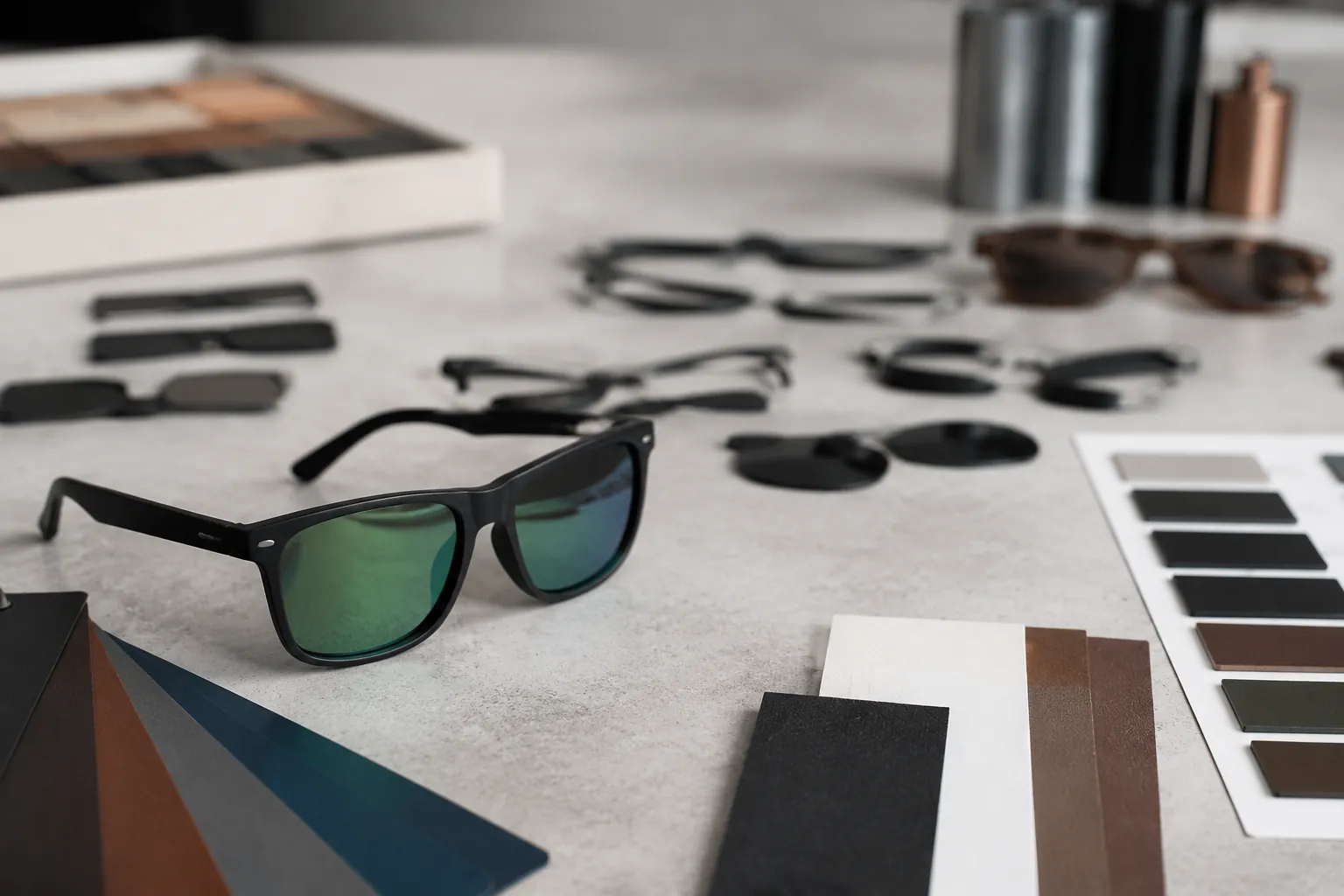
This article is for buyers building a multi-SKU sunglasses line under real MOQ, cost, and lead-time pressure. The goal is not to launch more styles for the sake of it. It is to build a line that looks coordinated, samples efficiently, and can be reordered without turning every SKU into its own tooling, sourcing, and QC project. One of the most practical ways to do that is to standardize selected parts: temple platforms, hinge specifications, lens colors, trim finishes, and logo treatments. Done well, shared parts cut avoidable development work, simplify quality control, and make low-volume testing easier to manage. Done badly, the line looks repetitive or becomes hard to fit across different front shapes. The difference is simple: clear collection architecture, realistic construction limits, tight tolerance control, and a brief that states what is shared and what is not.
Start with the collection plan, not isolated SKUs
Many buyers pick several front shapes first and try to make them feel related later. That usually creates extra trim changes, more approvals, and more sample revisions than expected. A better approach is to define the collection plan before final SKUs are locked. Decide which components stay common, which details change, and where the customer should notice variation first.
For an early collection, keep the structure simple. Separate styles by material family. Keep one temple platform per family where possible. Align hinge specifications within each family when construction allows. Carry a limited lens palette across the line. Repeat one branding position. That is enough consistency for the range to read as one collection while leaving the fronts to create visible differentiation.
For example, a six-SKU line might include three injection styles that share one temple mold and three acetate styles that share one temple profile. Across all six SKUs, the buyer may keep the same logo placement, the same metal trim tone, and the same approved lens palette. That matters. The factory is not re-engineering every small part for each style.
Before sample briefing, lock these decisions in writing:
- One temple platform per material family, or two at most for the full line
- One hinge size and screw specification per family where construction allows
- One metal trim language, such as brushed silver, satin gunmetal, or light gold
- Three carryover lens colors plus one seasonal lens option
- One fixed logo position, for example measured from hinge center on the outer temple
- Target FOB price ladders at 50, 300, 1000, and 5000 pairs per design
This reduces design drift and gives the factory a more stable engineering base. It also helps the buyer review samples as a family instead of as disconnected styles. Problems show up faster that way.
Choose the right parts to standardize
Do not standardize everything. Some parts create real savings in tooling, purchasing, and assembly. Others save very little while limiting design freedom. The best candidates are usually parts that are costly to tool, sensitive to fit, repeated in purchasing, or hard to control when every SKU uses a different version.
Temples are often the best shared part. In injection production, reusing one temple mold across multiple front shapes can reduce tooling count and simplify fit correction. In acetate, reusing one temple profile can simplify CNC cutting, wire core planning, logo placement, polishing sequence, and balancing during assembly.
Other parts that often benefit from standardization include wire core shape in acetate temples, hinge specification, logo plate size, pad print artwork width, and lens base curve within the same product family. Keeping one base curve across a family, for example, can simplify lens sourcing and reduce repeated fitting adjustments, provided the front geometry supports it.
Fronts should carry more variation than temples. Fronts drive shelf impact, perceived fit, and trend direction. A square front, a round front, and a narrow rectangle can feel like distinct products even when they share the same temple language. Several fronts that are only slightly different will not read as a strong collection, even if the logos or color names change.
A useful rule is blunt but accurate: if a component is expensive to tool and not the first thing the customer notices, share it. If it is the visual focal point, leave room to vary it.
Use finishes and decoration to create range
Shared parts only look repetitive when the finish system is too narrow or poorly controlled. Finish is where you create range without forcing the supplier into too many one-off materials and approvals.
Start with a master finish board and keep it tight. A practical palette for a first line might include frame colors such as black, dark tortoise, crystal smoke, and olive; lens colors such as solid grey, G15 green, and brown gradient; and one metal accent family such as brushed silver or pale gold. That gives the buyer several workable colorways from approved components instead of a new finish language for every SKU.
Decoration needs the same discipline. Pad printing is flexible and cost-efficient, especially for injection temples, but it needs artwork size limits and adhesion control. Laser engraving can produce a cleaner, quieter mark on suitable surfaces, but readability depends on material color, polish level, and texture. Metal logo plates give stronger brand presence, but they add hardware sourcing, placement tolerance, and assembly complexity.
Write all finishing controls into the tech pack. At minimum, specify:
- Frame color code, Pantone reference, or acetate sheet reference
- Lens color target, density, and gradient direction where applicable
- Surface gloss level, especially for black frames where gloss mismatch is easy to see
- Decoration method by SKU and exact artwork size
- Metal trim finish and allowable visual variation
- Logo position from hinge center and tolerance for placement shift
These details matter because inconsistency is often subtle. A lens that reads slightly greener than the rest of the line or a logo that sits farther back on one temple can make the collection look pieced together. Shared parts save time only if shared finishes stay under control too.
Know where shared parts save money and where they do not
Buyers often focus on visible decoration costs because they show up clearly on quotations. The bigger savings usually sit elsewhere: reduced tooling duplication, simpler assembly, fewer changeovers, and easier purchasing of repeated components. Shared systems matter most when the buyer is working with lower MOQs and does not want every style to become a separate development program.
| Shared element | Main benefit | Typical commercial effect | Watch-out |
|---|---|---|---|
| Temple mold or acetate temple profile | Lower development complexity and fewer fit adjustments | Less tooling duplication, faster sample alignment, simpler replacement parts planning | Can make the range feel repetitive if front shapes are too similar |
| Hinge specification | More stable assembly and repair consistency | Lower component complexity and fewer adjustment issues in bulk | Must match front and temple thickness; not every style can use one hinge |
| Lens color family | Smoother planning for sampling and bulk | Fewer tint approvals, less small-batch variation, cleaner reorder logic | Some lens colors do not suit every frame color equally well |
| Metal logo plate size | Consistent branding and simpler hardware sourcing | Fewer custom hardware variations and easier placement control | Plate proportions must work across all temple widths |
| Decoration method | Cleaner production flow and easier QC | Lower setup variation and better repeatability | One method may not suit both glossy injection and acetate equally well |
At MOQ level, the logic is straightforward. A supplier may accept a low trial quantity per design, but small runs are less forgiving when every SKU needs unique tooling, custom logo hardware, and separate lens development. As order volume rises, shared components usually become easier to buy and plan because hardware sourcing, lens planning, and line balancing can be managed across a wider group of styles. But shared parts only deliver value if the line is built on repeatable systems. Not custom engineering every time.
In practical buying terms, several styles that share temples, trims, and lens colors are usually easier to sample, quote, inspect, and reorder than several styles that each follow their own engineering logic.
Build variation through front shape, scale, and material behavior
The safest way to widen a collection without losing cohesion is to vary silhouette, eye size, bridge expression, thickness, and material character while keeping repeated parts underneath. Customers usually notice proportion first. They notice shared temple language later. That is often exactly how a strong line should work.
One medium-weight temple can support a bold square front, a softer round front, and a slim rectangle if the front-end geometry is engineered correctly. The match still has to feel balanced. A thick acetate temple on a very delicate front can feel heavy. A very thin temple on a thick front can look underbuilt even if the frame passes basic mechanical checks.
Material behavior matters too. Injection frames usually offer high repeatability at volume and are often useful for controlled commercial testing. Acetate offers richer visual depth, stronger polishing potential, and a more premium hand feel, but it also brings natural sheet variation and more finishing work. Metal families have their own constraints around soldering, plating consistency, and nose pad integration. For that reason, most buyers should standardize temple systems within a material family rather than force one construction approach across injection, acetate, and metal.
Ask for side-view drawings, hinge-area details, and basic dimensions before samples are made. A drawing review can catch poor temple taper, weak front-end balance, or a logo plate that is too large for the available flat area. Catch it there. Not after a full sample is built.
Plan compliance and QC as shared systems too
A cohesive line is not only a design project. It is also a compliance and quality-control project. When multiple SKUs share lens families, materials, hinge systems, and decoration methods, inspection becomes more systematic and documentation becomes easier to manage. But only if the shared systems are defined from the start.
For export programs, buyers should align the collection with target-market requirements before sampling is finalized. Depending on destination and product type, that may include CE EN ISO 12312-1, ANSI Z80.3, AS/NZS 1067, REACH, and FDA registration requirements where applicable. These are not end-stage paperwork items. They can affect lens specification, labeling, technical files, and test preparation.
Shared parts help because one controlled lens family or one approved hinge system can be monitored across several models. Even so, each finished SKU still needs model-level review for cosmetics, labeling, fit, and pack-out accuracy. A shared lens color can simplify color control, but it does not remove the need to confirm that each model is assembled and labeled correctly for its intended market.
Useful QC checkpoints include:
- Incoming verification of resin, acetate sheets, lenses, hinges, screws, nose pads, and trim hardware
- In-process checks after molding, CNC shaping, or polishing for dimensions, warpage, and surface defects
- Assembly checks for hinge movement, lens seating, alignment, and left-right symmetry
- Decoration checks for artwork sharpness, adhesion, engraving clarity, and metal plate placement
- Final inspection for open-close tension, lens cleanliness, color consistency, labeling, and carton accuracy
System certifications such as ISO 9001 and social audit standards such as BSCI can indicate process discipline. Useful, yes. A substitute for product-level compliance review and final QC execution, no.
Use a practical SKU plan for sampling, MOQ, and reorders
A first collection does not need to be large. In many cases, six SKUs are enough to test shape preference, price acceptance, and color performance without making development harder than it needs to be.
A clean structure looks like this:
- Three injection styles sharing one temple mold, with fronts differentiated by square, round, and narrow rectangular shapes
- Three acetate styles sharing one temple profile and one logo plate size, with different front thicknesses and eye shapes
- Three core lens colors used across all six SKUs: grey, green, and brown gradient
- One fixed branding position on the outer temple across the entire line
This creates visible range while keeping drawings, hardware, and color standards manageable. Sampling and production timing will depend on construction, tooling status, workload, and packaging scope, so buyers should confirm actual lead times with the supplier rather than assume a standard schedule. Reorders are usually easier under this structure because temple tooling, logo files, color references, and lens standards already exist. Instead of rebuilding the line operationally, the buyer is mainly replenishing proven combinations or adding a limited number of new fronts on an existing platform.
Simple rule: keep most of the line on repeatable carryover parts and finishes, and reserve a smaller share for seasonal front-shape or color updates.
That balance keeps the collection fresh without making purchasing messy. If you are testing close to a low MOQ per design, stay tighter and let front shape do most of the work. If volumes rise, you can usually add more front differentiation without weakening the operating structure of the line.
Write a briefing checklist that prevents expensive repetition
Many repetitive collections do not come from weak design instincts. They come from weak briefs. If the supplier receives only mood images, broad color names, and loose logo instructions, the factory will fill the gaps with assumptions. Those assumptions usually push the line toward safe shapes, generic temple widths, and default trim treatments.
The brief should state clearly what is shared, what is unique, and what must not drift. A strong development brief should include shared-component codes, unique front details by SKU, decoration method by material, target compliance path, and a master finish standard that governs the whole line.
At minimum, the briefing checklist should cover:
- Shared components by code: temples, hinges, screws, logo plates, lens colors, nose pads
- Unique components by SKU: front shape, eye size, bridge form, thickness, colorway pairing
- Branding method by material: pad print, laser engraving, hot stamp, or metal logo plate
- Target markets and required compliance route
- Master finish approval before all SKU sample approvals
- A sample matrix review of the full family together, not random one-by-one approvals
That last point matters. Review the family together. It is one of the fastest ways to spot overlap, weak differentiation, a lens tone that feels out of place, or a temple that visually overpowers one front shape. When buyers manage shared parts intentionally, they usually get three practical benefits at once: clearer brand identity, more efficient MOQ planning, and fewer avoidable surprises in production and reorders.
Have a custom sunglasses project in mind?
Send us your styles, target market and quantities and we will return a detailed quote with MOQ, lead time and a sample plan.
Get a QuoteWhy source this from Wenzhou with LumiShades
Wenzhou in Zhejiang Province is widely regarded as China’s eyewear manufacturing capital, producing a large share of the world’s sunglasses. That concentration matters to buyers: a deep local supply chain for acetate sheet, hinges, lens blanks, plating and packaging means shorter component lead times, easier color and material matching, and a workforce with decades of eyewear-specific skill. LumiShades has manufactured in this ecosystem since 2009, and our vertical integration — in-house injection molding, acetate cutting, CNC milling, lens tinting, decoration and quality control — means no part of your order is quietly subcontracted to a workshop you cannot audit.
For international buyers, that vertical control translates into accountability. When a single factory owns every step, defects are traced and fixed at source rather than bounced between vendors, and your specifications survive intact from first sample to bulk. We back this with 15+ years of experience, shipments to 60+ countries, more than 5 million pairs produced per year and a 98.5% on-time delivery rate. Our certifications — CE EN ISO 12312-1, FDA registration, ANSI Z80.3, AS/NZS 1067, REACH, ISO 9001 and BSCI audit — mean the compliance documentation your market requires already exists. Explore our manufacturing capabilities and quality control process to see how this works in practice.
Frequently asked questions
How many SKUs can realistically share one temple design before the line looks repetitive? For most early-stage collections, three to five SKUs within the same material family is a practical range. To stop the line from looking recycled, vary the front silhouette, eye size, bridge shape, front thickness, and colorway pairing. Before approving samples, review all styles side by side and ask a simple question: if the logos were removed, would the fronts still read as meaningfully different products? If the answer is no, add a second temple platform or widen the front-shape differences.
Is it better to share temples across injection and acetate styles? Usually no. It is generally better to share branding language, lens palette, and finish direction across injection and acetate while keeping temple construction separate by material family. Injection and acetate differ in wall thickness, weight, hinge integration, finishing behavior, and visual depth. If you want the line to feel connected across both families, align the logo position, trim tone, and lens colors first, then standardize temple systems only within each material group.
What decoration method is safest for repeating a brand mark across many SKUs? Pad printing is often the safest starting point for repeat use across multiple SKUs because it is flexible, widely used, and relatively easy to control when artwork size and adhesion standards are defined clearly. Laser engraving can work well when the substrate and finish provide enough contrast. Metal logo plates create stronger visibility and a more premium impression, but they require tighter control of hardware sourcing and placement tolerances. The practical way to choose is to test the same artwork on the actual temple materials you plan to buy, then compare readability, durability, placement consistency, and rework risk before locking the method.
How should I use a 50-pair MOQ without creating too many weak sellers? Use a low MOQ to test front shapes and consumer response, not too many construction systems at once. Keep temples, hinges, logo treatment, lens colors, and trim finishes shared across the trial group, then vary the front silhouette and scale. Limit the number of colorways per SKU, review all trial styles as one family, and define in advance which results will trigger a reorder, a color expansion, or a stop. That way, the low MOQ produces clearer buying data instead of fragmented inventory.
Can shared lenses simplify compliance work? They can help because a shared lens material and tint family are easier to document, control, and inspect across several SKUs. But they do not remove model-level responsibility. Buyers should confirm that each finished model meets the requirements of its target market, which may involve CE EN ISO 12312-1, ANSI Z80.3, AS/NZS 1067, REACH, and FDA registration requirements where applicable. In practice, that means locking the lens specification early, keeping records consistent across the family, and checking that labeling, performance, cosmetics, and technical documentation match each final SKU.
Ready to start?
Explore our rimless sunglasses or request a quote — our sales team replies within 12 hours.
Request a Quote