
Retail vs Promo Packaging for Custom Sunglasses Orders
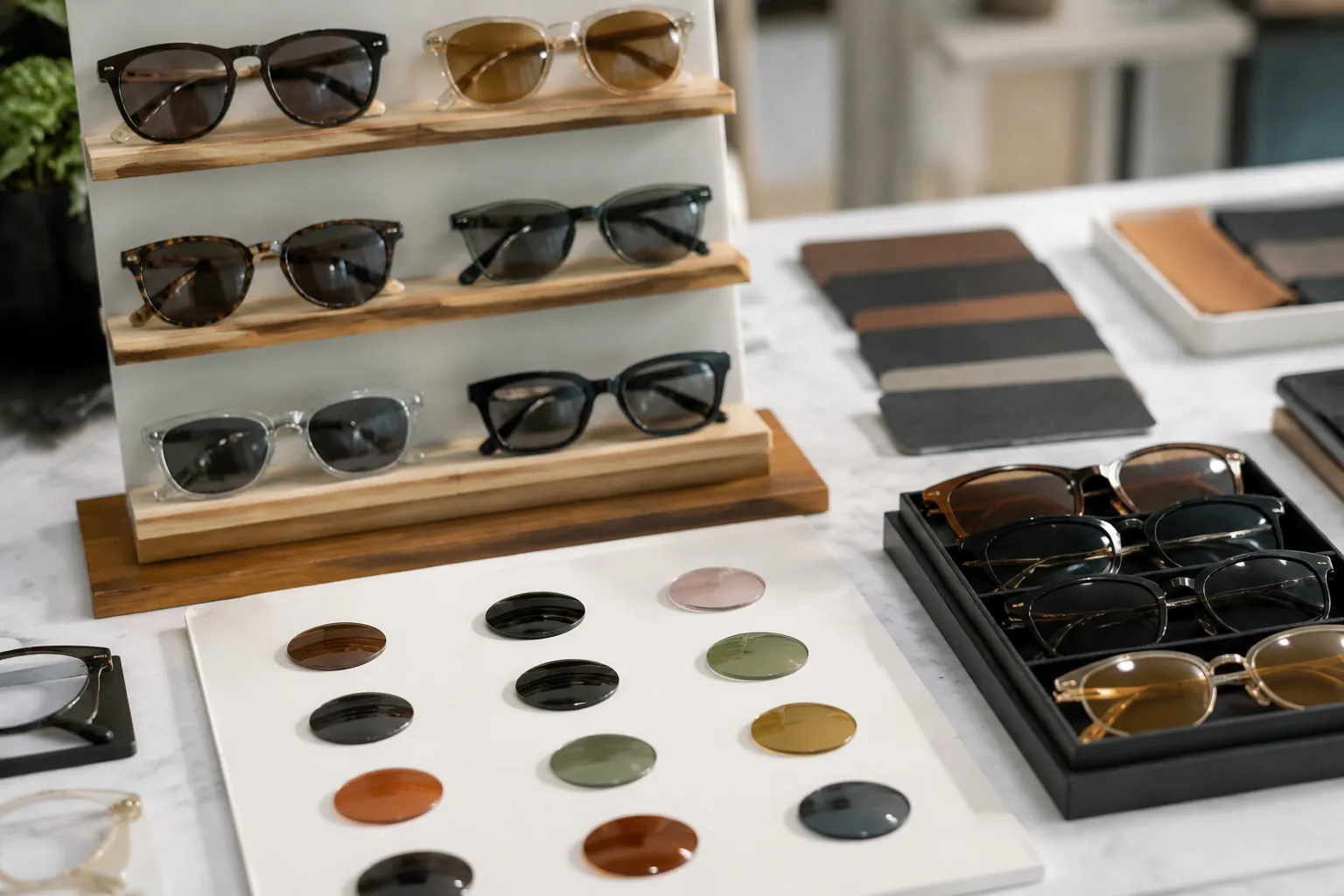
This guide is for brand owners, importers, distributors, and retail buyers sourcing custom sunglasses in volume. The key decision is not which pack looks more premium. It is whether the packaging spec fits the sales channel, product finish, labeling requirements, handling risk, and order economics. In most cases, a retail program and a promotional order should not use the same packaging. When pack structure, print method, accessory count, and inspection points match the channel, buyers cut avoidable cost, reduce transit damage risk, and keep production planning more predictable.
Start with the selling channel, not the box
Many buyers start with the visible items: a case, a printed box, and a cleaning cloth. That is usually the wrong place to begin. First define where the sunglasses will be sold or distributed, how many handling points are involved, and what kind of presentation, labeling, or damage failure would be costly.
Retail eyewear packaging is shelf-facing and inspection-heavy. It usually needs clear branding, barcode space, country-of-origin marking, and any product or usage text required by the importer or market. It also needs enough structure to arrive presentable after export packing, warehousing, and store-level handling. In practice, that often means an individual unit pack that protects the sunglasses and supports accurate SKU matching.
Promotional packaging serves a different job. The buyer usually cares more about landed cost, packing efficiency, and deadline control than about unboxing. If the sunglasses will be handed out at an event, packed into a campaign kit, or shipped in bulk to branches, the pack is often simpler, lighter, and faster to assemble. A one-color printed pouch or a polybag with a label may make better commercial sense than a custom rigid box.
The product itself also changes the packaging requirement. Frames with glossy surfaces, mirrored lenses, pad-printed logos, foil details, or exposed metal trims are more vulnerable to rubbing during packing and transit. Heavier constructions also put more load on weak cartons or poorly arranged master packs. Packaging should be built around actual product risk, not brand preference alone.
- Retail program: prioritize presentation, traceability, and damage control.
- Promotional order: prioritize budget, speed, and carton efficiency.
- Mixed program: treat the same sunglasses in two different packs as two separate SKUs.
- Shared rule: do not cut packaging cost so far that claims, relabeling, or rework erase the savings.
Retail pack vs promo pack: what actually changes
The main differences are pack structure, branding method, accessory count, and inner protection. Retail programs usually include more components because the unit must arrive shelf-ready or suitable for direct consumer delivery. Promotional orders usually strip out anything that does not support distribution, campaign branding, or basic scratch prevention.
| Packaging element | Retail order priority | Promotional order priority | Typical cost / process effect |
|---|---|---|---|
| Primary pack | Folded paper box, EVA case, or structured pouch | Polybag, microfiber pouch, or simple tuck box | More structured packs usually add material cost and slower assembly |
| Branding method | CMYK print, Pantone color matching, barcode label, insert printing | One-color screen print, heat-transfer logo, or sticker label | Each added print step can add setup, approval, and production time |
| Inner protection | Tissue wrap, lens sleeve, nose bridge support, pouch before boxing | Basic sleeve or pouch if finish is durable | Better inner protection can reduce scuff risk but increases packing labor |
| Accessory count | Cleaning cloth, hangtag, UPC/EAN, warning or care insert | Only campaign-required pieces | Every added loose item increases counting and inspection work |
| Carton configuration | Cleaner presentation on arrival, lower crush risk, lower unit density | Higher units per carton, lower dimensional weight | Promotional programs often gain more from freight efficiency than from premium unit packs |
For small custom runs, packaging economics matter more than many buyers expect. A branded retail box may be technically possible at a low MOQ, but unit cost can rise fast when artwork setup, proofing, die-line preparation, and manual pack-out are spread over a small quantity. At higher volumes, those fixed costs spread more efficiently, so the same pack spec becomes easier to justify.
That is the real split. Retail buyers usually spend more on the individual pack to control presentation and downstream handling risk. Promotional buyers usually spend less on the individual pack to control unit cost and freight impact.
Protection rules by frame finish, lens surface, and decoration
Packaging should follow product behavior, not brand preference alone. Many packaging claims start with surface contact after production, not with a defect in the frame itself.
Glossy frame surfaces can show rub marks if packed without a barrier. Heavier or more rigid constructions may need better support inside the unit pack and tighter arrangement inside the master carton. Sunglasses with mirrored or flash-coated lenses usually need more careful separation than standard tinted lenses because cosmetic damage is easier to see.
Lens finish is often the most sensitive area. A mirrored lens can pass final inspection and still arrive scratched if it rubs against a zipper, a temple tip, or another hard surface during cartoning. Decorative details create similar risk. Pad-printed temple logos can rub if packed before curing is complete. Metal trims or logo plates can scratch adjacent units if products shift in transit. Choose packaging around the most vulnerable contact point on the finished product.
- Complete final frame and lens QC before packing, not after.
- Inspect lenses under consistent lighting so surface scratches are easier to detect.
- Use tissue, a PE sleeve, or a microfiber barrier based on lens and frame sensitivity.
- Fold temples to a repeatable position so pressure does not shift onto the front.
- Use orderly rows, dividers, or inner bags in master cartons so units do not migrate in transit.
The cheapest packing method is rarely the cheapest outcome. Once claims, replacement freight, and resorting are added, the numbers change fast. Buyers should ask the factory which surface is most vulnerable and protect that point first.
Budget math: where packaging cost moves fastest
Serious buyers should ask for sunglasses cost and packaging cost as separate quotation lines. If those figures are blended together, an overbuilt pack can hide behind an attractive frame price.
Packaging cost usually moves fastest in three places: structure, print complexity, and component count. Polybags and simple pouches are generally cheaper than EVA cases or rigid presentation boxes. One-color logo printing is usually simpler than multi-location CMYK work, foil stamping, or inside-and-outside print coverage. Every cloth, insert, sticker, or hangtag adds both material cost and handling time.
- Structure: simple flexible packs usually cost less than rigid or semi-rigid packs.
- Print complexity: more colors, more print locations, and tighter color control usually increase cost and approval time.
- Component count: each added accessory increases both materials and pack-out labor.
MOQ logic matters here. At lower quantities, fixed setup costs for print and pack-out are spread across fewer units. At higher quantities, buyers can usually justify better color control, cleaner labeling, and stronger inner protection with less distortion to total unit economics.
For promotional orders, ask a blunt question: will the end user keep the pack, or is it only for short-term distribution? If it is short-term distribution, budget may be better spent on lens quality, logo durability, or delivery control instead of decorative packaging. For retail, ask whether the pack must stay presentable after store handling or parcel delivery. If yes, invest first in crush resistance, scuff prevention, and clear labeling before decorative effects.
Lead time: packaging can become the bottleneck
Buyers often focus on frame sampling and lens approval, then lose time on packaging artwork. It happens a lot. Packaging has its own approval path. Dielines, barcode data, warning text, label content, and print proofs all need to be right before mass packing starts.
Retail packaging usually takes longer because there are more approval points: dieline sign-off, text review, barcode validation, print proofing, and sometimes importer-specific transit or drop-test requirements. Promotional packaging usually moves faster when the buyer accepts standard pouch sizes, simple logo application, and standard master carton formats.
| Order type | Typical packaging approach | Main lead-time risk | Best control action |
|---|---|---|---|
| Retail launch | Custom box, pouch, cloth, barcode, inserts | Artwork approval and multi-component assembly | Freeze artwork before production approval and confirm carton count early |
| Promotional event | Simple pouch or polybag, minimal print | Freight cutoff and campaign date | Use standard packaging sizes and simple print where possible |
| Mixed program | Same frame, two separate pack formats | Packing-line mix-up between SKUs | Split SKU codes clearly and approve carton marks in writing |
| Private label retail repeat | Existing approved box and pouch spec | Reprint timing for labels or inserts | Re-use approved artwork and keep variable data controlled |
As a working rule, simple pouch-based promotional packaging usually adds less complexity than a new retail packaging set with custom print, inserts, and barcode control. If the same frame is packed in both retail and promotional versions, do not treat that as a minor note. Create separate SKU references, separate pack-out instructions, and separate carton markings. A common failure is not the wrong sunglasses. It is the right sunglasses packed in the wrong format.
Compliance and labeling: keep claims aligned with the pack
Packaging does not create compliance, but it can support it or contradict it. The sunglasses, test documentation, and packaging text need to point in the same direction.
For buyers serving different markets, that means confirming exactly what information belongs on the product, on the unit pack, and on the export carton. If the importer needs a barcode label, model reference, country-of-origin statement, or warning text, approve that content before bulk printing. Reprinting labels after production is slow and raises error risk.
Relevant standards and systems may include CE EN ISO 12312-1, ANSI Z80.3, AS/NZS 1067, REACH, FDA registration, ISO 9001, and BSCI. Buyers should request only the certifications, test references, or factory credentials that apply to the target market and product category. A common mistake is printing broad compliance wording on packaging without checking whether the actual model and documentation support that wording.
- EU retail: packaging text and product information should align with documentation for CE EN ISO 12312-1 where applicable.
- US retail: avoid consumer-facing claims that conflict with ANSI Z80.3 requirements or importer labeling instructions; FDA registration is a factory or establishment matter, not a general marketing claim for sunglasses packaging.
- Australia/New Zealand: ensure intended lens use and category wording remain consistent with AS/NZS 1067 documentation where applicable.
- Chemical compliance: if REACH conformity is requested, review inks, coatings, and accessory materials during packaging approval, not after printing.
Promotional packaging is often minimal, which is fine. Minimal does not mean careless. Even if the unit pack is only a pouch or polybag, product identification, carton marks, and shipment paperwork still need to stay accurate and consistent.
Practical spec sheets for retail and promotional orders
The easiest way to avoid overbuying packaging is to build the approval sheet around the channel and the real risk points. A useful spec sheet combines product details, pack-out instructions, barcode data, accessory count, labeling text, and carton configuration in one document.
Scenario 1: Retail optical chain or fashion retailer
Use an individual paper box or protective case, a branded pouch if required, barcode labeling, and controlled carton quantity. For mirrored lenses, glossy finishes, exposed metal trims, or abrasion-sensitive logos, specify a tissue or sleeve barrier before pouching or boxing. If brand color consistency matters, approve the print standard before mass production. Confirm product-to-box matching by SKU and request final inspection that checks both product and packaging presentation.
Scenario 2: Promotional campaign, giveaway, or event order
Use a microfiber pouch or polybag with simple logo application unless the campaign brief clearly requires a box. Keep insert count low. Increase units per master carton where finish sensitivity allows it. If the campaign date is fixed, prioritize standard packaging sizes, simple print, and a fast packing flow over custom presentation. For mirrored lenses or delicate decoration, add a basic barrier even in a promotional pack so cost savings do not turn into avoidable claims.
A practical buyer rule is simple: retail pack specs should help the product sell, while promotional pack specs should help the program ship. That distinction usually saves both money and argument during production.
Buyer checklist before packaging approval
Before bulk packing starts, issue one approval sheet that covers the product, accessories, labels, and carton details in one place. Fragmented email instructions are a common cause of mispacking.
- Confirm the selling channel: retail shelf, e-commerce, giveaway, event, or mixed program.
- List the frame finish, lens surface, and logo method so protection level matches actual risk.
- Approve artwork, barcode data, carton marks, insert text, and country-of-origin wording before print release.
- State exact pack-out: what goes into each unit pack and how many units go into each master carton.
- Confirm only the compliance references relevant to the market, such as CE EN ISO 12312-1, ANSI Z80.3, AS/NZS 1067, REACH, FDA registration, ISO 9001, or BSCI where applicable.
- Request a packed sample for mirrored lenses, delicate decoration, complex accessories, or mixed-SKU orders.
- Freeze approvals before mass packing starts; late packaging changes usually create rework, relabeling, and shipment delay.
This is not paperwork for its own sake. It is production control. The best packaging decision is usually the simplest spec that still protects the product, supports the channel, and fits the economics of the order.
Have a custom sunglasses project in mind?
Send us your styles, target market and quantities and we will return a detailed quote with MOQ, lead time and a sample plan.
Get a QuoteWhy source this from Wenzhou with LumiShades
Wenzhou in Zhejiang Province is widely regarded as China’s eyewear manufacturing capital, producing a large share of the world’s sunglasses. That concentration matters to buyers: a deep local supply chain for acetate sheet, hinges, lens blanks, plating and packaging means shorter component lead times, easier color and material matching, and a workforce with decades of eyewear-specific skill. LumiShades has manufactured in this ecosystem since 2009, and our vertical integration — in-house injection molding, acetate cutting, CNC milling, lens tinting, decoration and quality control — means no part of your order is quietly subcontracted to a workshop you cannot audit.
For international buyers, that vertical control translates into accountability. When a single factory owns every step, defects are traced and fixed at source rather than bounced between vendors, and your specifications survive intact from first sample to bulk. We back this with 15+ years of experience, shipments to 60+ countries, more than 5 million pairs produced per year and a 98.5% on-time delivery rate. Our certifications — CE EN ISO 12312-1, FDA registration, ANSI Z80.3, AS/NZS 1067, REACH, ISO 9001 and BSCI audit — mean the compliance documentation your market requires already exists. Explore our manufacturing capabilities and quality control process to see how this works in practice.
Frequently asked questions
Can I use the same packaging for retail and promotional orders to save cost? Only if the labeling needs, finish sensitivity, and distribution method are truly the same. Start by comparing four points: required unit labeling, required presentation level, scratch risk, and carton density target. If the retail version needs barcode control, stronger shelf presentation, or better scuff protection, keep it separate from the promotional pack. The safest buyer instruction is to issue separate SKU codes and separate pack-out sheets whenever the same sunglasses are packed for two different channels.
What packaging is usually enough for a low-cost promotional sunglasses order? For many event or giveaway programs, a printed microfiber pouch or a labeled polybag is enough if the sunglasses have a durable finish and no sensitive decoration. Before approving that spec, check three things with the factory: whether the lens surface scratches easily, whether the logo can rub during transit, and how units will be arranged inside the master carton. If any of those points is high risk, add a simple tissue or sleeve barrier rather than jumping straight to an expensive retail-style box.
How early should packaging artwork be approved? Approve it before bulk packing materials are ordered and before final production scheduling is fixed. At minimum, the buyer should sign off on dielines, barcode data, country-of-origin wording, warning or usage text, and carton marks before print release. If multiple components are involved, ask for one final packaging approval sheet that shows every printed item together so mismatched data is caught before mass production.
Does retail packaging need compliance text on the box? That depends on the target market and the importer's labeling requirements. Do not assume that every standard belongs on the consumer-facing box. First confirm which information must appear on the product, which belongs on the unit pack, and which belongs only in technical files or shipment documents. Any wording printed on the package should be checked against the actual documentation for CE EN ISO 12312-1, ANSI Z80.3, AS/NZS 1067, REACH, or other applicable requirements so the pack does not overstate the product status.
At what order size does custom retail packaging make more sense? There is no single threshold because it depends on the pack structure, print complexity, and number of accessories. The buyer should compare the total added packaging cost against the sales channel requirement: shelf presentation, e-commerce presentation, or retailer labeling compliance. For low-volume orders, ask the supplier to quote both a simple standard pack and a fully custom retail pack as separate lines. That side-by-side comparison shows whether the custom packaging supports the business case or only adds setup cost.
Ready to start?
Explore our wayfarer sunglasses or request a quote — our sales team replies within 12 hours.
Request a Quote