
How to Vet a Sunglasses Factory's In-House Capabilities
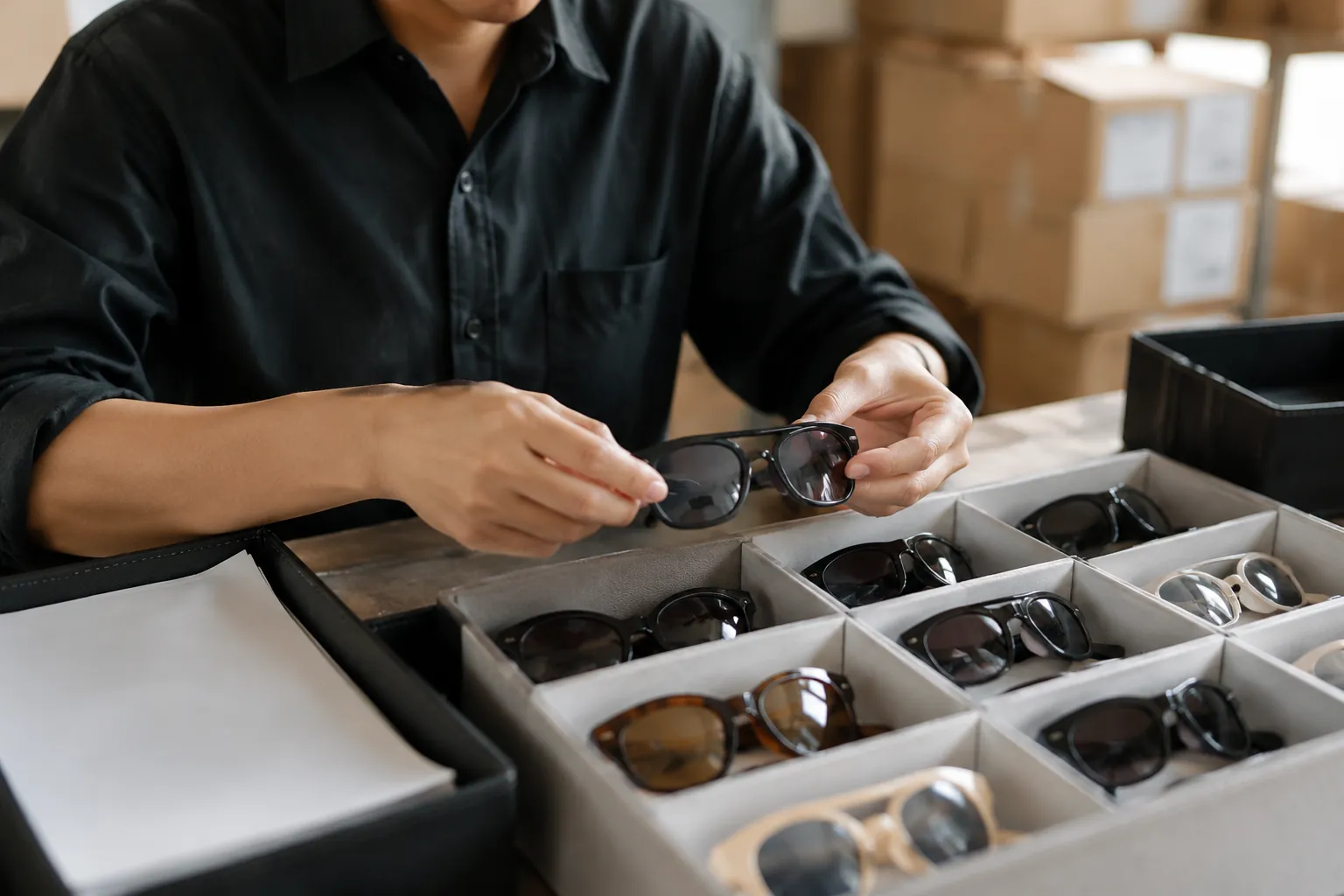
If you buy custom sunglasses for a brand, importer, retail chain, or distributor, the real question is not whether a factory can make one good sample. It is which steps it actually controls in-house, which steps it outsources, and what that means for cost, lead time, and repeatability. In eyewear, small shifts in hinge alignment, lens tint, coating quality, or logo placement can turn an approved sample into a bulk problem. This checklist shows you how to verify in-house capability before you place an order, using the production steps that matter most: tooling, frame making, lens work, decoration, QC, and compliance.
Start with the process map, not the sales pitch
Ask the factory to map the job from raw material receipt to packed carton. A real sunglasses manufacturer should be able to walk you through the full sequence for your style: incoming material inspection, drying or pre-treatment, molding or cutting, front and temple shaping, hinge assembly, lens work, surface finishing, logo decoration, final QC, and packing.
If they say, "we work with partners for some processes," keep going. Name the outsourced steps. That is where hidden lead time, extra handling, and quality drift usually show up.
For example, a factory that controls injection molding and CNC shaping can usually fix a fit issue faster because the change stays close to production. If molding is external, even a small adjustment can trigger tool transfer, a new queue, and another approval cycle. The same goes for lens tinting. If tinting or coating is not in-house, matching an approved shade often takes more rounds because one supplier controls the frame and another controls the lens finish.
If a supplier says they do everything but cannot explain where each step happens, take that as a warning. Ask them to trace one style from material receipt to finished pair. A real factory should name the machines, the checkpoints, and the team responsible at each stage.
Buyer rule: Do not place an order until you know which operations are inside the building and which are not.
Use one simple test. Ask them to describe one style from incoming material to finished pair. If they cannot give you a clean process flow with the right machines and checkpoints, you are likely dealing with a trader, an assembler, or a partial producer rather than a full manufacturer.
Verify the hard processes that affect cost and consistency
Not every in-house claim matters equally. Some processes have a much bigger effect on repeatability, defect rate, and unit cost. Start with the operations below. They usually decide whether a style stays stable in production and consistent across repeat orders.
- Injection molding: Important for repeatable frame geometry, hinge seat position, and temple symmetry. For molded parts, the factory should explain which critical dimensions it monitors and how it checks them. If molds are outside the factory, changes are slower and trial costs usually rise.
- Acetate cutting: Critical for premium-looking frames. Poor cutting shows up as uneven edge thickness, asymmetrical front curves, and extra polishing time. Acetate also needs controlled drying and machining because it can move slightly after cutting if humidity is unstable.
- CNC milling: Useful for precise temple shaping, front bevels, groove work, and logo detail. Ask about machine count, process control, and inspection methods, not just the word "CNC." A good supplier should explain how it checks groove depth and symmetry on the finished part.
- Lens tinting: Directly affects color consistency and batch matching. If tinting is outsourced, you may see shade drift between runs. Ask whether the factory controls tint time, dye concentration, drying temperature, and the checks used to confirm the lens meets the approved sample.
- Decoration: Laser engraving, pad printing, hot stamping, and metal logo plates require tight control. Logos are where many approved-sample issues appear in bulk. A good supplier should explain how it verifies placement, legibility, and durability before packing.
- Final QC: If inspection is done in-house, defects can be caught before carton packing. If QC is left to a third party, the factory may keep producing defects until a report comes back. That gets expensive fast when the issue is basic, like lens orientation, temple tension, or visible scratches.
Material behavior matters too. TR90 and injected nylon are light and flexible, but they can show stress if cooling is uneven. Acetate has a richer finish, but it is more sensitive to heat, polishing quality, and humidity. Metal frames need attention to plating quality, solder points, and corrosion resistance. A factory that understands these differences will talk about process conditions and inspection points, not just style names.
A factory with these steps under one roof can usually resolve problems faster because the people making the part and the people checking it are in the same workflow. A factory that farms them out may need an extra approval loop, a new queue, or another sample cycle.
Use a comparison table to spot hidden outsourcing
The same style can look cheap on paper and expensive in practice. Use the table below to compare factory setups before you talk price. The point is not only who can quote the lowest number. It is who can keep tolerances, finishes, and batch consistency stable without hidden handoffs.
| Capability | Usually in-house | If outsourced | Buyer impact |
|---|---|---|---|
| Injection molding | Tool changes, short trials, faster revisions, easier dimension control | Tool transfers, extra handling, slower fixes, higher trial risk | Longer change cycles and higher sample risk |
| Acetate cutting / CNC milling | Tighter fit, cleaner edges, quicker adjustment of front and temple geometry | More handwork, more mismatch risk, more time spent polishing or reworking | More rework and less consistent finish |
| Lens tinting | Better shade control within a batch, easier match to approved sample | Shade drift between suppliers, more variation in darkness or tone | Color inconsistency across repeat orders |
| Decoration | Logo placement can be checked the same day, easier to correct alignment | Separate approval loop, more transit and setup time | Slower launch and more logo errors |
| Final QC | Issues caught before carton packing, rework can happen immediately | Problems found after shipment or by a third party | More claims, returns, and write-offs |
Price and lead time should be read through this lens. A quote only means something if you know which steps are in-house and which are not. If a factory controls more of the chain, it can usually manage schedule and quality with fewer handoffs. If it relies on outside providers for key steps, the quote should reflect the added handling and scheduling risk.
Here is the sourcing rule. If a style is simple, with one frame color, one lens color, and one logo method, moving from a very small order to a larger repeat order should reduce unit cost because setup is spread across more pairs. The biggest savings usually come from better setup efficiency and lower rework, not from material cost alone. When a supplier says the price drops sharply but cannot explain whether the savings come from tooling amortization, faster line speed, or reduced finishing labor, treat the quote as incomplete.
Ask for proof, not promises
Good factories can show evidence. Bad ones talk around it. Request these items before you discuss deposit or production timing:
- Shop-floor photos or live video of the actual machines and operators, not brochure images.
- Process flow sheet for your specific style, showing each step and where it happens.
- Tooling and mold ownership statement if you are funding molds, dies, or cutting tools.
- Sample history showing first sample, revised sample, and bulk reference if available.
- QC checkpoints with the exact items measured at each stage.
- Certificate copies for the markets you sell into: CE EN ISO 12312-1, ANSI Z80.3, AS/NZS 1067, REACH, ISO 9001, and BSCI if relevant to your sourcing policy.
- Test reports that match the product type, lens category, and market destination.
- FDA registration details if the supplier claims U.S. FDA registration or U.S.-related compliance support.
Be specific on compliance. CE EN ISO 12312-1 is the sunglasses safety standard used for the EU market. ANSI Z80.3 is used for sunglasses in the U.S. market. AS/NZS 1067 applies in Australia and New Zealand. REACH covers chemical restrictions, not product styling. ISO 9001 is a quality management system standard, not proof that every pair is defect-free. BSCI relates to social compliance, not product testing. FDA registration, where relevant, is not a substitute for product testing or market-specific compliance.
If the factory claims a certificate but cannot show the current document, issue date, and issuing body details, treat it as unverified. If they only send a screenshot or a PDF with no traceable report number, assume the document needs confirmation.
Also ask how they measure critical points in production. A capable eyewear supplier should know where they check lens fit, temple opening force, screw torque, coating appearance, and logo placement. A hinge screw that is too loose can create wobble after shipping vibration. Too tight, and it can strip the thread or damage the temple boss. That level of detail separates a real producer from a middleman.
Match in-house capability to your price and lead-time target
Capability changes the economics. With more in-house control, a factory can usually move sample work and bulk production more predictably because there are fewer external queues. That does not mean every order hits the same window. It means the factory has more control over the schedule when the design is not unusually complex.
Use this basic logic when judging price:
| Order size | Typical buyer need | What in-house control changes | What to watch |
|---|---|---|---|
| 50 pairs/design | Market test or small launch | Samples and small-batch tweaks are faster | Tooling recovery and setup cost may dominate |
| 300 pairs | First meaningful replenishment | Unit price usually starts to improve as setup is spread out | Check consistency across all cartons, not just first-off samples |
| 1,000 pairs | Core SKU production | Better cost absorption and steadier workflow | Confirm packaging, barcode, and logo control |
| 5,000+ pairs | Program buy or chain rollout | Best pricing because setup and finishing are spread over more pairs | Demand strict QC, shipment scheduling, and spare-part planning |
Now read the pricing logic plainly. If a style uses a new mold set, the first order may carry tooling recovery cost. If the frame uses multiple decoration methods, such as laser logo plus pad print plus metal badge, each step adds setup and yield risk. If the lenses require tint matching to a specific shade, allow extra time for approvals and possible rework. Low MOQ helps. It is not the same thing as low landed cost.
If a factory says it can beat the market price by a lot but cannot show in-house capability, that is usually not a real saving. It is a cost that has not shown up yet. You may pay later through delays, rejects, rework, or chargebacks.
Inspect the sample path before you trust bulk production
Samples tell you whether the factory can actually control the style. A strong sample process should follow this sequence: brief, tech pack or reference, material confirmation, first sample, correction notes, revised sample, and final sign-off. If the factory says the sample is "only for reference," be careful. That often means bulk will drift unless the line uses the same materials, machines, and checks.
For sunglasses, watch these sample failure points:
- Temple alignment off by eye, causing uneven closing force or one side sitting higher than the other.
- Lens tint too dark or too light against the approved target, especially on mirrored or gradient finishes.
- Logo placement shifted after decoration, particularly on curved temples or glossy acetate.
- Surface marks from poor polishing, dust contamination, or careless handling.
- Frame front warp after cooling or milling, which changes how the sunglasses sit on the face.
- Hinge tension inconsistent from left to right, making the fold action feel loose on one side and stiff on the other.
Ask for a physical sample control point. Good factories keep an approved master sample and compare bulk against it at line end. For a style with multiple colorways, the better suppliers also label each master by SKU, lens category, and approved decoration method so there is no confusion between revisions.
If the sample path includes manual finishing that will not exist in bulk, ask for a production-intent sample. A prototype may confirm shape, but not polish quality, coating durability, or final packaging fit. A production-intent sample should match the intended material, decoration, and finishing route as closely as possible.
Run a blunt factory audit before you place the PO
Use this checklist on video call, in person, or through a sourcing agent who knows eyewear. Keep it blunt. Ask for specifics, not generalities.
- Ask which steps are fully in-house today, not last year.
- Ask how many injection, CNC, tinting, and QC lines are running.
- Ask what tolerances they control on hinge alignment, lens seat fit, and temple symmetry.
- Ask who owns the molds, decoration files, and final artwork.
- Ask for current certification copies, not summaries.
- Ask how defects are handled before shipment and who signs off rework.
- Ask whether the sample room uses the same materials and processes as mass production.
- Ask for a clear bulk lead time and what causes it to move from the normal range to longer timing.
- Ask what happens if lens tint is off by one shade or if the logo is shifted by 1 mm.
Then compare the answers to the quote. If a factory has real in-house capability, the quote usually makes sense because setup cost, yield, and finishing labor are visible in the pricing. If it has to outsource lens tinting, decoration, or QC, the pricing should reflect extra handling and extra risk. If it does not, you are being sold a neat number with missing steps behind it.
Bottom line: the right sunglasses factory is not the one with the longest capabilities list. It is the one that can prove, step by step, that the work you care about is controlled inside the building and repeatable at the order size you plan to buy.
Have a custom sunglasses project in mind?
Send us your styles, target market and quantities and we will return a detailed quote with MOQ, lead time and a sample plan.
Get a QuoteWhy source this from Wenzhou with LumiShades
Wenzhou in Zhejiang Province is widely regarded as China’s eyewear manufacturing capital, producing a large share of the world’s sunglasses. That concentration matters to buyers: a deep local supply chain for acetate sheet, hinges, lens blanks, plating and packaging means shorter component lead times, easier color and material matching, and a workforce with decades of eyewear-specific skill. LumiShades has manufactured in this ecosystem since 2009, and our vertical integration — in-house injection molding, acetate cutting, CNC milling, lens tinting, decoration and quality control — means no part of your order is quietly subcontracted to a workshop you cannot audit.
For international buyers, that vertical control translates into accountability. When a single factory owns every step, defects are traced and fixed at source rather than bounced between vendors, and your specifications survive intact from first sample to bulk. We back this with 15+ years of experience, shipments to 60+ countries, more than 5 million pairs produced per year and a 98.5% on-time delivery rate. Our certifications — CE EN ISO 12312-1, FDA registration, ANSI Z80.3, AS/NZS 1067, REACH, ISO 9001 and BSCI audit — mean the compliance documentation your market requires already exists. Explore our manufacturing capabilities and quality control process to see how this works in practice.
Frequently asked questions
What in-house capabilities matter most for custom sunglasses? Start with injection molding, acetate cutting, CNC milling, lens tinting, decoration, and final QC. Those steps have the biggest effect on fit, lens color consistency, logo quality, and repeatability. Ask the supplier to show where each step happens and how it is checked before you judge the quote.
How do I know if a factory is outsourcing part of production? Ask for a step-by-step process map, shop-floor proof, and sample traceability for one specific style. If the supplier cannot show where each operation happens, ask which steps are done by partners and who owns the handoff between them. If the answer stays vague, assume some work is outsourced until proven otherwise.
What tolerances should I ask about when vetting a sunglasses factory? Ask the factory which dimensions it controls on your style, such as temple symmetry, hinge alignment, lens seat fit, groove depth, and logo placement. Do not force one universal number onto every product. The right tolerance depends on the material, design, and production method. What matters most is that the factory can name the critical dimensions and explain how it measures them consistently.
Are CE EN ISO 12312-1, ANSI Z80.3, AS/NZS 1067, REACH, ISO 9001, BSCI, and FDA registration all the same thing? No. CE EN ISO 12312-1, ANSI Z80.3, and AS/NZS 1067 are product standards used in different markets. REACH is a chemical compliance requirement for the EU. ISO 9001 is a quality management system standard. BSCI relates to social compliance. FDA registration, where relevant, is not the same as product testing and does not replace market-specific compliance documents.
What lead times should I expect from a capable sunglasses factory? Lead time depends on style complexity, tooling status, decoration method, and whether the factory controls the key steps in-house. A well-organized supplier can often move samples faster than a fragmented one and can usually manage bulk more predictably. Ask for lead time by production stage, not just one total number, and confirm what happens if the design needs a revision.
Does a lower MOQ mean a better factory? No. A lower MOQ can help with testing, but it does not prove production control. A factory with a very small MOQ still may outsource molding, tinting, or QC. Judge the supplier by process control, sample traceability, QC system, and compliance documents, not MOQ alone.
Ready to start?
Explore our square sunglasses or request a quote — our sales team replies within 12 hours.
Request a Quote