
Cut Sunglasses Sample Costs Without Bias
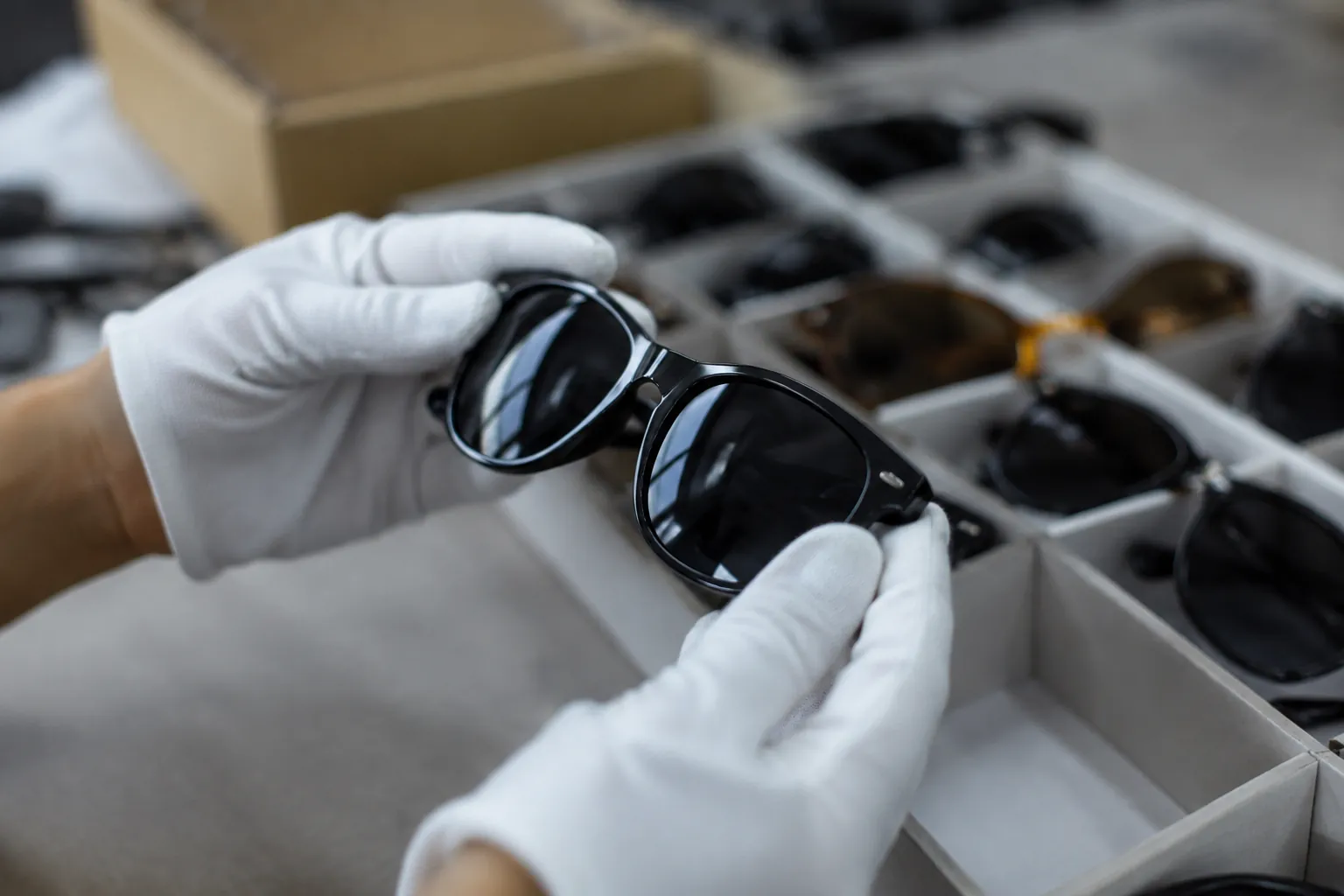
If you buy custom sunglasses for a brand, retail chain, or distribution business, sampling can get expensive fast. The problem is usually not the cost of one sample. It is the trail of "almost the same" samples from several suppliers that are hard to compare fairly. One factory sends a hand-polished acetate frame with a refined matte finish. Another sends a stock frame with the wrong lens tint. A third quietly changes temple length by a few millimeters. You end up paying for variation instead of useful information. This guide shows a stricter way to request samples, inspect build quality, and control sample spend without bias.
Define the sample objective first
Most sample budgets are wasted because the buyer asks every factory for the wrong thing. A prototype, a sales sample, and a pre-production sample are not the same. If you do not define the purpose, suppliers will send different levels of finish, different lens types, and different logo methods. Then you compare products that are not actually equivalent.
For supplier selection, ask for one of two things only:
- Visual sample: to judge shape, color, finish, logo placement, and overall appearance.
- Engineering sample: to judge fit, hinge feel, lens alignment, and material stability before bulk production.
Keep the brief short. Do not make it vague. State the frame material, color reference, lens requirement, logo method, and target market standard. A good first-round brief can fit on one page and still include the critical details: acetate or injection, gloss or matte, polarized or non-polarized, and whether the lens must meet a compliant sun-lens specification or is for styling review only. If you sell into Europe, ask the supplier to build against CE EN ISO 12312-1. If you sell into the U.S., ask for ANSI Z80.3 where product testing is relevant and confirm FDA establishment registration status for the manufacturer or facility as applicable. If you sell into Australia or New Zealand, ask for AS/NZS 1067. For material and chemical compliance, REACH matters.
Factory systems matter too, but they are not product approvals. ISO 9001 is a quality management system standard, and BSCI is an audit framework used by many buyers for social compliance. Neither one replaces product testing, product review, or a buyer's own sample inspection.
Process matters as well. A supplier with in-house injection molding, acetate cutting, CNC milling, lens tinting, and decoration can usually make samples that are closer to bulk reality because the part does not change hands multiple times. If a temple logo is pad printed after final polishing, you want the sample to follow the same order. Otherwise the decoration may look right on the sample and behave differently in production because the surface preparation, curing time, or polish level is not the same.
At LumiShades, that process control matters because the shop can produce the frame, lens, and decoration under one roof. A buyer still needs a clear spec. Otherwise the sample is just a guess with a shipping label.
Use one sample sheet for every supplier
Fair comparison starts with one document. Send the same sheet to every factory and keep it version-controlled. Avoid relying on chat messages for critical details. Written specs reduce "we thought you meant…" later, and they also let you compare revisions cleanly.
A useful sample sheet should include:
- Frame style or reference photo with front, side, and inside-temple views.
- Material: acetate, injection, metal, or mixed construction.
- Target dimensions: lens width, bridge, temple length, total front width, and acceptable tolerance.
- Lens requirement: tint color, category, polarized or non-polarized, and whether UV400 is required.
- Finish: gloss, matte, soft-touch, pattern, translucent, or marble effect.
- Logo method: laser engraving, pad printing, hot stamping, or metal logo plate.
- Market standard needed: CE EN ISO 12312-1, ANSI Z80.3, AS/NZS 1067, FDA registration where applicable, REACH.
- Packaging requirement: polybag, microfiber pouch, hard case, carton mark, and any retail insert.
Be specific about tolerances. If a front width tolerance is critical to fit, state the acceptable range in millimeters instead of using words like "close" or "similar." Lens width and bridge dimensions often need the same control if the frame is intended for a defined face fit. Temple length can sometimes vary slightly depending on tooling and trimming method, but buyers should state what is acceptable instead of assuming. If the factory cannot hold the tolerance in a sample, it is unlikely to improve in bulk without process changes.
If you want suppliers to quote fairly, ask them to state exactly what is included in the sample fee. Some will include basic tinting and one logo position. Some will charge extra for a custom lens tint, special temples, anti-slip temple tips, or a metal logo plate. That is normal. What is not normal is comparing a fully engineered sample with a stock look-alike and pretending they are equal.
For volume planning, ask the factory to also confirm MOQ and tier pricing. A common structure is a small first run for a custom design, with unit pricing improving as order volume increases and decoration is standardized. Acetate, metal, and polarized lenses usually sit higher because the material and labor load is greater. That pricing ladder helps buyers decide whether a lower-cost sample from a weak supplier is actually saving money or just hiding later production problems.
Inspect build quality with the same checklist
Do not judge samples by eye alone. Sunglasses fail in practical places: crooked temples, weak hinge rivets, lens rattle, poor tint consistency, sharp edges, and logo wear. These are the issues that drive returns, not the front-view photo on a desktop screen.
Use the same check on every sample:
- Fit and symmetry: front should sit square; temple opening force should feel even left to right; no obvious frame twist.
- Critical dimensions: compare lens width, bridge, temple length, and front width against the brief. A small bridge error can affect wearability more than a cosmetic color issue.
- Hinge quality: check screw seating, resistance, and wobble. On spring hinges, open and close the frame multiple times and listen for grinding or uneven tension.
- Surface finish: look for sink marks, polish lines, mold flash, sanding marks, or fiber pull on acetate edges.
- Lens clarity and tint: judge color uniformity under daylight, not office light alone. Rotate the lens to catch banding, haze, or coating streaks.
- Logo durability: rub lightly with cloth; inspect for print lift, pad-print edge break, or engraving burrs.
- Edge safety: temples, bridge, and lens rims should not have sharp contact points or raw cut edges.
Material behavior matters. Acetate can look excellent but may show edge whitening if it is trimmed poorly or over-polished. Injection frames are generally more stable in repeatability, but thin sections can warp if cooling is uneven or the mold is not balanced. Metal frames can deliver a clean appearance, yet solder joints and coating thickness become weak points. Polarized lenses add value, but buyers should confirm that the pair is visually even and that the lens construction is consistent across samples.
Some buyers ask every supplier for "best quality samples." That is a mistake. If each supplier sends a hand-finished one-off pair, you are testing the sample room, not the factory. Ask for a normal production-intent sample. If a supplier cannot explain how the sample maps to the bulk process, that is a warning sign.
Short version: a sample is only useful if it can be repeated in bulk without changing the result.
Know where sample costs come from
Sampling is not just the cost of a pair of sunglasses. It also includes setup work. That is why one supplier may charge more than another and still be fair. The question is not "who is cheapest?" but "who is transparent about what is being charged?"
| Sample type | Typical purpose | What usually drives cost | How to judge it |
|---|---|---|---|
| Stock sample | Quick style check | Existing frame, standard lens, no logo, no special packaging | Good for shape and silhouette only |
| Modified sample | New color, logo, or lens tint | Color matching, pad-print setup, lens tint adjustment, packaging change | Good for commercial review and sell-in testing |
| Engineering sample | Process and fit validation | Tooling adjustment, CNC or mold tweaks, QC checks, repeatability checks | Good for pre-production approval and risk reduction |
If a supplier offers a sample at a very low price, ask what is excluded. Sometimes the answer is reasonable: a plain stock frame, no logo, no packaging, no compliance testing. Sometimes it means the sample is not representative. That sample does not help decision-making.
Common cost drivers are straightforward once you know them. Acetate takes more time than injection because it is cut, shaped, buffed, and edge-finished. CNC milling adds labor and machine time, especially if the design uses thick temples, detailed bevels, or mixed construction. A decorated temple with pad print, laser engraving, or a bonded metal plate costs more than a plain one. Polarized lenses cost more than fashion tints because the lens stack is more complex. Anti-reflective coating, mirrored film, and gradient tint all add steps.
If the supplier has decoration and QC in-house, sample cost can be easier to control because fewer handoffs reduce coordination errors and rework. That does not make the sample cheaper by default, but it makes the cost more understandable and often more repeatable.
Set a budget before you contact suppliers
A fair budget depends on how many factories you are comparing and how far from final production you need to go. If you are only screening styles, a small stock-sample budget is enough. If you need to confirm fit and compliance-related details, budget more. Do not assume every sample round should cost the same.
A practical rule:
- Round 1: 3 to 5 suppliers, stock or near-stock samples, narrow style screen.
- Round 2: 2 to 3 suppliers, modified samples with your logo and target tint.
- Round 3: 1 to 2 suppliers, engineering sample or pre-production sample only.
This avoids paying multiple factories for fully customized samples when only a few are still in the running. It also keeps your team focused. Too many samples create false confidence and slow decisions. A buyer reviewing many frames without a scorecard will usually remember the prettiest one, not the most manufacturable one.
Shipping is part of the budget too. Courier service can cost more than the sample itself on small orders, especially if the destination is outside the supplier's regular shipping lane. If the factory offers samples in 7 to 10 days, that is useful because you can compare earlier and avoid a long back-and-forth. For custom jobs, a first-round stock sample might ship in 3 to 5 days, a modified sample in 7 to 10 days, and an engineering sample in 10 to 15 days depending on decoration and lens work. Bulk lead time of 25 to 35 days is common for many programs, but only if the sample round is disciplined and decisions are made quickly.
Be direct with suppliers. Tell them whether sample charges are refundable against bulk and whether you expect the cost to be offset if the order converts. Some factories will do that. Some will not. Get it in writing. If you are comparing several suppliers, ask each one to quote the same freight terms for sample shipment if possible so shipping does not distort the comparison.
Watch for false comparisons
Most unfair comparisons happen because one supplier quietly changes the spec. The frame is slightly thicker. The lens is darker. The logo is easier to apply. The result looks better, but it is not the same product.
Check these common distortions:
- Different lens category: a fashion tint is not the same as a compliant sun-lens build.
- Different temple length: a shorter temple can make a frame feel more stable in hand but worse on face.
- Different surface finish: gloss hides flaws better than matte, and dark translucent material can hide mold marks better than light transparent material.
- Different logo method: laser engraving, pad printing, and a metal plate do not wear the same way.
- Hand-polished sample vs production process: some samples are cleaned up by hand. Bulk will not be.
Also watch for process shortcuts. A sample may use a thicker lens to improve appearance, but the bulk lens may not match the same stiffness or weight feel. A supplier may place the logo where it is easiest to decorate rather than where your retail buyer wants it. A matte sample may be post-treated by hand, while the bulk finish comes directly from the mold and shows more texture.
If you are comparing factories in any eyewear manufacturing cluster, ask whether the sample is made on the same line path as bulk. The value of in-house injection molding, acetate cutting, CNC milling, lens tinting, and QC is that the sample can be made in a process chain that resembles real production. That reduces surprises later. It does not remove the need for buyer inspection. It just makes the comparison more honest.
Score samples and cut weak suppliers fast
Do not argue over opinions. Score the sample against fixed criteria. Keep it to one page and use the same scorer whenever possible. If multiple people review samples, average the scores and note any hard fails separately.
Suggested scorecard:
- Design match: 20 points
- Fit and symmetry: 20 points
- Surface finish: 15 points
- Hinge and assembly: 15 points
- Lens quality and tint consistency: 15 points
- Logo and decoration: 10 points
- Compliance documentation readiness: 5 points
Anything under 70 points is usually not worth a second round unless the supplier can explain the defect clearly and make a specific correction plan. Anything with obvious safety or compliance problems should be dropped immediately. A low price is not low cost if it becomes a claims or recall problem.
Also look at reliability signals. What matters is not a single percentage, but whether the supplier communicates clearly and consistently. Ask how they handle sample revisions, missing specs, color re-matches, and document requests. The answer matters. A factory that is slow and vague on samples usually becomes harder to manage under bulk pressure.
If the supplier can provide repeatable QC records, even better. Ask for defect categories, not just pass/fail. For example: hinge torque out of range, lens tint mismatch, cosmetic scratch, logo misalignment, or dimension drift. That tells you whether the factory can learn from mistakes instead of just sending another random sample.
Use a buyer workflow that keeps spend under control
Use this order and you will waste less money:
- Write one sample sheet and one scorecard.
- Send the same brief to a small group of suppliers.
- Request only the sample type needed for that round.
- Ask what is included in the sample fee before approval.
- Inspect samples under the same light and with the same checklist.
- Cut weak suppliers quickly.
- Only then request customized pre-production samples from the final two.
This is where real buying discipline shows. A supplier that can support CE EN ISO 12312-1, FDA registration where applicable, ANSI Z80.3, AS/NZS 1067, REACH, ISO 9001, and BSCI can be useful, but only if the product, finish, and process match the promise. Certifications and audits do not fix weak sampling. They only reduce certain types of risk.
For custom sunglasses in volume, the goal is not to collect the cheapest samples. The goal is to spend just enough to compare suppliers on equal terms, then move quickly to the one that can repeat the result in bulk. If you standardize the brief, lock the process, and score the results consistently, sample cost becomes a controlled expense instead of a recurring surprise.
Have a custom sunglasses project in mind?
Send us your styles, target market and quantities and we will return a detailed quote with MOQ, lead time and a sample plan.
Get a QuoteWhy source this from Wenzhou with LumiShades
Wenzhou in Zhejiang Province is widely regarded as China’s eyewear manufacturing capital, producing a large share of the world’s sunglasses. That concentration matters to buyers: a deep local supply chain for acetate sheet, hinges, lens blanks, plating and packaging means shorter component lead times, easier color and material matching, and a workforce with decades of eyewear-specific skill. LumiShades has manufactured in this ecosystem since 2009, and our vertical integration — in-house injection molding, acetate cutting, CNC milling, lens tinting, decoration and quality control — means no part of your order is quietly subcontracted to a workshop you cannot audit.
For international buyers, that vertical control translates into accountability. When a single factory owns every step, defects are traced and fixed at source rather than bounced between vendors, and your specifications survive intact from first sample to bulk. We back this with 15+ years of experience, shipments to 60+ countries, more than 5 million pairs produced per year and a 98.5% on-time delivery rate. Our certifications — CE EN ISO 12312-1, FDA registration, ANSI Z80.3, AS/NZS 1067, REACH, ISO 9001 and BSCI audit — mean the compliance documentation your market requires already exists. Explore our manufacturing capabilities and quality control process to see how this works in practice.
Frequently asked questions
How many sample rounds should I run before choosing a sunglasses supplier? Usually two, sometimes three. Use the first round to screen style and basic build quality, the second to review the version with your logo and target lens spec, and a third only if you need pre-production validation. If a supplier needs repeated rounds just to align on the same specification, that is a warning sign. A practical rule is to stop expanding the sample process once the remaining suppliers can only differ on execution, not on basic compliance with your brief.
Should I ask every supplier for the exact same sample? Yes, as closely as possible. Use the same frame reference, lens requirement, logo method, packaging request, and tolerance target. If one supplier proposes a better alternative, ask them to quote it separately rather than substituting it into the baseline. That keeps the comparison fair and lets you decide whether the alternative is an upgrade or just a different product.
What sample costs should I expect to pay separately? Common extras include special lens tint, logo setup, metal plates, packaging, courier freight, and sometimes color matching. A simple stock sample may have minimal cost, while a modified or engineering sample can cost more because it includes setup and repeat checks. Before you approve the sample, ask the supplier to break out what is included and what is excluded so you can compare quotes on the same basis.
How do I know if a sample reflects mass production quality? Ask whether it was made on the same process path as bulk production, not hand-finished in a sample room. Then check hinge feel, symmetry, surface finish, lens consistency, and logo durability against your production tolerance. If the sample has hand-polished edges, special tint work, or one-off decoration that bulk will not use, treat it as a presentation sample only unless the supplier can prove the same method will be used in production.
Which compliance documents matter for overseas sunglasses orders? For product standards, ask for CE EN ISO 12312-1, ANSI Z80.3, or AS/NZS 1067 depending on the destination market. For the U.S., confirm FDA establishment registration status where applicable. For materials and substances, ask for REACH-related compliance. ISO 9001 and BSCI are useful factory-system signals, but they do not replace product testing or market-specific documentation.
Ready to start?
Explore our aviator sunglasses or request a quote — our sales team replies within 12 hours.
Request a Quote